From Surf Wiki (app.surf) — the open knowledge base
Rolls-Royce Trent 900
2000s British turbofan aircraft engine
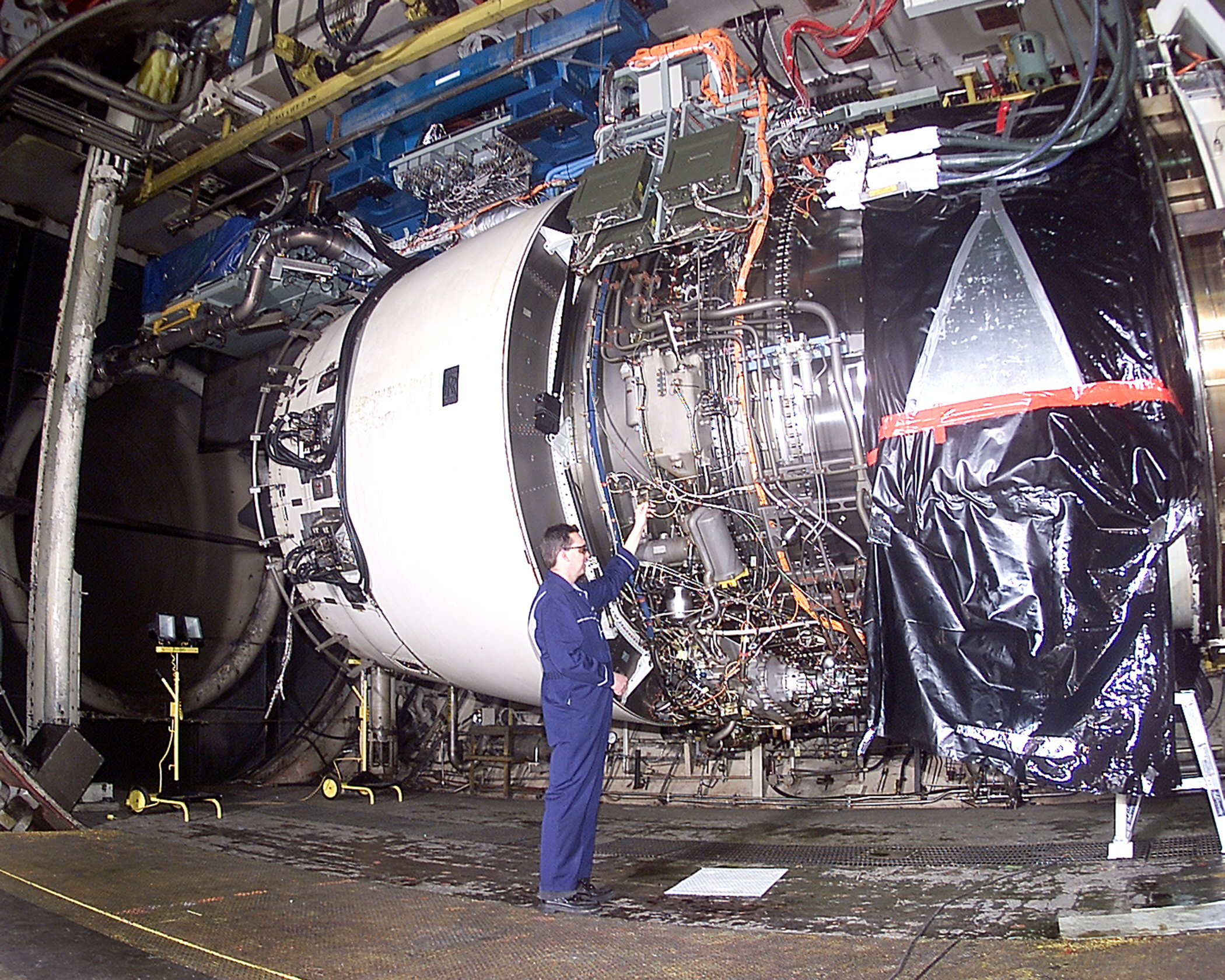
2000s British turbofan aircraft engine
| Field | Value |
|---|---|
| name | Trent 900 |
| image | File:Airbus Lagardère - Trent 900 engine MSN100 (6).JPG |
| engine_type | Turbofan |
| manufacturer | Rolls-Royce Holdings |
| national_origin | United Kingdom |
| first_run | 18 March 2003 |
| major_applications | Airbus A380 |
| developed_from | Trent 800 |
| developed_into | Trent 1000 |
The Rolls-Royce Trent 900 is a high-bypass turbofan produced by Rolls-Royce plc to power the Airbus A380, competing with the Engine Alliance GP7000. Initially proposed for the Boeing 747-500/600X in July 1996, this first application was later abandoned but was offered for the A3XX, launched as the A380 in December 2000. It first ran on 18 March 2003, made its maiden flight on 17 May 2004 on an A340 testbed, and was certified by the EASA on 29 October 2004. Producing up to 374 kN of thrust, the Trent 900 has the three shaft architecture of the Rolls-Royce Trent family with a 2.95 m fan. It has a 8.5–8.7:1 bypass ratio and a 37–39:1 overall pressure ratio.
Development
In July 1996, Rolls-Royce offered the Trent 900 for the proposed Boeing 747-500/600X, targeting a 2000 service entry and competing with the General Electric/Pratt & Whitney Engine Alliance. With a scaled-down Trent 800 core and a similar 2.8 m fan, increasing bypass ratio from 6.5 to 8.5, the 345-365 kN engine could also power the Airbus A3XX. The $450 million development aimed for a December 1999 certification but the 747X was later abandoned, leaving the A3XX, its Airbus competitor, as a possible application from 2003.
By July 2000, the Trent 900 was the first engine to be ordered for the A3XX, by then with a swept fan. By September, its design was not frozen and the fan diameter could increase by up to 13 cm for a 68,000 to 80,000 lbf thrust. The A3XX was launched as the A380 on 19 December 2000, and the Trent 900 was selected by Singapore Airlines and Virgin Atlantic over the competing GP7200. The Trent 900 ran for the first time on 18 March 2003, achieving its certification thrust of 81,000 lbf on 2 April and attaining 88,000 lbf a week later, with growth room to 94,000 lbf. Its 300 cm fan comes from the Trent 8104 demonstrator, and a contra-rotating HP spool is used for the first time, for up to 2% better efficiency.
The Trent 900 made its maiden flight on 17 May 2004 on Airbus's A340-300 testbed, replacing the port inner CFM56 engine. Its final certification was granted by the EASA on 29 October 2004, On 27 September 2007, British Airways announced the selection of the Trent 900 to power 12 A380 aircraft, helping to take the engine's share of the A380 engine market to 52% at the end of February 2009.
Design
The Trent 900 is an axial flow, high bypass turbofan with the three coaxial shafts of the Rolls-Royce Trent family. The 2.95 m fan with swept blades is driven by a 5-stage LP turbine, the 8-stage IP compressor and the 6-stage HP compressor are both powered by a single stage turbine, with the HP spool rotating in the opposite direction of the others. It has a single annular combustor and is controlled by an EEC. It is certified for thrusts between 334.29 -.
Its swept-back fan is inherited from the Trent 8104 demonstrator and a contra-rotating HP spool is used for the first time.
Variants

| Variant | Take-off | Maximum Continuous |
|---|---|---|
| Trent 970-84 | 334.29 (75,152) | 319.60 (71,850) |
| Trent 972-84 | 341.41 (76,752) | |
| Trent 970B-84 | 348.31 (78,304) | |
| Trent 972B-84 | 356.81 (80,213) | |
| Trent 977-84 | 359.33 (80,781) | |
| Trent 977B-84 | 372.92 (83,835) | |
| Trent 980-84 | 374.09 (84,098) | |
| Trent 972E-84 | 341.41 (76,752) |
Upgrades
The Trent 900 family of engines had their first set of upgrades marketed as the Trent 900EP; these were available for delivery from 2012. This package delivered a 1% saving on fuel burn compared to non EP engines. Rolls-Royce told Aviation Week and Space Technology that the upgrades were intended in most cases for both new engines and as retrofits. This upgrade is based on advancements made during the development of the Trent XWB for the Airbus A350 XWB and matches improvements made for the Trent 700 called the Trent 700EP. Block 1 includes elliptical leading edges in the compressor, smaller low-pressure turbine tip clearances, and new coating for the high-pressure compressor drum, as well as an upgrade to the engine control (FADEC) software.
The EP2 package entered testing in May 2013 and was scheduled to be available for delivery in mid 2014. This package aims to provide a further 0.8% reduction in fuel burn on top of the improvements offered by the EP package. Changes include better sealing of the low-pressure turbine, improvements to fan blade tip clearances, and other changes derived from the engines developed for the Boeing 787 and Airbus A350. and an update type certificate was issued on 11 December 2013.
Another modernization was introduced in 2016 with the EP3 package.
Applications
- Airbus A380
Incidents
Qantas QF32 uncontained engine failure
Main article: Qantas Flight 32
Cost
In 2000 Qantas were quoted a price of US$12.85 million per Trent 900. In 2015 the airline Emirates signed a contract for 200 Trent 900s including long-term service support at a cost of US$9.2 billion or US$ million per engine. In 2016 ANA bought engines for three new Airbus A380 aircraft for $300m: $m per Trent 900. A new set of LLPs is worth $7 million and an overhaul costs slightly more.
Specifications (Trent 900)
| and start a new, fully-formatted line with -- |thrust/weight = –
References
References
- Kingsley-Jones, Max. (24 July 1996). "R-R offers Trent 900 on 747-X". [[Flight International]].
- Doyle, Andrew. (26 February 1997). "Kawasaki, R-R reconsider plans for Trent 900 engine".
- Moxon, Julian. (25 July 2000). "Trent 500 shapes up". Flight International.
- Norris, Guy. (12 September 2000). "GP7000 to get launch on A3XX". Flight International.
- (19 December 2000). "Airbus jumbo on runway". CNN.
- (9 January 2001). "Workshare deals increase European stake in GP7000". Flight International.
- (20 May 2003). "Thrust advance". Flight International.
- (17 May 2004). "Airbus A380 Engine Begins Flight Trials on A340 Testbed". Airbus.
- (15 October 2007). "Rolls-Royce settles into a launch groove for A380". Flight International.
- (6 October 2006). "Rolls-Royce hit by Airbus delays". [[BBC News]].
- (21 February 2019). "Type certificate data sheet E.012". EASA.
- (6 July 2009). "Trent 900 Brochure". Rolls-Royce.
- Norris, Guy. (7 October 2013). "Rolls Begins Improved A380 Engine Tests". Aviation Week and Space Technology.
- (28 October 2009). "Trent 900EP's 1% improvement is 'just the start': Rolls-Royce". [[Flight Global]].
- (19 June 2013). ["Rolls Tests A380 Trent Upgrade"](https://aviationweek.com/commercial-aviation/rolls-tests-a380-trent-upgrade }}{{Dead link). [[Aviation Week & Space Technology]].
- (26 November 2013). "Enhanced Trent 900 passes EASA type test". [[Flight Global]].
- "Rolls-Royce Trent 900". Rolls-Royce plc.
- Horton, Will. (14 December 2010). "High thrust Trent 900s limited to 75 flight cycles: Qantas". FlightGlobal.
- (17 April 2015). "Rolls-Royce wins largest ever order from Emirates". Rolls-Royce.
- (29 January 2016). "ANA Group selects Rolls-Royce engines worth $300m for Airbus A380 aircraft". Rolls-Royce.
- (25 June 2018). "Semi-Annual Jet Aircraft Value Listing". Aircraft Value News.
- Roux, Élodie. (2007). "Turbofan and turbojet engines: Database handbook". Elodie Roux.
This article was imported from Wikipedia and is available under the Creative Commons Attribution-ShareAlike 4.0 License. Content has been adapted to SurfDoc format. Original contributors can be found on the article history page.
Ask Mako anything about Rolls-Royce Trent 900 — get instant answers, deeper analysis, and related topics.
Research with MakoFree with your Surf account
Create a free account to save articles, ask Mako questions, and organize your research.
Sign up freeThis content may have been generated or modified by AI. CloudSurf Software LLC is not responsible for the accuracy, completeness, or reliability of AI-generated content. Always verify important information from primary sources.
Report