From Surf Wiki (app.surf) — the open knowledge base
Rolls-Royce Silver Ghost
Luxury car produced from 1906 to 1926
Luxury car produced from 1906 to 1926
| Field | Value |
|---|---|
| name | Rolls-Royce 40/50 Silver Ghost |
| caption | AX201, Roi-des-Belges tourer by Barker |
| image | Rolls-Royce Silver Ghost at Centenary.jpg |
| manufacturer | Rolls-Royce Ltd (UK) |
| Rolls-Royce of America (US) | |
| assembly | United Kingdom: Derby, England |
| United States: Springfield, Massachusetts | |
| aka | 40/50 |
| production | 1906–1926 |
| 7,874 made | |
| engine | straight 6 |
| 7036cc (429.4cid) (1906–1910) | |
| 7428cc (453.3cid) (from 1910) | |
| transmission | 3-speed manual (1909–1913) |
| 4-speed manual (from 1913) | |
| wheelbase | 135.5 in (1906–1913) |
| 143.5 in (1913–1923) | |
| 144 in and | |
| 150.5 in (from 1923) | |
| predecessor | Rolls-Royce 30 hp |
| successor | Phantom I |
| related | Rolls-Royce armoured car |
| class | Luxury car |
Rolls-Royce of America (US) United States: Springfield, Massachusetts 7,874 made 7036cc (429.4cid) (1906–1910) 7428cc (453.3cid) (from 1910) 4-speed manual (from 1913) 143.5 in (1913–1923) 144 in and 150.5 in (from 1923)

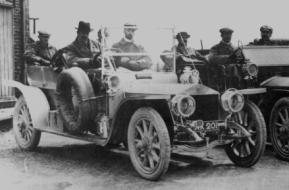
The Rolls-Royce Silver Ghost name refers both to a car model and one specific car from that series. Originally named the "40/50 h.p." the chassis was first made at Royce's Manchester works, with production moving to Derby in July 1908, and also, between 1921 and 1926, in Springfield, Massachusetts, USA. Chassis no. 60551, registered AX 201, was the car that was originally given the name "Silver Ghost". Other 40/50 hp cars were also given names, but the Silver Ghost title was taken up by the press, and soon all 40/50s were called by the name, a fact not officially recognised by Rolls-Royce until 1925, when the Phantom range was launched.
The Silver Ghost was the origin of Rolls-Royce's claim of making the "best car in the world" – a phrase coined not by themselves, but by the prestigious publication Autocar in 1907. The chassis and engine were also used as the basis of a range of Rolls-Royce Armoured Cars. In December 1923, four friends of Woodrow Wilson chipped in to buy the former president a Silver Ghost, just weeks before Wilson's death in February 1924. The car was modified so that Wilson, who was disabled, could enter and exit the car more easily.
History

In 1906, Rolls-Royce produced four chassis to be shown at the Olympia car show, two existing models, a four-cylinder 20 hp and a six-cylinder 30 hp, and two examples of a new car designated the 40/50 hp. The 40/50 hp was so new that the show cars were not fully finished, and examples were not provided to the press for testing until March 1907.
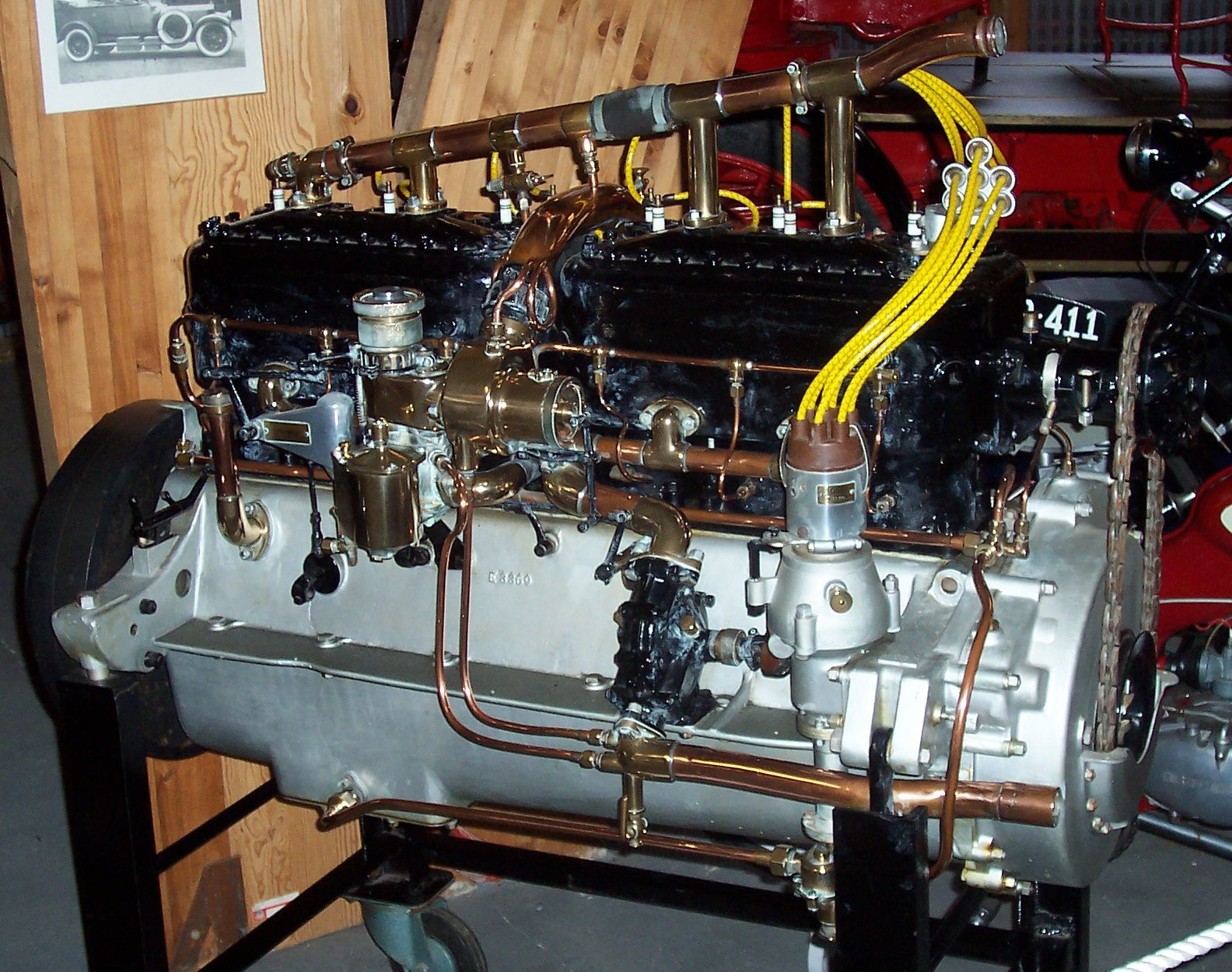
The car at first had a new side-valve, six-cylinder, 7036 cc engine (7428 cc from 1910) with the cylinders cast in two units of three cylinders each as opposed to the triple two-cylinder units on the earlier six. A three-speed transmission was fitted at first with four-speed units used from 1913. The seven-bearing crankshaft had full pressure lubrication, and the centre main bearing was made especially large to remove vibration, essentially splitting the engine into two three-cylinder units. Two spark plugs were fitted to each cylinder with, from 1921, a choice of magneto or coil ignition. along with electric lights to replace the older ones that used acetylene or oil.
Development of the Silver Ghost was suspended during World War I, although the chassis and engine were supplied for use in Rolls-Royce Armoured Cars. A blue 1909 Silver Ghost known as Blue Mist, previously owned by an Irish lord, was used by Lawrence of Arabia as his personal staff car during the Arab Revolt. Construction of a replica Blue Mist began in 2018.
The chassis had rigid front and rear axles and leaf springs all round. Early cars only had brakes on the rear wheels operated by a hand lever, with a pedal-operated transmission brake acting on the propeller shaft. The footbrake system moved to drums on the rear axle in 1913. Four-wheel servo-assisted brakes became optional in 1923.
Despite these improvements the performance of the Silver Ghost's competitors had improved to the extent that its previous superiority had been eroded by the early 1920s. Sales declined from 742 in 1913 to 430 in 1922. The company decided to launch its replacement which was introduced in 1925 as the New Phantom. After this, older 40/50 models were called Silver Ghosts to avoid confusion.
A total of 7874 Silver Ghost cars were produced from 1907 to 1926, including 1701 from the American Springfield factory. The documented chassis price listed for the 1921 American version was US$11,750 ($ in dollars ). Many of them still run today. A fine example is on display at the National Motor Museum, Beaulieu.
The Alpine Eagles
A 40/50 was privately entered in the prestigious 1912 Austrian Alpine Trial by James Radley, but its 3-speed gearbox proved inadequate for the ascent of the Katschberg Pass. A factory team of four cars were prepared for the 1913 event with four-speed gearboxes, and engine power increased from 60 bhp to 75 bhp by an increase in compression ratio and larger carburettor. The team gained six awards including the Archduke Leopold Cup. Replicas of the victorious cars were put into production and sold officially as Continental models, but they were called Alpine Eagles by chief test driver (and later Rolls-Royce Managing Director) Ernest Hives, and this is the name that they have kept.
The Silver Ghost
In 1907 Claude Johnson, commercial and managing director of Rolls-Royce, ordered a car to be used as a demonstrator by the company. With chassis no. 60551 and registered AX 201, it was the 12th 40/50 hp to be made, and a plaque bearing this name adorned the bulkhead. An open-top Roi-des-Belges body by coachbuilder Barker was fitted, and the car readied for the Scottish reliability trials of 1907 and, immediately afterwards, another 15000 mi test which included driving between London and Glasgow 27 times.
The aim was to raise public awareness of the new company and to show the reliability and quietness of their new car. This was a risky idea: cars of this time were notoriously unreliable, and roads of the day could be horrendous. Nevertheless, the car set off on trials, and with press aboard, broke various records. Even after 7,000 miles (11,000 km), the cost to service the car was a negligible £2 2s 7d (£2.13). The reputation of the 40/50, and Rolls-Royce, was established.
The “AX 201” was sold in 1908, for £750, to Sir Daniel Hanbury who used it repeatedly to travel to his Italian residence, Villa della Pergola in Alassio, in the Italian Riviera, starting from his English residence Castle Malwood in Lyndhurst in Hampshire.
This car was then recovered by the company in 1948. Since then, it has been used as a publicity car and travelled worldwide. In 1991, the car was restored.
In 2005 it was noted to be the world's most valuable car, its insured value was placed at US$35 million.
After the 1998 sale of Rolls-Royce Motors Ltd the car passed into the ownership of Bentley Motors.
File:Rolls Royce Silverghost AX201 restore1.jpg|AX 201 in a photo from 1990, prior to restoration File:Rolls Royce Silverghost AX201 restore2.jpg|AX 201 with body & chassis separated File:Rolls Royce Silverghost AX201 restore3.jpg|AX 201 rear end showing ash frame
Gallery
File:Rolls-Royce Silver Ghost.jpg|1909 landaulet by Hooper, Science Museum, London File:1910 Rolls-Royce Silver Ghost Tourer (1419230816).jpg|1910 tourer, National Automobile Museum, Reno File:1912 Rolls Royce Silver Ghost Touring.jpg|1912 Tourer File:L'evoluzione dell'automobile Rolls Royce.jpg|1914 tourer in Museo Nazionale dell'Automobile, Torino File:Rétromobile 2018 - Rolls Royce Silver Ghost - 1914 - 003.jpg|1914 Silver Ghost by Kellner interior File:1924 Rolls-Royce Silver Ghost Labourdette - Flickr - edvvc.jpg|1920 chassis 40FW tourer by Labourdette File:Rolls-Royce Silver Ghost Kégresse.jpg|A 1922 half-track owned by Vladimir Lenin, at Gorki Leninskiye
References
Notes
Bibliography
References
- The Rolls-Royce Motor Car. Anthony Bird and Ian Hallows. Batsford Books. 2002 {{ISBN. 0-7134-8749-6
- (1923-01-01). "Book of general & technical information useful to drivers and owners of Rolls-Royce cars. 40-50 H.P. six cylinders.". Rolls-Royce, 1923..
- "1907-1918 Rolls-Royce Silver Ghost pre-WW1".
- Evans, Michael. (2004). "In the Beginning-the Manchester Origins of Rolls-Royce". Rolls-Royce Heritage Trust.
- Baldwin, N.. (1994). "A-Z of Cars of the 1920s". Bay View Books.
- [https://www.autoweek.com/car-life/a1827976/armored-rolls-royce-ghosts-ruled-deserts-arabia-chariots-war/ Chariots of war]
- [https://www.wellhereweare.com/home/2017/7/4/blue-mist-how-lawrence-of-arabia-stole-grannys-rolls-royce Well Here We Are]
- [https://www.cambridge-news.co.uk/news/cambridge-news/how-discovered-truth-lawrence-arabias-13299489 Cambridge News]
- [https://www.prweb.com/releases/historians_discover_the_identity_of_lawrence_of_arabia_s_rolls_royce/prweb14472745.htm PR Web]
- Pugh, Peter. (2001). "The Magic of a Name - The Rolls-Royce Story: The First 40 Years". Icon Books.
- "1922 Rolls Royce Silver Ghost". Heritage Museums & Gardens.
- (October 2020). "The Original Silver Ghost". Automobil.
- "2005 Concours at Cranbrook".
This article was imported from Wikipedia and is available under the Creative Commons Attribution-ShareAlike 4.0 License. Content has been adapted to SurfDoc format. Original contributors can be found on the article history page.
Ask Mako anything about Rolls-Royce Silver Ghost — get instant answers, deeper analysis, and related topics.
Research with MakoFree with your Surf account
Create a free account to save articles, ask Mako questions, and organize your research.
Sign up freeThis content may have been generated or modified by AI. CloudSurf Software LLC is not responsible for the accuracy, completeness, or reliability of AI-generated content. Always verify important information from primary sources.
Report