From Surf Wiki (app.surf) — the open knowledge base
Rolls-Royce Phantom II
Ultra-luxury flagship automobile in its second generation

Ultra-luxury flagship automobile in its second generation
| Field | Value |
|---|---|
| image | 1933 Rolls-Royce Phantom II Continental.jpg |
| name | Rolls-Royce Phantom II |
| manufacturer | Rolls-Royce Ltd |
| production | 1929–1935 |
| 1,681 produced | |
| predecessor | Phantom I |
| successor | Phantom III |
| class | Luxury car |
| engine | 7668 cc I6 |
| transmission | 4-speed manual |
| wheelbase | 144 in (3658 mm) |
| 150 in (3810 mm) | |
| assembly | United Kingdom: Derby, England |
1,681 produced 1,400 "regular" cars
281 Continentals 9 experimental cars 150 in (3810 mm)
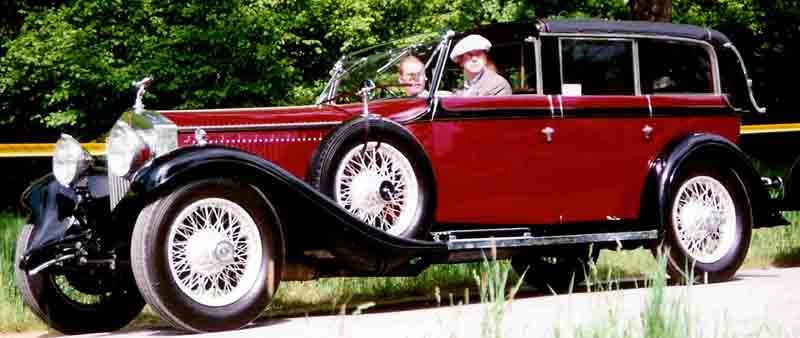
The Rolls-Royce Phantom II was the third and last of Rolls-Royce's 40/50 hp models, replacing the New Phantom in 1929. It used an improved version of the New Phantom engine in an all-new chassis. A "Continental" version, with a short wheelbase and stiffer springs, was offered.
Description
Drivetrain
The Phantom II used a refinement of the New Phantom's 7.7 L (7668 cc) pushrod-OHV straight-6 engine with a new crossflow cylinder head. Unlike on previous 40/50 hp models, the engine was bolted directly to the 4-speed manual transmission. Synchromesh was added on gears 3 and 4 in 1932 and on gear 2 in 1935. Power was transmitted to the rear wheels using an open driveshaft, a hypoid bevel final drive, and Hotchkiss drive, replacing the torque tube from a remotely mounted gearbox used on earlier 40/50 hp models.
Chassis
The chassis of the Phantom II was completely new. The front axle was mounted on semi-elliptical leaf springs as on earlier 40/50 hp models, but the rear axle was now also mounted on semi-elliptical springs instead of cantilever springs. This, along with the drivetrain changes, allowed the frame to be lower than before, improving the handling. The 4-wheel servo-assisted brakes from the Phantom I were continued, and the Bijur centralized lubrication system from the Springfield-built Phantom I was included on all Phantom II chassis.
The standard wheelbase of the Phantom II was 150 in. A 144 in short-wheelbase chassis was also available.
A total of 1,681 Phantom II chassis of all types were built.
"Continental" model

Henry Royce had body designer Ivan Evernden design him a one-off short-wheelbase Phantom II. Designated 26EX, the car had a tuned engine, five-leaf springs that were stiffer than standard and a Barker four-seat lightweight close-coupled saloon body painted with an artificial pearl lacquer made from ground herring scales. The sales department initially showed no interest in 26EX but, when Evernden returned to the office from the 1930 Biarritz Grand Concours d'Elegance, where 26EX had won the Grand Prix d'Honneur, he found that the sales department had already announced the new "Phantom II Continental Saloon", prepared a brochure for it, and costed it.
According to Evernden, neither he, Royce, nor the Rolls-Royce sales department had written specifications for the "Continental" model, although he and Royce had a clear specification in mind. Based on Evernden's writings and examination of company records, historian Ray Gentile determined that the common specifications of the Continental chassis were the short wheelbase and stiffer, five-leaf springs. By this definition, two hundred and eighty-one Continental Phantom II's were produced, including 125 left-hand drive versions.
Regarded as the two most important P-II Continentals are 20MS and 2SK, the only two P-II Continental Roadsters ever built. 20MS has been in a private Mid-Atlantic collection since 1989, 2SK, the Thrupp and Maberly Roadster once owned by Tyrone Power, was in the Fred Buess collection since 1958 but was sold at auction in 2010. Most Continentals were sports saloons, but various body styles were produced on the Continental chassis, including formal sedanca de villes, sporting open roadsters, and closed coupes meant for long-distance touring. Most were bodied by British coachbuilders, such as Barker, Hooper, H.J. Mulliner and Windovers, but various other coachbuilders in Europe, Australia and the United States built bodies for the Continentals, including Kellner of Paris, Martin & King of Sydney, and Brewster of New York City.
US-market versions
All Phantom II rolling chassis were built at Rolls-Royce's factory in Derby. The factory in Springfield, Massachusetts was closed upon ending production of the US-market Phantom I/New Phantom in 1931. Two US-market series, AJS and AMS, were built at Derby.
It competed with the recently introduced Lincoln Model K, Chrysler Imperial, Mercedes-Benz 770, Duesenberg Model J, Packard Eight, and the Cadillac Series 355. The left-hand-drive configuration was unsurprisingly most popular in the United States and Canada, but customers in Monaco, Denmark, Switzerland and Poland also purchased left-hand-drive chassis, which were not regularly available outside the USA.
Bodywork

Only the chassis and mechanical parts were made by Rolls-Royce. The body was made and fitted by a coachbuilder selected by the owner. Some of the most famous coachbuilders who produced bodies for Rolls-Royce cars are Park Ward, Brewster, Thrupp & Maberly, Mulliner, Carlton, Windovers, and Hooper. Outside the UK, cars were bodied in Australia by Martin & King, Italy by Castagna, Spain by Baltasar Fiol, Germany by Erdmann und Rossi, Sweden by Nordberg, Belgium by Van den Plas (Bruxelles,) The Netherlands by Van Rijswijk, France by Saoutchik, Kellner, Binder and Gaston Grümmer, and the United States by Brewster and F.R. Wood.
In popular culture
The Phantom II was featured in the films The Sorcerer's Apprentice and Indiana Jones and the Last Crusade. When its specifications are quoted during the scene in the Kingdom of Hatay, the Sultan states that the Rolls-Royce Phantom II has a "4.3 litre, 30 horsepower, six cylinder engine, with Stromberg downdraft carburetor; can go from zero to 100 kilometers an hour in 12.5 seconds (and I even like the color)." However, the car used in the film was actually a Rolls-Royce Barker Saloon, with 20/25 hp. It is also the star of the 1964 film The Yellow Rolls-Royce where its engine specifications are given as the engine having a bore of 4.5" and stroke of 5.5", which would equate to 525 cubic inches.
Pocher Model Kits
Pocher models are recognised as some of the most complex and detailed automobile kits ever made, and they released 2 1/8th scale museum level model kits of the Phantom II:
- Pocher Rolls-Royce Phantom II Sedanca Coupe 1932 1:8 K72 Tyco Kit K 72
- Pocher Rolls-Royce Torpedo Phantom II Convertible with 2,905 parts
Production
- Phantom II: 1400
- Phantom II Continental: 281
- Phantom II Experimental: 9 Total production: 1,681 total cars
Gallery
File:00 3929 Rolls-Royce Phantom II, Pullman limousine.jpg|Rolls-Royce Phantom II pullman limousine File:Rolls Royce Phantom II Kellner 1930.jpg|1930 Rolls-Royce Phantom II Kellner File:Rolls Royce 1932 Phantom II on Pebble Beach Tour d'Elegance 2011 -Moto@Club4AG.jpg|1932 Rolls-Royce Phantom II Brewster Croydon File:Dülmen, Rolls-Royce Phantom II -- 2024 -- 5829 (cinematic).jpg|1932 Rolls-Royce Phanthom II 40 50HP coupé de ville File:1933 Rolls-Royce Phantom II Continental Gurney Nutting Sedanca DHC - green - fvl.jpg|1933 Rolls Royce Phantom II Continental Gurney Nutting File:Rolls Royce ATA 410.jpg|1934 Rolls-Royce Phantom II, Hooper limousine File:Royce Phantom II Boattail - Villa d'Este 2014 - (14642122065).jpg|1934 Rolls Royce Phantom II Boattail Gurney Nutting File:1934-35 Rolls Royce Limousine (7540814792).jpg|1934 Rolls-Royce Phantom II Limousine interior File:Sternvonindien.JPG|Rolls-Royce Phantom II with All-Weather Cabriolet coachwork by Thrupp & Maberly for the Maharajah of Rajkot, Chassis #188PY (1934). This car also is known as the "Star of India"
References
Sources
References
- (2009). "Sir Henry's Final Masterpiece Or How Glenn Ford Pushed a Button and Won the War". Faircount.
- (2011). "Phantom II". Rolls-Royce Owners' Club.
- Posthumus. Cyril. "The Story of Veteran & Vintage Cars". (1977). Hamlyn
- [http://www.conceptcarz.com/vehicle/z15619/Rolls-Royce-Phantom-II.aspx 1935 Rolls-Royce Phantom II (P2)]
- Rolls-Royce Enthusiasts Club B205/58
- Wood. Jonathan. "The Rolls-Royce". link. (2003). Shire Publications
- [https://www.imdb.com/title/tt0097576/quotes Internet Movie Database]
- [http://www.imcdb.org/vehicle_3150-Rolls-Royce-20-25-hp-GPG4.html] 1935 Rolls-Royce 20/25 h.p. Barker Saloon as Rolls-Royce Phantom II [GPG4]
This article was imported from Wikipedia and is available under the Creative Commons Attribution-ShareAlike 4.0 License. Content has been adapted to SurfDoc format. Original contributors can be found on the article history page.
Ask Mako anything about Rolls-Royce Phantom II — get instant answers, deeper analysis, and related topics.
Research with MakoFree with your Surf account
Create a free account to save articles, ask Mako questions, and organize your research.
Sign up freeThis content may have been generated or modified by AI. CloudSurf Software LLC is not responsible for the accuracy, completeness, or reliability of AI-generated content. Always verify important information from primary sources.
Report