From Surf Wiki (app.surf) — the open knowledge base
Roller derby
Contact sport on roller skates
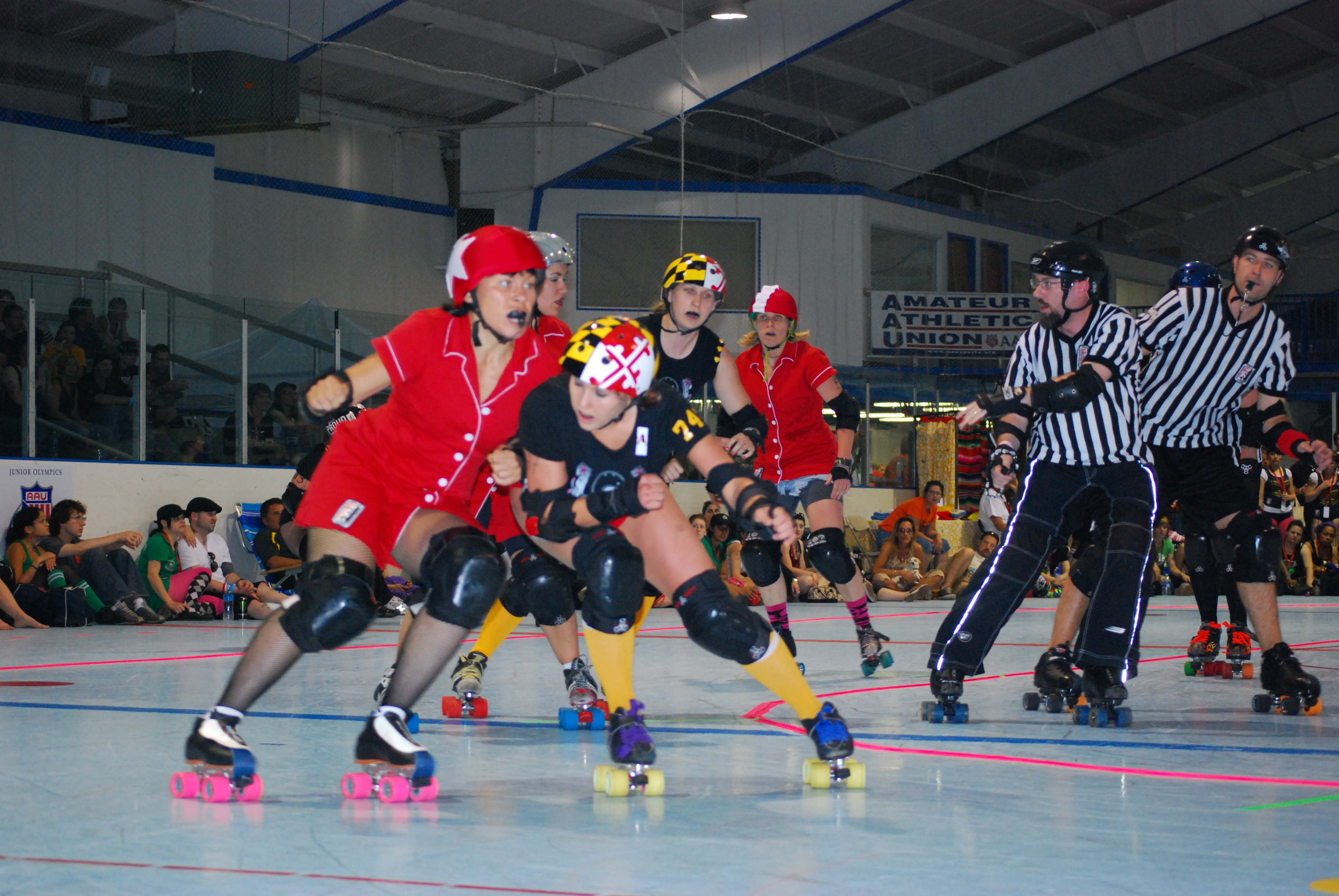
Contact sport on roller skates
| Field | Value |
|---|---|
| name | Roller derby |
| image | WasatchVsJunctionCity.jpg |
| caption | A roller derby scrimmage in Utah (2012) |
| union | WFTDA, MRDA, JRDA, World Skate |
| nickname | Derby |
| first | 1935, Chicago, Illinois |
| clubs | 4,700+ |
| contact | Full |
| team | 15 on roster, up to 5 on track during each jam. |
| category | Indoor, roller sport |
| equipment | Roller skates, helmet, knee pads, elbow pads, wrist guards, mouthguard |
| venue | Roller rink, pitch |
| olympic | No |
Roller derby is a roller skating contact sport played on an oval track by two teams of five skaters. It is played by approximately 1,250 amateur leaguesA Roller Derby league is synonymous with an individual club or team in other team sports, as opposed to the more typical use of the word league. worldwide, though it is most popular in the United States.
A 60-minute roller derby game, or bout, is a series of two-minute timed jams. Each team, typically with a roster of 15, fields five skaters during each jam: one jammer, designated with a star on their helmet, and four blockers. During each jam, players skate counterclockwise on a circuit track. The jammer scores a point for each opposing blocker they lap. The blockers simultaneously defend by hindering the opposing jammer, while also playing offense by maneuvering to aid their own jammer. Because roller derby uses a penalty box, power jams, in which one team has a temporary numerical advantage after a foul, can have a major effect on scoring.
Overview
While the sport has its origins in the banked-track roller-skating marathons of the 1930s, Leo Seltzer and Damon Runyon are credited with evolving the sport to its competitive form. Professional roller derby quickly became popular; in 1940, more than 5 million spectators watched in about 50 American cities. In the ensuing decades, however, it predominantly became a form of sports entertainment, where theatrical elements overshadowed athleticism. Gratuitous showmanship largely ended with the sport's grassroots revival in the first decade of the 21st century. Although roller derby retains some sports entertainment qualities such as player pseudonyms and colorful uniforms, it has abandoned scripted bouts with predetermined winners.
Modern roller derby is an international sport, mostly played by amateurs. It was under consideration as a roller sport for the 2020 Summer Olympics. Fédération Internationale de Roller Sports (FIRS), recognized by the International Olympic Committee as the official international governing body of roller sports, released its first set of Roller Derby Rules for the World Roller Games, organised by World Skate, that took place September 2017 in Nanjing, China. Most modern leagues (and their back-office volunteers) share a strong "do-it-yourself" ethic that combines athleticism with the styles of punk and camp. , the Women's Flat Track Derby Association (WFTDA) had 451 full member leagues and 46 apprentice leagues and the Roller Derby Coalition of Leagues (RDCL) supporting women's banked track roller derby had eight full member leagues.
Rules
Contemporary roller derby has a basic set of rules, with variations reflecting the interests of a governing body's member leagues. The summary below is based on the rules of the Women's Flat Track Derby Association (WFTDA). In March 2010, Derby News Network said that more than 98% of roller derby competitions were conducted under WFTDA rules. For example, members of the United Kingdom Roller Derby Association are required to play by WFTDA rules, while members of the former Canadian Women's Roller Derby Association were encouraged to join the WFTDA.
Basics of play
| Position | Helmet cover | Responsibility |
|---|---|---|
| Jammer | Star | 7}} |
| Blocker | None | 18}} hinders the opposing jammer from passing through the pack, and helps their team's jammer pass through the pack. |
| Pivot | Stripe | 7}} if the jammer's helmet cover is correctly transferred in a "star pass" maneuver. The pivot is often an experienced player who establishes team strategy during play and sets the pace of the pack. |
Roller derby is played in two periods of 30 minutes. Two teams of up to 15 players each field up to five members for episodes called "jams". Jams last two minutes unless called off prematurely. Each team designates a scoring player (the "jammer"); the other four members are "blockers". One blocker can be designated as a "pivot"—a blocker who is allowed to become a jammer in the course of play. The next jam may involve different players of the 15 roster players, and different selections for jammer and pivot.
During each jam, players skate counterclockwise on a circuit track. Points are scored only by a team's jammer. After breaking through the pack and skating one lap to begin another "trip" through the pack, the jammer scores one point for passing any opposing blocker.Until 2019, the jammer also scored a point by passing the opposing jammer. There were 5 potential points per trip. The rules describe an "earned" pass; notably, the jammer must be in-bounds and upright. The jammer's first earned pass scores a point for passing that blocker and a point for each opponent blocker not on the track (for instance, serving a penalty, or when the opposition did not field five players for the jam). If the jammer passes the entire pack, it is a four-point scoring trip, commonly called a "grand slam".
Each team's blockers use body contact, changing positions, and other tactics to help their jammer score while hindering the opposing team's jammer.
Jams
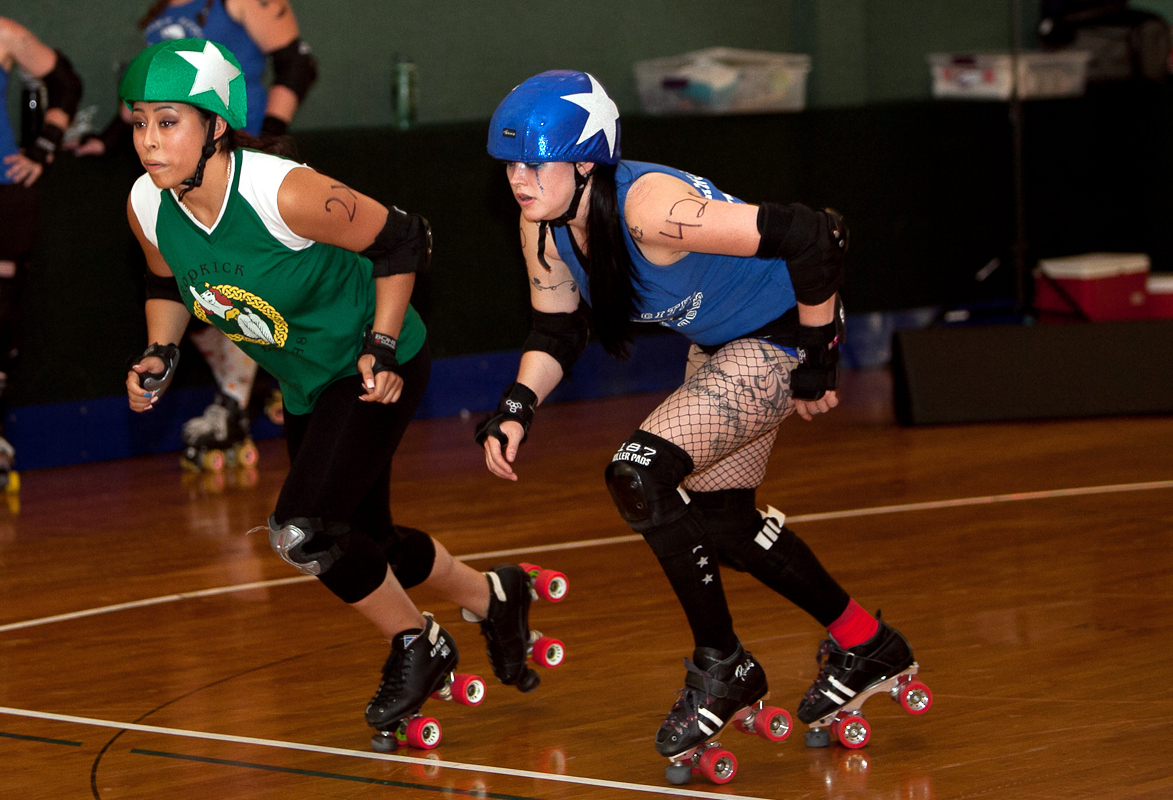
Play begins by blockers lining up on the track anywhere between the "jammer line" and the "pivot line" 30 ft in front. The jammers start behind the jammer line. Jams begin on a single short whistle blast, upon which both jammers and blockers may begin engaging immediately.

The pack is the largest single group of blockers containing members of both teams skating in proximity, arranged such that each player is within 10 ft of the next. Blockers must maintain the pack, but can skate freely within 20 ft behind and ahead of it, an area known as the "engagement zone".
The first jammer to break through the pack earns the status of "lead jammer". A designated referee blows the whistle twice and continually points at the jammer to confer lead jammer status, which lets that jammer stop the jam at any time by repeatedly placing hands on hips. Lead jammer status cannot be transferred to other skaters, but certain actions (such as being sent to the penalty box) cancel lead jammer status, meaning that the jam has no lead jammer and must continue for the full two-minute period. If the jam is not called off by the lead jammer, it ends after two minutes. If time remains in the period, teams then have 30 seconds to get on the track and line up for the next jam. If the 30-minute period ends while a jam is underway, the jam plays out to its natural conclusion.
Blocking
A skater may block an opponent to impede their movement or to force them out of bounds. The blocker must be upright, skating counterclockwise, in bounds, and within the engagement zone. Groups of blockers on the same team typically create formations, known as walls, to prevent the opposing blocker from passing. Blocking with hands, elbows, head, and feet is prohibited, as is contact above the shoulders, below mid-thigh, or to the back.
Penalties

Referees penalize rules violations. A player receiving a penalty is removed from play and must sit in the penalty box for 30 seconds of jam time. If the jam ends during this interval, the player remains in the penalty box during the subsequent jam until the interval ends. While the penalty is being served, the penalized player's team plays short-handed, as in ice hockey. A player "fouls out" of the game on the seventh penalty, and is required to return to the locker room.
A "power jam", derived from ice hockey's "power play", refers to a scenario when one team's jammer is sent to the penalty box. In this case, that jammer's team cannot score. If the lead jammer is penalized, no one can prematurely end the jam.
It would be pointless to play if neither team could score; thus, both jammers cannot serve a penalty at the same time. If one jammer is sent to the penalty box while the opposing jammer is already serving a penalty, the opposing jammer is released from the penalty box early. The second jammer's penalty is then only as long as the amount of time the first jammer spent in the box.
Equipment
.jpg)
Players skate on four-wheeled ("quad") roller skates, and are required to wear protective equipment, including a helmet, wrist guards, elbow pads, knee pads, and mouth guards. All current sets of roller derby rules explicitly forbid inline skates for players. (USARS requires quad skates for all skaters. WFTDA and MRDA permit inline skates for referees, but virtually all referees wear quad skates.) Individual teams may mandate additional gear, such as padded knee length pants, similar to what aggressive skateboarders wear, and sex-specific gear such as a hard-case sports bra and protective cups.
Strategy and tactics
Offense and defense are played simultaneously, a volatile aspect that complicates strategy and tactics. For example, one team's blockers may take offensive action to create a gap in the opposing wall for their jammer to pass through, but this same maneuver could potentially weaken their own defenses and allow the opposing team's jammer to score.
Strategies (high-level plans toward achieving the game's goal, which is to outscore the opposition) include the following:
- Ending the jam: The lead jammer can "call off" or end the jam at any time, controlling the opposition's ability to score points. The strategy for a jam is not to score a lot of points but to outscore the opposition. Often, the lead jammer scores as many points as possible on the first scoring trip, and then ends the jam before the opposing jammer has the opportunity to score any points. If the jammer gets the lead but is then passed by the opposing jammer, they may decide to call off the jam without scoring any points themself in order to prevent the other team's jammer from scoring any points.
- Passing the star: The jammer for a team may "pass the star" (may perform a "star pass") to the pivot—that is, hand the helmet cover with the star to the pivot, which turns the pivot into the jammer. Passing the star does not nullify any earned pass of an opponent that the former jammer made, but passing the star forward never constitutes an earned pass. A jammer might pass the star because of fatigue, injury, or because the pivot is in a better position to score. Passing the star is also sometimes referred to as "passing the panty", as helmet covers are sometimes known as "panties".
- Killing a penalty: Captained by the pivot, blockers adapt their play to a penalty situation. For example, a short-handed team may try to make the pack skate faster to slow down scoring action until the team returns to full strength.Before 2013, there were "major" and "minor" penalties, the former included any player's fourth penalty, and it was strategic for a key player to deliberately commit such a penalty when it would have least effect.
Tactics (deliberate conceptual tasks in support of the strategy) may include the following:
- Walling up: Two or more blockers skate together to make it difficult for the opposing team (especially its jammer) to maneuver. They may skate side by side and use a "wide stance" to maximize the blockade, but must not link with or grasp each other, or otherwise form an impenetrable connection. The ability to suddenly form a wall denies the opposition time to respond. A wall can inhibit, slow down, and ultimately trap the opposing jammer. An effective wall may last for an entire jam. Variations on the tactic include the following:
- Backwards bracing, in which one skater, forward of the wall, skates backward to sight the jammer and direct teammates forming the wall.
- A skater may break off from the wall to actively challenge the opposing jammer, with a teammate replacing the skater in the wall.
- If the opposing jammer tries to pass the wall on one side, players may abandon the other side to fortify the active side of the wall.
.jpg)
- Jammer tactics, in response to a wall or other obstacles by the opposing team's defense, include the following:
- Pushing through gaps in the wall or inducing the wall to separate by use of physical force.
- Evading the obstacle to one side or the other.
- Juking, where the jammer seems to be skating to one side but quickly shifts to the other side.
- Rolling around the end of the obstacle (spinning 360°) to end up ahead of it.
- Using teammates to impede the defense from adjusting, such as by setting screens.
- Using a whip, where one or more teammates grasp the jammer's hand(s) and swing the jammer forward, transferring speed and momentum to the jammer.
- Apex Jump: Using the inside curve of the track to leap out of bounds but land in bounds, passing opposing players.
- Goating: The pack is defined as the largest group of in-bounds blockers, skating in proximity, containing members from both teams. In the "goat-herding" tactic, one team surrounds a blocker of the opposing team and then slows so that that group becomes the pack. The rest of the opposing team, skating ahead, are thus put out of play and cannot legally block the goat-herders' jammer.
- Running back or recycling: When a skater bumps the opponent jammer off the track, the jammer can only re-enter the track behind the skater. The skater skates clockwise on the track toward the rear of the engagement zone to maximize the time the jammer must spend before returning to action.
- Bridging: By separating up to 10 ft, blockers can stretch both the pack and the engagement zone, allowing teammates to keep hindering the opposition jammer. For example, in the strategy of running back (see above), coordinated action by the four skaters other than the jammer could force the opponent jammer to detour a full 40 ft before returning to action.
Officials

WFTDA bouts are officiated by three to seven skating referees and many non-skating officials (NSOs). Volunteer leagues adapt when fewer than the optimal number of officials are present.
Referees
Up to four referees skate on the inside of the track. In flat-track derby, up to three additional referees skate on the outside of the track. They call penalties, award points, and ensure safe game play. Referees must wear skates and typically wear white and black stripes.
| Type | Number | Responsibility |
|---|---|---|
| Head Referee | 1 | 35}} and for announcing the results of official reviews. |
| Pack Referees | Up to 5 | 35}} |
| Jammer Referees | 2 | 29}} a jammer referee watches the jammer of a designated team, awards points scored by their jammer, signals whether their jammer has achieved lead jammer status, and signals the end of the jam if their jammer is lead and calls off the jam. Jammer referees wear a wristband (and optionally a helmet cover) in that team's color to identify which team's jammer they are watching. |
Non-skating officials (NSOs)
NSOs take up a range of positions inside and outside the track, start and time the jams, record and display scores and penalties communicated by referees, record the number of each skater on track for a given jam, and time and record skaters in the penalty box.
| Type | Number | Responsibility |
|---|---|---|
| Scorekeepers | 2 | 36}} |
| Penalty Trackers | 1 (min) | 36}} and notify the head referee of skaters in the current jam who are in danger of fouling out. |
| Penalty Box Manager | 1 | The manager is the head of the affairs within the penalty box. The manager can call penalties for penalty box violations or illegal procedures (such as removing the helmet in the penalty box). Also, the manager points where the player is assigned to sit, times the jammers, and executes any necessary jammer swap. |
| Penalty Box Timers | 2 (min) | 36}} and notify referees if any do not. |
| Jam Timer | 1 | 36}} and call official timeouts. |
| Lineup Tracker | 2 | 5}} |
| Scoreboard Operator | 1 | 36}} |
History
Main article: History of roller derby
Professional endurance races
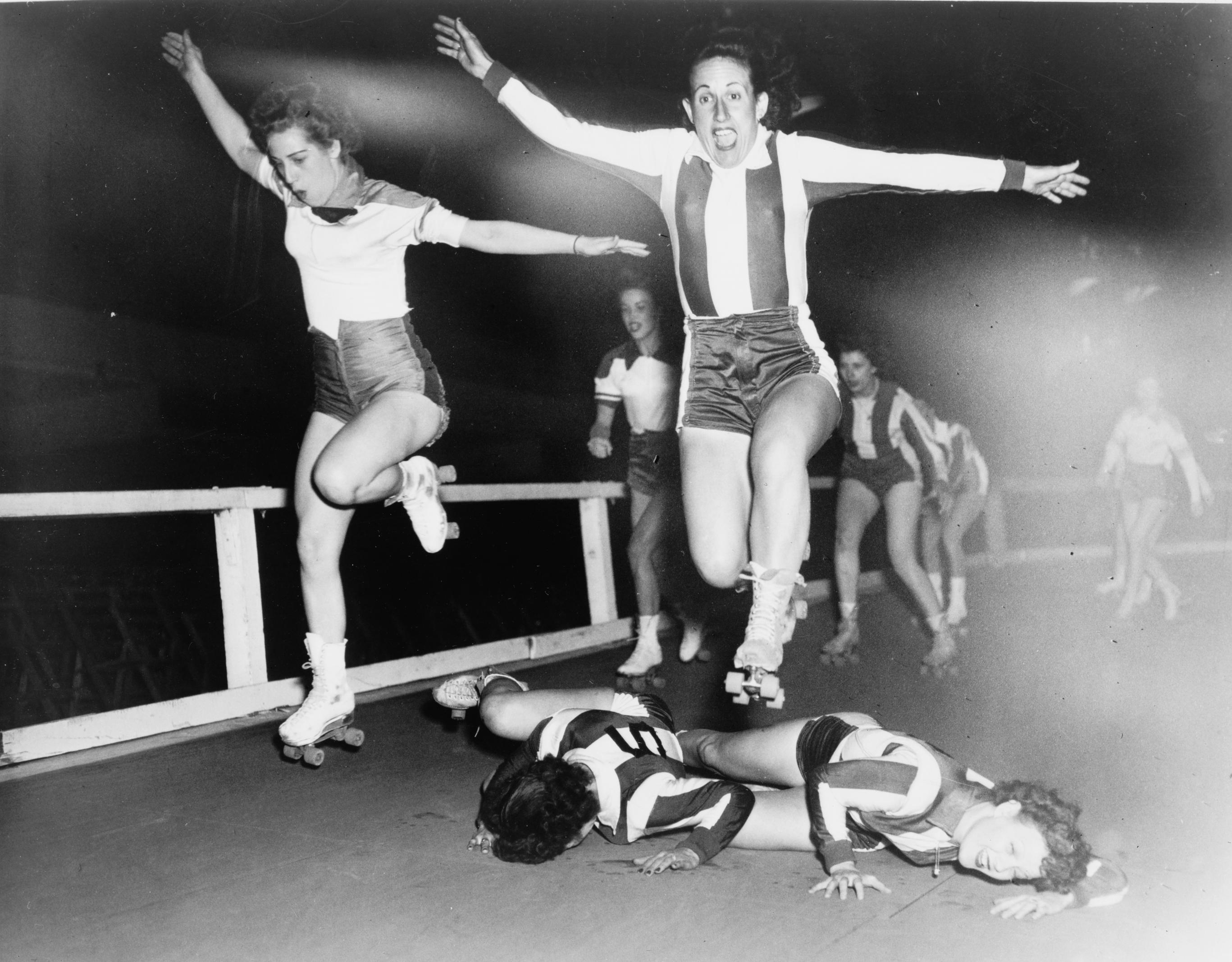
Evolution to contact sport
The endurance races began to transform into the contemporary form of the sport in the mid-1930s, when promoter Leo Seltzer created the Transcontinental Roller Derby, a month-long simulation of a road race between two-person teams of professional skaters. The spectacle became a popular touring exhibition. In the late 1930s, sportswriter Damon Runyon persuaded Seltzer to change the Roller Derby rules to increase skater contact. By 1939, after experimenting with different team and scoring arrangements, Seltzer's created a touring company of four pairs of teams (always billed as the local "home" team versus either New York or Chicago),{{Cite book
Television
On November 29, 1948, before television viewership was widespread, Roller Derby debuted on New York television. For the 1949–1950 season, Seltzer formed the National Roller Derby League (NRDL), comprising six teams.{{cite web |access-date=2007-06-08 |url-status=dead |archive-url=https://web.archive.org/web/20070405093016/http://www.ktvu.com/station/1854338/detail.html |archive-date= 2007-04-05
1989 saw the debut of RollerGames, an even more theatrical variant of roller derby for national audiences. It used a figure-8 track and rules adapted for this track. Bill Griffiths, Sr. served as commissioner while his son, Bill Griffiths, Jr., managed the L.A. T-Birds, who (according to the storyline) were seeking revenge on the Violators (led by Skull) for cheating in the Commissioner's Cup. The other teams included the Maniacs (led by Guru Drew), Bad Attitude (led by Ms. Georgia Hase), the Rockers (led by DJ Terringo and consisting of skaters who were also professional rock and roll musicians), and Hot Flash (led by Juan Valdez Lopez). It ran one season, because some of its syndicators went bankrupt.
In 1999, TNN debuted RollerJam, which used the classic rules and banked oval track, but allowed inline skates (although some skaters wore traditional quad skates). Jerry Seltzer was commissioner for this version.
The emphasis on showmanship, theatrical storylines, and pre-determined outcomes (much like professional wrestling) was a factor in the decline of professional roller derby.
Contemporary roller derby

Amateur revival
.jpg)
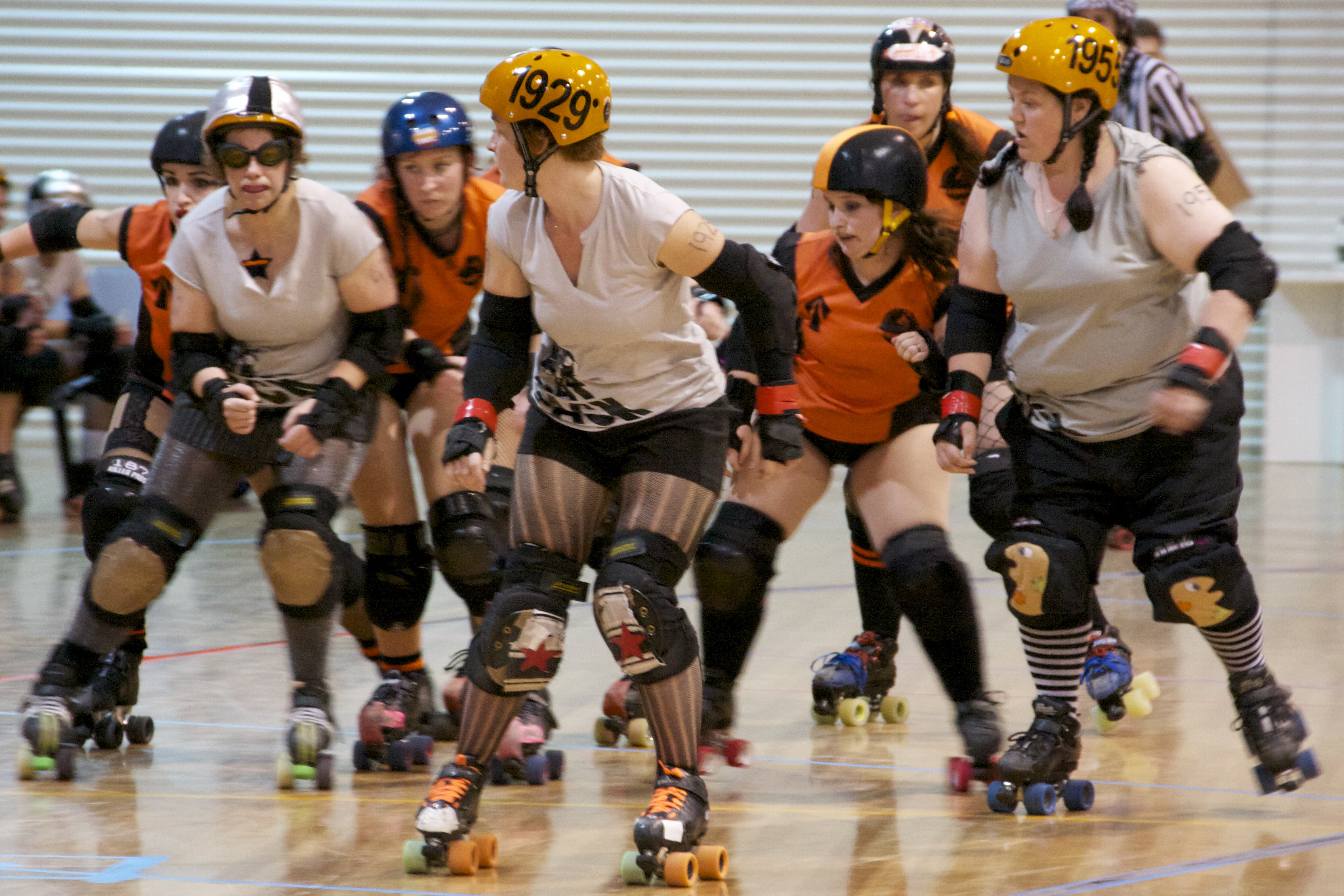
Roller derby began its modern revival in Austin, Texas in the early 2000s as an all-female, woman-organized amateur sport. By August 2006, there were over 135 similar leagues. Leagues outside the U.S. also began forming in 2006, and international competition soon followed. There are over 2,000 amateur leagues worldwide in countries including Canada, Australia, New Zealand, the United Kingdom, France, Brazil, Germany, Belgium, Finland, Norway, Sweden, Denmark, Israel, Singapore, UAE, Egypt, Thailand, and China. In many international leagues, gear and equipment must be imported. Roller derby's contemporary resurgence has been regarded as an aspect of globalization which demonstrates "the speed with which pop culture is now transported by highly mobile expatriates and social media, while also highlighting the changing role of women in many societies".
Many roller derby leagues are amateur, self-organized and all-female and were formed in a do-it-yourself spirit by relatively new enthusiasts. In many leagues (especially in the U.S.), a punk aesthetic and/or third-wave feminist ethic is prominent. Members of fledgling leagues often practice and strategize together, regardless of team affiliation, between bouts. Most compete on flat tracks, though several leagues skate on banked tracks, with more in the planning stages.
Each league typically features local teams in public bouts that are popular with a diverse fan base. Some venues host audiences ranging up to 7,000. Successful local leagues have formed traveling teams comprising the league's best players to compete with comparable teams from other cities and regions. In February 2012, the International Olympic Committee considered roller derby, amongst eight other sports, for inclusion in the 2020 Olympic Games.
In 2009, the feature film Whip It featured roller derby and introduced a wider audience to the sport. The WFTDA encouraged leagues to coordinate with promotions during the film's release to increase awareness of the leagues. Furthermore, corporate advertising has used roller derby themes in television commercials for insurance,{{Cite web | access-date = 2016-03-01
Derby names
| Name | Allusion |
|---|---|
| Guinefear of Jamalot | Guinevere of Camelot |
| Mazel Tov Cocktail | Mazel tov, Molotov cocktail |
| O Hell No Kitty | Hello Kitty |
| Sandra Day O'Clobber | Sandra Day O'Connor |
| Punky Bruiser | Punky Brewster |
| Roly Mary Mother of Quad | Holy Mary Mother of God |
| Ania Marx | On Your Marks |
| Princess Lay-Ya Flat | Princess Leia |
| Anna Mosity | Animosity |
| Smack Ops | Black Ops |
| Cactus Rack | Cactus Jack, a persona of retired |
| Trauma Queen | Drama Queen |
| Bonnie Thunders | Johnny Thunders |
Most players in roller leagues skate under pseudonyms, also called "derby names" or "skater names". These typically use word play with satirical, mock-violent or sexual puns, alliteration, and allusions to pop culture. Referees often use derby names as well, often shown on the backs of their striped uniforms. Some players claim their names represent alter egos that they adopt while skating.
Whether a team should skate under real names or derby names is sometimes debated. Some derby names are obscene, a subject of some internal controversy.
Copying of derby names has attracted legal and sociological analysis as an example of indigenous development of property rights.
The names of roller derby events are also as sardonic and convoluted—for example, Night of the Rolling Dead (Night of the Living Dead), Knocktoberfest (Oktoberfest), Spanksgiving (Thanksgiving), Seasons Beatings (Seasons Greetings), Grandma Got Run Over By a Rollergirl ("Grandma Got Run Over by a Reindeer"), Cinco de May-hem (Cinco de Mayo), and War of the Wheels (War of the Worlds).
Safety

Roller derby is a contact sport, and injuries can occur. Superficial injuries include bruising. However, torn ligaments, broken bones, and concussions also occur.{{Cite web | access-date = 2016-03-01 | access-date = 2016-03-01 | archive-date = 2011-11-01 | archive-url = https://web.archive.org/web/20111101050541/http://blog.timesunion.com/rollerderby/dain-bramage/393/ | url-status = dead
Some leagues prominently display their injuries, to embellish the image of violence or machismo. However, some skaters say the sport is reasonably safe if skaters take precautions.{{Cite web | access-date = 2016-03-01 | archive-date = 2016-03-03 | archive-url = https://web.archive.org/web/20160303215853/http://www.skatelogforum.com/forums/showthread.php?t=5090 | url-status = dead
Expansion
-1005.jpg)
Although the early 2000s revival of roller derby was initially all-female, some leagues later introduced all-male teams and all-gender games; there were over 140 junior roller derby programs in the United States, and many more around the world.
College roller derby is also expanding in the United States. The University of Arizona's Derby Cats describe themselves as the first-ever official college flat-track roller derby team. The first intercollegiate derby bout took place on March 3, 2018, when the Claremont Colleges roller derby team defeated Arizona State University.
The website FlatTrackStats compiles ratings of WFTDA teams, adjusting them after every bout based on how the actual score compares to the predicted score. The WFTDA's own Stats Repository has comparable information and often is updated at halftime of a bout.
Roller derby bouts are now streamed online, and there are archived videos of past bouts and tournaments. The WFTDA offers live streaming video of its tournaments at wftda.tv. Derby News Network offered live streaming video and archived video including events outside the WFTDA.
FiveOnFive magazine covers roller derby and diverse aspects such as business, training, junior roller derby, and nutrition.
Governance and organization
Main article: List of roller derby associations
The largest governing body for the sport is the Women's Flat Track Derby Association (WFTDA), with 397 full member leagues and 48 apprentice leagues. WFTDA membership is a major goal of aspiring leagues.{{Cite web | access-date = 2016-03-01
Although WFTDA has been the largest worldwide roller-derby organization, the IOC has recognized World Skate (formerly Fédération Internationale de Roller Sports) as the only governing body able to sanction international roller derby competitions within the Olympic Movement. Disputes between World Skate and WFTDA has meant that only 4 teams were present in the first Roller Derby World Championships organized by World Skate in 2017, as part of the 2017 World Roller Games
USA Roller Sports (USARS) is recognized by the International Roller Sports Federation (FIRS) and the United States Olympic Committee (USOC) as the National Governing Body of competitive roller sports in the United States, including speed, figure, hockey, roller derby and slalom. WFTDA and USARS maintain a reciprocity agreement for insurance purposes.
Outside the United States, many roller derby leagues enjoy support from their national skate federations, such as Skate Australia, the British Roller Sports Federation, and Roller Sports Canada. In Europe, roller derby was recognized as a sport in Paris in 2010 by the Federation Internationale de Roller Sports (FIRS), which reports directly to the International Olympic Committee. As of 2017, FIRS has been accepted as the international rule set by the International Olympic Committee. Teams competed under the FIRS rules at the 2017 Nanjing Games. The former Canadian Women's Roller Derby Association worked with the American federation.
Tournaments
- Roller Derby World Cup
- Men's Roller Derby World Cup
- WFTDA Championships
Also Part of World Skate Games and other Events and Regional Championship by World Skate.
Since 2006, the WFTDA has sponsored an annual championship. In 2008, it adopted the "Big 5" format: four regional playoffs and a final championship tournament. As of 2019, the WFTDA postseason includes two playoffs that feed into the Championship tournament, plus three standalone, regionally-based Continental Cups. The WFTDA also recognizes eligible tournaments hosted by member leagues.
Internationally, the first Roller Derby World Cup took place in Toronto, Canada, in December 2011. The second World Cup took place in Dallas, Texas, in December 2014.
Since 2012, USARS has held an annual Roller Derby National Championship. In 2017, FIRS and the USOC recognized USARS to participate in the 2017 Nanjing games.
The largest roller derby tournament in the southern hemisphere, the Great Southern Slam, has been held biennially in Adelaide, South Australia, since 2010.
Notes
References
References
- Moffett, Matt. (2013-02-03). "As the World Turns, So Do the Wheels of Roller Derby".
- (2023). "The Rules of Flat Track Roller Derby".
- (2012). "Common Ground: the alternative sport of roller derby". [[The Virginian-Pilot]].
- (2012-02-26). "Roller Derby: The Fastest Growing Sport In America". [[YouTube]].
- Neale, Rick. (24 June 2008). "All-Female Roller Derby Elbows Its Way In as a Legitimate Sport". [[USA Today]].
- (4 July 2011). "Will roller derby be included in the 2020 Olympics? | Olympics | Sports | National Post".
- (2013-05-28). "Roller Sports's pitch for the 2020 Olympics".
- Greg Otto. (2013-05-30). "Three Sports Make Olympic Cut for 2020 Summer Games". U.S. News.
- (2012-08-29). "SpudTown Knockdown 3: An Interview with CandyMan, Tournament Director | Fragglepuss".
- Fagundes, Dave. (2011-03-15). "Talk Derby to Me: Intellectual Property Norms Governing Roller Derby Pseudonyms".
- "RDCL - Roller Derby Coalition of Leagues".
- "The Rules of Flat Track Roller Derby". Women's Flat Track Derby Association (WFTDA).
- (2010-03-05). "DNN Releases First Power Rankings of 2010". Derby News Network.
- "Join Us". United Kingdom Roller Derby Association.
- "Welcome to CWRDA". Canadian Women's Roller Derby Association.
- "Derby 101". Canberra Roller Derby League.
- Em Dash. (2016-04-22). "Learning to Pivot in Roller Derby". DerbyLife.com.
- (5 February 2009). "Roller derby: A glossary". Silicon Valley Roller Girls.
- Brauns, Katie. (2009-04-14). "A Local Roller Derby Team Shows Its Toughness at a Saturday Bout but Doesn't Get a Win". Bend Bulletin.
- Vodoo, Big Daddy. "Roller Derby Strategies and Plays". Little City Roller Girs.
- Joulwan, Melissa. (2007-04-06). "Rollergirl: Totally True Tales from the Track - p 94". Simon and Schuster.
- "Game Play: Strategy". Atlanta Roller Girls.
- Crouse, Tripp. (15 July 2011). "Five Point Grand Slam: By the Position – Pivot/No. 1".
- (9 August 2015). "Passing the Panty".
- Bump, Speed. "Strategy 101: The Wall". Rose City Rollers.
- Lucy Croysdill. "Roller Derby Training: Evasive Jamming – Part One". pivotstar.com.
- Joulwan, Melissa. (2007-04-06). "Rollergirl: Totally True Tales from the Track - p 95". Simon and Schuster.
- Ma, Ling. (21 October 2010). "Game Changer". [[Chicago Reader]].
- "Derby Techniques of Interest Part 1: Knocking a jammer out of bounds and forming a bridge". Thunder Bay Roller Derby League.
- Parnavelas, Ellen. (2012). "The Roller Derby Athlete". [[Bloomsbury Publishing.
- (1884-04-13). "Remarkable roller-skating feat". Chicago Daily Tribune.
- (1885-03-02). "A six-day roller skate race". Chicago Daily Tribune.
- (2 March 1885). "On rollers for six days: beginning the race at the Madison-Square Garden. Thirty-six entries, including Frank Hart and several champions—cheering the start". New York Times.
- (1908-11-27). "Roller marathon thrills and jars: 100 boys meet with adventures and tumbles in West Side Boulevard race. Dodge cars and autos. But records are smashed by contestants in red tights, overalls, etc". Chicago Daily Tribune.
- (1922-12-17). "Roller skating on banked track: old-time sport is revived with speed contests at the Garden". New York Times.
- (1914-12-17). "24-hour roller race: Ollie Moore will be teamed with Willie Blackburn at Garden". New York Times.
- (1922-04-24). "Roller derby on tomorrow". Chicago Daily Tribune.
- Boulware, Jack. (2000). "San Francisco Bizarro: A Guide to Notorious Sights, Lusty Pursuits, and Downright Freakiness in the City by the Bay". Macmillan.
- Luker, Kelly. (1997-07-23). "Blood on the Tracks". Metro Santa Cruz.
- Rasmussen, Cecilia. (1999-02-21). "L.A. Then and Now: The Man Who Got Roller Derby Rolling Along". [[Los Angeles Times]].
- (1936-02-03). "Roller Derby".
- (1936-09-21). "Variations".
- (2004). "Roller Derby at the National Museum of Roller Skating". National Roller Skating Museum.
- (1998-12-14). "A Forward Roll: Dusted off and spiffed up, the Roller Derby is aiming to regain the hold it once had on TV".
- "USARS Rules of Roller Derby".
- Brick, Michael. (2008-12-17). "Pushing the Limit: The Dude of Roller Derby and His vision". New York Times.
- La Gorce, Tammy. (2008-11-07). "With Names That Could Kill, Women Rev Up Roller Derby". New York Times.
- "Teams - Roller Derby Stats & Rankings - Flat Track Stats".
- (2012-04-08). "Paris, les filles et le Roller Derby (Paris Roller Girls)". [[YouTube]].
- "Oslo Roller Derby".
- Cat O'Ninetails. (2011). "Roller Derby Worldwide".
- "Copenhagen Roller Derby".
- "TLV Derby Girls Official site".
- "Roller Derby Singapore".
- (2011-12-19). "New roller derby sport kicks off in Singapore". asiaone.com.
- (2011-04-01). "Roller Derby Singapore | CPDG | Teaser Video". [[YouTube]].
- Dani. (2012-10-13). "In the beginning". Dubai Roller Derby.
- (2013-01-15). "21 sports in Dubai this week - Sport & Outdoor Features". Time Out Dubai.
- "Up Close and Personal with the CaiRollers of Cairo, Egypt".
- (2012-11-27). "Egypt's Cairollers Have Best Name Ever, Are Super Rad Rollergirls".
- (2013-01-18). "thoughts on the start of the 12th year of Modern Roller Derby « Jerry Seltzer".
- Welle (www.dw.com), Deutsche. "Top stories in 90 seconds {{!}} DW {{!}} 05.01.2022".
- jknotts. (2019-09-08). "Why Roller Derby is the Toughest Sport on Eight Wheels".
- (13 March 2013). "Cairollers Bring Roller Derby to Egypt".
- Whittaker, Richard. "Electric Skaterland: Austin births a Roller Derby revolution Austin Sports".
- (2008-02-22). "The Dames: The Story of the Boston Roller Derby League". Cambridge Community Television.
- Wells, Steven. (2005-05-23). "Roller derby gets a good punking". [[The Guardian]].
- "Punk On The Rocks: Roller Derby Wrecker".
- Jackie. (2006-10-26). "Roller Derby: Uniting Younger Women, One Bout at a Time". Younger Women's Task Force.
- Pat Zanghi. (2010-04-22). "Oddballs: Roller Derby". Uncle Boise.
- "Soldiers in the Roller Derby". Army Live.
- "Reno Roller Girls". Reno Roller Girls.
- "WFTDA 2011 Demographic Survey Results". WFTDA.
- "New Jersey Roller Derby packs thousands into Convention Hall - Video - NJ.com".
- Van, Samantha. "Roller Derby May Be Included in 2020 Olympics: A Female's Reaction".
- Loca, Chica. "Whip It-Marketing Session". WFTDA.
- {{YouTube. zDxFHNF8kTg. Cheerios TV ad
- {{YouTube. bm8BTcL-MQI. Aleve TV ad
- (2014-09-01). "International Rollergirls' Master Roster". twoevils.org.
- Tracy "Justice Feelgood Marshall" Williams. (2008-12-08). "Killbox retires (sort of)". [[Derby News Network]].
- "Seattle Derby Brats – No Flash in the Pan".
- "Denver Roller Dolls—Teams—Mile High Club".
- (2011-09-14). "Derby Names: Not Ready for Prime Time".
- "Derby Roll Call".
- "Treasure Valley Rollergirls". Treasure Valley Rollergirls.
- Wilson, Tracy. (2005-11-07). "How Roller Derby Works". HowStuffWorks, Inc..
- Ryder, Kari. (2008-06-19). "PCL Injuries in Roller Derby".
- "Injury Gallery". Rat City Rollergirls.
- "Pabst Bruise Gallery". Minnesota RollerGirls.
- "WFTDA Insurance Program". WFTDA.
- "Roller Derby Worldwide".
- Looser, Devoney. (2014-05-02). "Could Roller Derby Be the Brighter Future of College Sports?".
- Patel, Rena. (2018-03-28). "5C Roller Derby Team Victorious Against ASU in First Ever Intercollegiate Derby Bout on the West Coast".
- (2017-05-18). "WFTDA Stats Actually Rule". The Derby Apex.
- "fiveonfive » women's flat track roller derby magazine".
- (2017). "WFTDA Leagues". WFTDA.
- "The State of Derby – Part II: OSDA and JRDA".
- "The State of Derby – Part III: Modern Athletic Derby Endeavor".
- Captain Gorgeous. (2011-06-28). "The State of Derby – Part IV: Men's Roller Derby Association". Roller Derby Inside Track.
- "RULES".
- USA Roller Sports. "To Whom It May Concern".
- (2011-05-12). "Open Letter to USA Roller Sports". Women's Flat Track Derby Association.
- (30 December 2016). "FIRS unveils 1st edition of international Roller Derby rules". rollerderbynotes.com.
- (2009-06-24). "USARS / WFTDA Reciprocity". USA Roller Sports.
- Rachel Afflick. "Ballarat Junior Roller Derby Star Set for Battle".
- (2011-10-02). "EuroDerby {{!}} European Roller Derby Central {{!}} News Frontpage".
- (2010-01-07). "Roller Derby".
- "Rolling Up to Tokio 2020".
- "Welcome to the CWRDA". Roller Derby Association of Canada.
- https://www.worldskate.org/results/category/1396-roller-derby.html?download=7173:2024-world-skate-games-italia
- https://web.archive.org/web/20250825183608/https://www.worldskate.org/results/category/1396-roller-derby.html?download=7173:2024-world-skate-games-italia
- "The Big 5 WFTDA Sponsored Tournaments". WFTDA.
- (1 March 2019). "2019 WFTDA Postseason Dates and Locations Released".
- "WFTDA Recognized Events". WFTDA.
- "Blood & Thunder Roller Derby World Cup 2011". Blood & Thunder Magazine.
- (2013-06-10). "Dallas to Host 2014 Roller Derby World Cup". Blood & Thunder Magazine.
- Arafat, Zaina, "POWER JAM: Roller Derby as Political Act", ''[[Virginia Quarterly Review]],'' vol. 93, no. 3, Summer2017, pp. 36-59.
- Gieseler, Carly. "Derby Drag: Parodying Sexualities in the Sport of Roller Derby". Sexualities, vol. 17, no. 5-6, 2014, pp. 758–776., doi:10.1177/1363460714531268.
This article was imported from Wikipedia and is available under the Creative Commons Attribution-ShareAlike 4.0 License. Content has been adapted to SurfDoc format. Original contributors can be found on the article history page.
Ask Mako anything about Roller derby — get instant answers, deeper analysis, and related topics.
Research with MakoFree with your Surf account
Create a free account to save articles, ask Mako questions, and organize your research.
Sign up freeThis content may have been generated or modified by AI. CloudSurf Software LLC is not responsible for the accuracy, completeness, or reliability of AI-generated content. Always verify important information from primary sources.
Report
Social significance
Zaina Arafat said in the Virginia Quarterly Review that roller derby defies heteronormativity and patriarchal standards. In Egypt, Arafat says, there are expectations that a woman will not show visible scars, will have an unblemished body for her husband, and will refrain from activities that may damage her body. She says roller derby in Egypt is subversive, as it acts as an indirect political statement.
Author Carly Giesler said that skaters enact sexualities that create or reclaim an identity, and their role parodies "hegemonic scripts of sexuality" through the use of costumes, derby names and personas. Roller derby acts as a unique stage for female athletes, letting them rebut constraints society places on women and female athletes. Giesler said that female sports objectifies them for the male gaze, but roller derby turns this on its head by disregarding gender roles and norms.