From Surf Wiki (app.surf) — the open knowledge base
Roland System-100M
Synthesizer introduced in the 1980s

Synthesizer introduced in the 1980s
| Field | Value |
|---|---|
| synth_name | System-100M |
| synth_manufacturer | Roland Corporation |
| image | Roland-cmu-800r c64 hg.jpg |
| image_caption | A Roland System-100M (top left) controlled by a Commodore 64 |
| dates | 1979-c.1984 |
| price | £1242 for 5-module system with monophonic keyboard |
| polyphony | Depends on chosen modules. Usually monophonic or 4-voice polyphonic. |
| oscillator | Each VCO has triangle, falling sawtooth, and pulse output (110, 112 modules) |
| lfo | Each voltage-controlled LFO has sine, triangle, square, rising sawtooth, and falling sawtooth output (140, 150 modules); the manually set LFO has triangle output only (172 module) |
| synthesis_type | Analog subtractive |
| filter | low-pass (110, 121 modules) |
| fx | Phase shifter and BBD-based audio delay available (172 module) |
| keyboard | 32 keys, monophonic (180 keyboard); 49 keys, monophonic (181 keyboard); 49 keys, 4-voice polyphonic (184 keyboard) |
| left_control | Pitch bend (181 and 184 keyboards only); portamento on/off (181 only); automated arpeggio (184 only) |
The Roland System-100M is a modular analog synthesizer manufactured by the Roland Corporation in the late 1970s and early 1980s. It was the successor of the Roland System-100, a semi-modular keyboard.
In the 1980s, shortly after its introduction, Richard Burgess of Landscape called the 100M "one of the best synthesisers on the market, with so many control functions available independently, whereas most synths only have one or two LFOs to do all the modulating." Ian Boddy considered the System 100M "an almost ideal introduction to the world of modular synthesis," and praised its oscillator sync sound, especially when sampled to achieve polyphony.
By the 1990s, although digital synthesizers were starting to replace analog ones, several prominent musicians still enthused about their 100Ms. Jack Dangers of Meat Beat Manifesto said "the best thing about it is that it's modular and it uses a patchbay, so you can send things back on themselves and get, like, analogue feedback, you really can... You can do cross-modulation, too. It's pretty good for external sound sources, as well." Chris Carter called it "as versatile, expandable, and affordable a system as you can get without going the DIY route" in 1995.
Components
| Model | Type | Released | Description |
|---|---|---|---|
| 110 | Module | 1979 | VCO / VCF / VCA |
| 111 | Module | Prototype | VCO / VCF |
| 112 | Module | 1979 | Dual VCOs |
| 120 | Module | Prototype | VCF / VCA |
| 121 | Module | 1979 | Dual VCFs |
| 130 | Module | 1979 | Dual VCAs |
| 131 | Module | 1980 | Output Mixer / Tuning Oscillator / Headphone Amp |
| 132 | Module | 1980 | Dual CV / Audio Mixers & Voltage Processors |
| 140 | Module | 1979 | Dual ADSR Envelope Generators / LFO |
| 141 | Module | Prototype | Dual Envelope / Gate Delay / Inverter-Adder |
| 150 | Module | 1979 | Ring Mod / Noise / S&H / LFO |
| 160 | Module | Prototype | Computer Interface |
| 165 | Module | 1983 | Dual Portamento Controller |
| 170 | Module | Prototype | Pitch to Voltage converter / Envelope Follower / Amp |
| 172 | Module | 1980 | Phase Shifter / Audio Delay / Gate Delay (with LFO) |
| 173 | Module | 1983 | Signal Gate & Multiple Jacks |
| 174 | Module | 1983 | Parametric EQ |
| 180 | Keyboard | 1979 | 32-key Controller Keyboard |
| 181 | Keyboard | 1979 | 49-key Controller Keyboard |
| 182 | Module | 1980 | Analog Sequencer |
| 184 | Keyboard | 1981 | 49-key 4-note Polyphonic Controller Keyboard |
| 190 | Rack | 1979 | Three-Module Rack |
| 191J | Rack | 1979 | Five-Module Rack |
New Modules
| Model | Type | Released | Description |
|---|---|---|---|
| 185 | Module | 2009/2021 | Multi-stage Sequencer by RYK Modular. Updated version released 2021 |
| 175 | Module | 2022 | Triple Vactrol Resonator by RYK Modular |
Hardware re-issues and recreations
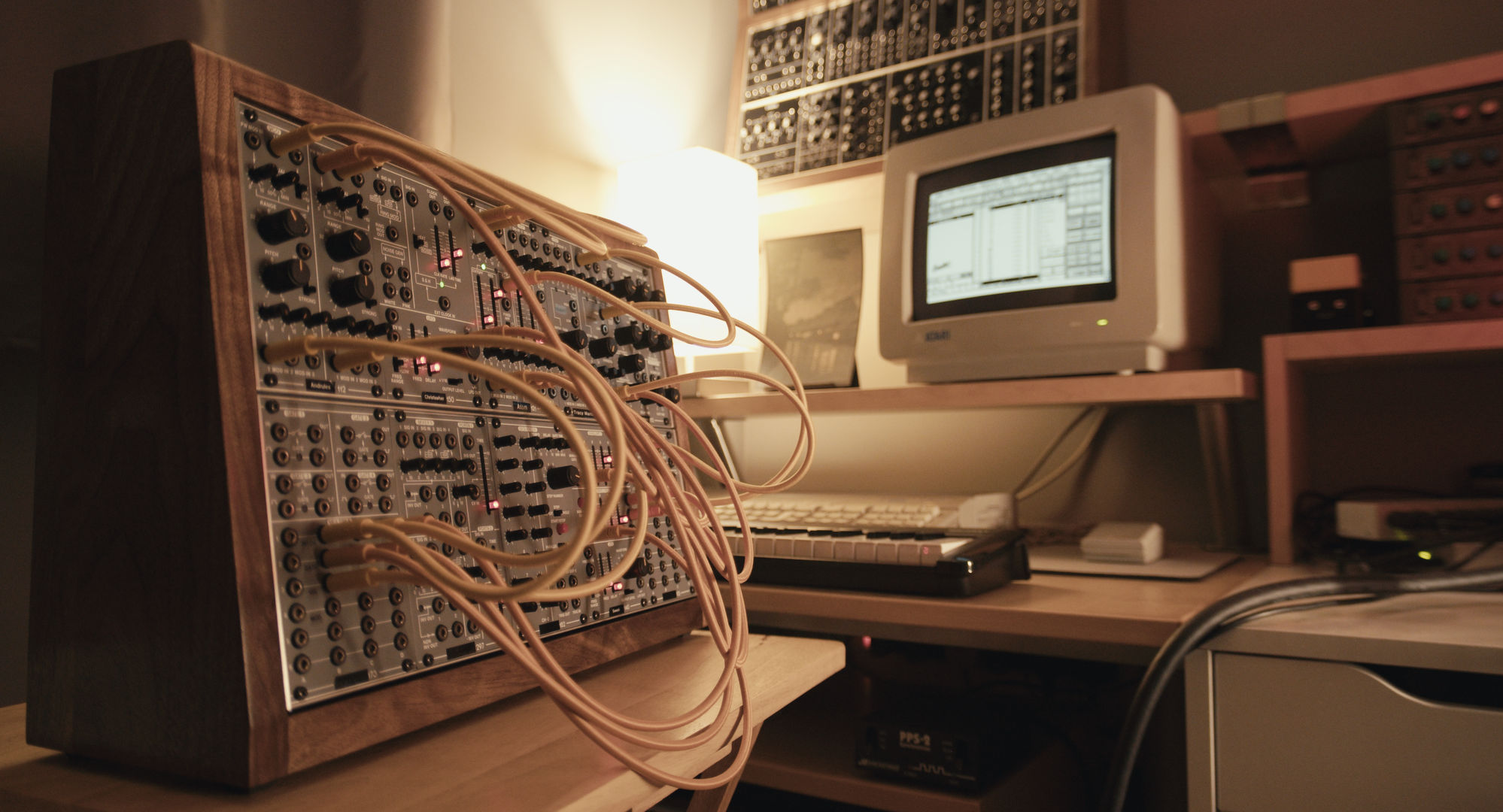
In 2020, Behringer announced a series of Eurorack format modular synthesizer modules based on the original Roland System-100M modules:
- 110 VCO/VCF/VCA
- 112 Dual VCO
- 121 Dual VCF
- 130 Dual VCA
- 140 Dual Envelope/LFO
- 150 Ring Mod/Noise/S&H/LFO
- 172 Phase Shifter/Delay/LFO
- 173 Quad Gate/Multiples
- 182 Sequencer
- 297 Dual Portamento/CV Utilities (combination of 132 Dual CV / Audio Mixers & Voltage Processors & 165 Dual Portamento Controller)
- 305 EQ/Mixer/Output (combination of 131 Output Mixer / Tuning Oscillator / Headphone Amp & 174 Parametric EQ)
Notable users
- Aphex Twin
- Ian Boddy
- Vince Clarke
- The Human League
- Landscape
- Meat Beat Manifesto
- Public Image Ltd
- Throbbing Gristle
References
References
- Murphy, Scott. (February 2003). "Nick Launay Interview".
- [http://boingboing.net/2010/07/02/industrial-music-pio.html Industrial music pioneer Chris Carter with gear, 1980], [[Boing Boing]]
- (March 2003). "The A-Z of Analogue Synthesisers, Part Two: N-Z, Revised and Expanded". Susurreal.
- Carter, Chris. (April 1995). "Roland System 100M".
- Gilby, Paul. (Dec 1986). "Ian Boddy: Phoenix".
- Boddy, Ian. (Mar 1984). "Roland System 100M". Music Maker Publications (UK), Future Publishing..
- Beecher, Mike. (Nov 1981). "Landscape Explored". Music Maker Publications (UK), Future Publishing..
- Ward, Phil. (May 1993). "Message In A Sample". Music Maker Publications (UK), Future Publishing..
- Reid, Gordon. (December 2004). "The History Of Roland: Part 2: 1979-1985".
- Robinson, Dave. (Apr 1993). "The Aphex Effect".
- [https://www.musicradar.com/news/namm-2020-behringer-brings-back-rolands-system-100m-modular-synth-in-eurorack-format musicradar.com]
- [https://www.gearnews.com/m185-sequencer-for-system-100m-format/ gearnews.com ]
This article was imported from Wikipedia and is available under the Creative Commons Attribution-ShareAlike 4.0 License. Content has been adapted to SurfDoc format. Original contributors can be found on the article history page.
Ask Mako anything about Roland System-100M — get instant answers, deeper analysis, and related topics.
Research with MakoFree with your Surf account
Create a free account to save articles, ask Mako questions, and organize your research.
Sign up freeThis content may have been generated or modified by AI. CloudSurf Software LLC is not responsible for the accuracy, completeness, or reliability of AI-generated content. Always verify important information from primary sources.
Report