From Surf Wiki (app.surf) — the open knowledge base
Roland Sound Canvas
PCM sound module and sound card series
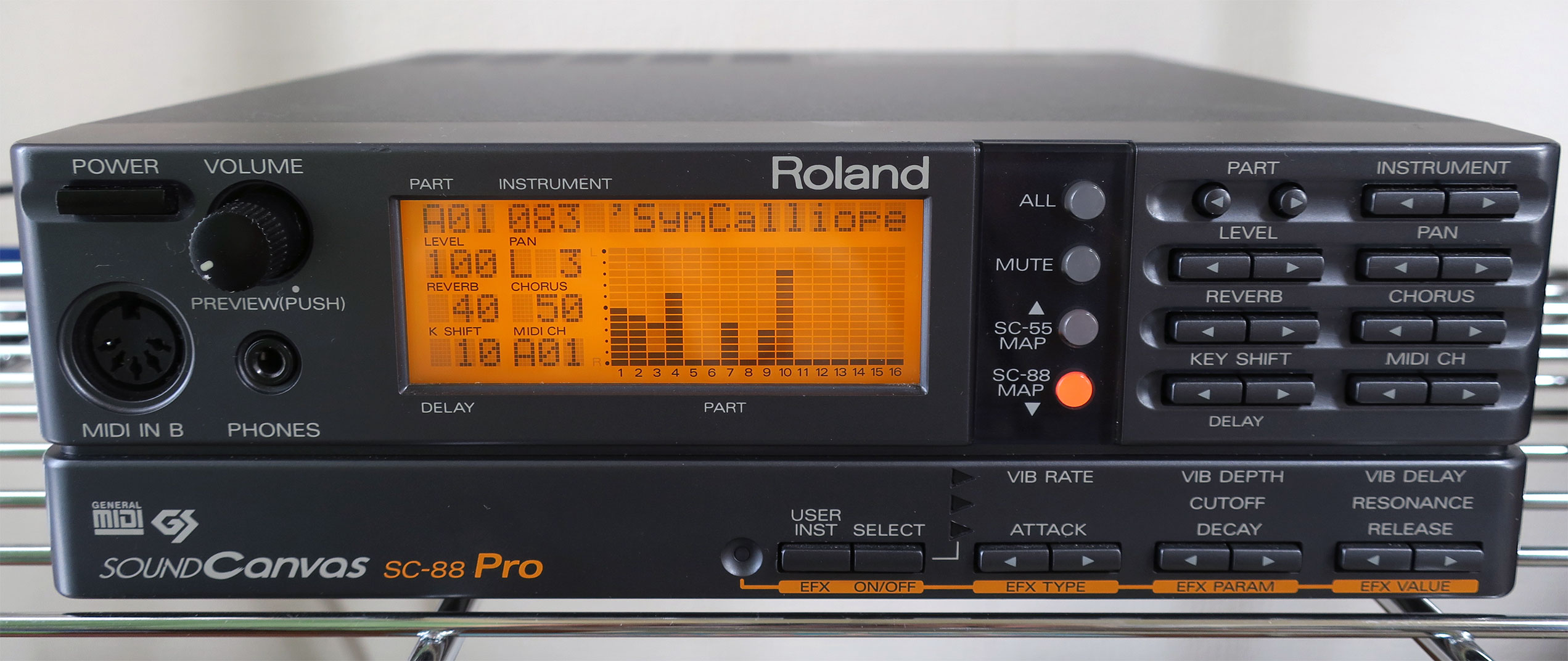
PCM sound module and sound card series
The Roland Sound Canvas lineup is a series of General MIDI (GM) based pulse-code modulation (PCM) sound modules and sound cards, primarily intended for computer music usage, created by Japanese manufacturer Roland Corporation. Some models include a serial or USB connection to a personal computer.
Products
Sound Canvas
The first Sound Canvas units (SC-55 and SB-55) were sold in the winter of 1991, in some cases also sold as "Edirol" rather than "Roland" as the brand name, mainly with the SC-88VL.
| Model | Year | Standards | Parts | Voices | Tones | Drumsets | Output resolution | Notes | References | |||||
|---|---|---|---|---|---|---|---|---|---|---|---|---|---|---|
| Roland SC-55 | 1991 | GM GS | 16 | 24 | 317 | 9 | 16-bit @ 32 kHz | Half Rack unit, first product of the line, units without GM logo and with firmware | ||||||
| Roland SB-55 | 1991 | Half Rack unit. Floppy disk-based MIDI file player that was bundled with a remote control (Also works on the SC-55, 155, and 55mkII). Supports SMF types 0 & 1. A blank disk can be inserted for recording purposes, but only records in type 0 (A whole performance merged into one track). Playback starts automatically when a disk is inserted. | ||||||||||||
| Roland SC-7 | 1992 | GM | 16 | 28 | 128 | 6 | 16-bit @ 32 kHz | No display, introduced serial port for PC/Mac connectivity. | cgw199310}} | |||||
| Roland SC-33 | 1992 | GM GS | 16 | 28 | 226 | 8 | 16-bit @ 32 kHz | Table top version of SC-50, rebranded as BOSS Dr. Synth DS-330 (fewer tones). | ||||||
| Roland SC-155 | 1992 | GM GS | 16 | 24 | 317 | 9 | 16-bit @ 32 kHz | Table top version of SC-55. | ||||||
| Roland SC-55mkII | 1993 | GM GS | 16 | 28 | 354 | 9 | 18-bit @ 32 kHz | Half Rack unit. A minor upgrade to the original SC-55. ALL of them uses the very same DAC from NEC model µPD63200GS, the ONLY change is the BIT parameter, it can be 16-bit or 18-bit, selected by pin 3 on NEC. Configuration as follow: LOW/OPEN for 16-bit, or HIGH (+5V) for 18-bit. | ||||||
| Roland SC-55ST | 1993 | GM GS | 16 | 28 | 354 | 9 | 16-bit @ 32 kHz | Half Rack unit. Lower cost version of SC-55mkII. No display and only one MIDI input. | url=http://xv2020.s14.xrea.com/ | title=Roland GS History | website=xv2020.s14.xrea.com}} | |||
| Roland SC-55K | 1993 | GM GS | 16 | 28 | 354 | 9 | 16-bit @ 32 kHz | Half Rack unit. Japan-exclusive karaoke model based on the SC-55ST. No display or front panel operation but features dual mic inputs and built-in echo effects, all of which can be individually adjusted by the knobs at the front of the unit. Retains rear I/O from the SC-55mkII. | ||||||
| Roland P-55 | 1993 | 3 | 28 | 32 | 0 | Piano module, with a limited set of instruments. Can be used in tandem with other GS/GM compatible synthesizers via their MIDI THRU ports to override certain instruments. | ||||||||
| Roland SD-35 | 1993 | GM GS | 16 | 28 | 223 | 8 | 16-bit @ 32 kHz | SC-50 with integrated MIDI sequencer. | ||||||
| Roland SC-50 | 1994 | GM GS | 16 | 28 | 226 | 9 | 18-bit @ 32 kHz | SC-55mkII without the Roland MT-32 patches, only one MIDI input. | ||||||
| Roland SC-88 | 1994 | GM GS | 32 | 64 | 654 | 22 | 18-bit @ 32 kHz | Half Rack unit, additional height for more controls, introduced multiple triggering and EQ, SC-55 map support (with differences). | ||||||
| Roland M-GS64 | 1995 | GM GS | 32 | 64 | 654 | 22 | 18-bit @ 32 kHz | A 1U rackmount version of the SC-88. | url=http://www1.hellasnet.gr/amidi/mgs64.htm | title=M-GS64 details DEAD LINK | access-date=14 December 2023 | archive-date=8 May 2008 | archive-url=https://web.archive.org/web/20080508091040/http://www1.hellasnet.gr/amidi/mgs64.htm | url-status=dead}} |
| Roland SC-88VL | 1996 | GM GS | 32 | 64 | 654 | 22 | 18-bit @ 32 kHz | Smaller sized version of SC-88, with a same size and panel layout as the SC-55. Some units are marketed as an "Edirol" product and have a distinct beige finish. | ||||||
| Roland SC-88ST | 1996 | GM GS | 32 | 64 | 654 | 22 | 18-bit @ 32 kHz | A black plastic box, with LEDs for MIDI activity. 2 MIDI ins, 1 out. There is one single button on the front panel for switching between SC-55 and SC-88 modes. | ||||||
| Roland SC-88 Pro | 1996 | GM GS | 32 | 64 | 1117 | 42 | 18-bit @ 32 kHz | SC-55 and SC-88 map support, introduced Insertion EFX and unofficial XG compatibility. | url=https://www.dtmstation.com/archives/51886276.html | title=1996年、Roland GS音源の最高峰として登場したSC-88Pro|藤本健の "DTMステーション" | date=February 1, 2014 | website=藤本健の “DTMステーション”}} | ||
| Roland SC-88ST Pro | 1997 | GM GS | 32 | 64 | 1117 | 42 | 18-bit @ 32 kHz | A black plastic box, with LEDs for MIDI activity. 2 MIDI ins, 1 out. There is one single button on the front panel for SC-55/SC-88/SC-88 Pro modes. | ||||||
| Roland SC-880 | 1998 | GM GS | 32 | 64 | 1117 | 42 | 18-bit @ 32 kHz | A 1U rackmount unit similar to the SC-88 Pro, but with an enhanced "patch mode" and a newer DAC. | url=https://www.soundonsound.com/music-business/history-of-roland-part5 | title=The History Of Roland: Part 5 | website=www.soundonsound.com}} | |||
| Roland ED SC-8850 | 1999 | GM GS GM2 | 64 | 128 | 1640 | 63 | 20-bit @ 32 kHz | Desktop module that can connect via USB. Contains a new native map as well as SC-55, SC-88, and SC-88 Pro maps for backwards compatibility. However, compatibility with these units is flawed due to modifications made to the synthesis engine as well as improper mapping of older instruments. | ||||||
| Roland ED SC-8820 | 1999 | GM GS GM2 | 32 | 64 | 1608 | 63 | 20-bit @ 32 kHz | Mobile MIDI device with no LCD display, successor of the SC-88ST Pro. USB-powered, but does not act as a full USB audio device. A software editor such as GS Advanced Editor is required to edit sounds. Despite similarities, patches and effects occasionally play differently from the 8850 - some samples on the 8850 are stereo while the 8820 versions are mono and vice versa. | ||||||
| Roland ED SC-D70 | 2001 | GM GS GM2 | 32 | 64 | 1608 | 63 | 20-bit @ 32 kHz for INST, 24-bit @ 44.1 kHz or 48 kHz for WAVE | Digital audio-oriented desktop module version of the SC-8820. Contains A/D inputs as well as USB audio functionality when connected to a host system. This is also the only Sound Canvas module to have digital audio ports built in. The output can be selected either 44.1 kHz or 48 kHz. |
Sound Canvas Personal Computer Products
| Model | Year | Standards | Parts | Voices | Tones | Drumsets | Output resolution | Notes | References | ||
|---|---|---|---|---|---|---|---|---|---|---|---|
| Roland SCC-1 | 1992 | GM GS | 16 | 24 | 317 / 354 | 9 | 16-bit @ 32 kHz | PC based ISA card (8-bit). The SCC-1A and SCC-1B (different software packed with card) revision upgraded the board to 354 tones. First model technically not GM compatible (GM reset interpreted as GS reset). | url=https://www.crossfire-designs.de/index.php?lang=en&what=articles&name=showarticle.htm&article=soundcards&page=10 | title=Crossfire Designs | website=www.crossfire-designs.de}} |
| Roland RAP-10 | 1993 | GM | 16 | 26 | 128 | 6 | 16-bit @ 32 kHz | PC based ISA high-end Soundcard. Includes two-channel 16-bit digital audio support. | |||
| Roland GPPC-N | 1993 | GM GS | 16 | 28 | 354 | 9 | 16-bit @ 32 kHz | NEC PC-9801 card to insert in computer | |||
| Roland SCB-7 | 1995 | GM | 16 | 28 | 128 | 6 | 16-bit @ 32 kHz | Daughter board to attach to a Soundcard Waveblaster port. Also sold as SCD-10 and SCM-10 in bundle with MPU-401/AT. | |||
| Roland SCB-55 | 1995 | GM GS | 16 | 28 | 354 | 9 | 18-bit @ 32 kHz | Daughter board to attach to a Soundcard Waveblaster port. Also sold as SCD-15 and SCM-15 in bundle with MPU-401/AT. Internally 18-bit resolution, will be limited to 16-bit because of daughterboard connector, unless a hardware modification is performed (L/R external connectors or as an external unit). The SCD-15 was installed in Charlie Lab Megabeat One MIDI devices as well. Charlie Lab was very popular in southern Europe back in the 1990s/2000s. | |||
| Roland SCP-55 | 1995 | GM GS | 16 | 28 | 354 | 9 | 18-bit @ 32 kHz | PCMCIA card to insert in notebook/laptop computer |
Computer Music Products
| Model | Year | Standards | Parts | Voices | Tones | Drumsets | Output resolution | Notes |
|---|---|---|---|---|---|---|---|---|
| Roland CM-300 | 1991 | GM GS | 16 | 24 | 317 | 9 | 16-bit @ 32 kHz | "Computer music" version of the SC-55, no screen. A beige box with a volume knob and two LEDs on the front, technically not GM compatible (GM reset interpreted as GS reset). |
| Roland CM-500 | 1991 | GM GS MT-32 | 16 | 24 | 317 | 9 | 16-bit @ 32 kHz | A beige box with a volume knob and two LEDs on the front, technically not GM compatible (GM reset interpreted as GS reset), combines the CM-300 with a CM-64. |
Sound Canvas and Keyboard
The following combine a sound canvas module with a built in MIDI keyboard
| Model | Year | Standards | Parts | Voices | Tones | Drumsets | Output resolution | Notes | References | ||
|---|---|---|---|---|---|---|---|---|---|---|---|
| Roland SK-50 | 1994 | GM GS | 16 | 28 | 226 | 8 | 16-bit @ 32 kHz | SC-50 with 61 key MIDI keyboard. Only SK unit with integrated speakers. | |||
| Roland SK-50 IV | 1997 | GM GS | 16 | 28 | 226 | 8 | 16-bit @ 32 kHz | Similar to above, but in a beige finish. | |||
| Roland SK-88 Pro | 1999 | GM GS | 32 | 64 | 1117 | 42 | 18-bit @ 32 kHz | SC-88Pro with 37 key MIDI keyboard | |||
| Roland SK-500 | 2000 | GM GS GM2 | 32 | 64 | 1608 | 63 | 24-bit @ 32 kHz | SC-8820 with 49 Key MIDI keyboard | url=http://www.synthman.com/roland/134960.html | title=Roland | website=www.synthman.com}} |
Studio Canvas
Studio Canvas was a series of PCM sound modules with built in audio interfaces (some models only) sold under both Edirol and Roland branding. The samples contained in the ROMs of these units do not in all cases mirror the original SC-7 / SC-55 GM/GS samples. GM2 is downward compatible with GM.
| Model | Year | Standards | Parts | Voices | Tones | Drumsets | Output resolution | Notes | References |
|---|---|---|---|---|---|---|---|---|---|
| Edirol SD-20 | 2002 | GM2 GS XGlite | 32 | 64 | 660 | 23 | 24-bit @ 44.1 kHz | A MIDI device with no LCD designed for laptops and computers, and has a very similar design to the SC-8820. USB-powered, but does not come with its own built-in audio interface. Has 3 analog output (2 RCA L/R) (1 3.5mm phones front pannel), one digital output (TOSLINK), and one input (1 3.5mm LINE IN) Has different presets than SD-80/90/50 | |
| Edirol SD-80 | 2002 | GM2 GS XGlite | 32 | 128 | 1050 | 30 | 24-bit @ 44.1 kHz | A 1U half-rack version of the Edirol SD-90 with 144 user patch slots (128Inst/16Rhythm) and without a built-in audio interface. Has five analog outputs (4 ¼"TS) (1 ¼"phones front pannel) and two digital outputs (1 S/PDIF) (1 TOSLINK). Digital outs locked at 44.1KHz sample rate. | |
| Edirol SD-90 | 2001 | GM2 GS XGlite | 32 | 128 | 1050 | 30 | 24-bit @ 44.1 or 48 kHz | Has a built in WDM/ASIO 2.0 compatible audio interface with inbuilt effects. Does not support saving of user patches. Has five analog outputs (4 RCA L/R) (1 3.5mm stereo front pannel), three analog inputs (2 RCA L/R) (¼"TRS front pannel), three digital outputs (1 S/PDIF) (1 TOSLINK) (1 USB), and three digital inputs (1 S/PDIF) (1 TOSLINK) (1 USB) | |
| Roland SD-50 | 2009 | GM2 GS | 16 | 128 | 1125 | 32 | 16 or 24-bit @ 44.1 kHz | Mobile Studio Canvas. Has a built in WDM/ASIO compatible audio interface. Has three analog outputs (2 RCA L/R)(1 3.5mm Stereo), one digital (USB), three analog inputs (1 stereo 3.5mm LINE IN) (1 XLR 48V available) (1 ¼"TRS Hi-Z available), one digital (USB). Has different presets than SD-20/80/90. Does not support XGlite. |
Virtual Sound Canvas

There is also the VSC, Virtual Sound Canvas, range of PC software which provide GM and GS synthesis on Windows PCs. Many versions of Cakewalk's Sonar software came bundled with a copy of VSC, though from Sonar 4 onwards they ship with the improved TTS-1 softsynth, which Roland has sold previously through its Edirol subsidiary as the HyperCanvas.
| Model | Year | Standards | Parts | Voices | Tones | Drumsets | Notes | References |
|---|---|---|---|---|---|---|---|---|
| VSC-55 | 1996 | GM GS | 16 | 128 | 226 | 9 | ||
| VSC-88H3 | 2000 | GM GS GM2 | 16 | 128 | 902 | 26 | With SC-55, SC-88 and SC-88 Pro compatible instrument mappings. Most of the instrument samples are from the SC-55. | |
| VSC-MP1 | 2001 | GM GS GM2 | 16 | 128 | 902 | 26 | With SC-55, SC-88 and SC-88 Pro compatible instrument mappings. Most of the instrument samples are from the SC-55. A multipack containing the standalone MIDI synthesizer, a DXi plugin and a VSTi plugin. This is the only Windows NT OS family compatible version (Windows 2000/XP). | |
| SOUND Canvas for iOS | 2015 | GM GS GM2 | 16 | 1600 | 63 | iOS MIDI player app without patch editing. | ||
| Sound Canvas VA | 2015 | GM GS GM2 | 16 | 64 | 1600 | 63 | VSTi/AU plugin based on the SC-8820. Discontinued on September 1, 2024. |
Microsoft GS Wavetable SW Synth
Microsoft GS Wavetable SW Synth, included in instances of DirectX as an integral part of DirectMusic, and on Microsoft Windows since Windows 98, incorporates sounds from the Sound Canvas series licensed by Microsoft from Roland in 1996. A four-megabyte file, titled "GM.DLS", contains the sample set in DLS format. Under Windows 9x, Microsoft GS Wavetable SW Synth is available only if WDM-capable sound driver is installed.
Apple QuickTime Software Wavetable Synthesizer
In 1997, Apple licensed the complete Roland Sound Canvas instrument set and GS Format extensions for improved playback of MIDI music files in QuickTime 3.0. This replaced the limited set of instrument sounds licensed from Roland in QuickTime 2.x.
Discontinuation of Sound Canvas VA
In July 2024 Roland announced that it would not longer be supporting the Sound Canvas VA software from the Roland Cloud service. The Software would no longer be freely available starting September 1, of 2024.
Distribution
North America
- Roland Systems Group U.S.
Europe
- EDIROL Europe Ltd., London, UK
References
References
- 藤本健. (2021-07-18). "GM登場前の1991年3月にリリースされたRoland初のGS音源、Sound Canvas SC-55|藤本健の"DTMステーション"".
- "Roland SC-55 Sound Canvas Module".
- "Roland SB-55 Technical Specifications".
- [[Sound on Sound]] - [http://www.soundonsound.com/sos/feb05/articles/roland.htm?print=yes The History of Roland Part 4]
- "Roland GS History".
- "Roland SD-35 MIDI Player".
- [http://www.soundonsound.com/sos/1994_articles/may94/rolandsc50.html Sound on Sound - Review of SC-50]
- [http://www.soundonsound.com/sos/1994_articles/sep94/rolandsc88.html Sound on Sound - Review of SC-88]
- "M-GS64 details DEAD LINK".
- "Toslink mod for somes SCs".
- "Roland SC-88vl Sound Canvas Edirol {{!}} Reverb".
- [http://www.soundonsound.com/sos/1997_articles/mar97/rolandsc88.html Sound on Sound - Review of SC-88 Pro]
- (February 1, 2014). "1996年、Roland GS音源の最高峰として登場したSC-88Pro|藤本健の "DTMステーション"".
- [http://www.soundonsound.com/sos/sep98/articles/roland_sc880.html?print=yes Sound on Sound - Review of SC-880]
- "The History Of Roland: Part 5".
- [http://www.soundonsound.com/sos/oct99/articles/rolandsc8850.htm Sound on Sound - Review of SC-8850]
- (18 November 2018). "Roland ED SC-8850: The First USB Synth! - Sound Profile".
- "SC-D70 Owner's Manual".
- "Crossfire Designs".
- (October 1993). "CGW Sound Card Survey".
- [http://www.soundonsound.com/sos/apr99/articles/rolandsk88.htm?print=yes Sound on Sound - Review of SK-88 Pro]
- "Roland".
- [https://static.roland.com/assets/media/pdf/SD-20_OM.pdf Edirol Studio Canvas SD-20 Owner's Manual] roland.com
- [https://static.roland.com/assets/media/pdf/SD-80_OM.pdf Edirol Studio Canvas SD-80 Owner's Manual] roland.com
- [https://static.roland.com/assets/media/pdf/SD-90_OM.pdf Edirol Studio Canvas SD-90 Owner's Manual] roland.com
- [https://static.roland.com/assets/media/pdf/SD-50_OM.pdf Roland Mobile Studio Canvas SD-50 Owner's Manual] roland.com
- "Exploring Sonar 4's TTS1 Synth".
- [http://www.roland.com/products/en/VSC-88H3/ Roland - VSC-88H3 details]
- [http://www.roland.com/products/en/VSC-MP1/index.html Roland - VSC-MP1 details]
- [https://web.archive.org/web/20150721052823/https://itunes.apple.com/en/app/sound-canvas-for-ios/id952549036?mt=8 Sound canvas for IOS] iTunes
- "Roland - Sound Canvas VA | Software Synthesizer".
- "Sound Canvas Va".
- (22 October 1996). "Microsoft Licenses Sound Canvas Sounds From Industry Leader Roland Corp". Microsoft Corp.
- (21 December 1997). "Apple Licenses Roland's Sound Canvas and GS Technology for Quicktime 3.0". Harmony Central.
- "Sound Canvas VA is being discontinued".
This article was imported from Wikipedia and is available under the Creative Commons Attribution-ShareAlike 4.0 License. Content has been adapted to SurfDoc format. Original contributors can be found on the article history page.
Ask Mako anything about Roland Sound Canvas — get instant answers, deeper analysis, and related topics.
Research with MakoFree with your Surf account
Create a free account to save articles, ask Mako questions, and organize your research.
Sign up freeThis content may have been generated or modified by AI. CloudSurf Software LLC is not responsible for the accuracy, completeness, or reliability of AI-generated content. Always verify important information from primary sources.
Report