From Surf Wiki (app.surf) — the open knowledge base
Rodelinda (opera)
1725 opera by Handel

1725 opera by Handel
Rodelinda, regina de' Longobardi (HWV 19) is an opera seria in three acts composed for the first Royal Academy of Music by George Frideric Handel. The libretto is by Nicola Francesco Haym, based on an earlier libretto by Antonio Salvi. Rodelinda has long been regarded as one of Handel's greatest works.
Performance history
Rodelinda was first performed at the King’s Theatre in the Haymarket, London, on 13 February 1725. It was produced with the same singers as Tamerlano. There were 14 performances; it was repeated on 18 December 1725, and again on 4 May 1731, a further 16 performances in all, each revival including changes and fresh material. A further notable London revival by the Handel Opera Society, in English and using a cut text, including both Joan Sutherland and Janet Baker in the cast, conducted by Charles Farncombe, was performed in June 1959. Among other performances, Rodelinda was staged at the Glyndebourne Festival in the UK in 1998, by the Metropolitan Opera in New York in 2004 and by English National Opera in 2014. The ENO production was revived at the Bolshoi Theatre in 2015. The Gran Teatre del Liceu, Barcelona, performed the opera in March 2019, with Lisette Oropesa and Bejun Mehta in the leading roles. The Dutch National Opera staged Rodelinda in January 2020, with Lucy Crowe and Bejun Mehta in the leading roles.
Roles
| title=G. F. Handel's Compositions | url=http://gfhandel.org/handel/worklist/1to42.html | website=GF Handel.org | publisher=Handel Institute | access-date=28 December 2016}} | Voice type | Premiere cast, 13 February 1725 |
|---|---|---|---|---|---|---|
| Rodelinda, Queen of Lombardy | soprano | Francesca Cuzzoni | ||||
| Bertarido, usurped King of Lombardy | alto castrato | Francesco Bernardi, called "Senesino" | ||||
| Grimoaldo, Duke of Benevento, Bertarido's usurper | tenor | Francesco Borosini | ||||
| Eduige, Bertarido's sister, betrothed to Grimoaldo | contralto | Anna Vincenza Dotti | ||||
| Unulfo, Bertarido's friend and counsellor | alto castrato | Andrea Pacini | ||||
| Garibaldo, Grimoaldo's counsellor, duke of Turin | bass | Giuseppe Maria Boschi | ||||
| Flavio, Rodelinda's son | silent |
Synopsis
The argument
Prior to the opening of the opera, Grimoaldo has defeated Bertarido, King of Lombardy, in battle and has usurped the throne of Milan. Bertarido has fled, leaving his wife Rodelinda and his son Flavio prisoners of the usurper. Failing to secure support to recover his crown, Bertarido has caused it to be reported that he has died in exile, a ruse to be used in an attempt to rescue his wife and son.
Act 1
Rodelinda's apartments

Alone in the palace, Rodelinda mourns the loss of her husband Bertarido. The usurper Grimoaldo enters, declaring a long-hidden passion for her. He proposes marriage and offers her back the throne that is rightfully hers. She angrily rejects him (Aria: "L'empio rigor del fato"). Eduige arrives looking for Grimoaldo. Grimoaldo, having previously been betrothed to Bertarido's sister Eduige, now spurns her. After Grimoaldo leaves, the scheming Garibaldo, his counsellor, professes love for Eduige. She promises to return his love once she has had revenge on Grimoaldo (Aria: "Lo farò, diro: spietato"). Alone, Garibaldo reveals that his love for Eduige is feigned, and is part of a plan to gain the throne for himself (Aria: "Di cupido impiego i vanni").
A cypress-grove
Bertarido, in hiding nearby, reads the inscription on his own memorial and longs for his beloved wife Rodelinda (Aria: "Dove sei, amato bene?"). Along with his friend and counsellor Unulfo, he secretly watches as a weeping Rodelinda and Flavio, her son, lay flowers at his memorial. Garibaldo enters with an ultimatum for Rodelinda: either she agrees to marry Grimoaldo, or her son will be put to death. Rodelinda consents but also vows to demand Garibaldo's death when she returns to the throne. Bertarido, still watching, is aghast and takes Rodelinda's decision as an act of betrayal.
Act 2
A great hall
Garibaldo taunts Eduige, telling her that she has missed her chance to become queen. Eduige satirically congratulates Rodelinda, noting her sudden decision to betray her husband's memory and marry his usurper. Eduige vows vengeance on Grimoaldo. Eduige departs and Grimoaldo enters. Rodelinda sets out her terms for marrying Grimoaldo: he must in her sight kill Flavio with his own hands. Grimoaldo, horrified, refuses. After Rodelinda leaves, Garibaldo encourages Grimoaldo to carry out the murder, but he again refuses. He says that Rodelinda's act of courage and determination has made him love her all the more, though he has now lost hope of winning her. When the two advisors are alone, Unulfo asks Garibaldo how he could give a king such advice, and Garibaldo expounds his tyrannical perspective on the use of power (Aria: "Tirannia gliel diede il regno").
A delightful prospect
Bertarido approaches the palace grounds in disguise; his sister Eduige recognizes his voice. Unulfo brings word of Rodelinda's fidelity, and Eduige agrees to help Bertarido rescue his wife and son. Unulfo promises to pass a message to Rodelinda that her husband is still alive. Bertarido rejoices.
A gallery in Rodelinda's apartment
Rodelinda and Bertarido meet in secret, and are discovered in an embrace by Grimoaldo who fails to recognise her husband. Grimoaldo is outraged, believing that Rodelinda has taken a lover. To save her honour, Bertarido reveals his identity but Grimoaldo vows to kill him anyway, whoever he may be. The spouses bid each other a last farewell (Duet: "Io t'abbraccio").
Act 3
A gallery

A very dark prison
Languishing in prison, Bertarido receives the sword, the key, and a written note. When Unulfo comes to release him, Bertarido mistakes the visitor in the darkness for the executioner and wounds him with the sword. Unulfo shrugs the injury off, and the two leave. Eduige guides Rodelinda into the cell. Finding it empty, and seeing blood on the floor, they fear that Bertarido is dead.
A royal garden
Grimoaldo is tormented by remorse and flees to the palace garden, hoping to find a peaceful spot where he can seek solace in sleep (Aria: "Pastorello d'un povero armento"). Garibaldo, finding him unprotected, decides to kill him. Bertarido appears and kills the intended assassin, though sparing Grimoaldo (Aria: "Vivi, tiranno!"). Grimoaldo renounces his claim to the throne of Milan, and pledges himself once again to Eduige. He offers the throne back to Bertarido who accepts it once he is assured that his wife and son will be returned to him. There is general rejoicing.
Sources
The opera's libretto is by Nicola Francesco Haym, and was based on an earlier libretto by Antonio Salvi that had been set by Giacomo Antonio Perti in 1710. Salvi's libretto was derived from Pierre Corneille's tragedy Pertharite, roi des Lombards (1652), which dealt with the history of Perctarit, king of the Lombards. The ultimate origin of the story, as of Handel's Flavio, is Paul the Deacon's eighth-century work* Gesta Langobardorum*. In the opera, 'Pertharite' becomes 'Bertarido'.
Context and analysis
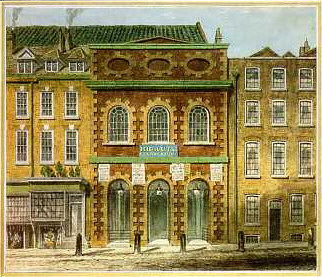
The German-born Handel, after spending some of his early career composing operas and other pieces in Italy, settled in London, where in 1711 he had brought Italian opera for the first time with his opera Rinaldo. A tremendous success, Rinaldo created a craze in London for Italian opera seria, a form focused overwhelmingly on solo arias for the star virtuoso singers. In 1719, Handel was appointed music director of an organisation called the Royal Academy of Music (unconnected with the present-day London conservatoire), a company under royal charter to produce Italian operas in London. Handel was not only to compose operas for the company but hire the star singers, supervise the orchestra and musicians, and adapt operas from Italy for London performance.
Within a year, 1724–1725, Handel wrote three great operas in succession for the Royal Academy of Music, each with Senesino and Francesca Cuzzoni as the stars, the other two being Giulio Cesare and Tamerlano.
Horace Walpole wrote of Cuzzoni in Rodelinda:She was short and squat, with a doughy cross face, but fine complexion; was not a good actress; dressed ill; and was silly and fantastical. And yet on her appearing in this opera, in a brown silk gown trimmed with silver, with the vulgarity and indecorum of which all the old ladies were much scandalised, the young adopted it as a fashion, so universally, that it seemed a national uniform for youth and beauty.
To 18th century musicologist Charles Burney, Rodelinda "contains such a number of capital and pleasing airs, as entitles it to one of the first places among Handel's dramatic productions". Burney notes particularly the aria for Bertarido in act 1, "Dove sei, amato bene", calling it "one of the finest pathetic airs that can be found in all his works... This air is rendered affecting by new and curious modulation, as well as by the general cast of the melody." This aria is also sometimes sung as a solo piece in English, to an unrelated text – "Art thou troubled?" – by W. G. Rothery, written in 1910.
Instrumentation
The opera is scored for two recorders, flute, two oboes, bassoon, two horns, strings and continuo (cello, lute, harpsichord).
Recordings
Audio recordings
| Year | Cast: |
|---|---|
| Rodelinda, Bertarido, | |
| Grimoaldo, Eduige, | |
| Unulfo, Garibaldo | Conductor, |
| orchestra | Label |
| 1959, live in London | Joan Sutherland, |
| Margreta Elkins, | |
| Alfred Hallett, | |
| Janet Baker, | |
| Patricia Kern, | |
| Raimund Herincx | Charles Farncombe, |
| Philomusica Orchestra | CD:Andromeda |
| Cat:ANDRCD9075 | |
| 1964, studio recording | Teresa Stich-Randall, |
| Maureen Forrester, | |
| Alexander Young, | |
| Hilde Rössel-Majdan, | |
| Helen Watts, | |
| John Boyden | Brian Priestman, |
| Vienna Radio Orchestra | CD:The Westminster Legacy |
| Cat:DG 4792343 | |
| 1985, April 25-30 and May 3-4, | |
| studio recording at St Barnabas’ Church, | |
| North Finchley, London | Joan Sutherland, |
| Alicia Nafé, | |
| Curtis Rayam, | |
| Isobel Buchanan, | |
| Huguette Tourangeau, | |
| Samuel Ramey | Richard Bonynge |
| Welsh National Opera Orchestra | CD:Decca (originally); |
| later Australian Eloquence | |
| Cat: ELQ4806105 | |
| 1990, June 3-4, live in Frankfurt | Barbara Schlick, |
| David Cordier, | |
| Christoph Prégardien, | |
| Claudia Schubert, | |
| Kai Wessel, | |
| Gotthold Schwarz | Michael Schneider |
| La Stagione Frankfurt | CD:Deutsche Harmonia Mundi |
| Cat: 05472-77182-2 | |
| 1996 | Sophie Daneman, |
| Daniel Taylor, | |
| Adrian Thompson, | |
| Catherine Robbin, | |
| Robin Blaze, | |
| Christopher Purves | Nicholas Kraemer |
| Raglan Baroque Players | CD:Virgin Classics Veritas |
| Cat: 45277 | |
| 2004, studio recording | Simone Kermes, |
| Marijana Mijanović, | |
| Steve Davislim, | |
| Sonia Prina, | |
| Marie-Nicole Lemieux, | |
| Vito Priante | Alan Curtis |
| Il Complesso Barocco | CD:DG Archiv |
| Cat:4775391 | |
| 2013, live in Martina Franca | Sonia Ganassi, |
| Franco Fagioli, | |
| Paolo Fanale, | |
| Marina De Liso, | |
| Antonio Giovannini, | |
| Gezim Myshketa | Diego Fasolis |
| Orchestra Internazionale d'Italia | CD:Dynamic |
| Cat:CDS7724 | |
| 2021, Sept. 16-21, studio recording | |
| at the Church of St John the Evangelist, | |
| Smith Square, London | Lucy Crowe, |
| Iestyn Davies, | |
| Joshua Ellicott, | |
| Brandon Cedel, | |
| Jess Dandy, | |
| Tim Mead | Harry Bicket |
| The English Concert | CD:Linn Records |
| Cat:CKD658 |
Video recordings
| Year | Cast: | ||
|---|---|---|---|
| Rodelinda, Bertarido, | |||
| Grimoaldo, Eduige, | |||
| Unulfo, Garibaldo | Conductor, | ||
| orchestra | Stage director | Label | |
| 1998, Glyndebourne | Anna Caterina Antonacci, | ||
| Andreas Scholl, | |||
| Kurt Streit, | |||
| Louise Winter, | |||
| Artur Stefanowicz. | |||
| Umberto Chiummo | William Christie | ||
| Orchestra of the Age of Enlightenment | Jean-Marie Villégier | DVD:Warner Classics | |
| Cat:3984230242 | |||
| 2003, Munich | Dorothea Röschmann, | ||
| Michael Chance, | |||
| Paul Nilon, | |||
| Felicity Palmer, | |||
| Christopher Robson, | |||
| Umberto Chiummo | Ivor Bolton | ||
| Bavarian State Opera Orchestra | David Alden | DVD:Farao | |
| Cat:D108060 | |||
| 2011, Dec. 3, New York | Renée Fleming, | ||
| Andreas Scholl, | |||
| Joseph Kaiser, | |||
| Stephanie Blythe, | |||
| Iestyn Davies, | |||
| Shenyang | Harry Bicket | ||
| Metropolitan Opera Orchestra | Stephen Wadsworth | DVD:Decca | |
| Cat:0743469 | |||
| 2018, Oct. 11, Lille | Jeanine de Bique, | ||
| Tim Mead, | |||
| Benjamin Hulett, | |||
| Avery Amereau, | |||
| Jakub Józef Orliński, | |||
| Andrea Mastroni | Emmanuelle Haïm, | ||
| Le Concert d'Astrée | Jean Bellorini | DVD:Erato Records | |
| Cat:9029541988 |
References
Notes
Sources
References
- Tommasini, Anthony. (December 4, 2004). "Handel Discovers Big Home at the Met". The New York Times.
- Sadie, Stanley. (2009). "Grove Book of Operas". Oxford University Press.
- "Handel:A Biographical Introduction".
- (15 June 2004). "Rodelinda". The Guardian.
- (3 April 2012). "GP at The Met: Rodelinda". PBS.
- "Rodelinda review – as restrained as it is over the top". The Observer.
- Bolshoi Theatre (13 December 2015). [http://www.bolshoi.ru/en/about/press/articles/premiere/rodelinda-premiere/ Press release: "A Lively Story"]. Retrieved 21 December 2015.
- "RODELINDA {{!}} Liceu Opera Barcelona".
- "Rodelinda {{!}} De Nationale Opera".
- "G. F. Handel's Compositions". Handel Institute.
- (20 June 1985). "Essays on Handel and Italian opera by Reinhard Strohm". CUP Archive.
- "Rodelinda".
- [[Charles Burney]]: ''A General History of Music: from the Earliest Ages to the Present Period.'' Vol. 4. London 1789, reprint: Cambridge University Press 2010, {{ISBN. 978-1-1080-1642-1, p. 301.
- "Art thou troubled? Music will calm thee (Anonymous, set by Georg Friedrich Händel) (The LiederNet Archive: Texts and Translations to Lieder, mélodies, canzoni, and other classical vocal music)".
- [https://www.boosey.com/shop/prod/H-ndel-Georg-Friedrich-Art-Thou-Troubled-SATB-Piano/2073979 "Art Thou Troubled? (Dove sei?)"], description and sheet music, [[Boosey & Hawkes]]
- "Recordings of Rodelinda".
- "Recordings of Rodelinda".
This article was imported from Wikipedia and is available under the Creative Commons Attribution-ShareAlike 4.0 License. Content has been adapted to SurfDoc format. Original contributors can be found on the article history page.
Ask Mako anything about Rodelinda (opera) — get instant answers, deeper analysis, and related topics.
Research with MakoFree with your Surf account
Create a free account to save articles, ask Mako questions, and organize your research.
Sign up freeThis content may have been generated or modified by AI. CloudSurf Software LLC is not responsible for the accuracy, completeness, or reliability of AI-generated content. Always verify important information from primary sources.
Report