From Surf Wiki (app.surf) — the open knowledge base
Robert F. Wagner
American politician (1877–1953)
American politician (1877–1953)
| Field | Value | ||
|---|---|---|---|
| birthname | Robert Ferdinand Wagner | ||
| image | WAGNER, ROBERT. SENATOR LCCN2016862639 (cropped).jpg | ||
| caption | Harris & Ewing photo, Library of Congress | ||
| order1 | United States Senator | ||
| from New York | |||
| term_start1 | March 4, 1927 | ||
| term_end1 | June 28, 1949 | ||
| predecessor1 | James W. Wadsworth Jr. | ||
| successor1 | John Foster Dulles | ||
| order2 | Justice of the New York Supreme Court | ||
| for the First Judicial Division | |||
| term_start2 | January 1, 1915 | ||
| term_end2 | September 28, 1926 | ||
| order3 | Acting Lieutenant Governor of New York | ||
| term_start3 | October 17, 1913 | ||
| term_end3 | December 31, 1914 | ||
| governor3 | Martin H. Glynn | ||
| predecessor3 | Martin H. Glynn | ||
| successor3 | Edward Schoeneck | ||
| state_senate4 | New York | ||
| district4 | 16th | ||
| term_start4 | January 1, 1909 | ||
| term_end4 | December 31, 1918 | ||
| preceded4 | John T. McCall | ||
| succeeded4 | James A. Foley | ||
| office5 | Member of the | ||
| New York State Assembly | |||
| constituency6 | 30th New York district | ||
| term_start6 | January 1, 1905 | ||
| term_end6 | December 31, 1905 | ||
| preceded6 | Gotthardt A. Litthauer | ||
| succeeded6 | Maurice F. Smith | ||
| constituency5 | 22nd New York district | ||
| term_start5 | January 1, 1907 | ||
| term_end5 | December 31, 1908 | ||
| preceded5 | Thomas Rock | ||
| succeeded5 | George W. Baumann | ||
| birth_date | |||
| birth_place | Nastätten, Hesse-Nassau, Kingdom of Prussia, German Empire | ||
| death_date | |||
| death_place | New York City, U.S. | ||
| party | Democratic | ||
| children | Robert F. Wagner Jr. | ||
| spouse | |||
| alma_mater | |||
| profession | Lawyer | ||
| footnotes | {{cite book | ||
| chapter | Robert Ferdinand Wagner | ||
| title | Dictionary of American Biography | ||
| location | New York | ||
| publisher | Charles Scribner's Sons | ||
| year | 1977 | ||
| access-date | February 26, 2012 | chapter-url=http://ic.galegroup.com/ic/bic1/ReferenceDetailsPage/ReferenceDetailsWindow?displayGroupName=Reference&disableHighlighting=false&prodId=BIC1&action=e&windowstate=normal&catId=&documentId=GALE%7CBT2310001400&mode=view&userGroupName=fairfax_main&jsid=ecd9a3017792196f3eef3c7af2be8cfd | |
| id | GALE | BT2310001400 | via = Fairfax County Public Library}} Gale Biography In Context. |
from New York for the First Judicial Division New York State Assembly |access-date=February 26, 2012 |chapter-url=http://ic.galegroup.com/ic/bic1/ReferenceDetailsPage/ReferenceDetailsWindow?displayGroupName=Reference&disableHighlighting=false&prodId=BIC1&action=e&windowstate=normal&catId=&documentId=GALE%7CBT2310001400&mode=view&userGroupName=fairfax_main&jsid=ecd9a3017792196f3eef3c7af2be8cfd Robert Ferdinand Wagner I (June 8, 1877May 4, 1953) was a German-born American attorney and Democratic Party politician who represented the state of New York in the United States Senate from 1927 to 1949.
Born in Prussia, Wagner immigrated to the United States with his family in 1885. After graduating from New York Law School, Wagner won election to the New York State Legislature, eventually becoming the Democratic leader of the New York State Senate. Working closely with fellow New York City Democrat Al Smith, Wagner and Smith embraced reform, especially to the benefit of their core constituency, the working class. They built a coalition for these reforms that embraced unions, social workers, some businessmen, and numerous middle-class activists and civic reform organizations across the state. Wagner left the state senate in 1918, and served as a justice of the New York Supreme Court until his election to the U.S. Senate in 1926.
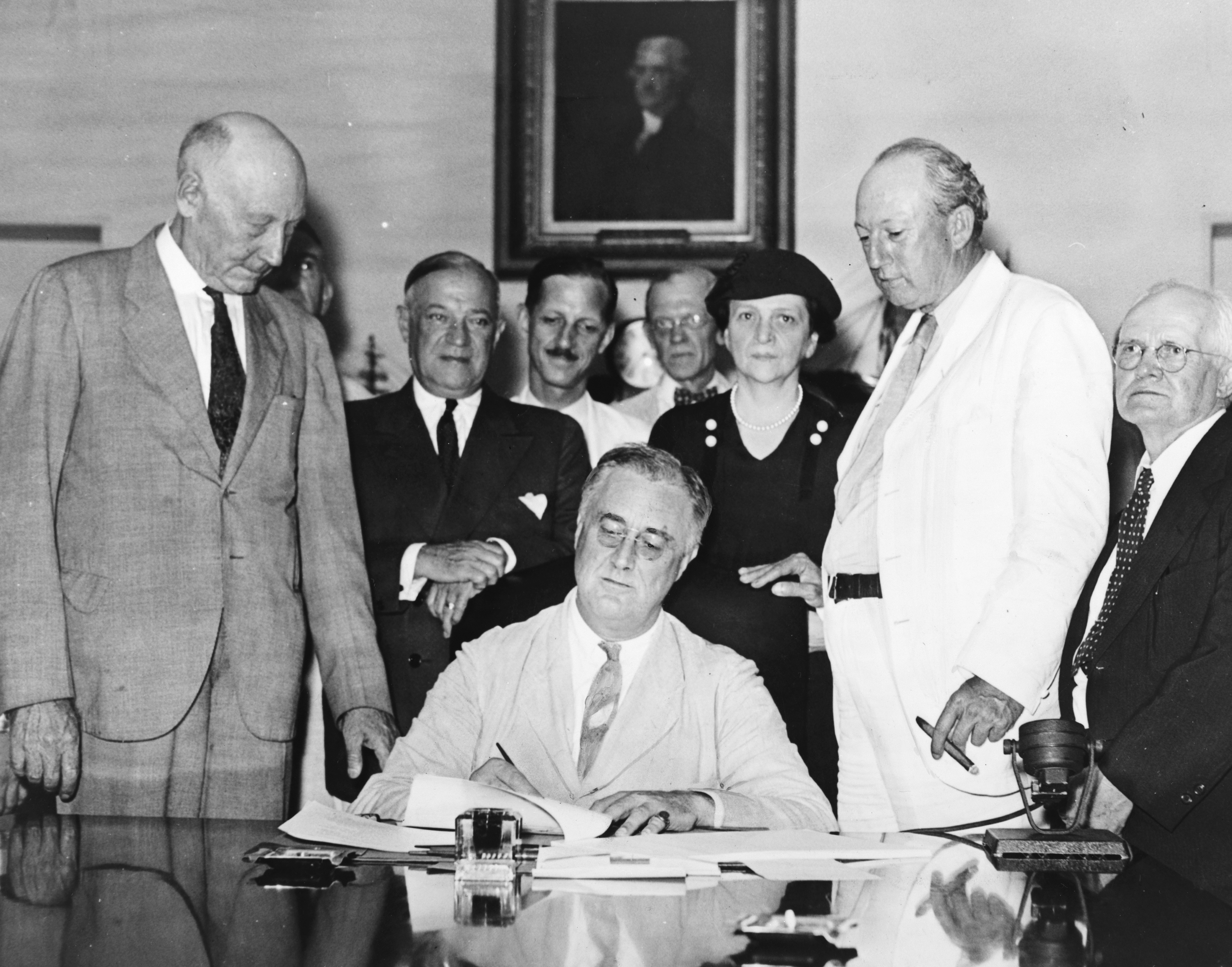
As a Senator, Wagner was a leader of the New Deal Coalition, putting special emphasis on supporting the labor movement. He was a close associate and strong supporter of President Franklin D. Roosevelt. He sponsored three major laws: the National Labor Relations Act of 1935 (also known as the Wagner Act), the Social Security Act of 1935, and the Housing Act of 1937. Wagner resigned from the Senate in 1949 due to ill health, and died in 1953. His son, Robert F. Wagner Jr., was mayor of New York City from 1954 through 1965.
Early life and education
Robert Ferdinand Wagner was born on June 8, 1877, in Nastätten, Hesse-Nassau, Kingdom of Prussia, German Empire (now in Rhein-Lahn-Kreis, Rhineland-Palatinate, Federal Republic of Germany). The family immigrated to the United States in 1885{{cite web |access-date=February 26, 2012
He graduated from the College of the City of New York (now named City College of New York) in 1898, where he was a brother of Phi Sigma Kappa fraternity and from New York Law School in 1900. He was admitted to the bar in 1900.
Political career
As a young lawyer he became part of the Tammany Hall Democratic machine in Manhattan. He was elected to New York State Assembly in 1905 (New York Co., 30th D.), 1907 and 1908 (both New York Co., 22nd D.).
New York State Senate
He was a member of the New York State Senate (16th D.) from 1909 to 1918, sitting in the 132nd, 133rd, 134th, 135th, 136th, 137th, 138th, 139th, 140th and 141st New York State Legislatures. He was President pro tempore of the New York State Senate from 1911 to 1914. Wagner became Acting Lieutenant Governor of New York after the impeachment of Governor William Sulzer, and the succession of Lieutenant Governor Martin H. Glynn to the governorship. In 1914, while Wagner remained President pro tempore, John F. Murtaugh was chosen Majority Leader of the State Senate. That was the only time before 2009 that the two offices were not held by the same person. After the Democrats lost their Senate majority, Wagner was Senate Minority Leader from January 1915 until he retired in 1918.
In the aftermath of the horrible Triangle Shirtwaist Factory fire, he was Chairman of the State Factory Investigating Committee (1911–1915). His Vice Chairman was fellow Tammany Hall politician, Al Smith. They held a series of widely publicized investigations around the state, interviewing 222 witnesses and taking 3500 pages of testimony. They started with the issue of fire safety and moved on to broader issues of the risks of injury in the factory environment. Their findings led to 38 new laws regulating labor in New York State and gave each of them a reputation as leading progressive reformers working on behalf of the working class. In the process, they changed Tammany's reputation from mere corruption to progressive endeavors to help workers.
Wagner was a delegate to the New York State Constitutional Conventions of 1915 and 1938 and a justice of the New York Supreme Court from 1919 to 1926.
U.S. Senate
_discusses_with_Senator_Robert_F._Wagner,_author_of_Wagner_Housing_Act,_the_LCCN2016872690.jpg)
Wagner was elected as a Democrat to the United States Senate in 1926 and re-elected in 1932, 1938, and 1944. He resigned on June 28, 1949, due to ill health. He was unable to attend any sessions of the 80th or 81st Congress from 1947 to 1949 because of a heart ailment. Wagner was the Chairman of the Committee on Patents in the 73rd Congress, of the Committee on Public Lands and Surveys in the 73rd and 74th Congresses, and of the Committee on Banking and Currency in the 75th through 79th Congresses. He was a delegate to the United Nations Monetary and Financial Conference in Bretton Woods, New Hampshire, in 1944.
Wagner, who had known the future President when they were in the New York state legislature together, was a member of Franklin Roosevelt's Brain Trust. He was very involved in labor issues, fought for legal protection and rights for workers, and was a leader in crafting the New Deal.
In April 1943, a confidential analysis by British scholar Isaiah Berlin of the Senate Foreign Relations Committee for the British Foreign Office stated of Wagner: :a veteran Liberal Tammany statesman, author of the United States labour code and devotee of the New Deal who is respected by the White House for his political acumen within his own State no less than for his political connexions. Greatest champion of the Liberal cause in the United States Senate since [George W.] Norris. A typical anti-Nazi German Democrat who has supported all the Administration measures, being usually well in advance of them.
His most important legislative achievements include the National Industrial Recovery Act in 1933 and the Wagner–Steagall Housing Act of 1937. After the Supreme Court ruled the National Industrial Recovery Act and the National Recovery Administration unconstitutional, Wagner helped pass the National Labor Relations Act (also known as the Wagner Act) in 1935,{{cite web |access-date = February 26, 2012 |url-status = dead |archive-url = https://web.archive.org/web/20120301185031/http://www.dol.gov/oasam/programs/laborhall/1990_wagner.htm |archive-date = March 1, 2012
Wagner was instrumental in writing the Social Security Act, and originally introduced it in the United States Senate.
The Wagner–Hatfield amendment to the Communications Act of 1934, aimed at turning over twenty-five percent of all radio channels to non-profit radio broadcasters, did not pass. In 1939 he co-sponsored with Representative Edith Nourse Rogers (R–MA) the Wagner–Rogers Bill to admit 20,000 Jewish refugees under the age of 14 to the United States from Nazi Germany, but the bill never passed.
Wagner and Edward P. Costigan sponsored a federal anti-lynching law in 1934. They tried to persuade President Roosevelt to support the bill but Roosevelt refused for fear of alienating Southern Democrats and losing their support for New Deal programs. There were 18 lynchings of blacks in the South in 1935, but after the threat of federal legislation, the number fell to eight in 1936 and to two in 1939.
On June 28, 1949, Wagner resigned from the Senate because of ill health; John Foster Dulles was appointed by Governor Thomas E. Dewey on July 7, 1949, to fill the vacancy temporarily.
Personal life and death
Wagner was raised as a Lutheran, but he became a Methodist in his college years and taught Sunday school; he converted to Roman Catholicism in 1946.
In 1908, Wagner married Margaret Marie McTague. She died in 1919. They had one son, Robert F. Wagner Jr.
In 1927, he received the first honorary citizenship of Nastaetten, his town of birth.
In the 1930s, Wagner dated the communist journalist Marguerite Young. | author-link = Donald A. Ritchie | url-access = registration | access-date = December 18, 2016}}
He died on May 4, 1953, in New York City, and was interred in Calvary Cemetery, Queens.
Legacy
His son Robert F. Wagner Jr. was Mayor of New York City from 1954 to 1965. His grandson, Robert (Bobby) Ferdinand Wagner III, was a Deputy Mayor, Director Urban Planning Commission and President of the New York City Board of Education in the 80s and 90s.
On September 14, 2004, a portrait of Wagner, along with one of Senator Arthur H. Vandenberg, was unveiled in the Senate Reception Room. The new portraits joined a group of distinguished former senators, including Henry Clay, Daniel Webster, John C. Calhoun, Robert M. La Follette, and Robert A. Taft. Portraits of this group of senators, known as the "Famous Five", were unveiled on March 12, 1959.
The public middle school located at 220 East 76th Street in New York City is named after him.
The former Wagner Hall on the campus of the City College of New York is named for him.
Notes
References
- Robert A. Slayton, ''Empire statesman: The rise and redemption of Al Smith'' (2001) ch 6-11
- J. Joseph. Huthmacher, "Senator Robert F. Wagner and the rise of urban liberalism." ''American Jewish Historical Quarterly'' (1969): 330-346. [https://www.jstor.org/stable/23876008 in JSTOR]
- (March 11, 2011). "Triangle Shirtwaist Factory Fire (1911)". [[The New York Times]].
- Robert Ferdinand Wagner" in '' Dictionary of American Biography'' (1977)
- Robert A. Slayton, ''Empire Statesman: The Rise and Redemption of Al Smith'' (2001)
- Zernike, Kate. (December 14, 2006). "Stricken Senate Democrat Undergoes Surgery". [[New York Times]].
- Hachey, Thomas E.. (Winter 1973–1974). "American Profiles on Capitol Hill: A Confidential Study for the British Foreign Office in 1943". Wisconsin Magazine of History.
- [https://encyclopedia.ushmm.org/content/en/article/wagner-rogers-bill Wagner-Rogers Bill]. ''Holocaust Encyclopedia''. Retrieved March 20, 2022.
- Huthmacher, ''Senator Robert Wagner'' (1971) pp 171-174.
- J. Joseph Huthmacher, ''Senator Robert F. Wagner and the rise of urban liberalism'' (1968) pp 14–15
- (1908-08-12). "12 Aug 1908, Page 5 - The New York Times at". Newspapers.com.
- Printed chronic of Nastaetten "893 Nastede - Nastaetten 1993" {{ISBN. 3-920388-20-8
- "The Lost World of CCNY: Architectural Gems of Our Past: Wagner Hall".
This article was imported from Wikipedia and is available under the Creative Commons Attribution-ShareAlike 4.0 License. Content has been adapted to SurfDoc format. Original contributors can be found on the article history page.
Ask Mako anything about Robert F. Wagner — get instant answers, deeper analysis, and related topics.
Research with MakoFree with your Surf account
Create a free account to save articles, ask Mako questions, and organize your research.
Sign up freeThis content may have been generated or modified by AI. CloudSurf Software LLC is not responsible for the accuracy, completeness, or reliability of AI-generated content. Always verify important information from primary sources.
Report