From Surf Wiki (app.surf) — the open knowledge base
Robert Adam
British neoclassical architect (1728–1792)
.jpg)
British neoclassical architect (1728–1792)
| Field | Value | |
|---|---|---|
| name | Robert Adam | |
| post-nominals | FRSE FRS FSAScot FSA FRSA | |
| image | Robert-adam.jpg | |
| alt | Portrait of Robert Adam | |
| caption | Portrait attributed to George Willison, –1775 | |
| nationality | British | |
| birth_date | ||
| birth_place | Kirkcaldy, Fife, Scotland | |
| death_date | ||
| alma_mater | University of Edinburgh | |
| death_place | London, England | |
| resting_place_coordinates | ||
| burial_place | Westminster Abbey | |
| burial_coordinates | ||
| agent | ||
| notable_works | ||
| style | Neoclassical | |
| net_worth | ||
| height | ||
| title | ||
| criminal_charge | ||
| spouse | ||
| partner | ||
| parents | ||
| father | William Adam | |
| mother | Mary Robertson | |
| relatives | {{unbulleted list | |
| website | ||
| module | {{Infobox architect | embed = yes |
| nocat_wdimage | 1 | |
| practice | Adam Brothers (Edinburgh, London) | |
| significant_buildings | Syon House | |
| Culzean Castle | ||
| Kedleston Hall | ||
| Pulteney Bridge | ||
| Harewood House | ||
| Charlotte Square |
| post-nominals = FRSE FRS FSAScot FSA FRSA |John Adam (brother) |James Adam (brother) }} Culzean Castle Kedleston Hall Pulteney Bridge Harewood House Charlotte Square
Robert Adam (3 July 17283 March 1792) was a British neoclassical architect, interior designer and furniture designer. He was the son of William Adam (1689–1748), Scotland's foremost architect of the time, and trained under him. With his older brother John, Robert took on the family business, which included lucrative work for the Board of Ordnance, after William's death.
In 1754, he left for Rome, spending nearly five years on the continent studying architecture under Charles-Louis Clérisseau and Giovanni Battista Piranesi. On his return to Britain he established a practice in London, where he was joined by his younger brother James. Here he developed the "Adam Style", and his theory of "movement" in architecture, based on his studies of antiquity and became one of the most successful and fashionable architects in the country. Adam held the post of Architect of the King's Works from 1761 to 1769.
Robert Adam was a leader of the first phase of the classical revival in England and Scotland from around 1760 until his death. He influenced the development of Western architecture, both in Europe and in North America. Adam designed interiors and fittings as well as houses. Much of his work consisted of remodelling existing houses, as well as contributions to Edinburgh's townscape and designing romantic pseudo-mediaeval country houses in Scotland.
He served as the member of Parliament for Kinross-shire from 1768 to 1774.
Biography
Early life

Adam was born on 3 July 1728 at Gladney House in Kirkcaldy, Fife, the second son of Mary Robertson (1699–1761), the daughter of William Robertson of Gladney, and architect William Adam. As a child he was noted as having a "feeble constitution". From 1734 at the age of six Adam attended the Royal High School, Edinburgh where he learned Latin (from the second year lessons were conducted in Latin) until he was 15, he was taught to read works by Virgil, Horace, Sallust and parts of Cicero and in his final year Livy.
In autumn 1743, he matriculated at the University of Edinburgh, and compulsory classes for all students were: the Greek language, logic, metaphysics and natural philosophy. Students could choose three elective subjects, Adam attended classes in mathematics, taught by Colin Maclaurin, and anatomy, taught by Alexander Monro primus. His studies were interrupted by the arrival of Bonnie Prince Charlie and his Highlanders, who occupied Edinburgh during the Jacobite rising of 1745. At the end of the year, Robert fell seriously ill for some months, and it seems unlikely that he returned to university, having completed only two years of study.
On his recovery from illness in 1746, he joined his elder brother John as apprentice to his father. He assisted William Adam on projects such as the building of Inveraray Castle and the continuing extensions of Hopetoun House. William's position as Master Mason to the Board of Ordnance also began to generate much work, as the Highlands were fortified following the failed Jacobite revolt. Robert's early ambition was to be an artist rather than architect, and the style of his early sketches in the manner of Salvator Rosa are reflected in his earliest surviving architectural drawings, which show picturesque gothic follies. William Adam died in June 1748, and left Dowhill, a part of the Blair Adam estate which included Dowhill Castle, to Robert. From his father, Robert inherited an extensive library and extended it.
Architectural practice in Edinburgh
On William Adam's death, John Adam inherited both the family business and the position of Master Mason to the Board of Ordnance. He immediately took Robert into partnership, later to be joined by James Adam. The Adam Brothers' first major commission was the decoration of the grand state apartments on the first floor at Hopetoun House, followed by their first "new build" at Dumfries House. For the Board of Ordnance, the brothers were the main contractor at Fort George, a large modern fort near Inverness designed by military engineer Colonel William Skinner. Visits to this project, begun in 1750, would occupy the brothers every summer for the next 10 years, and, along with works at many other barracks and forts, provided Robert with a solid foundation in practical building.
In the winter of 1749–1750, Adam travelled to London with his friend, the poet John Home. He took the opportunity for architectural study, visiting Wilton, designed by Inigo Jones, and the Queens Hermitage in Richmond by Roger Morris. His sketchbook of the trip also shows a continuing interest in Gothic architecture.
Among his friends at Edinburgh were the philosophers Adam Ferguson and David Hume and the artist Paul Sandby whom he met in the Highlands. Other Edinburgh acquaintances included Gilbert Elliot, William Wilkie, John Home and Alexander Wedderburn.
Grand Tour

.jpg)
On 3 October 1754, Robert Adam in the company of his brother James (who went as far as Brussels) set off from Edinburgh for his Grand Tour, stopping for a few days in London, where they visited the Mansion House, London, St Stephen Walbrook, St Paul's Cathedral, Windsor, Berkshire, in the company of Thomas Sandby who showed them his landscaping at Windsor Great Park and Virginia Water Lake. They sailed from Dover arriving in Calais on 28 October 1754. He joined Charles Hope-Weir, brother of the Earl of Hopetoun in Brussels and together they travelled to Rome. Hope agreed to take Adam on the tour at the suggestion of his uncle, the Marquess of Annandale, who had undertaken the Grand Tour himself. While in Brussels the pair attended a Play and Masquerade, as well as visiting churches and palaces in the city. Travelling on to Tournai, then Lille, where they visited the citadel designed by Sébastien Le Prestre de Vauban. By 12 November 1754 Adam and Hope were in Paris where they took lodgings in Hotel de Notre Dame.
Adam and Hope travelled on to Italy together, before falling out in Rome over travelling expenses and accommodation. Robert Adam stayed on in Rome until 1757, studying classical architecture and honing his drawing skills. His tutors included the French architect and artist Charles-Louis Clérisseau, and the Italian artist Giovanni Battista Piranesi. Here, he became acquainted with the work of the pioneering classical archaeologist and art historian, theorist Johann Joachim Winckelmann. On his return journey, Adam and Clerisseau spent time intensively studying the ruins of Diocletian's Palace at Spalatro in Dalmatia (now known as Split, in modern Croatia). These studies were later published as Ruins of the Palace of the Emperor Diocletian at Spalatro in Dalmatia in 1764.
Architectural practice in London


He returned to Britain in 1758 and set up in business in London with his brother James Adam. They focused on designing complete schemes for the decoration and furnishing of houses. Palladian design was popular, and Robert designed a number of country houses in this style, but he evolved a new, more flexible style incorporating elements of classical Roman design alongside influences from Greek, Byzantine and Baroque styles. The Adam brothers' success can also be attributed to a desire to design everything down to the smallest detail, ensuring a sense of unity in their design. In Adam interiors, all the furnishings were custom designed to accord with the decoration of the room in a unified harmony. Often the carpets were woven to match the intricate patterns of the ceiling above, while every fitting including sconces, mirrors, and doorknobs also received a custom design emulating the motifs of the room.
| use_new_UK-LEG = | UK-LEG_title = The Adam practice was not without mishap, however. In 1768 the brothers purchased a 99-year lease for a marshy plot of land beside the Thames in Westminster, where they built a 24-house terrace development known as the Adelphi. The project was very ambitious and is the first instance where terraced houses were designed individually to give unified harmony to the whole development (previously terraced houses were built to one replicated design, side-by-side around a square). However, the project became a white elephant for Robert and his brothers, with uncertain financing and costs spiralling out of control. The houses were built on a huge artificial terrace resting on vaulted substructures on the level of the Thames, which Robert Adam was certain could be leased to the British government as warehouses. However, this intention failed to materialize; the Adam brothers were left with huge debts and, in 1772, had to lay off 3,000 workmen and cease building. Robert Adam himself moved into one of the houses in the Adelphi, along with supportive friends like David Garrick and Josiah Wedgwood, who opened a showroom for his ceramics in one of the houses. In 1774, a public lottery authorised under the Adam Buildings Act 1772 (13 Geo. 3. c. 75) was held to raise funds for the brothers, which allowed them to avert bankruptcy.
Public life

Adam was elected a fellow of the Society for the Encouragement of Arts, Manufactures and Commerce in 1758 and of the Society of Antiquaries in 1761, the same year he was appointed Architect of the King's Works (jointly with Sir William Chambers). His younger brother James succeeded him in this post when he relinquished the role in 1768 to devote more time to his elected office as member of Parliament for Kinross-shire.
Architectural style
Adam rejected the Palladian style, as introduced to England by Inigo Jones, and advocated by Lord Burlington, as "ponderous" and "disgustful". However, he continued their tradition of drawing inspiration directly from classical antiquity, during his four-year stay in Europe. Adam developed a new style of architectural decoration, one which was more archaeologically accurate than past neoclassical styles, but nonetheless innovative and not bound only by ancient precedents. In Works in Architecture, co-authored by Robert and James, the brothers stated that Graeco-Roman examples should "serve as models which we should imitate, and as standards by which we ought to judge." The discoveries being made in Herculaneum and Pompeii at the time provided ample material for Robert Adam to draw on for inspiration.
The Adam brothers' principle of "movement" was largely Robert's conception, although the theory was first written down by James. "Movement" relied on dramatic contrasts and diversity of form, and drew on the picturesque aesthetic. The first volume of the Adam brothers' Works (1773) cited Kedleston Hall, designed by Robert in 1761, as an outstanding example of movement in architecture.
By contrasting room sizes and decorative schemes, Adam applied the concept of movement to his interiors also. His style of decoration, described by Pevsner as "Classical Rococo", drew on Roman "grotesque" stucco decoration.
Influence
,_1776_-IMG_1604.JPG)
Adam's work had influenced the direction of architecture and design across the western world. In England his collaboration with Thomas Chippendale resulted in some of the finest neoclassicist designs of the time, most notably in the Harewood House collection of Chippendale's work. In North America, the Federal style owes much to neoclassicism as practised by Adam. In Europe, Adam notably influenced Charles Cameron, the Scotsman who designed apartments in the Catherine Palace, Tsarskoye Selo and other Russian palaces for Catherine the Great. However, by the time of his death, Adam's neoclassicism was being superseded in Britain by a more severe, Greek phase of the classical revival, as practised by James "Athenian" Stuart. The Adam brothers employed several draughtsmen who would go on to establish themselves as architects, including George Richardson, and the Italian Joseph Bonomi, who Robert originally hired in Rome.
Written works
During their lifetime Robert and James Adam published two volumes of their designs, Works in Architecture of Robert and James Adam (in 1773–1778 and 1779; a third volume was published posthumously, in 1822).
Death and burial
Adam had long suffered from stomach and bowel problems, probably caused by a peptic ulcer and irritable bowel syndrome. While at home – 11 Albemarle Street, London – on 1 March 1792, one of the ulcers burst, and on 3 March Adam died.
The funeral was held on 10 March; he was buried in the south aisle of Westminster Abbey. The pall-bearers were several of his clients: Henry Scott, 3rd Duke of Buccleuch; George Coventry, 6th Earl of Coventry; James Maitland, 8th Earl of Lauderdale; David Murray, 2nd Earl of Mansfield; Lord Frederick Campbell and Sir William Pulteney, 5th Baronet.
Knowing he was dying, he drafted his will on 2 March 1792. Having never married, Adam left his estate to his sisters Elizabeth Adam and Margaret Adam.
His obituary appeared in the March 1792 edition of The Gentleman's Magazine:
It is somewhat remarkable that the Arts should be deprived at the same time of two of their greatest ornaments, Sir Joshua Reynolds and Mr Adam: and it is difficult to say which of them excelled most in his particular profession. ... Mr Adam produced a total change in the architecture of this country: and his fertile genius in elegant ornament was not confined to the decoration of buildings, but has been diffused to every branch of manufacture. His talents extend beyond the lie of his own profession: he displayed in his numerous drawings in landscape a luxuriance of composition, and an effect of light and shadow, which have scarcely been equalled ... to the last period of his life, Mr Adam displayed an increasing vigour of genius and refinement of taste: for in the space of one year preceding his death, he designed eight great public works, besides twenty five private buildings, so various in their style, and so beautiful in their composition, that they have been allowed by the best judges, sufficient of themselves, to establish his fame unrivalled as an artist.
He left nearly 9,000 drawings, 8,856 of which (by both Robert and James Adam) were subsequently purchased in 1833 for £200 by the architect John Soane and are now at the Soane Museum in London.
List of architectural works
Works include:
Public buildings
- Fort George, Scotland, the buildings within the fort were designed by William Adam, after his death his sons oversaw completion (1748–1769)
- The Argyll Arms, Inveraray (1750–1756)
- The Town House, Inveraray (1750–1757)
- Royal Exchange, Edinburgh, with his brother John Adam (1753–1754)
- Screen in front of the Old Admiralty, Whitehall, London (1760)
- Kedleston Hotel, Quarndon (1760)
- Little Market Hall, High Wycombe, Buckinghamshire (1761) later altered
- Riding School, Edinburgh (1763) demolished
- Courts of Justice and Corn Market, Hertford, Hertfordshire, now Shire Hall (1768). Altered, but partially restored to original design. A joint project with James Adam.
- Pulteney Bridge, Bath (1770)
- County House, Kinross (1771)
- Royal Society for the encouragement of Arts, Manufactures & Commerce (1772)
- Register House, Edinburgh (1774–1789)
- Market Cross, Bury St Edmunds, refaced and upper floor added (a theatre now art gallery) (1776)
- Theatre Royal, Drury Lane, London, remodelled, (1775) demolished
- Red Lion Inn, Pontefract (1776)
- Drummonds Bank, Charing Cross, London (1777–1778) demolished
- Home House, London (1777)
- Old College, University of Edinburgh, (1788–onwards) completed to an amended design by William Henry Playfair 1831
- The Bridewell, Edinburgh, (1791) demolished
- The Assembly Rooms, Glasgow (1791–1794) demolished
- Trades Hall, Glasgow, Scotland (1791–1792) (completed 1792–1802 by his brothers)
- Glasgow Royal Infirmary (1791–1794) rebuilt 1914
- Coutts Bank enclosed bridge, John Adam Street (1799) later demolished
File:Edinburgh City Chambers.jpg|City Chambers, Edinburgh File:AdamBrothersRecordsOfficeEdinburgh1775.jpg|Register House, Edinburgh File:Register House cross section.jpg|Register House, cross section, Edinburgh File:Register House, Edinburgh.jpg|Register House, Edinburgh File:Old College.JPG|Old College Edinburgh, Dome added later File:Bury St Edmunds - Market Cross.jpg|Market Cross, Bury St Edmunds File:Drury lane facade 1775.png|Theatre Royal Drury Lane, London, rebuilt File:Edinburgh from Calton Hill 2.jpg|Edinburgh Bridewell in foreground, demolished File:Pulteney Bridge Bath.jpg|Pulteney Bridge, Bath File:Little Market House - geograph.org.uk - 1127978.jpg|Little Market Hall, High Wycombe File:McLennan Arch - geograph.org.uk - 277897.jpg|McLennan Arch, Glasgow, built from the remains of Glasgow Assembly Rooms File:The Kedleston Hotel and Restaurant - geograph.org.uk - 284906.jpg|Kedleston Hotel, Quarndon File:Coutts 20130414 170.jpg|Coutts Bank, John Adam Street, demolished and replaced with this building File:Register House rotunda (2892537345).jpg|Register House Edinburgh, interior of the dome
Churches
- Yester Chapel, Lothian, new west front in Gothic style (1753)
- Cumnock church, Ayrshire (1753–1754) demolished
- St. Mary Magdalene, Croome Park, interior (1761–1763) the church was designed by Lancelot "Capability" Brown
- St. Andrew's Church, Gunton Hall, Gunton, Norfolk (1769)
- St Mary's, Mistley (1776) only the towers survive
- St. George's Chapel, Edinburgh, (1792) demolished File:Mistley Church by Robert and James Adam. Published 1776.jpg|Mistley Church as built File:Mistley towers 700.jpg|Mistley Church as it survives File:St Andrew, Gunton, Norfolk - geograph.org.uk - 318535.jpg|St. Andrew's Church Gunton File:Yester Chapel.jpg|Yester Chapel, west front
Mausoleums
- William Adam Mausoleum, Greyfriars Kirkyard (1753–1755)
- Bowood House Mausoleum (1761–1764)
- David Hume Mausoleum, Old Calton Cemetery (1777–1778)
- Templetown Mausoleum, Castle Upton, County Antrim Ireland (1789) for 2nd Lord Templetown.
- Johnstone Family Mausoleum, Ochil Road graveyard, Alva, Clackmannanshire (1789–1790)
- Johnstone Family Mausoleum, Westerkirk graveyard, near Bentpath, Dumfries and Galloway (1790) File:Old Calton David Hume.jpg|David Hume Mausoleum File:The Templetown Mausoleum - geograph.org.uk - 78372.jpg|Templetown Mausoleum File:The Johnstone Mausoleum, Bentpath - geograph.org.uk - 208025.jpg|Johnstone Family Mausoleum, Bentpath
Urban domestic work
- Little Wallingford House, Whitehall, London, alterations (1761) demolished
- Lansdowne House, Berkeley Square, London (1762–1767), partially demolished, the Dining Room is in the Metropolitan Museum of Art and the Drawing Room is in Philadelphia Museum of Art
- 34 Pall Mall, London (1765–1766) demolished
- Langford House, Mary Street, Dublin, Ireland. (1765) First recorded work in Ireland remodelling of house for Rt. Hon. Hercules Langford Rowley. Demolished 1931.
- 16 Hanover Square, London, alterations (1766–1767) demolished
- Deputy Ranger's lodge, Green Park, London (1768–1771) demolished in the 19th century
- The Adelphi development, London (1768–1775) mostly demolished 1930s, a ceiling & fireplace are in the Victoria and Albert Museum
- Chandos House, London (1770–1771)
- 8 Queen Street, Edinburgh (1770–1771) originally designed for Lord Chief Baron Ord, now housing the Royal College of Physicians of Edinburgh
- Mansfield Street, London (1770–1772)
- Northumberland House, London, alterations (1770) demolished, parts of the Glass Drawing Room survive in the Victoria and Albert Museum
- 20 St. James's Square (1771–1774)
- 33 St. James's Square (1771–1773)
- Ashburnham House, Dover Street, London, alterations (1773)
- Derby House, 26 Grosvenor Square (1773–1774) demolished
- Portland Place, London (1773–1794) (only a few houses survive)
- 11 St. James's Square (1774–1776)
- Frederick's Place, London (1775–1778)
- Roxburghe House, Hanover Square, London (1776–1778) demolished
- Home House, London (1777 – before 1784)
- 31 (now 17) Hill Street, London alterations (1777–1779)
- Apsley House, London (1778) altered
- Cumberland House, Pall Mall, London, alterations and interiors (1780–1788) demolished
- Marlborough House, Brighton (1786)
- Fitzroy Square, London (1790–1794) only the south and east sides were built
- Charlotte Square (north side), Edinburgh (1791–1794)
- 169–185 High Street, Glasgow (1793) demolished
- 1–3 Robert Street
File:Charlotte Square - geograph.org.uk - 105918.jpg|North side, Charlotte Square, Edinburgh File:Bute House, Edinburgh, Scotland.jpg|Centre of North side, Charlotte Square, Edinburgh File:Chandos House.jpg|Chandos House London File:Home House 05.jpg|Music Room, Home House, London File:Home House 09.jpg|Drawing Room, Home House, London File:HomeHouseEtruscanRoom.jpg|Design for the Etruscan Room, Home House, London File:Home House 10.jpg|Detail of the Etruscan Room, Home House, London File:Home House 03.jpg|Staircase, Home House, London File:Home House 04.jpg|Staircase Dome, Home House, London File:Fitzroy Square S.jpg|South side, Fitzroy Square, London File:Fitzroy Square E.jpg|East side, Fitzroy Square, London File:Polish Embassy 47 Portland Place London.jpg|Surviving Adam Houses, Portland Place, London File:Adelphi 20130414 161.jpg|The Adelphi, London, largely demolished File:WLA vanda Robert Adam Ceiling roundel with octagon and Apollo and Horae.jpg|Robert Adam ceiling from the Adelphi, now in the V&A File:WLA vanda Model of Northumberland House.jpg|Model of the Glass Drawing Room Northumberland House, in the V&A File:WLA vanda glass drawing room Northumberland House.jpg|Panels from the Glass Drawing Room Northumberland House, in the V&A File:Derby Great withdrawing room Countess's Dressing room.jpg|Design for fireplaces in the withdrawing room and the Countess of Derby's dressing room, Derby House File:Derby House 2nd withdrawing room.jpg|Drawing Room, Derby House File:Dercy House drawing-room1777.jpg|Drawing Room, Derby House File:Derby House1777.jpg|Plan, Derby House File:AdamBrothersCountessofDerbysDressingroomEtruscanTaste1777.jpg|Ceiling, Countess of Derby's Dressing Room, Derby House File:Robert and James Adam. Details for Derby House in Grosvenor Square. Published 1777.jpg|Details for Derby House in Grosvenor Square, an example of the Adam Brothers' decorative designs File:RobertJamesAdamengravedJohnRobertsfacadeWatkinWilliamsWynnStJames1777.jpg|20 St. James's Square, London, front facade File:20 St James's Square - elevation of the offices towards the back court 1777.jpg|20 St. James's Square, London, rear facade File:Wynn House Dining Room ceiling 1777.jpg|Dining Room ceiling, 20 St. James's Square, London File:RobertJamesAdamengravedTMorrisMusicRoomCeilingWatkinWilliamsWynnStJames1775.jpg|Music Room ceiling, 20 St. James's Square, London File:20 St James's Square 2nd drawing room edited.jpg|Drawing Room ceiling, 20 St. James's Square, London File:Robert Adam fireplace, Round room, Strawberry Hill.jpg|Fireplace, Round room, Strawberry Hill House, Middlesex File:Robert Adam 20130414 154.jpg|1-3 Robert Street File:Lansdowne House Philadelphia 01.JPG|Lansdowne House Drawing Room, now in Philadelphia Art Museum File:Dining room from Lansdowne House MET DT211259.jpg|Lansdown House dining room, now in the Metropolitan Museum of Art, New York
Country houses with major work
- Dumfries House, Ayrshire (1754–1759)
- Hatchlands Park, Surrey, interiors (1756)
- Douglas Castle, Lanarkshire (1757–1761)
- Paxton House, near Berwick-upon-Tweed (1758)
- Shardeloes, Amersham, Buckinghamshire (altered and completed the original design by Stiff Leadbetter) (1759–63)
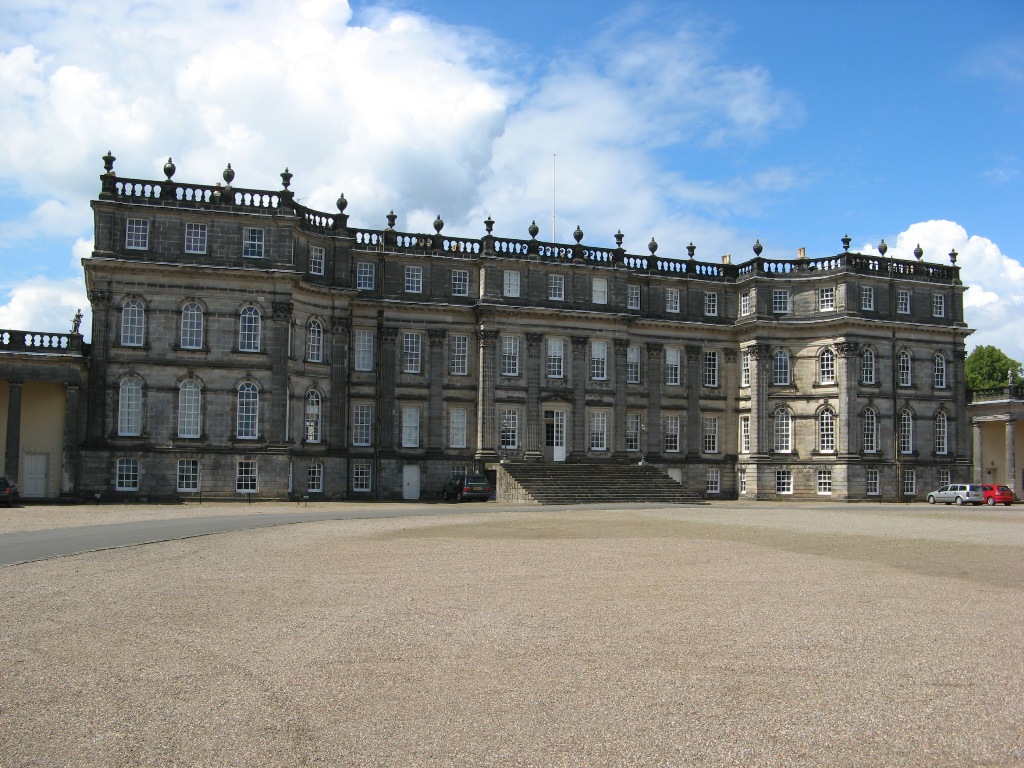
- Harewood House, West Yorkshire (1759–1771)
- Kedleston Hall, near Derby (1759–1765)
- Mellerstain House, Kelso, Scottish Borders (1760–1768)
- Ugbrooke, Devon
- Osterley Park, west London (1761–1780)
- Mersham le Hatch, Mersham, Ashford, Kent (1762–1766)
- Syon House interior, Brentford (1762–1769)
- Luton Hoo, Bedfordshire (1766–1770) later extensively reconstructed 1816 by Robert Smirke and other architects later
- Nostell Priory (1766–80)
- Newby Hall, Newby Boroughbridge, North Yorkshire (1767–76)
- Kenwood House, Hampstead, London (1768)
- Saltram House, Plymouth, Devon (1768–69)
- Bowood House, near Calne, Wiltshire, Diocletian wing, and other interiors (1770)
- Wedderburn Castle, Duns, Scottish Borders, Berwickshire (1770–1778)
- Culzean Castle, South Ayrshire (1772–1790)
- Moreton Hall, Suffolk (1773–1776), building and interiors
- Stowe, Buckinghamshire (1774)
- Moreton Hall, Bury St Edmund (1783)
- Brasted Place, Kent ()
- Pitfour Castle, Tayside, attributed ()
- Seton Castle, East Lothian (1789)
- Newliston, Lothian (1789)
- Dalquharran Castle, South Ayrshire (1789–1792); now a ruin
- Airthrey Castle, Stirlingshire (1790–1791)
- Balbardie House, Lothian (1792); demolished
- Gosford House, near Longniddry, East Lothian (1790–1800) File:Paxton House.jpg|Paxton House, Berwickshire File:Kedleston Hall 04.jpg|South front, Kedleston Hall File:Kedleston cross section.jpg|Cross section, Kedleston Hall File:Inside Kedleston.jpg|Kedleston Hall, Marble Hall File:Stowe House 04.jpg|South front, Stowe House, slightly modified in execution File:AdamBrothersHallatSyon1778.jpg|Cross section of Hall, Syon House, London File:Syon Plan.jpg|Plan, Syon House, London File:Syon House, Great Hall.jpg|Apse, Entrance Hall, Syon House File:Syon House 2.jpg|The Dining Room, Syon House File:Syon House 1.jpg|The Ante-Room, Syon House File:Syon House, Ante room, Gilded panels (2).jpg|The ceiling, Ante-Room, Syon House File:Syon House, Long Gallery.jpg|Long Gallery, Syon House File:Syon House, Long Gallery, Circular Closet.jpg|Closet off Long Gallery, Syon House File:Kenwood House.jpg|Kenwood House, London File:Kenwood House 088.jpg|Entrance portico, Kenwood House, London File:Kenwood-House-JBU 04.jpg|Kenwood House, Library File:RobertAdamLibraryKenwood1774 edited.jpg|Cross section of the library, Kenwood House, London File:Kenwood Library ceiling edited.jpg|The library ceiling, Kenwood House, London File:Nostell Priory 1.jpg|Nostell Priory, Yorkshire, Adam wing on right File:Culzean Castle - geograph.org.uk - 1437106.jpg|Culzean Castle, Ayrshire File:Culzean Castle - the seaward side - geograph.org.uk - 976649.jpg|Culzean Castle, Ayrshire File:Pitfour Castle.jpg|Pitfour Castle, Tayside File:The Saloon (7279934644).jpg|The Saloon, Saltram House File:Bowood House 3.jpg|Bowood House, Adam's Diocletian wing on left, the main block demolished in 1950s File:Orangery, Bowood House - geograph.org.uk - 1572435.jpg|Bowood House, Diocletian wing File:Wedderburn Castle.jpg|Wedderburn Castle, Berwickshire File:Entrance Hall ceiling - Harewood House - West Yorkshire, England - DSC01582.jpg|The Entrance Hall Ceiling, Harewood House File:Harewood Castle 01.jpg|Harewood House, Yorkshire, altered by Sir Charles Barry File:Harewood House The State Bedroom.jpg|Harewood House, State Bedroom File:State Bedroom ceiling - Harewood House - West Yorkshire, England - DSC01810.jpg|The Ceiling, State Bedroom, Harewood House File:Harewood House The Old Library.jpg|Harewood House, Old Library File:Music Room ceiling, with paintings by Angelica Kaufman - Harewood House - West Yorkshire, England - DSC02050.jpg|Harewood House, Music Room Ceiling File:Harewood House The Music Room.jpg|The Music Room, Harewood House File:Gallery ceiling by Robert Adam - Harewood House - West Yorkshire, England - DSC01960.jpg|Gallery ceiling, Harewood House File:Gallery - Harewood House - West Yorkshire, England - DSC01996.jpg|The Gallery, Harewood House File:Gallery fireplace, design by Robert Adam - Harewood House - West Yorkshire, England - DSC01966.jpg|Gallery fireplace, Harewood House File:Newliston House - geograph.org.uk - 1306052.jpg|Newliston House File:Dalquarran Castle - geograph.org.uk - 790426.jpg|Dalquarran Castle, Ayrshire File:Luton Hoo.jpg|Luton Hoo House, Bedfordshire, altered by Sir Robert Smirke and again in the late 19th century File:Mellerstain House - geograph.org.uk - 52335.jpg|Mellerstain House, Berwickshire File:Osterley Park 800.jpg|Osterley Park, London File:Osterley Park Interior.jpg|Main Staircase, Osterley Park, London File:Osterley Park House-11891497834.jpg|Entrance Hall, Osterley Park, London File:Drawing Room Ceiling, Osterley House.jpg|Osterley Park, Drawing Room Ceiling File:WP 004275.jpg|Portico Ceiling, Osterley Park
Garden buildings and follies
- Stables, Inveraray Castle, joint work with his brother John (1758–1760)
- North Lodge, Kedleston Hall (1759)
- Circular and Octagon pavilion, La Trappe, Hammersmith (1760) for George Bubb Dodington (demolished)
- Conservatory Croome Park (1760)
- Rotunda Croome Park, attributed (1760)
- Old Rectory, Kedleston Hall ()
- Entrance screen, Moor Park, Hertfordshire (1763)
- The Conservatory, Osterley Park (1763)
- Bridge, Audley End House, Essex ()
- Tea Pavilion, Moor Park, Hertfordshire ()
- Gatehouse Kimbolton Castle ()
- Bridge, Kedleston Hall (1764)
- Estate Village Lowther, Cumbria (1766)
- Dunstall 'Castle' and Garden Alcove, Croome Park (1766)
- Entrance arch, Croome Court (1767)
- Entrance Screen, Cullen House, Cullen, Moray (1767)
- Bridge, Osterley Park ()
- Entrance screen, Syon House (1769)
- Fishing, Boat & Bath House, Kedleston Hall (1770–71)
- Circular Temple, Audley End House, Essex (1771)
- Lion Bridge, Alnwick (1773)
- Stag Lodge, Saltram House, Devon ()
- The Stables, Featherstone entrance & Huntwick arch Nostell Priory (1776)
- Wyke Green Lodges, Osterley, Middlesex (1777); remodelled
- The Home Farm, Culzean Castle, Ayrshire (1777–1779)
- Brizlee Tower, Alnwick, Gothic tower (1777–1781)
- Oswald's Temple, Auchincruive, Ayrshire (1778)
- 'Ruined' arch and viaduct, Culzean Castle (1780)
- The semi-circular conservatory, Osterley Park (1780)
- Tea House Bridge, Audley End House, Essex (1782)
- The Stables, Culzean Castle ()
- Stables, Castle Upton, Templepatrick, County Antrim, Ireland. (1788–1789). Important range of office buildings in castle style
- Montagu Bridge, Dalkeith Palace, Lothian (1792)
- Loftus Hall, Fethard-on-sea, County Wexford, Ireland. Date unknown. Proposed gates
- Lion Gate and Lodge, Syon Park, London. Date unknown
File:Syon Gateway and porters' lodges 1769 edited.jpg|Screen, Syon House, London File:No-longer used entrance to Syon Park, Brentford - geograph.org.uk - 1123299.jpg|The Lion Gate, Syon Park, London File:Kimbolton Castle 03.jpg|Gatehouse, Kimbolton Castle File:Entrance gates Croome Court.jpg|Entrance Arch, Croome Park, Worcestershire File:Croome Landscape Park - geograph.org.uk - 42459.jpg|Garden Alcove, Croome Court, Worcestershire File:Rotunda Croome Park.jpg|Rotunda, Croome Park, Worcestershire File:Dunstall "Castle" - geograph.org.uk - 15460.jpg|Dunstall "Castle", Croome Court, Worcestershire File:Brizlee Tower - Alnwick - Northumberland - UK - 2006-03-04.jpg|Brizlee Tower, Alnwick File:2008-09-14 Osterley GardenHouse.jpg|The semi-circular conservatory, Osterley Park File:Nostell Priory Park2.jpg|Featherstone entrance, Nostell Priory, Yorkshire File:Oswald's Temple, Auchincruive - geograph.org.uk - 1149431.jpg|Oswald's Temple, Auchincruive, Ayrshire File:Robert AdamFishing Room and Boat House at Kedleston Circa 1769.JPG|Kedleston Fishing, Bathing & Boat House File:Boathouse Bridge - geograph.org.uk - 1472741.jpg|Kedleston Bridge File:Entering The Culzean Visitor Centre - geograph.org.uk - 1229843.jpg|Former Home Farm, Culzean Castle File:Model Village, Lowther - geograph.org.uk - 59691.jpg|Lowther Castle Model Village File:Montagu Bridge, Dalkeith Country Park - geograph.org.uk - 1589872.jpg|Montagu Bridge, Dalkeith Palace File:The Lion Bridge - geograph.org.uk - 919287.jpg|The Lion Bridge, Alnwick File:Tea House Bridge - geograph.org.uk - 1442099.jpg|Tea House Bridge, Audley End File:Clock Tower, Upton Castle, Templepatrick - geograph.org.uk - 33750.jpg|Clock Tower, Stables, Castle Upton, County Meath File:Culzean Castle - clock tower courtyard - geograph.org.uk - 1560844.jpg|Stables, Culzean Castle, Ayrshire
Country houses with minor work
- Hopetoun House, West Lothian (interiors) (1750–1754), the house was designed by William Adam
- Ballochmyle House, Ayrshire ()
- Compton Verney House, added the wings and interiors (1760–1763)
- Croome Park, three interiors: the Library the fittings are in the Victoria and Albert Museum, Gallery and Tapestry Room this is now in the Metropolitan Museum of Art, (1760–1765)
- Audley End House, redecoration of ground floor rooms (1763–1765)
- Goldsborough Hall, near Knaresborough, North Yorkshire (1764–1765)
- Alnwick Castle, Northumberland (interiors) (1766) destroyed when Anthony Salvin created the current state rooms
- Woolton Hall, Woolton, Merseyside (1772), remodelled main façade and the interior
- Headfort House, County Meath, Ireland. Internal work, including stairs and notably the Great Eating Room (1775) for Thomas Taylour, 1st. Earl Bective.
- Wormleybury, Hertfordshire, internal work including entrance hall & staircase (1777)
- Downhill, near Coleraine, County Londonderry, Ireland. (1780) Design for dining room. Not executed. House is now a crumbling ruin.
- Moccas Court, Moccas, Herefordshire, internal work including drawing room (1781)
- Castle Upton, Templepartick, County Antrim, Ireland. Remodelling of house. (1782–1783) for 1st. Lord Templetown.
- Archerfield House, Lothian, internal work including library (1791)
- Summerhill House, County Meath, Ireland. 1765 unexecuted. Proposed alterations including a quadrant link connecting two wings. File:Summerhill House, Main front.jpg|Summerhill House, Main Front. File:Comptonverney.jpg|Compton Verney House, wings by Adam
References
Sources
- Adam, Robert (1764) Ruins of the palace of the Emperor Diocletian at Spalatro in Dalmatia
- Beard, Geoffrey (1978) The Work of Robert Adam, John Bartholomew & Son.
- Bolton, Arthur T. (1922, reprinted 1984) The Architecture of Robert & James Adam, 1785–1794, 2 volumes
- Curl, James Stevens (2006) Oxford Dictionary of Architecture and Landscape Architecture 2nd Edition. Oxford University Press.
- Fleming, John (1962) Robert Adam and his Circle John Murray
- Glendinning, Miles, and McKechnie, Aonghus, (2004) Scottish Architecture, Thames and Hudson.
- Graham, Roderick (2009) Arbiter of Elegance: A Biography of Robert Adam (Birlinn, )
- Harris, Eileen (1963) The Furniture of Robert Adam Alec Tiranti, London. .
- Harris, Eileen (2001) The Genius of Robert Adam: His Interiors
- Lees-Milne, James (1947) The Age of Adam
- Pevsner, Nikolaus (1951) An Outline of European Architecture 2nd Edition. Pelican
- Roderick, Graham (2009) Arbiter of Elegance A Biography of Robert Adam. Birlinn
- Stillman, Damie (1966) The Decorative Work of Robert Adam
- Tait, A. A. (2004) "Adam, Robert (1728–1792)", Oxford Dictionary of National Biography, Oxford University Press,
- Yarwood, Doreen (1970) Robert Adam and (1973 paperback)
- Belamarić, Joško – Šverko, Ana (eds.): Robert Adam and Diocletian's Palace in Split, Zagreb 2017,
References
- James, Jude. (2005). "Kirkcaldy: A History & Celebration of the Town". Francis Frith Collection.
- Pevsner, p. 237
- Adam silver (1953). Victoria & Albert Museum, London. Her Majesty's Stationery Office ([[HMSO]]), p. 1.
- Norwich, John Julius. (1990). "Oxford Illustrated Encyclopedia of the Arts". Oxford University Press.
- (July 2006). "Former Fellows of the Royal Society of Edinburgh 1783–2002: Biographical Index". [[The Royal Society of Edinburgh]].
- (2004). "Adam, Robert (1728–1792), architect".
- Fleming, p. 76
- Graham, p. 2
- Graham, p. 4
- Graham, p. 26
- Graham, p. 27
- Fleming, pp. 79–80
- Fleming, p. 81
- "Robert Adam 1728–1792 – Book Owners Online".
- Fleming, pp. 85–86
- Fleming, p. 85
- Graham, p. 47
- Graham, p. 48
- Graham, p. 50
- Graham, p. 52
- Graham, p. 54
- Graham, p. 49
- Graham, p. 53
- Graham, p. 53-54
- Graham, p. 55
- [http://www.megalithic.co.uk/article.php?sid=17691 C.M. Hogan, "Diocletian's Palace", The Megalithic Portal, A. Burnham ed, 6 Oct 2007]
- Roth, p. 397
- Roth, p. 402
- David Irwin. (1997). "Neoclassicism". Phaidon.
- Steven Parissien. (1992). "Adam Style". Phaidon.
- Glendinning and McKechnie, p. 106
- Pevsner, p. 238
- Glendinning & McKechnie, p. 108
- Graham, Roderick (2009) ''Arbiter of Elegance: A Biography of Robert Adam'', Birlinn, {{ISBN. 978-1-84158-802-5, pp. 328–329
- Graham, p. 330
- page 11, ''The Adam Brothers in Rome: Drawings from the Grand Tour'', A.A. Tait, 2008 Scala Publishers Ltd, {{ISBN. 978-1-85759-574-1
- David King, The Complete Works of Robert & James Adam, 1991, Butterworth
- (11 January 2013). "1765 – Interior Designs, Langford House, Mary St., Dublin".
- Craig, W. S.. (1976). "History of the Royal College of Physicians of Edinburgh". Blackwell.
- "Summerhill House, Co. Meath: unexecuted design for an extension to the house for the Rt Hon. Hercules Langford Rowley, 1765 (1)".
This article was imported from Wikipedia and is available under the Creative Commons Attribution-ShareAlike 4.0 License. Content has been adapted to SurfDoc format. Original contributors can be found on the article history page.
Ask Mako anything about Robert Adam — get instant answers, deeper analysis, and related topics.
Research with MakoFree with your Surf account
Create a free account to save articles, ask Mako questions, and organize your research.
Sign up freeThis content may have been generated or modified by AI. CloudSurf Software LLC is not responsible for the accuracy, completeness, or reliability of AI-generated content. Always verify important information from primary sources.
Report