From Surf Wiki (app.surf) — the open knowledge base
Rivet nut
Kind of threaded insert

Kind of threaded insert
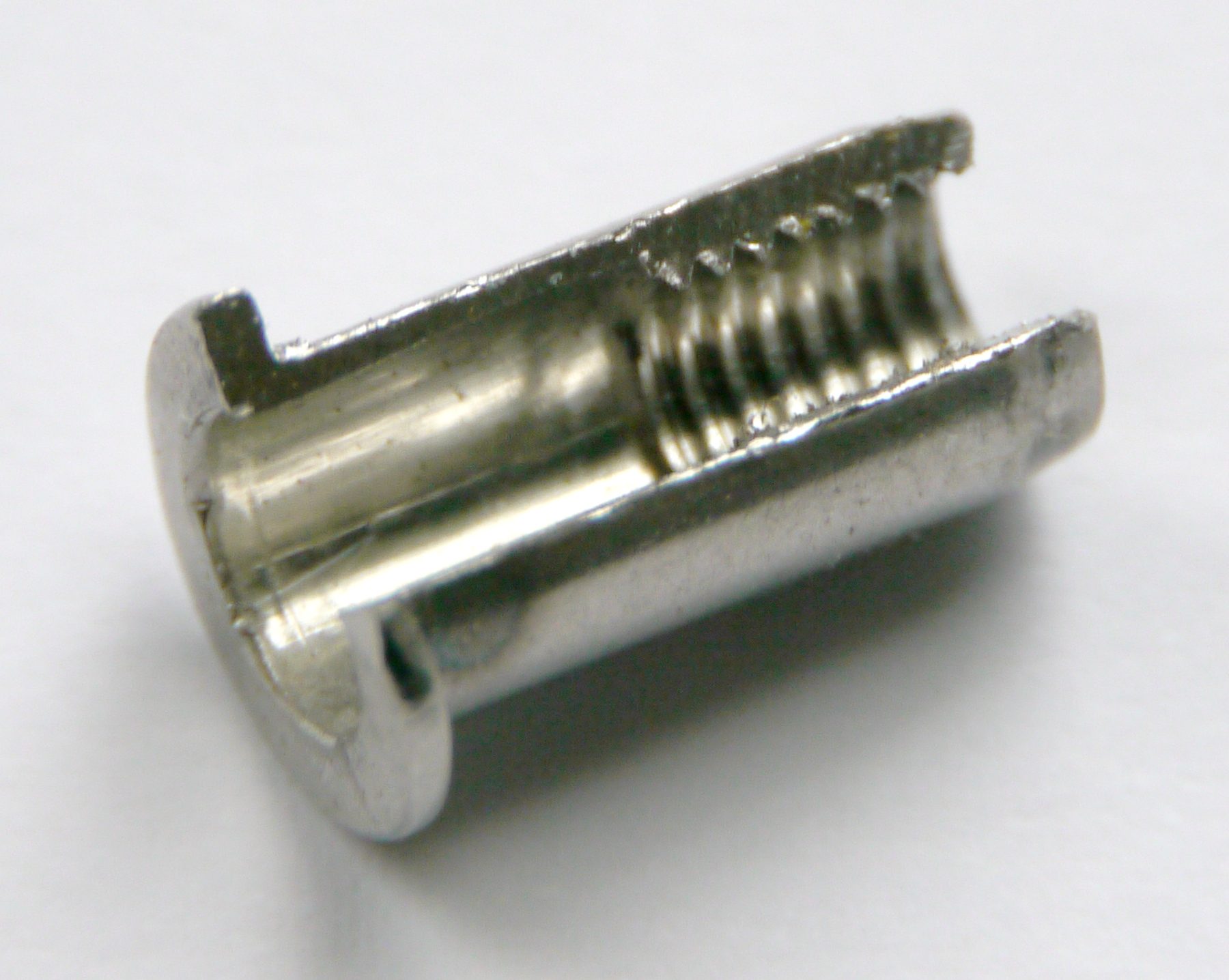

A rivet nut, also known as a blind rivet nut, or rivnut, is a one-piece internally threaded and counterbored tubular rivet that can be anchored entirely from one side. It is a kind of threaded insert. There are two types: one is designed to form a bulge on the back side of the panel as a screw is tightened in its threads. The other is similarly drawn in using a screw, but is drawn into the sleeve instead of creating a bulge.
History
The first rivet nut was created by BF Goodrich in the 1930s, and sold under the trademark RIVNUT®. It was first used to mount rubber de-icing boots to aircraft wings.
Usage
In the field of aviation, rivet nuts are often used to attach various items, such as static dischargers and inspection access covers, to the surface of an aircraft. Rivet nuts are an ideal replacement for weld nuts because they will not distort base materials, eliminate weld splatter, toxic fumes, and other by-products of the welding process, and can be installed in many different kinds of material including steel, plastic, composites, and fiberglass.
References
Notes
Bibliography
- .
- .
References
- Smith, p. 112.
- McMaster-Carr, p. [http://www.mcmaster.com/#catalog/114/3213 3213].
- McMaster-Carr, p. [http://www.mcmaster.com/#catalog/114/3215 3215].
- Smith, pp. 111–112.
- "Blind Rivet Nuts".
This article was imported from Wikipedia and is available under the Creative Commons Attribution-ShareAlike 4.0 License. Content has been adapted to SurfDoc format. Original contributors can be found on the article history page.
Ask Mako anything about Rivet nut — get instant answers, deeper analysis, and related topics.
Research with MakoFree with your Surf account
Create a free account to save articles, ask Mako questions, and organize your research.
Sign up freeThis content may have been generated or modified by AI. CloudSurf Software LLC is not responsible for the accuracy, completeness, or reliability of AI-generated content. Always verify important information from primary sources.
Report