From Surf Wiki (app.surf) — the open knowledge base
Riverfront Stadium
Former multi-purpose stadium in Cincinnati, Ohio

Former multi-purpose stadium in Cincinnati, Ohio
| Field | Value | ||||
|---|---|---|---|---|---|
| name | Riverfront Stadium | ||||
| nickname | "The Home of the Big Red Machine" | ||||
| "The Jungle" | |||||
| former_names | Riverfront Stadium (1970–1996) | ||||
| Cinergy Field (1996–2002) | |||||
| image | [[File:Riverfront Stadium in Cincinnati, Ohio.jpg | 220px]] | |||
| caption | The Stadium in 1980 | ||||
| location | 201 East Pete Rose Way, Cincinnati 45202 | ||||
| coordinates | |||||
| broke_ground | February 1, 1968 | ||||
| opened | June 30, 1970 | ||||
| closed | September 22, 2002 | ||||
| demolished | December 29, 2002 | ||||
| owner | City of Cincinnati | ||||
| surface | AstroTurf 8 (1970–2000) | ||||
| Grass (2001–2002) | |||||
| architect | Heery & Heery | ||||
| FABRAP | |||||
| structural_engineer | Prybylowski and Gravino, Inc. | ||||
| general_contractor | Huber, Hunt & Nichols | ||||
| dimensions | 1970–2000 | ||||
| Left field – 330 ft | |||||
| Left-center field – 375 ft | |||||
| Center field – 404 ft | |||||
| Right-center field – 375 ft | |||||
| Right field – 330 ft | |||||
| Backstop – 51 ft | |||||
| [[File:RiverfrontStadiumBaseballFieldDimensions.svg | 200px]] | ||||
| <br />2001–2002<br />Left field – {{convert | 325 | ft | m | abbr | on}} |
| Left-center field – 370 ft | |||||
| Center field – 393 ft | |||||
| Right-center field – 373 ft | |||||
| Right field – 325 ft | |||||
| Backstop – 41 ft | |||||
| tenants | Cincinnati Bengals (NFL) (1970–1999) | ||||
| Cincinnati Reds (MLB) (1970–2002) | |||||
| Cincinnati Bearcats (NCAA) (1982–1988; part time, 1990; full time) | |||||
| construction_cost | US$45 million | ||||
| ($ in dollars) | |||||
| seating_capacity | 52,952 (baseball, 1970–2000) | ||||
| 59,754 (football) | |||||
| 39,000 (baseball, 2001–02) |
"The Jungle" Cinergy Field (1996–2002) Grass (2001–2002) FABRAP Left field – 330 ft Left-center field – 375 ft Center field – 404 ft Right-center field – 375 ft Right field – 330 ft Backstop – 51 ft
2001–2002 Left field – 325 ft Left-center field – 370 ft Center field – 393 ft Right-center field – 373 ft Right field – 325 ft Backstop – 41 ft Cincinnati Reds (MLB) (1970–2002) Cincinnati Bearcats (NCAA) (1982–1988; part time, 1990; full time) ($ in dollars) 59,754 (football) 39,000 (baseball, 2001–02)
Construction began on February 1, 1968, and was completed at a cost of less than $50 million. Riverfront's grand opening was held on June 30, 1970, an 8–2 Reds loss to the Atlanta Braves. Braves right fielder Hank Aaron hit the first home run in Riverfront's history, a two-run shot in the first inning which also served as the stadium's first runs batted in. Two weeks later on July 14, 1970, Riverfront hosted the 1970 Major League Baseball All-Star Game. This game is best remembered for the often-replayed collision at home plate between Reds star Pete Rose and catcher Ray Fosse of the Cleveland Indians.
In September 1996, Riverfront Stadium was renamed "Cinergy Field" in a sponsorship deal with Greater Cincinnati energy company Cinergy. In 2001, to make room for Great American Ball Park, the seating capacity at Cinergy Field was reduced to 39,000. There was a huge in-play wall in center field visible after the renovations, to serve as the batter's eye. The stadium was demolished by implosion on December 29, 2002.
History
Riverfront was a multi-purpose, circular "cookie-cutter" stadium, one of many built in the United States in the late 1960s and early 1970s as communities sought to save money by having their football and baseball teams share the same facility. Riverfront, Veterans Stadium in Philadelphia, Busch Memorial Stadium in St. Louis, Atlanta–Fulton County Stadium in Atlanta, Three Rivers Stadium in Pittsburgh, Shea Stadium in New York and Robert F. Kennedy Memorial Stadium in Washington, D.C., all opened within a few years of each other and were largely indistinguishable from one another; in particular, it was often confused with fellow Ohio River cookie-cutter Three Rivers Stadium by sportscasters because of the two stadium's similar names and similar designs.
One feature of Riverfront that distinguished it from other cookie-cutters was that the field level seats ("blue" seats) for baseball were divided in half directly behind home plate. For conversion to a football seating configuration, the third-base side stands were wheeled around clockwise on a track to the area of left field. The first-base side remained stationary. This setup provided a more rectangular zone for the football configuration. The AstroTurf panels covering the tracks could be seen in left field during Reds games.
The site Riverfront Stadium sat on originally included the 2nd Street tenement, birthplace and boyhood home of cowboy singer and actor Roy Rogers, who joked that he was born "somewhere between second base and center field."
Riverfront Stadium's scoreboard was designed by American Sign and Indicator, but in its last years was maintained by Trans-Lux. That scoreboard would be upgraded in the 1980s with the addition of an adjacent Sony JumboTron. The playing field was originally illuminated by 1,648 thousand-watt GTE Sylvania Metalarc lamps.
Big Red Machine
The Reds moved to Riverfront Stadium midway through the 1970 season, after spending over 86 years at the intersection of Findlay Street and Western Avenue – the last 57½ of those years at Crosley Field. Riverfront quickly earned a place in Cincinnati's century-long baseball tradition as the home of one of the best teams in baseball history. The Reds had only won three pennants in their final 39 years at Crosley Field (1939, 1940, 1961) but made the World Series in Riverfront's first year (1970) and a total of four times in the stadium's first seven years, with the Reds winning back-to-back championships in 1975 and 1976. The World Series would return in 1990, with Cincinnati winning the first two of a four-game sweep of the Oakland Athletics at Riverfront.
Riverfront hosted the MLB All-Star Game twice: first on July 14, 1970, with President Richard Nixon in attendance (51,838 total attendance), and again on July 12, 1988 (55,837 attendance).
Professional football
Despite Cincinnati's love of baseball, it was the prospect of a professional football team that finally moved the city to end 20 years of discussion and build a new stadium on the downtown riverfront. After playing for two seasons at Nippert Stadium on the University of Cincinnati campus, the Bengals built on the Reds' success in the stadium's first year when they recorded their first winning season and playoff appearance in 1970, just their third year of existence.
Perhaps the most memorable football game at Riverfront Stadium was the 1981 AFC Championship Game on January 10, 1982. The game became known as the Freezer Bowl and was won by the Bengals over the San Diego Chargers, 27–7. The air temperature during the game was -9 °F and the wind chill was -37 °F, the coldest in NFL history. The win earned the Bengals their first of two trips to the Super Bowl (XVI) while playing at Riverfront Stadium, and the first of three in team history overall.
Riverfront Stadium hosted the 1988 AFC Championship Game, as the Bengals beat the Buffalo Bills 21–10 to advance to their second Super Bowl appearance.
During the Bengals' tenure, they defeated every visiting franchise at least once, enjoying perfect records against the Arizona Cardinals (4–0), New York Giants (4–0), and Philadelphia Eagles (3–0). They posted a 5–1 record in playoff games played in Riverfront Stadium, with victories over the Buffalo Bills (twice), San Diego Chargers, Seattle Seahawks, and Houston Oilers. Their only home playoff loss came to the New York Jets.
For most of the Bengals' tenure at the stadium, the field contained only the basic markings required for play. Until the late 1990s, there wasn't a logo at midfield or any writing in the end zone, which had long become standard in NFL stadiums.
During the 1988 season as the Bengals were making another Super Bowl run, Riverfront Stadium was nicknamed the Jungle as the Bengals went a perfect 10–0 at home during the regular season and in the playoffs. With the new stadium nickname, the fans and team adopted the Guns N' Roses song "Welcome to the Jungle" as the unofficial theme song for the Bengals. When Paul Brown Stadium (now Paycor Stadium) opened in 2000, the Jungle theme was incorporated into the stadium design.
College football
Between 1970 and 1990 Riverfront Stadium hosted 25 University of Cincinnati football games to accommodate higher-caliber visiting teams and local rivals which would overwhelm demand in their usual on-campus home, Nippert Stadium (which then could only hold 28,000). Among the Bearcats' opponents were the University of Maryland, University of Kentucky, University of Louisville, Boston College, West Virginia University, Penn State University, whose 1985 game took place with the Nittany Lions number one in the coaches' poll, and the University of Miami three times, twice while the Hurricanes were the defending national champions. It would be a temporary full-time home for the Bearcats during the 1990 season, when Nippert Stadium was undergoing renovations.
The Bearcats finished with a 12–13 all-time record at Riverfront.
| List of college football games at the stadium | Date | Home Team | Opponent | Score | Attendance |
|---|---|---|---|---|---|
| Cincinnati | Dayton | 13–7 | 19,781 | ||
| Cincinnati | No. 16 Maryland | 19–21 | 16,478 | ||
| Cincinnati | Louisville | 38–16 | 14,324 | ||
| Cincinnati | Long Beach State | 34–14 | 13,187 | ||
| Cincinnati | 52–0 | 17,965 | |||
| Cincinnati | Miami (OH) | 20–10 | 26,101 | ||
| Cincinnati | Cornell | 48–20 | 13,840 | ||
| Cincinnati | Temple | 31–16 | 18,272 | ||
| Cincinnati | No. 8 Miami (FL) | 7–17 | 14,163 | ||
| Cincinnati | Rutgers | 18–7 | 18,484 | ||
| Cincinnati | Memphis State | 43–10 | 12,125 | ||
| Cincinnati | No. 10 Miami (FL) | 25–49 | 25,642 | ||
| Cincinnati | Louisville | 40–21 | 15,767 | ||
| Cincinnati | Alabama | 7–29 | 27,482 | ||
| Cincinnati | Miami (OH) | 26–31 | 15,211 | ||
| Cincinnati | Temple | 16–28 | 12,103 | ||
| Cincinnati | Boston College | 24–17 | 17,217 | ||
| Cincinnati | No. 2 Penn State | 10–31 | 33,528 | ||
| Cincinnati | Miami (OH) | 45–38 | 23,709 | ||
| Cincinnati | Kentucky | 20–37 | 36,233 | ||
| Cincinnati | No. 3 Miami (FL) | 10–48 | 20,011 | ||
| Cincinnati | No. 4 West Virginia | 13–51 | 21,511 | ||
| Cincinnati | Bowling Green | 20–34 | 6,563 | ||
| Cincinnati | Miami (OH) | 12–16 | 9,794 | ||
| Cincinnati | No. 25 Louisville | 16–41 | 23,575 |
Final years as a baseball-only stadium

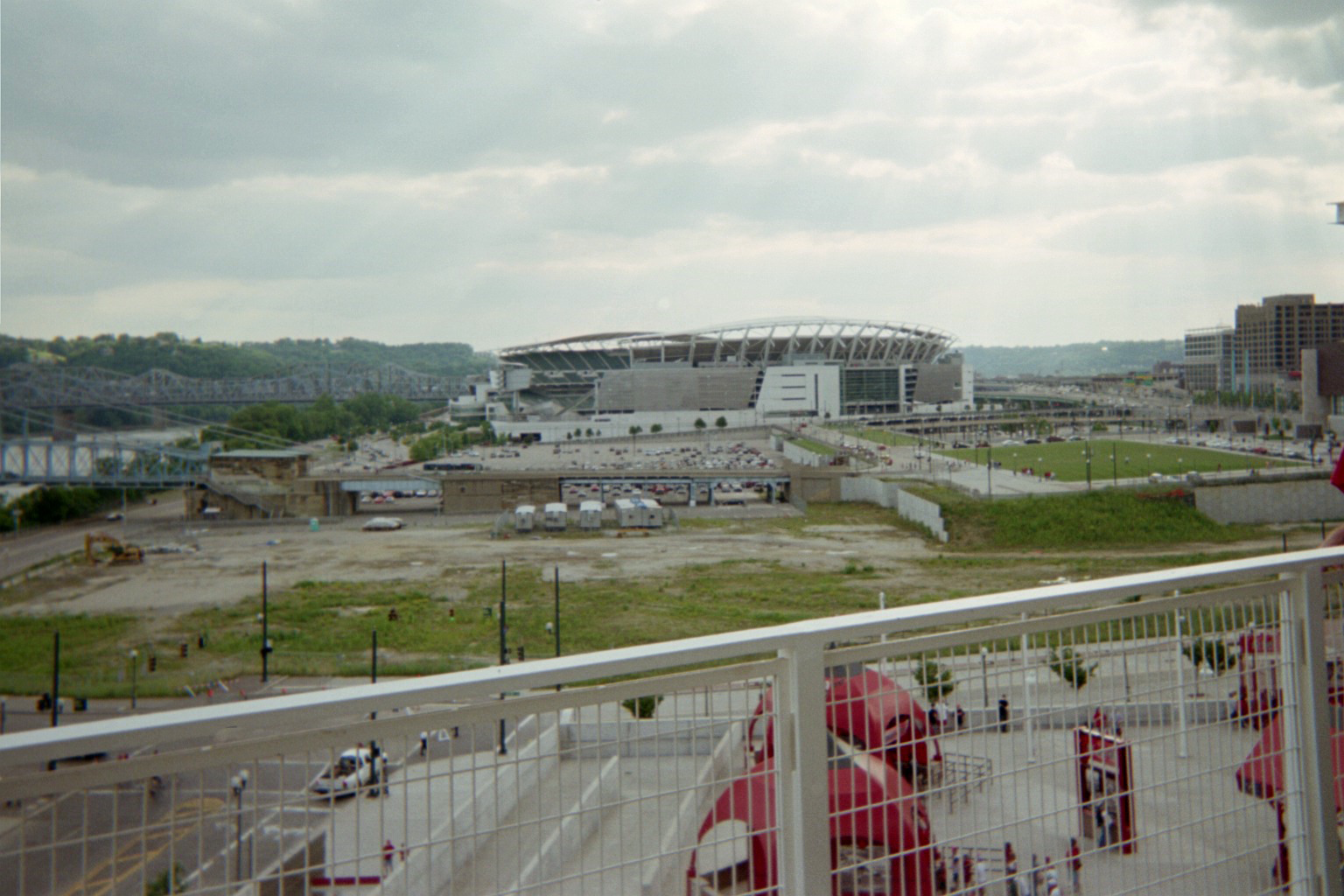
When the Bengals moved to Paul Brown Stadium in 2000, the Reds were left as Riverfront Stadium’s only tenant. Prior to the 2001 baseball season, the stadium was remodeled into a baseball-only configuration, and the artificial turf surface was replaced with natural grass.
To allow room for the construction of Great American Ball Park, which was being built largely over the grounds the stadium already sat on, a large section of the left and center field stands was removed and the distance to the fences was shortened by 5 ft. The new and old stadium were 26 in apart at their closest point during this time. A 40 ft wall was built in deep center field to prevent easy home runs and to serve as a batter's eye. It was nicknamed the "Black Monster", a play on the Green Monster at Fenway Park in Boston.
In the Reds' final two seasons in the stadium, ongoing construction on Great American was plainly visible just beyond the outfield walls while the team played their games. The stadium's final game was played on September 22, 2002, as the Reds lost, 4–3, to the Philadelphia Phillies before a crowd of 40,964. Reds third baseman Aaron Boone hit the final home run in Riverfront's history in the loss, an eighth-inning solo home run off Phillies reliever Dan Plesac.
The stadium was demolished by implosion on December 29, 2002. Part of the former Riverfront Stadium site is now occupied by Great American Ball Park (which opened the following April) and the National Underground Railroad Freedom Center, along with several mixed-use developments and parking facilities. A small portion of the site is now occupied by the Reds' Hall of Fame and Museum and Main Street, which was extended when the new park was built and when the old park was demolished.
Seating capacity
| Cincinnati Reds}};" | Years | Cincinnati Reds}};" | Capacity | Cincinnati Reds}};" | 1970 | Cincinnati Reds}};" | 1971 | Cincinnati Reds}};" | 1972–1974 | Cincinnati Reds}};" | 1975–1983 | Cincinnati Reds}};" | 1984–1991 | Cincinnati Reds}};" | 1992–2000 | Cincinnati Reds}};" | 2001–2002 |
|---|---|---|---|---|---|---|---|---|---|---|---|---|---|---|---|---|---|
| 51,500 | |||||||||||||||||
| 51,744 | |||||||||||||||||
| 51,726 | |||||||||||||||||
| 51,786 | |||||||||||||||||
| 52,392 | |||||||||||||||||
| 52,952 | |||||||||||||||||
| 40,007 |
| Cincinnati Bengals}};" | Years | Cincinnati Bengals}};" | Capacity | Cincinnati Bengals}};" | 1970–1980 | Cincinnati Bengals}};" | 1981–1991 | Cincinnati Bengals}};" | 1992–1999 |
|---|---|---|---|---|---|---|---|---|---|
| 56,200 | |||||||||
| 59,754 | |||||||||
| 60,389 |
Attendance records
Bold indicates the winner of each game.
Baseball
| Cincinnati Reds}};" | Rank | Cincinnati Reds}};" | Attendance | Cincinnati Reds}};" | Date | Cincinnati Reds}};" | Game result | Cincinnati Reds}};" | Notes | 1 | 2 | 3 | 4 | 5 |
|---|---|---|---|---|---|---|---|---|---|---|---|---|---|---|
| 56,393 | October 16, 1975 | Reds 6, Red Sox 2 | 1975 World Series, Game 5 | |||||||||||
| 56,079 | October 12, 1990 | Reds 2, Pirates 1 | 1990 NLCS, Game 6 | |||||||||||
| 56,040 | October 22, 1972 | Athletics 3, Reds 2 | 1972 World Series, Game 7 | |||||||||||
| 55,832 | October 17, 1990 | Reds 5, Athletics 4 (10) | 1990 World Series, Game 2 | |||||||||||
| 55,830 | October 16, 1990 | Reds 7, Athletics 0 | 1990 World Series, Game 1 |
- The 1988 All-Star Game had an attendance of 55,837
Football
| Cincinnati Bengals}};" | Rank | Cincinnati Bengals}};" | Attendance | Cincinnati Bengals}};" | Date | Cincinnati Bengals}};" | Game result | 1 | 2 | 3 | 4 | 5 |
|---|---|---|---|---|---|---|---|---|---|---|---|---|
| 60,284 | October 17, 1971 | Bengals 24, Browns 27 | ||||||||||
| 60,157 | December 20, 1970 | Bengals 45, Patriots 7 | ||||||||||
| 60,099 | October 10, 1970 | Bengals 13, Dolphins 23 | ||||||||||
| 60,084 | December 9, 1990 | Bengals 17, 49ers 20 | ||||||||||
| 60,067 | November 4, 1990 | Bengals 7, Saints 21 |
Milestones
Baseball

- First stadium to have its entire field covered by AstroTurf, except for the cutouts around the bases and pitcher's mound.
- First hit: Félix Millán, June 30, 1970.
- First home run: Hank Aaron, June 30, 1970.
- First Presidential Visit: Richard Nixon, July 14, 1970.
- First upper deck home run: Tony Pérez, August 11, 1970.
- First World Series game ever played on artificial turf: October 10, 1970 (Reds vs. Baltimore Orioles).
- First no-hitter: Ken Holtzman, June 3, 1971.
- First pitcher ever to pitch a no-hitter and hit two home runs in the same game: Rick Wise, June 23, 1971.
- Hank Aaron ties the all-time home run record with number 714: April 4, 1974.
- First stadium to display metric distances on the outfield walls (100.58 meters down the lines, 114.30 to the alleys, 123.13 to center): 1976.
- Highest season attendance, 2,629,708: 1976.
- First rain checks issued: August 30, 1978.
- First player to hit for the cycle: Mike Easler, June 12, 1980.
- Pete Rose breaks the all-time hit record with number 4,192: September 11, 1985.
- First player ever to be caught stealing four times in one game: Robby Thompson, June 27, 1986.
- Perfect Game: Tom Browning, September 16, 1988.
- Umpire John McSherry collapsed and died on April 1, 1996.
- Ray Lankford hits two upper-deck home runs on July 15, 1997, becoming the only player to do so in the stadium's history to that point.
- Longest home run, 473': Mark McGwire, May 5, 2000.
Football
- First touchdown: Sam Wyche, September 20, 1970
- First Field goal: Horst Muhlmann, September 20, 1970
- Freezer Bowl: lowest wind-chill (2nd lowest temperature) in NFL history, January 10, 1982
- Steve Largent becomes the first player in NFL History to catch 100 TD's in career, December 10, 1989.
- Corey Dillon breaks the single-game rookie rushing record with 246 yards on December 4, 1997.
Concerts
| Date | Artist | Opening act(s) | Tour / Concert name | Attendance | Revenue | Notes |
|---|---|---|---|---|---|---|
| August 4, 1976 | Jethro Tull | — | Too Old To Rock 'N' Roll Tour | — | — | |
| August 16, 1978 | The Eagles | Eddie Money | ||||
| The Steve Miller Band | Hotel California Tour | 51,855 | — | |||
| September 14, 1989 | The Rolling Stones | Living Colour | Steel Wheels Tour | 53,555 / 53,555 | $1,522,536 | |
| July 10, 1990 | New Kids on the Block | Perfect Gentlemen | The Magic Summer Tour | 48,000 / 48,000 | — | |
| May 5, 1993 | Paul McCartney | — | The New World Tour | 38,000 / 40,000 | $1,156,513 | |
| August 30, 1994 | The Rolling Stones | Lenny Kravitz | Voodoo Lounge Tour | 34,137 / 55,000 | — | |
| May 21, 2000 | George Strait | Asleep at the Wheel | ||||
| Lee Ann Womack | ||||||
| Mark Chesnutt | ||||||
| Kenny Chesney | ||||||
| Martina McBride | George Strait Country Music Festival | 42,000 | — | |||
| July 14, 2000 | 'N Sync | Sisqo | ||||
| P!nk | No Strings Attached Tour | 48,234 / 48,234 | $2,091,097 | |||
| June 6, 2001 | 'N Sync | Dream | Pop Odyssey Tour | 36,371 / 42,285 | $1,947,461 |
- The Kool Jazz Festival (now the Macy's Music Festival) was an annual fixture.
Religious gatherings
- The Jehovah's Witnesses hosted three conventions in the stadium, in 1971, 1974 and 1978.
- Promise Keepers held a meeting there in 1997.
Gallery
File:Redsvscubs.jpg|Riverfront Stadium during a Cincinnati Reds game vs. the Chicago Cubs on May 23, 1988 File:Riverfront Stadium Cincinnati Ohio 1974.jpg|Riverfront Stadium in July 1974 File:Riverfront stadium.jpg|Riverfront Stadium in 1992 File:Cinergy Field on April 27, 2001 with Great American Ballpark under construction in Cincinnati, Ohio.jpg|Riverfront Stadium during a Cincinnati Reds game vs. the New York Mets on April 27, 2001
References
Sources
- Dittmar, Joseph J. (1997). Baseball Records Registry: The Best and Worst Single-Day Performances and the Stories Behind Them. McFarland & Company.
- Munsey & Suppes (1996–2004). Riverfront Stadium. Ballparks.
- Smith, Ron (2000). Riverfront Stadium. The Ballpark Book. The Sporting News.
- Riverfront Stadium Opens. BaseballLibrary.com.
References
- "Atlanta Braves at Cincinnati Reds Box Score, June 30, 1970". [[Baseball-Reference.com]].
- "Riverfront Stadium - history, photos and more of the Cincinnati Reds former ballpark".
- [https://books.google.com/books?id=xVQEAAAAMBAJ&dq=gte+%22metalarc%22+riverfront+stadium&pg=PA22 General Telephone & Electronics (GTE) print advertisement in the April 14, 1972 issue of ''LIFE'' (magazine).] Retrieved February 25, 2023.
- (September 20, 1970). "UC fends off Flyers' swoops to win, 13–7". The Cincinnati Enquirer.
- (November 9, 1975). "Major upset barely missed by Bearcats". The Cincinnati Enquirer.
- (September 12, 1982). "Bearcats breeze as Barrett hits four TD passes". The Cincinnati Enquirer.
- (October 10, 1982). "Cincinnati beats Long Beach". The Daily Breeze.
- (November 14, 1982). "Morgan State routed by Cincinnati 52–0". The Daily Times.
- (November 19, 1982). "Cincy tops Redskins". The Bryan Times.
- Flynn, Terry. (October 2, 1983). "UC Lets Cornell Off with 48–20 Beating". [[The Cincinnati Enquirer]].
- (October 9, 1983). "Cincinnati sends Temple reeling to fourth loss, 31–16". The Philadelphia Inquirer.
- (October 23, 1983). "Strange doings don't stop Miami, 17–7". The Orlando Sentinel.
- (November 6, 1983). "Erring Rutgers falls to Cincinnati, 18–7". The Star-Ledger.
- (November 13, 1983). "Cincinnati demolished". The Tennessean.
- (October 14, 1984). "'Canes hold big 4th-quarter lead vs. Cincinnati". St. Petersburg Times.
- (October 28, 1984). "Taylor runs wild as UC routs Louisville 40–21". The Park City Daily News.
- (November 18, 1984). "Listless Tide strong enough to sink 'Cats". The Cincinnati Enquirer.
- (November 23, 1984). "Miami outlasts UC in shoot-out". The Cincinnati Post.
- (October 6, 1985). "Owls collect second victory". The Record.
- (October 27, 1985). "UC defense holds off Boston Col.". The Cincinnati Enquirer.
- (November 10, 1985). "No. 2 Penn State sinks Cincinnati". Sunday Press.
- Tom Groeschen. (September 14, 1986). "UC outslugs rival Miami in thriller: Taylor rushes for 259 yards to lead UC to 45–38 win". The Cincinnati Enquirer.
- (September 28, 1986). "Interceptions ruin UC, 37–20". The Cincinnati Enquirer.
- (October 25, 1987). "Hurricanes run over Cincinnati 48–10". The Palm Beach Post.
- Groeschen, Tom. (November 6, 1988). "W. Virginia survives mild UC uprising". The Cincinnati Enquirer.
- (September 3, 1990). "Freshman gives BG a big lift". The Plain Dealer.
- (September 23, 1990). "Zimmer comes through on cue as Miami jolts UC, 16–12". Dayton Daily News.
- (November 4, 1990). "Cummings catches Louisville's spirit". The Paducah Sun.
- "2009 University of Cincinnati Football Media Guide". gobearcats.com.
- Erardi, John. (April 2, 2001). "Players like new look at old ballpark". [[The Cincinnati Enquirer]].
- "Philadelphia Phillies at Cincinnati Reds Box Score, September 22, 2002". [[Baseball-Reference.com]].
- (September 19, 1970). "Capsule Preview of NFL Games". Boston Globe.
- (January 9, 1982). "Expect Good Game". Bryan Times.
- [http://www.setlist.fm/setlist/paul-mccartney/1993/riverfront-stadium-cincinnati-oh-73d242ed.html Paul McCartney Setlist Riverfront Stadium, Cincinnati, Ohio, USA on 5 May 1993]
This article was imported from Wikipedia and is available under the Creative Commons Attribution-ShareAlike 4.0 License. Content has been adapted to SurfDoc format. Original contributors can be found on the article history page.
Ask Mako anything about Riverfront Stadium — get instant answers, deeper analysis, and related topics.
Research with MakoFree with your Surf account
Create a free account to save articles, ask Mako questions, and organize your research.
Sign up freeThis content may have been generated or modified by AI. CloudSurf Software LLC is not responsible for the accuracy, completeness, or reliability of AI-generated content. Always verify important information from primary sources.
Report