From Surf Wiki (app.surf) — the open knowledge base
River Tees
East coast river of Northern England
East coast river of Northern England
| Field | Value | |
|---|---|---|
| name | River Tees | |
| name_etymology | ||
| image | High Force waterfall showing twin falls. Teesdale, England.jpg | |
| image_caption | High Force on the River Tees | |
| map | Tees (rivière).png | |
| map_size | 250 | |
| map_caption | Course of the Tees http://u.osmfr.org/m/375509/ | |
| mapframe | yes | |
| mapframe-zoom | 7 | |
| <!---------------------- LOCATION --> | subdivision_type1 | Country |
| subdivision_name1 | England | |
| subdivision_type3 | County | |
| subdivision_name3 | {{unbulleted list | |
| subdivision_name5 | ||
| length | 137 km | |
| discharge1_max | ||
| source1_location | Cross Fell | |
| source1_coordinates | ||
| source1_elevation | 754 m | |
| mouth | North Sea | |
| mouth_location | between Seal Sands and Redcar | |
| mouth_coordinates | ||
| mouth_elevation | 0 m | |
| basin_size | 1834 km2 | |
| tributaries_left | Harwood Beck, Hudeshope Beck, | |
| Eggleston Burn, Skerne, Billingham Beck | ||
| tributaries_right | Maize Beck, Lune, Balder, Greta, Leven |
| mapframe-zoom = 7 |County Durham |North Yorkshire |Yorkshire (historical) |Cumbria |Cumberland (historical) |Westmorland (historical) Eggleston Burn, Skerne, Billingham Beck
The River Tees (), in England, rises on the eastern slope of Cross Fell in the North Pennines and flows eastwards for 85 mi to reach the North Sea in the North East of England. The modern-day history of the river has been tied with the industries on Teesside in its lower reaches, where it has provided the means of import and export of goods to and from the North East England. The need for water further downstream also meant that reservoirs were built in the extreme upper reaches, such as Cow Green.
Etymology
The name Tees is possibly of Brittonic origin. The element *tēs, meaning "warmth" with connotations of "boiling, excitement" (Welsh tes), may underlie the name. *Teihx-s, a root possibly derived from Brittonic *ti (Welsh tail, "dung, manure"), has also been used to explain the name Tees (compare River Tyne).
Geography
The river drains 710 sqmi and has a number of tributaries including the River Greta, River Lune, River Balder, River Leven and River Skerne. Before the reorganisation of the historic English counties, the river formed the boundary between County Durham and Yorkshire. In its lower reaches it now forms the boundary between the ceremonial counties of County Durham and North Yorkshire, while in the highest part of its course it forms the boundary between the historic counties of Westmorland and Durham. The head of Teesdale (the name of valley especially at this end), has a desolate grandeur, surrounded by moorland and hills, some exceeding 2500 ft. This area is part of the North Pennine Area of Outstanding Natural Beauty.
The source of the river at Teeshead just below Cross Fell is at an elevation of about 2401 ft. It flows east-north-east through an area of shake holes through carboniferous limestone. Below Viewing Hill, it turns south to the Cow Green Reservoir constructed to store water to be released in dry conditions to satisfy the industrial need for water on Teesside.
Emerging from the reservoir at Cauldron Snout the river traverses a series of hard black basalt and dolerite rocks that intrude through the softer limestone, in a succession of falls or rapids. From this point downstream the Tees forms the boundary between the traditional counties of Durham and Yorkshire almost without a break, although since 1974 much of it is wholly in Durham. The dale widens below Cauldron Snout, and trees appear, contrasting with the broken rocks where the water descends over High Force. After a short turn northwards, the river continues to meander south-easterly. Close to where the B6277 road begins to run parallel to the river is the 21 m High Force waterfall. About 1+1/2 mi downstream is the smaller Low Force waterfall.
The scenery becomes gentler and more picturesque as the river descends past Middleton-in-Teesdale (Durham). This locality has lead and ironstone resources. Just to the east of Middleton-in-Teesdale, the River Lune joins the Tees. After passing the village of Romaldkirk to the west, the river is joined by the River Balder at Cotherstone. The ancient town of Barnard Castle, Egglestone Abbey, and Rokeby Park, known through Sir Walter Scott's poem Rokeby, are all passed. At Rokeby the Tees is joined by the River Greta. From the area near Eggleston, the river is crossing over millstone grit. From here the valley begins to open out, and traverses the rich plain east and south of Darlington in large meandering curves.
The course of the valley down to here has been generally east-south-east, but it now turns north-east near the village of Whorlton. Passing Ovington and Winston it runs parallel to the A67 south-east past Gainford and Piercebridge to Darlington, passing under the A1 and A66. The section from Piercebridge to Hurworth flows over magnesian limestone. It is at Croft-on-Tees that the River Skerne joins the Tees. The river now flows south past Croft-on-Tees before swinging northwards past Hurworth-on-Tees. A series of large meanders takes the course past Neasham, Low Dinsdale and Sockburn to Middleton St George. In the lower reaches of the river valley the water flows over bunter sandstone and pebble beds.
Just past Yarm, the River Leven joins the Tees, before passing the settlements of Eaglescliffe, Ingleby Barwick and Thornaby-on-Tees. Now nearing the sea, the Tees becomes an important commercial waterway, with the ports of Stockton-on-Tees and Middlesbrough on its banks. It passes through the Tees Barrage between these ports, turning tidal downstream from the barrage.
Teesport is built on reclaimed land on the south side of the Tees estuary below Middlesbrough. A direct line from the source of the Tees to Teesmouth is 50 mi, but due to the meandering of the river, it flows for over 80 mi.
Water levels
| Monitoring station | Station elevation | Low water level | High water level | Record high level |
|---|---|---|---|---|
| Middleton-on-Tees | 216 m | 0.37 m | 1.5 m | 3.19 m |
| Barnard Castle (Startforth) | 141 m | 0.46 m | 1.4 m | 2.68 m |
| Broken Scar (Darlington) | 41 m | 0.54 m | 1.7 m | 3.28 m |
| Low Moor (Low Dinsdale) | 18 m | 0.31 m | 4 m | 6.32 m |
| Yarm | 7 m | 0.45 m | 2.05 m | 4.08 m |
- Low and high water levels are an average figure.
Seal Sands
Main article: Seal Sands
Before the heavy industrialisation of the Tees, the flats at Seal Sands in the estuary were home to common seals. For around 100 years this species was absent from the estuary but have now returned and can be seen on the flats at Seal Sands. The Seal Sands area is now designated as the Teesmouth National Nature Reserve.
Alterations
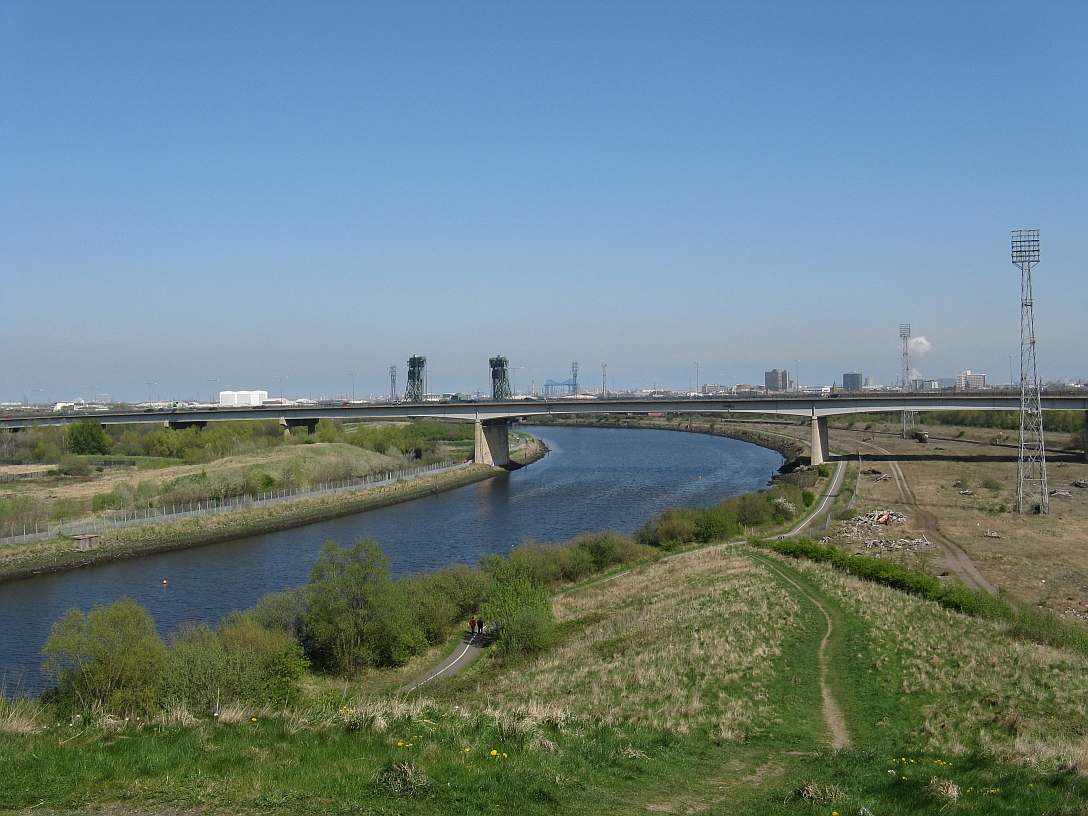
A proposal was made in 1769 to make cuts in the river which would straighten the course and enable ships to save time and money in navigation. Between Stockton-on-Tees and Middlesbrough, the river previously meandered first south and then north of its current channel. Two "cuts", known as the Mandale Cut and the Portrack Cut, were made to straighten its course in 1810 and 1831 respectively. Before these cuts were made, the journey by sailing barge from Thornaby to the mouth of the Tees, allowing for tides and other factors, could take as long as seven days. The Mandale Cut was the shorter of the two, at about 220 yd, with the Portrack Cut being considerably longer (1,100 yard), although the northern meander it removed was smaller than the southern meander. Neither meander is visible today, except for the flow of Stainsby Beck into a waterway which is marked on maps first as "The Fleet" and then "Old River Tees". The current Tees Barrage is close to the site of the Mandale Cut.
Since the cuts were made, the river has continued to undergo alterations to its bed and banks to make it deeper and more navigable. The channel has been made considerably narrower by dumping ship's ballast and ironworks slag along the former banks, increasing the scouring due to its natural flow. Maps made prior to 1900 show that between Stockton and Middlesbrough the river flowed in a channel up to 330 yd wide in places, with many shoals and sandbars. The modern channel varies between about 110 yd and 220 yd.
In October 2021 the UK engineering company, GRAHAM, started work on the 1.2 km South Bank Quay project to provide a deep water facility. It is expected that two million tonnes of material will be dredged to allow GE Renewable Energy to load huge wind turbine blades onto ships. The 107 m long blades are destined for the Dogger Bank wind farm. The Heavy Fuel Oil Farm and Tarmac jetties are to be removed.
Industry
The River Tees has been used for transporting industrial goods since the Industrial Revolution, particularly for the shipment of coal from the Durham Coalfields and also for the steel industries that later developed around Middlesbrough. In the early years merchant ships left the River Tees after loading in Yarm and Stockton on Tees; but as merchant ships became bigger, these smaller docks were superseded by bigger and deeper docks in Middlesbrough, and later even further downstream at Teesport close to the mouth of the River Tees. The emergence of the Steel industry in the late 19th century earned it the nickname "The Steel River" owing to the many steelworks that operated along the banks of the Tees. In the 20th century the river also became important to the developing chemical industry, contributing particularly to the development of Imperial Chemical Industries (ICI) who used reclaimed land on the north bank for import/export facilities.
The move to loading coal on bigger ships in Middlesbrough was the economic driver for the development not only of the town of Middlesbrough itself but also of the railway between Stockton and Darlington. This is where George Stephenson developed his railway engine "Locomotion" and this railway was the first steam railway to carry passengers, as well as industrial materials. The Stockton and Darlington Railway was founded after an initial shareholders' meeting in a room in a public house in Yarm.
Today Teesport is owned by PD Ports; it is located close to the North Sea and 3 mi east of Middlesbrough. Teesport is currently the third largest port in the United Kingdom, and among the ten biggest in Western Europe, handling over 56 million tonnes of domestic and international cargo per year. The vast majority of these products are still related to the steel and chemical industries made by companies that are members of the Northeast of England Process Industry Cluster (NEPIC). The areas where large scale commodity chemical industry continues to be based are Billingham and Seal Sands, both on the north bank of the River Tees, and Wilton on the south bank. The Teesside Steelworks at Redcar operated until closure in 2015.
Other industrial companies that use the River Tees are manufacturing and servicing the North Sea oil and gas industry as well as the renewable energy industry sector, including offshore wind turbines. The south bank of the mouth of the River Tees has the 62-megawatt Teesside Offshore Wind Farm, built 2011–13.
Near the mouth of the River Tees is the large dry dock facility of ABLE UK, named TERRC (Teesside Environmental Reclamation and Recycling Centre), used to dismantle or oil rigs and other large vessels. Hartlepool Nuclear Power Station is adjacent to the east.
2021 North-East England shellfish die-off
Main article: 2021 North-East England shellfish die-off
In early October 2021 thousands of dead crabs and lobsters were washed up on the Tees estuary and beaches along the North-East coast of England. The deaths were first reported in Seaton Carew, Redcar and Seaham. A 95% decline in the lobster and crab catch was noticed by those employed in the local fishing industry. A spokesperson for the UK Environment Agency said, "Samples of water, sediment, mussel and crab have been collected and are being sent to our labs for analysis to consider whether a pollution incident could have contributed to the deaths of the animals." The Centre for Environment, Fisheries and Aquaculture Science (Cefas) labs were also testing crustaceans for disease. There is no evidence of any link to recent strandings of marine mammals and seabirds across the UK and countries along the North Sea coast, according to the EA.
By late November the crustacean die-off had spread as far south as Robin Hood's Bay and was affecting catches in Whitby. The Environment Agency has ruled out chemical pollution as the cause of the mass shellfish deaths. Dredging was also rejected as the cause of the environmental disaster. Environment Agency operations manager Sarah Jennings said, "We've used both traditional and innovative screening methods to analyse samples of water, sediment and crab looking for traces of contamination. We’ve screened for over 1,000 potential chemical contaminants but found no anomalies that could lead to an event of this scale."
In early February 2022 it was reported that, "Defra and partner agencies have completed a thorough investigation of the cause of dead crabs and lobsters which were found washed up on the North East coast between October and December 2021. Following significant testing and modelling to rule out possible causes, Defra and partner agencies consider that the deaths of the crabs and lobsters potentially resulted from a naturally occurring harmful algal bloom." In June 2022 George Monbiot wrote in The Guardian, "Astonishingly, although there is no evidence that it conducted such sampling, the government concluded not only that a bloom had occurred, but that it was caused by a particular, toxic species: Karenia mikimotoi. This is the stuff of science fiction. Karenia thrives in temperatures between 20 and 24 C. The average water temperature on this coast in October is 13 C. There is no plausible mechanism by which a Karenia bloom could cause the mass death of lobsters and crabs without also killing large numbers of fish, sea urchins and many other species." Monbiot reported that when he asked the UK government to publish its evidence the government refused.
Legends and folklore
Peg Powler is a hag in English folklore who is said to inhabit the River Tees.
In popular culture
The River Tees was featured in the television series Seven Natural Wonders as one of the wonders of the North, and in the post-apocalyptic drama The Last Train having blown its banks.
Crossings
Gallery
Yarm Viaduct - geograph.org.uk - 6000189.jpg|Yarm Viaduct Infinity Bridge.jpg|Infinity Bridge Tees Barrage-Tower of lights-1088.jpg|Tees Barrage with White Water course in background Tees Newport Bridge-1200.jpg|Tees Newport Bridge Tees Transporter Bridge, Middlesbrough.jpg|Tees Transporter Bridge
References
Notes
Citations
Sources
- {{cite web|last1= James|first1= Alan G.|title= The Brittonic Language in the Old North, A Guide to the Place-Name Evidence, Volume 2 |access-date= 1 January 2023}}
References
- [https://www.bbc.co.uk/tees/features/tees_trail/index.shtml "BBC Where I Live"] – BBC. Retrieved 2 March 2007.
- (16 April 2018). "Cow Green reservoir".
- "Environment Agency Tees Salmon Action Plan Map Page 4".
- "OpenData support | OS Tools & Support".
- [http://www.environment-agency.gov.uk/hiflows/station.aspx?25008 Tees at Barnard Castle in Dales Area – Artificial influences]
- "Upper Teesdale Geology".
- "BBC – Seven Wonders – High Force".
- "Tees Valley Geology".
- "Tees Dock; the Heart of Teesport".
- (1986). "The book of Middlesbrough". Barracuda Books.
- "River levels".
- [https://web.archive.org/web/20100322231211/http://www.naturesworld.org.uk/old/tees/map.htm "Natures World"] Natures World Tees Feature
- "Cleveland's National Nature Reserves".
- (1957). "A History of Yarm; an Ancient North Riding Town". Wardell.
- (18 May 2019). "Where and what is Middlesbrough?". BBC News.
- "Tees Navigation Company".
- The History of the River Tees in Maps, 3rd. Ed. (2001), D. W. Pattenden, published by Cleveland and Teesside Local History Society {{ISBN. 0-9507199-6-X
- (30 September 2021). "Construction starts on Quayside for the UK's premier offshore wind hub".
- (6 October 2021). "Creating UK's premier offshore wind hub through dredging".
- (February 2019). "Industrial Teesside, lives and legacies: a post-industrial geography". Planning Perspectives.
- (2018). "Industry in the Tees Valley". Tees Valley Rediscovered.
- (23 June 2015). "Teesport gets fit for next generation as £22m upgrade takes shape". Gazette Live.
- (12 August 2016). "MGT Power Q&A: All you need to know about Teesside energy plant". Gazette Live.
- (12 October 2015). "SSI Redcar steelworks to be shut". BBC News.
- (7 June 2013). "EDF fully equips 62-MW offshore wind farm in UK – report". Renewables Now.
- (23 November 2010). "Able UK's TERRC yard on Teesside". BBC News.
- (October 2010). "Appraisal of Sustainability: Site Report for Hartlepool".
- Davies, Caroline. (29 October 2021). "'Apocalyptic': dead crabs litter beaches in north-east England".
- Newton, Grace. (26 November 2021). "Environment Agency confirm dead crabs and lobsters washed up on Yorkshire beaches were not killed by pollution".
- Blackburne, Elaine. (3 February 2022). "Reason behind deaths of thousands of shellfish on North East beaches". HullLive.
- (3 February 2022). "North East coast shellfish deaths blamed on harmful algae". BBC News.
- Monbiot, George. (6 June 2022). "Are the dead shellfish littering our beaches evidence of a toxic waste cover-up? {{!}} George Monbiot".
- O'Donnell, Elliot. (2003). "Ghosts, Helpful and Harmful (1924)". Kessinger Publishing.
- Longstaffe, William Hylton Dyer. (1854). "The History and Antiquities of the Parish of Darlington, in the Bishoprick". Darlington and Stockton Times.
- Roalfe Cox, Marian. (2003). "Introduction to Folklore (1904)". Kessinger Publishing.

This article was imported from Wikipedia and is available under the Creative Commons Attribution-ShareAlike 4.0 License. Content has been adapted to SurfDoc format. Original contributors can be found on the article history page.
Ask Mako anything about River Tees — get instant answers, deeper analysis, and related topics.
Research with MakoFree with your Surf account
Create a free account to save articles, ask Mako questions, and organize your research.
Sign up freeThis content may have been generated or modified by AI. CloudSurf Software LLC is not responsible for the accuracy, completeness, or reliability of AI-generated content. Always verify important information from primary sources.
Report