From Surf Wiki (app.surf) — the open knowledge base
River Seven
River in North Yorkshire, England
River in North Yorkshire, England
| Field | Value |
|---|---|
| name | River Seven |
| image | River Seven Weir - geograph.org.uk - 1150202.jpg |
| image_caption | The Seven near Normanby |
| pushpin_map | North Yorkshire |
| pushpin_map_caption | Location of the mouth within North Yorkshire |
| subdivision_type1 | Country |
| subdivision_name1 | England |
| subdivision_type3 | Counties |
| subdivision_name3 | North Yorkshire |
| length | 25 km |
| discharge1_location | Normanby |
| discharge1_avg | 1.6 m3/s |
| source1_location | Rosedale Head |
| mouth | Rye at Brawby |
| mouth_coordinates |
The River Seven is a river in North Yorkshire, England. It rises on Danby High Moor, in the middle of the North York Moors, and flows south for about 15 mi to meet the River Rye, at Brawby.
Name
Reeking Gill is a tributary of the River Seven and rises on Seavey Hill near Rosedale Head. During the medieval period sedges and rushes were known as "seaves", hence the origin of the name Seavey Hill.
The name Seven may derive from English dialect seave – " sedge, rush ". Another possibility is that the name arose from a common mistake whereby Anglo-Saxons confused Old Norse sef ( "sedge, rush" ) for Old English seofon ( "seven" ).{{efn|WiKtionary : Old Norse
- " sedge, rush ".}}{{efn|WiKtionary : Old English
- " seven ". }}
Examples of rivers that might share a similar etymology:
- River Seph, Bilsdale, North York Moors.
- River Severn (Welsh: Afon Hafren) (Sephern,1479).
Course
After leaving Danby High Moor, the river flows through Rosedale and passes Rosedale Abbey. In its lower course, it meanders due to interlocking spurs. A number of villages lie along the lower course of the River Seven. Some of these date from the 12th century or earlier, and likely none of them would exist if not for the river. For early settlers, the river may have been the only source of water and fertile land in its flood plains. They relied on the river for fishing, and washing. There are fossils in the sedimentary layers in the river, in the Jurassic layer of rock.{{cite web |access-date=7 January 2016}}
Geology
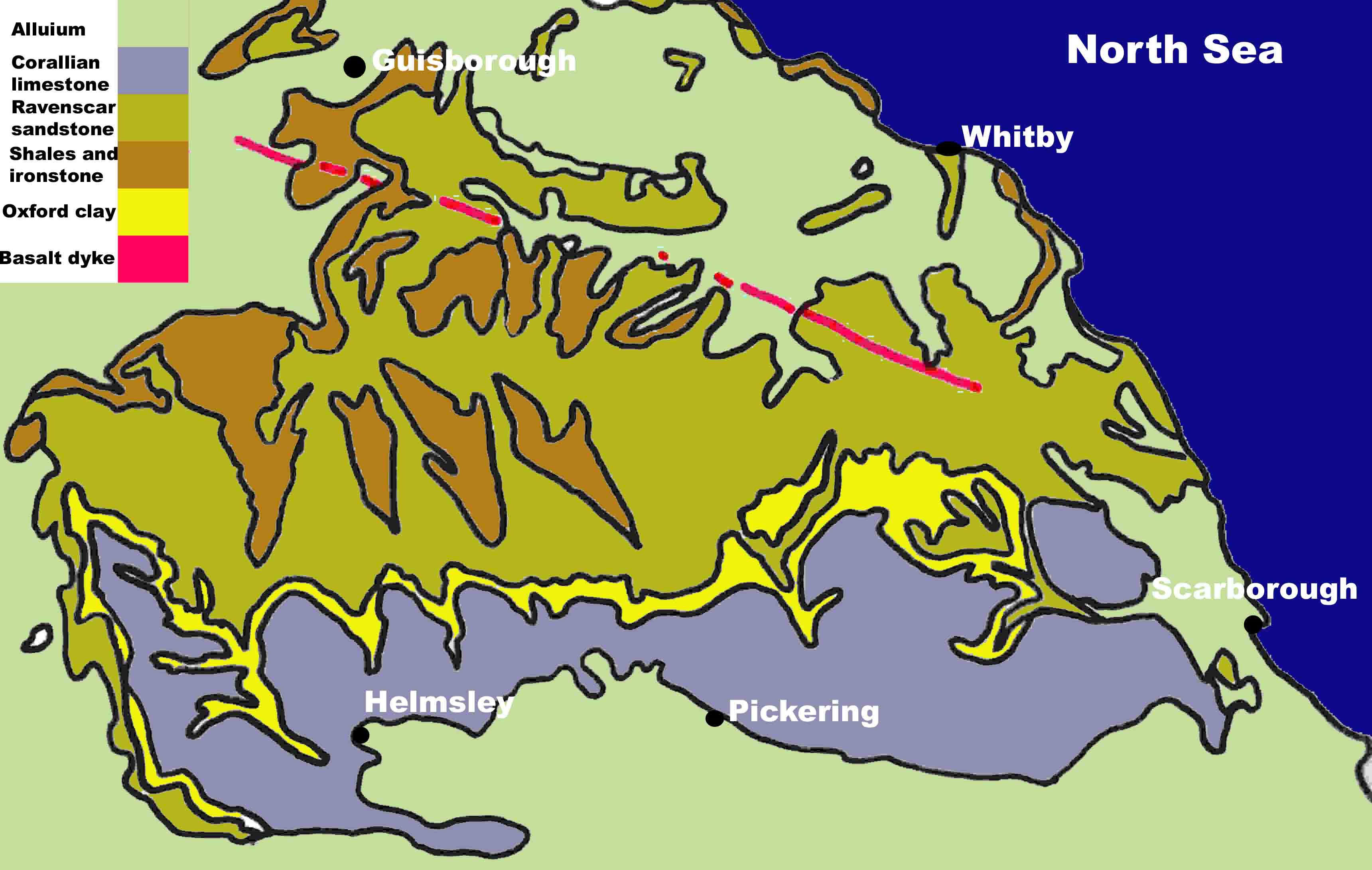
The River Seven is a small river, with not much influence on the geology of the area, although over time it has exposed various rock zones. The lacustrine deposits from the last ice age are exposed and visible in the bed of the river. There are three different time zones (periods) in the area.
- Lower Jurassic
- Middle Jurassic
- Upper Jurassic The rock types consist of : Corallian Limestone (top layer), Oxford Clay, Raven-scar Limestone and Shales and Ironstone.
These are split up depending on their rock band and type. Over time the North York Moors are sliding downhill: you can tell this from the new bands of rock visible in the northern regions.
Hydrology
Since 1974 the river levels and flows of the Seven have been measured at a weir near Normanby in its lower reaches. The forty year record shows that the catchment of 122 km2 to the gauging station yielded an average flow of 1.6 m3/s.
The catchment upstream of the station has an average annual rainfall of 875 mm and a maximum altitude of 433 m. Land use is primarily rural, made up of grassland, forest and moorland in the upper reaches.
The river has a natural flow regime, unaffected by direct artificial influences.
Settlements
- Thorgill
- Rosedale Abbey
- Cropton
- Appleton-le-Moors
- Sinnington
- Marton
- Normanby
- Great Barugh
- Brawby
References
Notes
Citations
References
- "27057 - Seven at Normanby Daily Flow Data". Centre for Ecology & Hydrology.
- "27057 - Seven at Normanby Spatial data". Centre for Ecology & Hydrology.
- "27057 - Seven at Normanby Station Information". Centre for Ecology & Hydrology.
This article was imported from Wikipedia and is available under the Creative Commons Attribution-ShareAlike 4.0 License. Content has been adapted to SurfDoc format. Original contributors can be found on the article history page.
Ask Mako anything about River Seven — get instant answers, deeper analysis, and related topics.
Research with MakoFree with your Surf account
Create a free account to save articles, ask Mako questions, and organize your research.
Sign up freeThis content may have been generated or modified by AI. CloudSurf Software LLC is not responsible for the accuracy, completeness, or reliability of AI-generated content. Always verify important information from primary sources.
Report