From Surf Wiki (app.surf) — the open knowledge base
Rio Grande Gorge
Canyon in New Mexico, United States
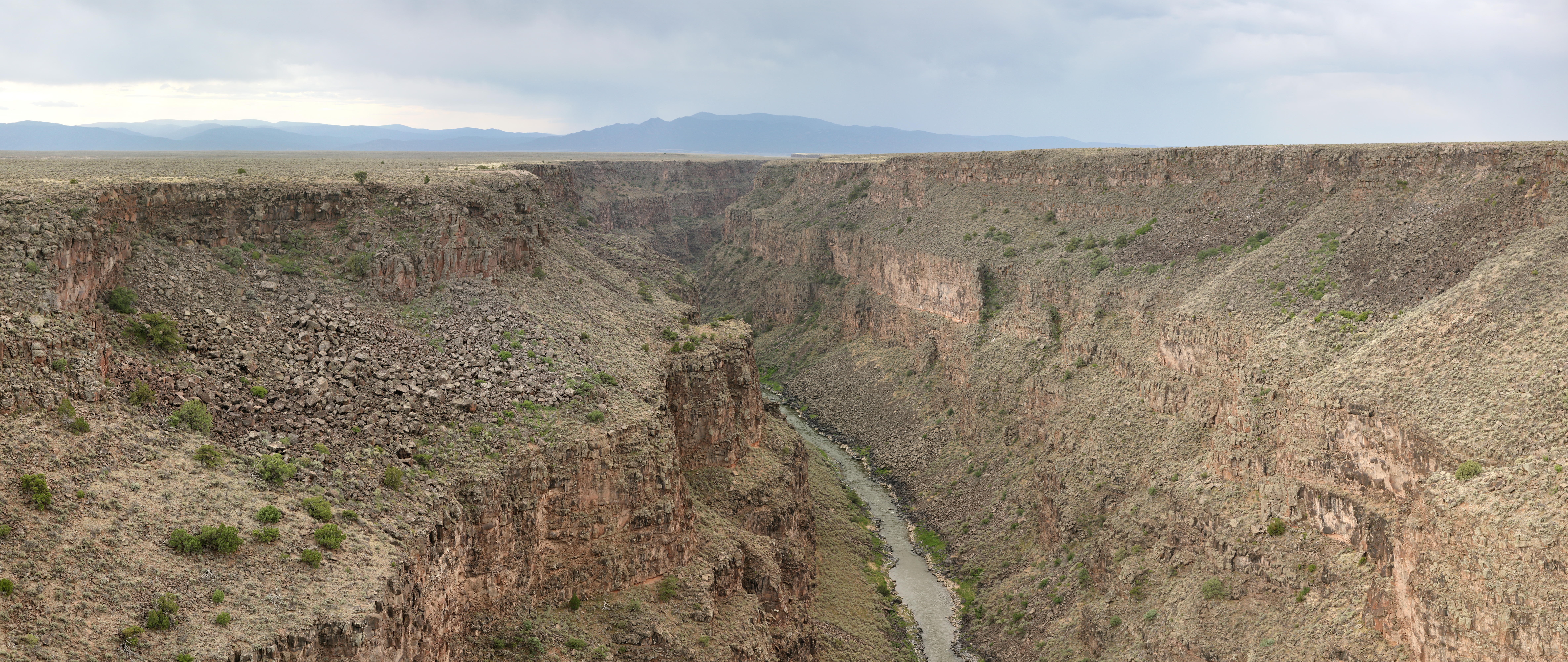
Canyon in New Mexico, United States
The Rio Grande Gorge is a geological feature in northern New Mexico where the watercourse of the Rio Grande follows an eroded chasm. Beginning near the Colorado border, the approximately 50 mi gorge runs from northwest to southwest of Taos, New Mexico, through the basalt flows of the Taos Plateau volcanic field. The gorge depth is 800 ft just south of the Rio Grande Gorge Bridge, which spans the gorge 10 mi northwest of Taos.
Geology


Geologically, the Rio Grande Gorge is a canyon, carved out by erosion over the last several million years. The Rio Grande Gorge and its river follow a topographical low within the larger Rio Grande Rift; a mixture of volcanic activity, shifting tectonic plates, and erosion of layers of gravels and lava yielded the recognizable narrow, deep gorge visible today.
Ecosystem
The canyon ecosystem descends 800 ft from rim to river, creating a unique diversity in plant and animal life. Ancient piñon and juniper forests are home to 500-year-old trees. Wildlife include mule deer, red-tailed hawk, mountain blue-bird, prairie dog and big horn sheep.
The climate is semi-arid with summer thunderstorms common in July and August, and snow possible from November through March. Summer temperatures range from 45 to and in winter from −15 to.
National Wild and Scenic River
In 1968, the Rio Grande was among the first eight rivers the US Congress designated into the National Wild and Scenic Rivers System to protect outstanding resources values. The Wild and Scenic River flows through the Rio Grande Gorge Recreation Area. The recreation areas include the Wild Rivers area in the north and the Orilla Verde area in the south, which provide hiking, boating, fishing and camping facilities.
Rio Grande del Norte National Monument
The gorge and 242500 acre of surrounding land was designated a national monument, Rio Grande del Norte National Monument, on March 25, 2013.
Whitewater
The gorge has Class II to Class V white water rapids that are managed for recreation by The U.S. Bureau of Land Management (BLM). The BLM maintains two developed recreation areas along the river that include hiking, biking and other recreational opportunities. In New Mexico, The Rio Grande has two main sections for rafting near Taos: the Taos Box and the Racecourse Run. The Taos Box, a more dramatic, deep canyon, is famous for its big, technical Class IV rapids, while the Racecourse Run is a Class III stretch better suited for first-time rafters and families.
History
The gorge is also the site of many ancient petroglyphs. At the bottom of the gorge, the Rio Grande is flanked by hidden hot springs and many ruins. The former Chili Line also ran there.
Astronaut Training

NASA geologically trained the Apollo Astronauts at the site in March and Sept. 1971, because of the striking similarities to the Apollo 15 landing site. Astronauts who would use this training on the Moon included Apollo 15's David Scott and James Irwin, Apollo 16's John Young and Charlie Duke, and Apollo 17's Jack Schmitt. Notable geologist instructors included William R. Muehlberger.
References
References
- "Rio Grande Rift Historical Marker". StateSign.
- Thompson, Linda. "The Rio Grande Gorge and the Geology That Formed It". Taos County Historical Society.
- "Taos Geologic Setting".
- "Geologic History of Taos".
- "Archived copy".
- (2019). "Pleistocene to recent geomorphic and incision history of the northern Rio Grande gorge, New Mexico: Constraints from field mapping and cosmogenic 3He surface exposure dating". Geosphere.
- "Wild Rivers Area of the Rio Grande Gorge". U.S. Department of the Interior Bureau of Land Management.
- "Rio Grande Wild and Scenic River". U.S. Department of the Interior Bureau of Land Management.
- "Orilla Verde Area of the Rio Grande Gorge". U.S. Department of the Interior Bureau of Land Management.
- "Rio Grande del Norte National Monument". Bureau of Land Management.
- "Rio Grande Whitewater Rafting Trips". Whitewater Rafting Guide to River Trips.
- (2015). "Science Training History of the Apollo Astronauts". NASA SP -2015-626.
This article was imported from Wikipedia and is available under the Creative Commons Attribution-ShareAlike 4.0 License. Content has been adapted to SurfDoc format. Original contributors can be found on the article history page.
Ask Mako anything about Rio Grande Gorge — get instant answers, deeper analysis, and related topics.
Research with MakoFree with your Surf account
Create a free account to save articles, ask Mako questions, and organize your research.
Sign up freeThis content may have been generated or modified by AI. CloudSurf Software LLC is not responsible for the accuracy, completeness, or reliability of AI-generated content. Always verify important information from primary sources.
Report