From Surf Wiki (app.surf) — the open knowledge base
Ring size
Tools for measuring ring and finger sizes
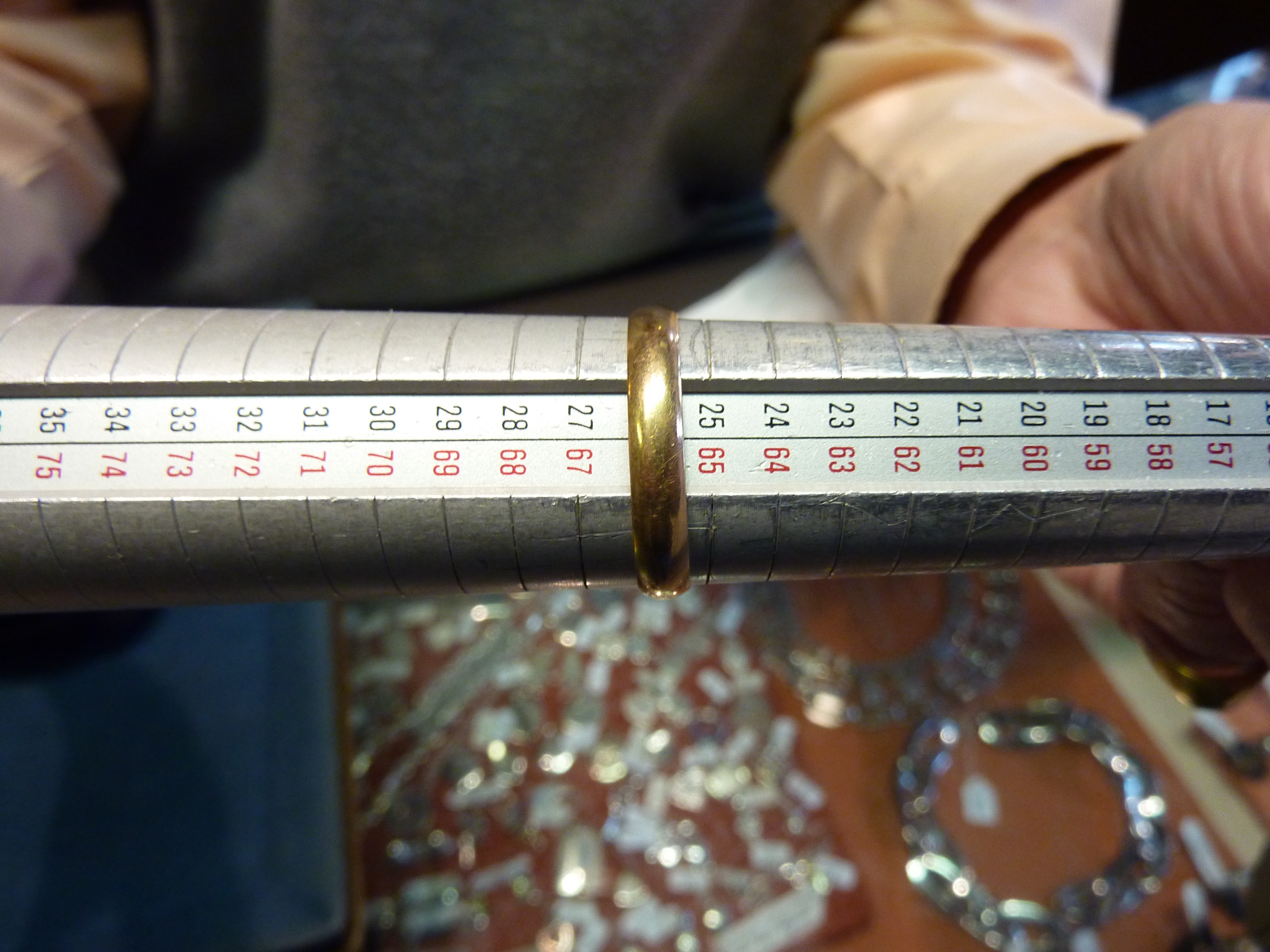
Tools for measuring ring and finger sizes
Ring size is a measurement used to denote the circumference (or sometimes the diameter) of jewellery rings and smart rings.
TOC
Measuring tools

Ring sizes can be measured physically by a paper, plastic, or metal ring sizer (as a gauge) or by measuring the inner diameter of a ring that already fits.
Ring sticks are tools used to measure the inner size of a ring, and are typically made from plastic, delrin, wood, aluminium, or of multiple materials. Digital ring sticks can be used for highly accurate measurements.
Measurement systems
International standard
ISO 8653:2016 defines standard ring sizes in terms of the inner circumference of the ring measured in millimetres. ISO sizes are used in Austria, France, Belgium, Nordic countries (Norway, Sweden, Denmark, Finland, Iceland), and other countries in Continental Europe.
| ISO size (internal ring circumference, mm) | Internal diameter (mm) |
|---|---|
| 49 | 50 |
Other traditional and regional systems

Other ring size measurement systems are used in areas that do not use ISO 8653:2016.
North America
In the United States, Canada, and Mexico, ring sizes are specified using a numerical scale with steps, where whole sizes differ by 0.032 in of internal diameter, equivalent to {{#expr: 0.032*pi round 4}} in of internal circumference. The relationship of this size (s_{NA}) to ISO 8653:2016 circumference (C_{ISO}) is C_{ISO} = 2.55 \times s_{NA} + 36.5, while the relationship to ISO 8653:2016 diameter (d_{ISO}) is d_{ISO} = 0.8128 \times s_{NA} + 11.63.
The Circular of the Bureau of Standards summarizes the situation with this system: "While there apparently is only one standard in use in the United States, in reality, because of the lack of specific dimensions and because of the errors introduced by the adoption of a common commercial article as a pattern, there are many, although similar, standards." The standards are generally consistent and remain so. There does not appear to have been any improvement in the standard since then.
Ireland, United Kingdom, Australia
In Ireland, the United Kingdom and Australia, ring sizes are specified using an alphabetical scale with half sizes. Originally in 1945, the divisions were based on the ring inside diameter in steps of 1/64 in. However, in 1987 BSI updated the standard to the metric system so that one alphabetical size division equals 1.25 mm of circumferential length. For a baseline, ring size C has a circumference of 40 mm.
India, Japan, China
In India, Japan and China, ring sizes are specified using a numerical scale with whole sizes that do not have a linear correlation with diameter or circumference.
Germany and Netherlands
Netherlands, Germany, and sometimes Argentina use a standard (referred to as the German System) where ring sizes are defined by the diameter of the ring, measured in mm. This system may also be used at times in Russia.
Italy, Spain, Switzerland
In Italy, Spain, and Switzerland, ring sizes are specified as the circumference minus 40 mm: for example, size 10 in this system is equivalent to ISO 8653:2016 size 50. This may also be referred to as the Swiss Ring Size System.
Russia
In Russia, ring sizes are equal to the inner diameter rounded to whole and half numbers, sometimes to quarters, for example diameter 16.92 mm is equal to size 17, 16.1 mm is equal to size 16.
Equivalency table
| Inside diameter | Inside circumference | Sizes | (in) | (mm) | (in) | (mm) | |||||
|---|---|---|---|---|---|---|---|---|---|---|---|
| ISO | |||||||||||
| (Continental | |||||||||||
| Europe) | United States, | ||||||||||
| Canada and | |||||||||||
| Mexico | United Kingdom, | ||||||||||
| Ireland, | |||||||||||
| Australia, | |||||||||||
| South Africa and | |||||||||||
| New Zealand | East Asia (China, | ||||||||||
| Japan, | |||||||||||
| South Korea), | |||||||||||
| South America | India | Italy, | |||||||||
| Spain, | |||||||||||
| Netherlands, | |||||||||||
| Switzerland | |||||||||||
| 0.458 | 0.458 in | {{#expr: 0.458*pi}} in | 0 | ||||||||
| 0.466 | 0.466 in | {{#expr: 0.466*pi}} in | |||||||||
| 0.474 | 0.474 in | {{#expr: 0.474*pi}} in | A | ||||||||
| 0.482 | 0.482 in | {{#expr: 0.482*pi}} in | |||||||||
| 0.49 | 0.49 in | {{#expr: 0.49*pi}} in | 1 | B | 1 | ||||||
| 0.498 | 0.498 in | {{#expr: 0.498*pi}} in | |||||||||
| 0.506 | 0.506 in | {{#expr: 0.506*pi}} in | C | ||||||||
| 0.514 | 0.514 in | {{#expr: 0.514*pi}} in | 1 | ||||||||
| 0.522 | 0.522 in | {{#expr: 0.522*pi}} in | 2 | D | 2 | 2 | |||||
| 0.53 | 0.53 in | {{#expr: 0.53*pi}} in | |||||||||
| 0.538 | 0.538 in | {{#expr: 0.538*pi}} in | E | 3 | 3 | ||||||
| 0.546 | 0.546 in | {{#expr: 0.546*pi}} in | 4 | ||||||||
| 0.554 | 0.554 in | {{#expr: 0.554*pi}} in | 3 | F | 4 | ||||||
| 0.562 | 0.562 in | {{#expr: 0.562*pi}} in | 5 | 5 | |||||||
| 0.57 | 0.57 in | {{#expr: 0.57*pi}} in | G | ||||||||
| 0.578 | 0.578 in | {{#expr: 0.578*pi}} in | 6 | 6 | |||||||
| 0.586 | 0.586 in | {{#expr: 0.586*pi}} in | 4 | H | 7 | ||||||
| 0.594 | 0.594 in | {{#expr: 0.594*pi}} in | 7 | ||||||||
| 0.602 | 0.602 in | {{#expr: 0.602*pi}} in | I | 8 | 8 | ||||||
| 0.61 | 0.61 in | {{#expr: 0.61*pi}} in | J | 9 | |||||||
| 0.618 | 0.618 in | {{#expr: 0.618*pi}} in | 5 | 9 | |||||||
| 0.626 | 0.626 in | {{#expr: 0.626*pi}} in | K | 10 | |||||||
| 0.634 | 0.634 in | {{#expr: 0.634*pi}} in | 10 | ||||||||
| 0.642 | 0.642 in | {{#expr: 0.642*pi}} in | L | 11 | |||||||
| 0.65 | 0.65 in | {{#expr: 0.65*pi}} in | 6 | 11 | 12 | ||||||
| 0.658 | 0.658 in | {{#expr: 0.658*pi}} in | M | 12 | |||||||
| 0.666 | 0.666 in | {{#expr: 0.666*pi}} in | 13 | 13 | |||||||
| 0.674 | 0.674 in | {{#expr: 0.674*pi}} in | N | ||||||||
| 0.682 | 0.682 in | {{#expr: 0.682*pi}} in | 7 | 14 | 14 | ||||||
| 0.69 | 0.69 in | {{#expr: 0.69*pi}} in | O | 15 | |||||||
| 0.698 | 0.698 in | {{#expr: 0.698*pi}} in | 15 | ||||||||
| 0.706 | 0.706 in | {{#expr: 0.706*pi}} in | P | 16 | |||||||
| 0.714 | 0.714 in | {{#expr: 0.714*pi}} in | 8 | 16 | 17 | ||||||
| 0.722 | 0.722 in | {{#expr: 0.722*pi}} in | |||||||||
| 0.73 | 0.73 in | {{#expr: 0.73*pi}} in | 17 | 18 | |||||||
| 0.738 | 0.738 in | {{#expr: 0.738*pi}} in | R | 19 | |||||||
| 0.746 | 0.746 in | {{#expr: 0.746*pi}} in | 9 | 18 | |||||||
| 0.754 | 0.754 in | {{#expr: 0.754*pi}} in | S | 20 | |||||||
| 0.762 | 0.762 in | {{#expr: 0.762*pi}} in | 19 | 21 | |||||||
| 0.77 | 0.77 in | {{#expr: 0.77*pi}} in | T | ||||||||
| 0.778 | 0.778 in | {{#expr: 0.778*pi}} in | 10 | 20 | 22 | ||||||
| 0.786 | 0.786 in | {{#expr: 0.786*pi}} in | U | 21 | 23 | ||||||
| 0.794 | 0.794 in | {{#expr: 0.794*pi}} in | 22 | ||||||||
| 0.802 | 0.802 in | {{#expr: 0.802*pi}} in | V | 24 | |||||||
| 0.81 | 0.81 in | {{#expr: 0.81*pi}} in | 11 | 23 | 25 | ||||||
| 0.818 | 0.818 in | {{#expr: 0.818*pi}} in | W | ||||||||
| 0.826 | 0.826 in | {{#expr: 0.826*pi}} in | 24 | 26 | |||||||
| 0.834 | 0.834 in | {{#expr: 0.834*pi}} in | X | ||||||||
| 0.842 | 0.842 in | {{#expr: 0.842*pi}} in | 12 | 25 | 27 | ||||||
| 0.85 | 0.85 in | {{#expr: 0.85*pi}} in | Y | 28 | |||||||
| 0.858 | 0.858 in | {{#expr: 0.858*pi}} in | 26 | ||||||||
| 0.866 | 0.866 in | {{#expr: 0.866*pi}} in | Z | 29 | |||||||
| 0.874 | 0.874 in | {{#expr: 0.874*pi}} in | 13 | 27 | 30 | ||||||
| 0.882 | 0.882 in | {{#expr: 0.882*pi}} in | Z1 | ||||||||
| 0.89 | 0.89 in | {{#expr: 0.89*pi}} in | 31 | ||||||||
| 0.898 | 0.898 in | {{#expr: 0.898*pi}} in | Z2 | 32 | |||||||
| 0.906 | 0.906 in | {{#expr: 0.906*pi}} in | 14 | Z3 | |||||||
| 0.914 | 0.914 in | {{#expr: 0.914*pi}} in | 33 | ||||||||
| 0.922 | 0.922 in | {{#expr: 0.922*pi}} in | Z4 | ||||||||
| 0.93 | 0.93 in | {{#expr: 0.93*pi}} in | 34 | ||||||||
| 0.938 | 0.938 in | {{#expr: 0.938*pi}} in | 15 | 35 | |||||||
| 0.946 | 0.946 in | {{#expr: 0.946*pi}} in | |||||||||
| 0.954 | 0.954 in | {{#expr: 0.954*pi}} in | 36 | ||||||||
| 0.962 | 0.962 in | {{#expr: 0.962*pi}} in | |||||||||
| 0.97 | 0.97 in | {{#expr: 0.97*pi}} in | 16 | 37 |
Resizing
Most rings can be resized; the method of doing so depends on the complexity of the ring and its material. Rings of soft material may be enlarged using mechanical stretching. For example, the ring may be enlarged using a rolling mill, a steel ring mandrel, or a Schwann Ring Stretcher.
Adding Material
In some cases, the ring may need to be cut open and material either added or removed before fusing the ring together again. The ring may be slightly heated to reveal any solder line so the jeweler can open the ring on the same seam so as to minimize the total number of solder joins on the ring.
Sizing beads
Small metal beads called sizing beads can be added to the inner circumference of a ring to:
- Decrease the effective inner diameter of a ring that is too big, to aid in holding the ring in place against the finger
- Counterbalance top-heavy rings
- Keep a ring from spinning for wearers whose knuckles are much larger than their finger base
Sizing beads are typically made of the same metal as the rest of the ring since it is easier to solder two similar metals.
References
References
- "ISO 8653:2016".
- "Ring and Bangle Size Charts {{!}} Norwegian Jewelry - Marketplace and Blog".
- "European Ring Size Conversion - Buchkosky Jewelers".
- "International Ring Size Conversion".
- S.W. Stratton, Director. (Jan 24, 1921). "Circular of the Bureau of Standards, No 43., Jewelers' and Silversmiths' Weights and Measures". United States Department of Commerce.
- British Standard 1283:1945
- British Standard 6820:1987
- Hahnefeld, Bjoern. (February 19, 2021). "ringgroesse".
- "Determine ring size".
- "How to measure your ring size".
- Juwelier Limburg. (21 November 2022). "Ring size measurement".
- "Different Methods on How to Resize Rings - Ganoksin Community". Ganoksin.
- [https://serengetiwest.com/do-i-need-ring-sizing-beads/ Do I Need Ring Sizing Beads?. Serengeti West Fine Jewelers]
This article was imported from Wikipedia and is available under the Creative Commons Attribution-ShareAlike 4.0 License. Content has been adapted to SurfDoc format. Original contributors can be found on the article history page.
Ask Mako anything about Ring size — get instant answers, deeper analysis, and related topics.
Research with MakoFree with your Surf account
Create a free account to save articles, ask Mako questions, and organize your research.
Sign up freeThis content may have been generated or modified by AI. CloudSurf Software LLC is not responsible for the accuracy, completeness, or reliability of AI-generated content. Always verify important information from primary sources.
Report