From Surf Wiki (app.surf) — the open knowledge base
Ring-opening polymerization
Chain polymerization involving cyclic monomers
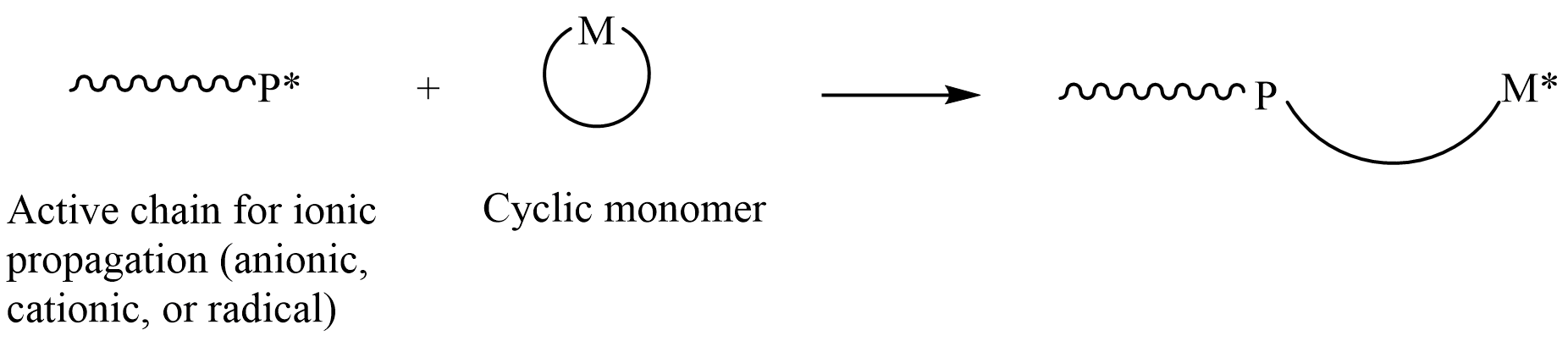
Chain polymerization involving cyclic monomers
Note: If monomer is polycyclic, the opening of a single ring is sufficient to classify the reaction as ring-opening polymerization.
Modified from the earlier definition.{{cite journal
In polymer chemistry, ring-opening polymerization (ROP) is a form of chain-growth polymerization in which the terminus of a polymer chain attacks cyclic monomers to form a longer polymer (see figure). The reactive center can be radical, anionic or cationic.
Ring-opening of cyclic monomers is often driven by the relief of bond-angle strain. Thus, as is the case for other types of polymerization, the enthalpy change in ring-opening is negative. Many rings undergo ROP.
Monomers
Many cyclic monomers are amenable to ROP. These include epoxides, cyclic trisiloxanes, some lactones and lactides, cyclic anhydrides, cyclic carbonates, and amino acid N-carboxyanhydrides. Many strained cycloalkenes, e.g norbornene, are suitable monomers via ring-opening metathesis polymerization. Even highly strained cycloalkane rings, such as cyclopropane and cyclobutane derivatives, can undergo ROP.
History
Ring-opening polymerization has been used since the beginning of the 1900s to produce polymers. Synthesis of polypeptides which has the oldest history of ROP, dates back to the work in 1906 by Leuchs. Subsequently, the ROP of anhydro sugars provided polysaccharides, including synthetic dextran, xanthan gum, welan gum, gellan gum, diutan gum, and pullulan. Mechanisms and thermodynamics of ring-opening polymerization were established in the 1950s. The first high-molecular weight polymers (Mn up to 105) with a repeating unit were prepared by ROP as early as in 1976.
New research shows that ROP can be completed with cyclic esters with minimal to no use of solvents by using resonant acoustic mixing.
An industrial application is the production of nylon-6 from caprolactam.
Mechanisms
Ring-opening polymerization can proceed via radical, anionic, or cationic polymerization as described below. Additionally, radical ROP is useful in producing polymers with functional groups incorporated in the backbone chain that cannot otherwise be synthesized via conventional chain-growth polymerization of vinyl monomers. For instance, radical ROP can produce polymers with ethers, esters, amides, and carbonates as functional groups along the main chain.
Anionic ring-opening polymerization (AROP)
Main article: Anionic polymerization
Anionic ring-opening polymerizations (AROP) involve nucleophilic reagents as initiators. Monomers with a three-member ring structure - such as epoxides, aziridines, and episulfides - undergo anionic ROP.
A typical example of anionic ROP is that of ε-caprolactone, initiated by an alkoxide. :
Cationic ring-opening polymerization
Main article: Cationic polymerization
Cationic initiators and intermediates characterize cationic ring-opening polymerization (CROP). Examples of cyclic monomers that polymerize through this mechanism include lactones, lactams, amines, and ethers. CROP proceeds through an SN1 or SN2 propagation, chain-growth process. The mechanism is affected by the stability of the resulting cationic species. For example, if the atom bearing the positive charge is stabilized by electron-donating groups, polymerization will proceed by the SN1 mechanism. The cationic species is a heteroatom and the chain grows by the addition of cyclic monomers thereby opening the ring system.

The monomers can be activated by Bronsted acids, carbenium ions, onium ions, and metal cations.
CROP can be a living polymerization and can be terminated by nucleophilic reagents such as phenoxy anions, phosphines, or polyanions. When the amount of monomers becomes depleted, termination can occur intra or intermolecularly. The active end can "backbite" the chain, forming a macrocycle. Alkyl chain transfer is also possible, where the active end is quenched by transferring an alkyl chain to another polymer.
Ring-opening metathesis polymerization
Main article: Ring-opening metathesis polymerization
Ring-opening metathesis polymerisation (ROMP) produces unsaturated polymers from cycloalkenes or bicycloalkenes. It requires organometallic catalysts.
The mechanism for ROMP follows similar pathways as olefin metathesis. The initiation process involves the coordination of the cycloalkene monomer to the metal alkylidene complex, followed by a [2+2] type cycloaddition to form the metallacyclobutane intermediate that cycloreverts to form a new alkylidene species.

Thermodynamics
The formal thermodynamic criterion of a given monomer polymerizability is related to a sign of the free enthalpy (Gibbs free energy) of polymerization: \Delta G_p(xy) = \Delta H_p(xy)-T\Delta S_p(xy) where: :x and y indicate monomer and polymer states, respectively (x and/or y = l (liquid), g (gaseous), c (amorphous solid), c' (crystalline solid), s (solution)); :ΔHp(xy) is the enthalpy of polymerization (SI unit: joule per kelvin); :ΔS(xy) is the entropy of polymerization (SI unit: joule); :T is the absolute temperature (SI unit: kelvin). The free enthalpy of polymerization (ΔGp) may be expressed as a sum of standard enthalpy of polymerization (ΔGp°) and a term related to instantaneous monomer molecules and growing macromolecules concentrations: \Delta G_p = \Delta G^\circ_p + RT\ln\frac{[\ldots - (\ce{m}){i+1} \ce{m}^\ast]}{[\ce{M}][\ldots-(\ce{m})i \ce{m}^\ast]} where: :R is the gas constant; :M is the monomer; :(m)i is the monomer in an initial state; :m* is the active monomer. Following Flory–Huggins solution theory that the reactivity of an active center, located at a macromolecule of a sufficiently long macromolecular chain, does not depend on its degree of polymerization (DP), and taking in to account that (where ΔHp° and ΔSp° indicate a standard polymerization enthalpy and entropy, respectively), we obtain: :\Delta G_p = \Delta H^\circ_p - T(\Delta S^\circ_p + R\ln[M]) At equilibrium (), when polymerization is complete the monomer concentration ([M]eq) assumes a value determined by standard polymerization parameters (ΔHp° and ΔSp°) and polymerization temperature: \begin{align} {}[\ce{M}]{\rm eq} &= \exp\left(\frac{\Delta H^\circ_p}{RT} - \frac{\Delta S^\circ_p}{R}\right) \[4pt] \ln\frac{DP_n}{DP_n - 1}[\ce{M}]{\rm eq} &= \frac{\Delta H^\circ_p}{RT} - \frac{\Delta S^\circ_p}{R} \[4pt] [\ce{M}]_{\rm eq} &= \frac{DP_n - 1}{DP_n} \exp\left(\frac{\Delta H^\circ_p}{RT} - \frac{\Delta S^\circ_p}{R}\right) \end{align} Polymerization is possible only when [M]0 [M]eq. Eventually, at or above the so-called ceiling temperature (Tc), at which , formation of the high polymer does not occur. \begin{align} T_c &= \frac{\Delta H^\circ_p}{\Delta S^\circ_p + R\ln[\ce{M}]_0} ; \quad (\Delta H^\circ_p T_f &= \frac{\Delta H^\circ_p}{\Delta S^\circ_p + R\ln[\ce{M}]_0} ; \quad (\Delta H^\circ_p0,\ \Delta S^\circ_p0) \end{align} For example, tetrahydrofuran (THF) cannot be polymerized above Tc = 84 °C, nor cyclo-octasulfur (S8) below Tf = 159 °C. However, for many monomers, Tc and Tf, for polymerization in the bulk, are well above or below the operable polymerization temperatures, respectively. The polymerization of a majority of monomers is accompanied by an entropy decrease, due mostly to the loss in the translational degrees of freedom. In this situation, polymerization is thermodynamically allowed only when the enthalpic contribution into ΔGp prevails (thus, when ΔHp° p*° p* −TΔSp}} is required). Therefore, the higher the ring strain, the lower the resulting monomer concentration at equilibrium.
Additional reading
References
References
- "Ring-opening polymerization".
- Young, Robert J.. (2011). "Introduction to Polymers". CRC Press.
- (2007). "Mechanisms of homocysteine toxicity in humans". Amino Acids.
- (2013). "Ring-Opening Polymerization—An Introductory Review". Polymers.
- Yann Sarazin. (2015). "Discrete Cationic Complexes for Ring-Opening Polymerization Catalysis of Cyclic Esters and Epoxides". Chemical Reviews.
- (2016). "Ring-Opening Copolymerization of Epoxides and Cyclic Anhydrides with Discrete Metal Complexes: Structure–Property Relationships". Chemical Reviews.
- (2008-06-10). "Recent advances in the synthesis of aliphatic polyesters by ring-opening polymerization☆". Advanced Drug Delivery Reviews.
- Kricheldorf, H. R.. (2006). "Polypeptides and 100 Years of Chemistry of α-Amino Acid ''N''-Carboxyanhydrides". Angewandte Chemie International Edition.
- Nikos Hadjichristidis. (2009). "Synthesis of Well-Defined Polypeptide-Based Materials via the Ring-Opening Polymerization of α-Amino Acid N-Carboxyanhydrides". Chemical Reviews.
- (1952). "The Polymerization of Cyclopropane". J. Phys. Chem..
- (1996). "Ring-Opening Polymerization of the Cyclobutane Adduct of Methyl Tricyanoethylenecarboxylate and Ethyl Vinyl Ether". Macromolecules.
- Leuchs, H.. (1906). "Glycine-carbonic acid". Berichte der Deutschen Chemischen Gesellschaft.
- Dainton, F. S.. (1955). "The thermodynamics of polymerization of cyclic compounds by ring opening". Transactions of the Faraday Society.
- Conix, André. (January 1955). "Ring opening in lactam polymers". Journal of Polymer Science.
- (1977). "Poly(2-hydro-2-oxo-1,3,2-dioxaphosphorinane). Preparation and NMR spectra". Die Makromolekulare Chemie.
- Libiszowski, Jan. (June 1978). "Polymerization of cyclic esters of phosphoric acid. VI. Poly(alkyl ethylene phosphates). Polymerization of 2-alkoxy-2-oxo-1,3,2-dioxaphospholans and structure of polymers". Journal of Polymer Science: Polymer Chemistry Edition.
- (2025-02-10). "Rapid, Highly Sustainable Ring-Opening Polymerization via Resonant Acoustic Mixing". ACS Sustainable Chemistry & Engineering.
- Nuyken, Oskar. (25 April 2013). "Ring-Opening Polymerization—An Introductory Review". Polymers.
- Dubois, Philippe. (2008). "Handbook of ring-opening polymerization". Wiley-VCH.
- (1992). "Inorganic Polymers". Prentice Hall.
- Cowie, John McKenzie Grant. (2008). "Polymers: Chemistry and Physics of Modern Materials". CRC Press.
- (1996). "Polyethers, Tetrahydrofuran and Oxetane Polymers". John Wiley & Sons.
- Sutthasupa, Sutthira. (13 October 2010). "Recent advances in ring-opening metathesis polymerization, and application to synthesis of functional materials". Polymer Journal.
- Hartwig, John F.. (2010). "Organotransition metal chemistry: from bonding to catalysis". University Science Books.
- (2017-09-25). "Kinetic Study of Living Ring-Opening Metathesis Polymerization with Third-Generation Grubbs Catalysts". Journal of the American Chemical Society.
- Tobolsky, A. V.. (July 1957). "Equilibrium polymerization in the presence of an ionic initiator". Journal of Polymer Science.
- Tobolsky, A. V.. (August 1958). "Equilibrium polymerization in the presence of an ionic initiator". Journal of Polymer Science.
- Tobolsky, Arthur V.. (May 1959). "Equilibrium Polymerization of Sulfur". Journal of the American Chemical Society.
- Tobolsky, A. V.. (January 1960). "A General Treatment of Equilibrium Polymerization". Journal of the American Chemical Society.
This article was imported from Wikipedia and is available under the Creative Commons Attribution-ShareAlike 4.0 License. Content has been adapted to SurfDoc format. Original contributors can be found on the article history page.
Ask Mako anything about Ring-opening polymerization — get instant answers, deeper analysis, and related topics.
Research with MakoFree with your Surf account
Create a free account to save articles, ask Mako questions, and organize your research.
Sign up freeThis content may have been generated or modified by AI. CloudSurf Software LLC is not responsible for the accuracy, completeness, or reliability of AI-generated content. Always verify important information from primary sources.
Report