From Surf Wiki (app.surf) — the open knowledge base
Right-wing politics
Political ideologies favouring social stratification
Political ideologies favouring social stratification
Right-wing politics or rightism is the range of political ideologies that view certain social orders and hierarchies as inevitable, natural, normal, or desirable, typically supporting this position in favour of conservatism, natural law, economics, authority, property, religion, or tradition. Hierarchy and inequality may be seen as natural results of traditional social differences or competition in market economies.
Right-wing politics are considered the counterpart to left-wing politics, and the left–right political spectrum is the most common political spectrum. The right includes social conservatives and fiscal conservatives, as well as laissez-faire economic policies. "Right" and "right-wing" have been variously used as compliments and pejoratives describing neoliberal, conservative, and fascist economic and social ideas.
Name
The political terms Left and Right were first used in the 18th century, during the French Revolution, referencing the seating arrangement of the French parliament. Those who sat to the right of the chair of the presiding officer (le président) were generally supportive of the institutions of the monarchist Old Regime. The original "Right" in France was formed in reaction to the "Left" and comprised those supporting hierarchy, tradition, and clericalism. The expression la droite ('the right') increased in use after the restoration of the monarchy in 1815, when it was applied to the ultra-royalists.
Positions
The following positions are typically associated with right-wing politics.
Anti-communism
Early communists used the term "right-wing" in reference to conservatives, placing the conservatives on the right, the liberals in the centre and the communists on the left. Both the conservatives and the liberals were strongly anti-communist, although the conservatives' anti-communism was much stronger than liberals'. The history of the use of the term right-wing about anti-communism is a complicated one.
Early Marxist movements were at odds with the traditional monarchies that ruled over much of the European continent at the time. Many European monarchies outlawed the public expression of communist views and the Communist Manifesto, which began "[a] spectre [that] is haunting Europe", and stated that monarchs feared for their thrones. Advocacy of communism was illegal in the Russian Empire, the German Empire, and Austria-Hungary, the three most powerful monarchies in continental Europe before World War I. Many monarchists (except constitutional monarchists) viewed inequality in wealth and political power as resulting from a divine natural order. The struggle between monarchists and communists was often described as a struggle between the Right and the Left.
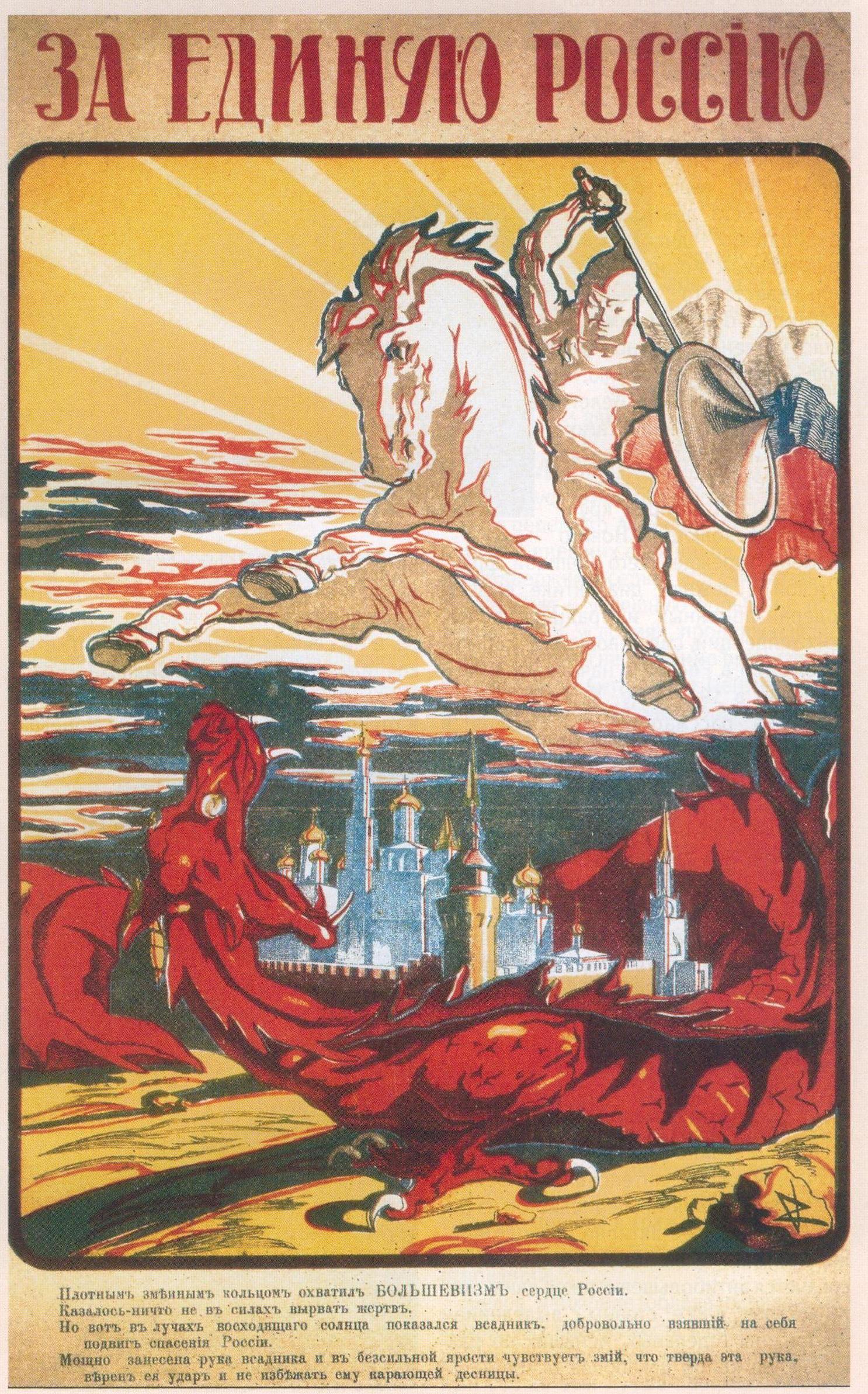
By World War I, in most European monarchies, the divine right of kings had become discredited and was replaced by liberal and nationalist movements. Most European monarchs became figureheads, or they yielded some power to elected governments. The most conservative European monarchy, the Russian Empire, was replaced by the communist Soviet Union. The Russian Revolution inspired a series of other communist revolutions across Europe in the years 1917–1923. Many of these, such as the German Revolution, were defeated by nationalist and monarchist military units. During this period, nationalism began to be considered right-wing, especially when it opposed the internationalism of the communists.
The 1920s and 1930s saw the decline of traditional right-wing politics. The mantle of conservative anti-communism was taken up by the rising fascist movements on the one hand and by American-inspired liberal conservatives on the other. When communist groups and political parties began appearing around the world, their opponents were usually colonial authorities and the term right-wing came to be applied to colonialism.
After World War II, communism became a global phenomenon and anti-communism became an integral part of the domestic and foreign policies of the United States and its NATO allies. Conservatism in the post-war era abandoned its monarchist and aristocratic roots, focusing instead on patriotism, religious values, and nationalism. Throughout the Cold War, postcolonial governments in Asia, Africa, and Latin America turned to the United States for political and economic support. Communists were also enemies of capitalism, portraying Wall Street as the oppressor of the masses. The United States made anti-communism the top priority of its foreign policy, and many American conservatives sought to combat what they saw as communist influence at home. This led to the adoption of several domestic policies that are collectively known under the term McCarthyism. While both liberals and conservatives were anti-communist, the followers of Senator McCarthy were called right-wing and those on the right called liberals who favoured free speech, even for communists, leftist.
Economics
Main article: Capitalism, Corporatism
Early forms of corporatism would be developed in Classical Greece and used in Ancient Rome. Plato would develop the ideas of totalitarian and communitarian corporatist systems of natural based classes and social hierarchies that would be organised based on function, such that groups would cooperate to achieve social harmony by emphasising collectives interests over individual interests. Corporatism as a political ideology advocates the organisation of society by corporate groups—such as agricultural, labour, military, scientific, or guild associations—based on their common interests.
After the decline of the Western Roman Empire corporatism became limited to religious orders and to the idea of Christian brotherhood, especially in the context of economic transactions. From the High Middle Ages onwards corporatist organisations became increasingly common in Europe, including such groups as religious orders, monasteries, fraternities, military orders such as the Knights Templar and the Teutonic Order, educational organisations such as the emerging universities and learned societies, the chartered towns and cities, and most notably the guild system which dominated the economics of population centres in Europe.
In post-revolutionary France, the Right fought against the rising power of those who had grown rich through commerce, and sought to preserve the rights of the hereditary nobility. They were uncomfortable with capitalism, the Enlightenment, individualism, and industrialism, and fought to retain traditional social hierarchies and institutions. In Europe's history, there have been strong collectivist right-wing movements, such as in the social Catholic right, that have exhibited hostility to all forms of liberalism (including economic liberalism) and have historically advocated for paternalist class harmony involving an organic-hierarchical society where workers are protected while class hierarchy remains.
In the 19th century, the Right had shifted to support the newly rich in some European countries (particularly Britain) and instead of favouring the nobility over industrialists, favoured capitalists over the working class. Other right-wing movements—such as Carlism in Spain and nationalist movements in France, Germany, and Russia—remained hostile to capitalism and industrialism. Nevertheless, a few right-wing movements—notably the French Nouvelle Droite, CasaPound, and American paleoconservatism—are often in opposition to capitalist ethics and the effects they have on society. These forces see capitalism and industrialism as infringing upon or causing the decay of social traditions or hierarchies that are essential for social order.
''Laissez-faire'' schools
Main article: Austrian school of economics, Chicago school of economics
In modern times, "right-wing" is sometimes used to describe laissez-faire capitalism. In Europe, capitalists formed alliances with the Right during their conflicts with workers after 1848. In 1871, the Austrian school came to be with the work of Carl Menger, Eugen von Böhm-Bawerk, Friedrich von Wieser, and others, originating from methodologically opposition to the Historical school, in a dispute known as Methodenstreit. The Austrian school opposition to be heterodox, advocating strict adherence to methodological individualism, the concept that social phenomena result primarily from the motivations and actions of individuals along with their self interest. Austrian-school theorists hold that economic theory should be exclusively derived from basic principles of human action.
In France, the Right's support of capitalism can be traced to the late 19th century. The so-called neoliberal Right, popularised by US President Ronald Reagan and UK Prime Minister Margaret Thatcher, combines support for free markets, privatisation, and deregulation with traditional right-wing support for social conformity.
Nationalism
Main article: Nationalism

In France, nationalism was originally a left-wing and republican ideology. After the period of boulangisme and the Dreyfus affair, nationalism became a trait of the right-wing. Right-wing nationalists sought to define and defend a "true" national identity from elements which they believed were corrupting that identity. Some were supremacists, who in accordance with scientific racism and social Darwinism applied the concept of "survival of the fittest" to nations and races.
Right-wing nationalism was influenced by Romantic nationalism in which the state derives its political legitimacy from the organic unity of those who it governs. This generally includes the language, race, culture, religion, and customs of the nation, all of which were "born" within its culture. Linked with right-wing nationalism is cultural conservatism, which supports the preservation of the heritage of a nation or culture and often sees deviations from cultural norms as an existential threat.
In the 21st century, neo-nationalism came to prominence after the Cold War in the Western world. It is typically associated with cultural conservatism, populism, anti-globalisation, and nativism and is opposed to immigration. The ideology takes historical association in determining membership in a nation, rather than racial concepts.
Natural law and traditionalism
Right-wing politics typically justifies a hierarchical society based on natural law or tradition.
Traditionalism was advocated by a group of United States university professors (labelled the "New Conservatives" by the popular press) who rejected the concepts of individualism, liberalism, modernity, and social progress, seeking instead to promote what they identified as cultural and educational renewal and a revived interest in concepts perceived by traditionalists as truths that endure from age to age alongside basic institutions of western society such as the church, the family, the state, and business.
Populism
Main article: Right-wing populism
Right-wing populism is a combination of civic-nationalism, cultural-nationalism and sometimes ethno-nationalism, localism, along with anti-elitism, using populist rhetoric to provide a critique of existing political institutions. According to Margaret Canovan, a right-wing populist is "a charismatic leader, using the tactics of politicians' populism to go past the politicians and intellectual elite and appeal to the reactionary sentiments of the populace, often buttressing his claim to speak for the people by the use of referendums".
In Europe, right-wing populism often takes the form of distrust of the European Union, and of politicians in general, combined with anti-immigrant rhetoric and a call for a return to traditional, national values. Daniel Stockemer states, the radical right is, "Targeting immigrants as a threat to employment, security and cultural cohesion".
In the United States, the Tea Party movement stated that the core beliefs for membership were the primacy of individual liberties as defined by the Constitution of the United States, preference for a small federal government, and respect for the rule of law. Some policy positions included opposition to illegal immigration and support for a strong national military force, the right to individual gun ownership, cutting taxes, reducing government spending, and balancing the budget.
In Indonesia, Islamic populism has a significant impact on right-wing politics. This is largely due to the historical context which Islamic organisations had during the 1960s in destroying the Indonesian Communist Party. Whilst the party is adopting democratic processes with neo-liberal market economies, socially pluralist positions are not necessarily adopted. The Islamic populism in Indonesia has boosted its influence in 1998 after the demise of the Suharto authoritarian regime. Islamic populism in Indonesia has similar properties with Islamic populist regimes like in the Middle East, Turkey and North Africa (MENA). The emphasis on social justice, pluralism, equality and progressive agendas could be potentially mobilised by Islamic cultural resources.
In India, supporters of the Bharatiya Janata Party (BJP) have more authoritarian, nativist, and populist ideas than other Indian citizens. Under Narendra Modi, populism is a core part of the party's ideology. The party's rhetoric reflects the idea is that the ordinary, "good" individuals are continuously under attack from "bad" political forces, the media, etc. Since Narendra Modi became the leader of the BJP, it has increasingly been considered a populist radical right party (PRR) and has also been considered a Hindu nationalist party.
Religion
Philosopher and diplomat Joseph de Maistre argued for the indirect authority of the Pope over temporal matters. According to Maistre, only governments which were founded upon Christian constitutions—which were implicit in the customs and institutions of all European societies, especially the Catholic European monarchies—could avoid the disorder and bloodshed that followed the implementation of rationalist political programmes, such as the chaos which occurred during the French Revolution. Some prelates of the Church of England–established by Henry VIII and headed by the current sovereign—are given seats in the House of Lords (as Lords Spiritual), but they are considered politically neutral rather than specifically right- or left-wing.
In The Possessed (1872) and The Brothers Karamazov (1880), Fyodor Dostoevsky portrayed socialism as an attempt to build a kingdom of Man as opposed to kingdom of God. According to Dostoevsky himself, the intention of the latter book was to portray "the seed of the idea of destruction in our time in Russia among the young people uprooted from reality". This seed is depicted as: "the rejection not of God but of the meaning of His creation. Socialism has sprung from the denial of the meaning of historical reality and ended in a programme of destruction and anarchism". In his 1931 encyclical Quadragesimo Anno, Pope Pius XI wrote that "true socialism" was irreconcilable with the teachings of the Catholic Church "because its concept of society itself is utterly foreign to Christian truth", stating:American right-wing media outlets oppose sex outside marriage and same-sex marriage, and they sometimes reject scientific positions on evolution and other matters where science is perceived to disagree with the Bible.
The term family values has been used by right-wing parties—such as the Republican Party in the United States, the Family First Party in Australia, the Conservative Party in the United Kingdom, and the Bharatiya Janata Party in India—to signify support for traditional families and opposition to the changes the modern world has made in how families live. Supporters of "family values" may oppose abortion, euthanasia, and birth control.
Outside the West, the Hindu nationalist movement has attracted privileged groups which fear encroachment on their dominant positions, as well as "plebeian" and impoverished groups which seek recognition around a majoritarian rhetoric of cultural pride, order, and national strength.
In Israel, Meir Kahane advocated that Israel should be a theocratic state, where non-Jews have no voting rights, and the far-right Lehava strictly opposes Jewish assimilation and the Christian presence in Israel. The Jewish Defence League (JDL) in the United States was classified as "a right wing terrorist group" by the FBI in 2001. Many Islamist groups have been called right-wing, including the Great Union Party, the Combatant Clergy Association/Association of Militant Clergy, and the Islamic Society of Engineers of Iran.
Social stratification

Right-wing politics involves, in varying degrees, the rejection of some egalitarian objectives of left-wing politics, claiming either that social or economic inequality is natural and inevitable or that it is beneficial to society. Right-wing ideologies and movements support social order. The original French right-wing was called "the party of order" and held that France needed a strong political leader to keep order.
Conservative British scholar R. J. White, who rejects egalitarianism, wrote: "Men are equal before God and the laws, but unequal in all else; hierarchy is the order of nature, and privilege is the reward of honourable service". American conservative Russell Kirk also rejected egalitarianism as imposing sameness, stating: "Men are created different; and a government that ignores this law becomes an unjust government for it sacrifices nobility to mediocrity". Italian scholar Norberto Bobbio argued that the right-wing is inegalitarian compared to the left-wing, as he argued that equality is a relative, not absolute, concept.
Right-libertarians reject collective or state-imposed equality as undermining reward for personal merit, initiative, and enterprise. In their view, such imposed equality is unjust, limits personal freedom, and leads to social uniformity and mediocrity.
In the view of philosopher Jason Stanley in How Fascism Works, the "politics of hierarchy" is one of the hallmarks of fascism, which refers to a "glorious past" in which members of the rightfully dominant group sat atop the hierarchy, and attempt to recreate this state of being.
History
According to The Cambridge History of Twentieth-Century Political Thought, (2003) the Right has gone through five distinct historical stages:
- The reactionary right sought a return to aristocracy and established religion.
- The moderate right distrusted intellectuals and sought limited government.
- The radical right favoured a romantic and aggressive form of nationalism.
- The extreme right proposed anti-immigration policies and implicit racism.
- The neo-liberal right sought to combine a market economy and economic deregulation with the traditional right-wing beliefs in patriotism, elitism and law and order.
From the 1830s to the 1880s, the Western world's social class structure and economy shifted from nobility and aristocracy towards capitalism. This shift affected centre-right movements such as the British Conservative Party, which responded supporting capitalism.
The people of English-speaking countries did not apply the terms right and left to their politics until the 20th century. The term right-wing was originally applied to traditional conservatives, monarchists, and reactionaries; a revision of this which occurred sometime between the 1920s and 1950s considers the far-right to denote fascism, Nazism, and racial supremacy.
Rightist regimes were common in Europe in the Interwar period, 1919–1938.
China
thumb|upright=0.8|[[Chiang Kai-shek]],
Republic of China (1912–1949)
Among Kuomintang (KMT)'s conservatives during the Republic of China, Dai Jitao Thought supporters formed the Western Hills Group in the 1920s.
Chiang Kai-shek initially claimed himself as a 'centrist' in the KMT left-right conflict, but became an anti-communist right-wing after Shanghai massacre. Chiangism (or 'Chiang Kai-shek Thought') was related to Confucianism, party-state capitalism, paternalistic conservatism, and Chinese nationalism.
People's Republic of China
Neoauthoritarianism is a current of political thought that rose in China in the late 1980's and came into ascendancy after the death of Deng Xiaoping; it advocates a powerful state to facilitate market reforms. It has been described as right-wing, classically conservative even though it incorporated some aspects of Marxist–Leninist and Maoist theories.
France
The political term right-wing was first used during the French Revolution, when liberal deputies of the Third Estate generally sat to the left of the presiding officer's chair, a custom that began in the Estates General of 1789. The nobility, members of the Second Estate, generally sat to the right. In the successive legislative assemblies, monarchists who supported the Old Regime were commonly referred to as rightists because they sat on the right side. A major figure on the right was Joseph de Maistre, who argued for an authoritarian form of conservatism.
Throughout France in the 19th century, the main line dividing the left and right was between supporters of the republic and those of the monarchy, who were often secularist and Catholic respectively. On the right, the Legitimists and Ultra-royalists held counter-revolutionary views, while the Orléanists hoped to create a constitutional monarchy under their preferred branch of the royal family, which briefly became a reality after the 1830 July Revolution.
The centre-right Gaullists in post-World War II France advocated considerable social spending on education and infrastructure development as well as extensive economic regulation, but limited the wealth redistribution measures characteristic of social democracy.
Hungary
The dominance of the political right of inter-war Hungary, after the collapse of a short-lived Communist regime, was described by historian István Deák: :Between 1919 and 1944 Hungary was a rightist country. Forged out of a counter-revolutionary heritage, its governments advocated a "nationalist Christian" policy; they extolled heroism, faith, and unity; they despised the French Revolution, and they spurned the liberal and socialist ideologies of the 19th century. The governments saw Hungary as a bulwark against bolshevism and bolshevism's instruments: socialism, cosmopolitanism, and Freemasonry. They perpetrated the rule of a small clique of aristocrats, civil servants, and army officers, and surrounded with adulation the head of the state, the counterrevolutionary Admiral Horthy.
India
Although freedom fighters are favoured, the right-wing tendency to elect or appoint politicians and government officials based on aristocratic and religious ties is common to almost all the states of India. Multiple political parties however identify with terms and beliefs which are, by political consensus, right or left wing. Certain political parties such as the Bharatiya Janata Party, identify with conservative and nationalist elements. Some, such as the Indian National Congress, take a liberal stance. The Communist Party of India, Communist Party of India (Marxist), and others, identify with left-wing socialist and communist concepts. Other political parties take differing stands, and hence cannot be clearly grouped as the left- and the right-wing.
United Kingdom

In British politics, the terms right and left came into common use for the first time in the late 1930s during debates over the Spanish Civil War.
The Conservative Party, one of the country's two main political parties, is placed on the centre-right to right-wing of the left–right political spectrum. Reform UK is situated on the right-wing of the political spectrum, generally to the Conservative Party's right.
United States
- Alt-right
- Centre-right politics
- Far-right politics
- Far-right subcultures
- List of right-wing political parties
- New Right
- Old Right
- Political repression
- Political violence
- Radical right (Europe)
- Radical right (United States)
- Right realism
- Right-wing antiglobalism
- Right-wing dictatorship
- Right-wing populism
- Right-wing terrorism
References
References
- (July 1985). "Similarities and Differences Between Left-Wing and Right-Wing Radicals". British Journal of Political Science.
- Leonard V. Kaplan, Rudy Koshar, ''The Weimar Moment: Liberalism, Political Theology, and Law'' (2012) p. 7–8.
- Alan S. Kahan, ''Mind Vs. Money: The War Between Intellectuals and Capitalism'' (2010), p. 184.
- Jerome L. Himmelstein, ''To the right: The transformation of American conservatism'' (1992).
- (2006). "The Desk Encyclopedia of World History". [[Oxford University Press]].
- Goodsell, Charles T., "The Architecture of Parliaments: Legislative Houses and Political Culture", British Journal of Political Science, Vol. 18, No. 3 (July 1988), pp. 287–302.
- Linski, Gerhard, ''Current Issues and Research In Macrosociology'' (Brill Archive, 1984) p. 59
- Clark, Barry ''Political Economy: A Comparative Approach'' (Praeger Paperback, 1998), pp. 33–34.
- Gauchet, Marcel, "Right and Left" in Nora, Pierre, ed., ''Realms of Memory: Conflicts and Divisions'' (1996) pp. 247–248.
- (2003). "Anti-Communism and Popular Culture in Mid-Century America". McFarland.
- "Revolutions / 1.0 / handbook".
- Nunberg, Geoffrey. (17 April 2003). "Sticks and Stones; The Defanging of a Radical Epithet". [[The New York Times]].
- (23 March 2022). "What was the Cold War—and are we headed to another one?".
- Adler, Franklin Hugh. ''Italian Industrialists from Liberalism to Fascism: The Political Development of the Industrial Bourgeoisie, 1906–34''. p. 349.
- Wiarda, Howard J.. (1997). "Corporatism and comparative politics: the other great "ism"". Sharpe.
- Wiarda, Howard J.. (1997). "Corporatism and Comparative Politics: The Other Great "Ism"". [[M.E. Sharpe]].
- Clarke, Paul A. B; Foweraker, Joe. ''Encyclopedia of democratic thought''. [[London, UK]]; [[New York (state). New York]]: [[Routledge]], 2001. Pp. 113
- (1994). "Fundamentalisms Observed". [[University of Chicago Press]].
- Holland, J., ''Modern Catholic Social Teaching: The Popes Confront the Industrial Age'', 1740–1958. Paulist Press, 2003, p. 132.
- (1983). "Fascism: Comparison and Definition". [[University of Wisconsin Press]].
- Joseph A. Schumpeter, History of economic analysis, Oxford University Press 1996, {{ISBN. 978-0195105599.
- (1994). "Hayek, Co-ordination and Evolution: His Legacy in Philosophy, Politics, Economics and the History of Ideas". [[Routledge]].
- (2003). "A Companion to the History of Economic Thought". Blackwell Publishing.
- (December 31, 2011). "Heterodox economics: Marginal revolutionaries". The Economist.
- (2008). "Dialectics and the Austrian School: A Surprising Commonality in the Methodology of Heterodox Economics?". The Journal of Philosophical Economics.
- (2007). "Principles of Economics". Ludwig von Mises Institute.
- Heath, Joseph. (1 May 2018). "The Stanford Encyclopedia of Philosophy". Metaphysics Research Lab, Stanford University.
- Ludwig von Mises. [[Human Action]], p. 11, "Purposeful Action and Animal Reaction". Referenced 2011-11-23.
- (2002). "The Oxford History of the French Revolution". [[Oxford University Press]].
- [[Michel Winock. Winock, Michel]] (dir.), ''Histoire de l'extrême droite en France'' (1993).
- Adams, Ian ''Political Ideology Today'' (2nd edition), Manchester University Press, 2002, p. 68.
- (1999). "The Radical Right in Central and Eastern Europe since 1989". [[Pennsylvania State University Press]].
- Barber, Tony. (2016-07-11). "A renewed nationalism is stalking Europe". Financial Times.
- "Neo-Nationalism - ECPS".
- ''Left and right: the significance of a political distinction'', Norberto Bobbio and Allan Cameron, pg. 68, [[University of Chicago Press]], 1997.
- Bruce Frohnen, Jeremy Beer and Jeffrey O. Nelson, ed. (2006) ''American Conservatism: An Encyclopedia'' Wilmington, DE: ISI Books, p. 870.
- [[Cas Mudde. Mudde, Cas]] and Rovira Kaltwasser, Cristóbal (2017) ''Populism: a Very Short Introduction''. New York: Oxford University Press. pp.14-15, 72-73. {{isbn. 978-0-19-023487-4
- (1981). "Populism". Harcourt Brace Jovanovich.
- (2004). "Elitism, Populism, and European Politics". Oxford University Press.
- Daniel Stockemer, "Structural data on immigration or immigration perceptions? What accounts for the electoral success of the radical right in Europe?." ''JCMS: Journal of Common Market Studies'' 54.4 (2016): 999-1016.
- (2 September 2004). "About Us". Tea Party.
- Hadiz, Vedi R.. (2018-08-08). "Imagine All the People? Mobilising Islamic Populism for Right-Wing Politics in Indonesia". Journal of Contemporary Asia.
- (October 2023). "Supporters of India's BJP: Distinctly Populist and Nativist". Government and Opposition.
- Frank, Joseph. (2010). "Dostoevsky A Writer in his Time". Princeton University Press.
- ''Quadragesimo anno'', 115–118
- DeGette, Diana. (2008). "Sex, Science, and Stem Cells: Inside the Right Wing Assault on Reason". [[The Lyons Press]].
- Chris Mooney, ''The Republican War on Science: Revised and Updated'', ASIN: B001OQOIPM
- "2004 Republican Party Platform: A Safer World and a More Hopeful America". MSNBC.
- Rozsa, Matthew. (July 5, 2019). "How did the Republican Party become so conservative?". Salon.
- Thomas Blom Hansen, ''The Saffron Wave: Democracy and Hindu Nationalism in Modern India'', Princeton University Press, 2001, {{ISBN. 1-4008-0342-X, 9781400803422.
- "Israel's Ayatollahs: Meir Kahane and the Far Right in Israel".
- (24 December 2015). "Good Will and Peace Towards Men Elusive This Year in Nazareth".
- "FBI — Terrorism 2000/2001". Federal Bureau of Investigation.
- Demirtas, Burcu. (27 March 2009). "Rescue Teams Could Not Reach Turkish Party Leader, Muhsin Yazicioglu after Helicopter Crash". Turkishweekly.net.
- (Fall 2007). "Readings". uvm.edu.
- (10 February 2000). "Poll test for Iran reformists". BBC News.
- (23 May 1997). "Middle East Report Online: Iran's Conservatives Face the Electorate, by Arang Keshavarzian". Merip.org.
- Anoushiravan Ehteshami and Mahjoob Zweiri, ''Iran and the rise of its neoconservatives: the politics of Tehran's silent revolution'', I.B. Tauris, 2007.
- Moyra Grant. ''Key Ideas in Politics''. Cheltenham, England, UK: Nelson Thornes, Ltd., 2003. p. 52.
- Bobbio, Norberto. Left and right: The significance of a political distinction. University of Chicago Press, 1996, pp.60-62
- [[Jason Stanley. Stanley, Jason]] (2018) ''How Fascism Works: The Politics of Us and Them''. New York: Random House. p.13. {{Isbn. 978-0-52551183-0
- Ball, T. and R. Bellamy, eds., ''The Cambridge History of Twentieth-Century Political Thought'', pp. 610–12.
- Alan S. Kahan. ''Mind Vs. Money: The War Between Intellectuals and Capitalism''. New Brunswick, New Jersey: [[Transaction Publishers]], 2010. p. 88.
- Ian Adams. ''Political Ideology Today''. Manchester, England, UK; New York, New York, US: [[Manchester University Press]], 2001. p. 57.
- ''The English Ideology: Studies in the Language of Victorian Politics'', George Watson Allen Lane, London, 1973, p. 94.
- Iain McLean and Alistair McMillan, ''The Concise Oxford Dictionary of Politics'', ''Right (-wing)...and for extreme right parties racism and fascism.'', p. 465, Oxford, 2009, {{ISBN. 978-0-19-920780-0.
- Bresciani, Marco. (2021-01-01). "Conservatives and Right Radicals in Interwar Europe". Conservatives and Right Radicals in Interwar Europe.
- Bramall, Chris. (2008). "Chinese Economic Development". Routledge.
- (March 20, 2008). "Communication in China: Political Economy, Power, and Conflict". Rowman & Littlefield Publishers.
- Sautman, Barry. (1992). "Sirens of the Strongman: Neo-Authoritarianism in Recent Chinese Political Theory". [[The China Quarterly]].
- Andrew Knapp and Vincent Wright. (2006). "The Government and Politics of France". Routledge.
- István Deák, "Hungary" in Hans Roger and Egon Weber, eds., ''The European right: A historical profile'' (1963), p. 364–407 quoting p. 364.
- (1 October 2019). "Right wing politics in India, by Archana Venkatesh". osu.edu.
- (1 October 2020). "Hindutva enters, takes centre-stage in Andhra Pradesh politics, by Balakrishna Ganeshan". thenewsminute.com.
- (11 July 2020). "India Will Move Beyond Modi, his Party, and Right Wing Populism, by Ajay Gudavarthy". newsclick.in.
- (25 October 2019). "The Indian Conservative : A History of Indian Right-Wing Thought". Juggernaut Press.
- IWANEK, Krzysztof. (2019). "Is the BJP Conservative?". Politeja.
- (2013-04-24). "Left-wing or Right-wing: Why labels simply don't capture India".
- [[Charles Loch Mowat]], ''Britain Between the Wars: 1918–1940'' (1955), p. 577.
- Bale, Tim. (2018). "Who leads and who follows? The symbiotic relationship between UKIP and the Conservatives – and populism and Euroscepticism". Politics.
- (2014). "Why Do Tories Defect to UKIP? Conservative Party Members and the Temptations of the Populist Radical Right". Political Studies.
- (2012). "Strategic Eurosceptics and Polite Xenophobes: Support for the United Kingdom Independence Party (UKIP) in the 2009 European Parliament Elections". European Journal of Political Research.
- (2022-11-22). "From green crap to net zero: Conservative climate policy 2015–2022". British Politics.
- (2023). "Boris Johnson to the Rescue? How the Conservatives Won the Radical-Right Vote in the 2019 General Election". Political Studies.
- (2021). "The centre-right versus the radical right: the role of migration issues and economic grievances". Journal of Ethnic and Migration Studies.
- (2024). "Encyclopedia of Contemporary Constitutionalism". [[Springer Nature]].
- (February 2023). "Do Opportunistic Snap Elections Affect Political Trust? Evidence from a Natural Experiment". [[Wiley (publisher).
- (March 2023). "The Conservative Party After Brexit: Turmoil and Transformation". [[Polity (publisher).
- (2022). "Sell-Outs or Warriors for Change? A Comparative Look at Conservative Women in Politics in Democracies". [[Routledge]].
- (September 2020). "Political Ideology and Social Services Contracting: Evidence from a Regression Discontinuity Design". Wiley-Blackwell.
- (October 2022). "Charitable behaviour and political affiliation: Evidence for the UK". [[Elsevier]].
- (14 June 2024). "All of Farage's Reform UK pledges on immigration – and how the Tories compare".
- Curtice, John. (16 February 2024). "John Curtice: By-election results leave Tories with mountain to climb". BBC News.
- Scott, Geraldine. "Tories fear Nigel Farage and Reform UK could deliver a red wall rout". The Times.
- Kenyon, Megan. (2025-05-07). "Reform faces an uphill battle in power".
- Farney, James. (2012). "Social Conservatives and Party Politics in Canada and the United States". University of Toronto Press.
- (9 January 2020). "The U.S. Remained Center-Right, Ideologically, in 2019". Gallup.
- "Rightwing Extremism: Current Economic and Political Climate Fueling Resurgence in Radicalization and Recruitment". United States Department of Homeland Security.
- (2006). "Social Cognition: An Integrated Introduction". Sage Publications.
- (2008). "The Concise Oxford Dictionary of Politics". Oxford University Press.
- Davies, p. 13.
- Berlet, p. 117.
- Eatwell: 1999, p. 284.
- Eatwell: 2004, pp. 7–8.
- Eatwell: 2004, p. 8, "Today four other traits feature most prominently in definitions: 1) anti-democracy; 2) nationalism; 3) racism; 4) the strong state".
- (1995). "Modern Political Ideologies". Blackwell.
- Betz & Immerfall 1998; Betz 1994; Durham 2000; Durham 2002; Hainsworth 2000; Mudde 2000; Berlet & Lyons, 2000.
- (2002). "The Routledge Companion to Fascism and the Far Right". Psychology Press.
- (2000). "The Christian Right, the Far Right and the Boundaries of American Conservatism". Manchester University Press.
- (30 June 2000). "Right-wing Extremism in the Twenty-first Century". Psychology Press.
- (2004). "Western Democracies and the New Extreme Right Challenge". Taylor & Francis.
- (7 March 2002). "Pim Fortuyn: The far-right Dutch maverick". BBC News.
- (14 September 2006). "A Dictator's Legacy of Economic Growth".
- Greenwald, Glenn. (31 May 2012). "Glenn Greenwald". Salon.com.
- Betz, Hans-Georg. (1994). "Radical Right-Wing Populism in Western Europe". Palgrave Macmillan.
- Michael E. Brown, Owen R. Cote Jr., ''Nationalism and Ethnic Conflict'', "Anti-immigrant and anti-refugee feeling is being exploited by extreme right-wing parties throughout Europe...", p. 442, MIT Press, 2001, {{ISBN. 978-0-262-52315-8.
- (1995). "La teoría social latinoamericana: La centralidad del Marxismo". Universidad Nacional Autónoma de México, Facultad de Ciencias Políticas y Sociales, Coordinación de Estudios Latinoamericanos, Dirección General de Asuntos del Personal Académico.
- (1996). "[[Left and Right: The Significance of a Political Distinction]]". [[University of Chicago Press]].
- (2005). "Encyclopedia of Politics: The Left and the Right". [[SAGE Publishing]].
- ''Left and right: the significance of a political distinction'', Norberto Bobbio and Allan Cameron, p. 37, [[University of Chicago Press]], 1997.
- (2003). "Capitalism, Not Globalism: Capital Mobility, Central Bank Independence, and the Political Control of the Economy". [[University of Michigan Press]].
- (2009-04-15). "Right".
- [[Seymour Martin Lipset]], cited in Fuchs, D., and Klingemann, H. 1990. The left-right schema. pp. 203–34 in Continuities in Political Action: A Longitudinal Study of Political Orientations in Three Western Democracies, ed.M.Jennings et al. Berlin:de Gruyter
- (2019). "Center-right political parties in advanced democracies 2019". Annual Review of Political Science.
- (2019). "Center-right political parties in advanced democracies 2019". Annual Review of Political Science.
- (1985). "An Introduction to Sociology". [[Cambridge University Press]].
- (1985). "An Introduction to Sociology". Cambridge University Press.
- Johnson, Paul. (2005). "Right-wing, rightist". Auburn University website.
- Lukes, Steven. (2003). "The Cambridge History of Twentieth-Century Political Thought". Cambridge University Press.
- Scruton, Roger "A Dictionary of Political Thought" "Defined by contrast to (or perhaps more accurately conflict with) the left the term ''right'' does not even have the respectability of a history. As now used it denotes several connected and also conflicting ideas (including) 1)conservative, and perhaps authoritarian, doctrines concerning the nature of civil society, with emphasis on custom, tradition, and allegiance as social bonds ... 8) belief in free enterprise free markets and a capitalist economy as the only mode of production compatible with human freedom and suited to the temporary nature of human aspirations ..." pp. 281–2, Macmillan, 1996
- T. Alexander Smith, Raymond Tatalovich. ''Cultures at war: moral conflicts in western democracies''. Toronto, Canada: Broadview Press, Ltd, 2003. p. 30. "That viewpoint is held by contemporary sociologists, for whom 'right-wing movements' are conceptualized as 'social movements whose stated goals are to maintain structures of order, status, honor, or traditional social differences or values' as compared to left-wing movements which seek 'greater equality or political participation.' In other words, the sociological perspective sees preservationist politics as a right-wing attempt to defend privilege within the ''social hierarchy''."
- Smith, T. Alexander and Raymond Tatalovich. ''Cultures at War: Moral Conflicts in Western Democracies'' (Toronto, Canada: Broadview Press, Ltd., 2003) p. 30. "That viewpoint is held by contemporary sociologists, for whom 'right-wing movements' are conceptualized as 'social movements whose stated goals are to maintain structures of order, status, honor, or traditional social differences or values' as compared to left-wing movements which seek 'greater equality or political participation.'
This article was imported from Wikipedia and is available under the Creative Commons Attribution-ShareAlike 4.0 License. Content has been adapted to SurfDoc format. Original contributors can be found on the article history page.
Ask Mako anything about Right-wing politics — get instant answers, deeper analysis, and related topics.
Research with MakoFree with your Surf account
Create a free account to save articles, ask Mako questions, and organize your research.
Sign up freeThis content may have been generated or modified by AI. CloudSurf Software LLC is not responsible for the accuracy, completeness, or reliability of AI-generated content. Always verify important information from primary sources.
Report