From Surf Wiki (app.surf) — the open knowledge base
Right kite
Symmetrical quadrilateral
Symmetrical quadrilateral
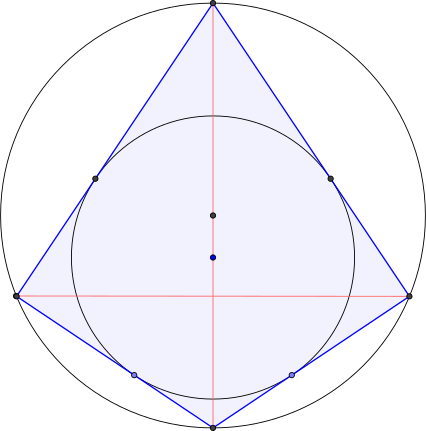
In Euclidean geometry, a right kite is a kite (a quadrilateral whose four sides can be grouped into two pairs of equal-length sides that are adjacent to each other) that can be inscribed in a circle. That is, it is a kite with a circumcircle (i.e., a cyclic kite). Thus the right kite is a convex quadrilateral and has two opposite right angles.{{citation
In a tangential quadrilateral (one with an incircle), the four line segments between the center of the incircle and the points where it is tangent to the quadrilateral partition the quadrilateral into four right kites.
Special case
A special case of right kites are squares, where the diagonals have equal lengths, and the incircle and circumcircle are concentric.
Characterizations
A kite is a right kite if and only if it has a circumcircle (by definition). This is equivalent to its being a kite with two opposite right angles.
Metric formulas
Since a right kite can be divided into two right triangles, the following metric formulas easily follow from well known properties of right triangles. In a right kite ABCD where the opposite angles B and D are right angles, the other two angles can be calculated from :\tan{\frac{A}{2}}=\frac{b}{a},\qquad \tan{\frac{C}{2}}=\frac{a}{b}
where a = AB = AD and b = BC = CD. The area of a right kite is :\displaystyle K=ab.
The diagonal AC that is a line of symmetry has the length :p=\sqrt{a^2+b^2}
and, since the diagonals are perpendicular (so a right kite is an orthodiagonal quadrilateral with area K=\frac{pq}{2}), the other diagonal BD has the length :q=\frac{2ab}{\sqrt{a^2+b^2}}.
The radius of the circumcircle is (according to the Pythagorean theorem) :R=\tfrac12\sqrt{a^2+b^2}
and, since all kites are tangential quadrilaterals, the radius of the incircle is given by :r=\frac{K}{s}=\frac{ab}{a+b}
where s is the semiperimeter.
The area is given in terms of the circumradius R and the inradius r as{{citation |access-date=November 1, 2012 |archive-date=December 5, 2022 |archive-url=https://web.archive.org/web/20221205165012/https://forumgeom.fau.edu/FG2012volume12/FG201222.pdf |url-status=dead :K=r(r+\sqrt{4R^2+r^2}).
If we take the segments extending from the intersection of the diagonals to the vertices in clockwise order to be d_1, d_2,d_3, and d_4, then, :d_1 d_3=d_2 d_4 This is a direct result of the geometric mean theorem.
Duality
The dual polygon to a right kite is an isosceles tangential trapezoid.
Alternative definition
Sometimes a right kite is defined as a kite with at least one right angle. If there is only one right angle, it must be between two sides of equal length; in this case, the formulas given above do not apply.
References
References
- Michael de Villiers, ''Some Adventures in Euclidean Geometry'', {{ISBN. 978-0-557-10295-2, 2009, pp. 154, 206.
- [http://www.1728.org/quadkite.htm 1728 Software Systems, ''Kite Calculator'', accessed 8 October 2012]
This article was imported from Wikipedia and is available under the Creative Commons Attribution-ShareAlike 4.0 License. Content has been adapted to SurfDoc format. Original contributors can be found on the article history page.
Ask Mako anything about Right kite — get instant answers, deeper analysis, and related topics.
Research with MakoFree with your Surf account
Create a free account to save articles, ask Mako questions, and organize your research.
Sign up freeThis content may have been generated or modified by AI. CloudSurf Software LLC is not responsible for the accuracy, completeness, or reliability of AI-generated content. Always verify important information from primary sources.
Report