From Surf Wiki (app.surf) — the open knowledge base
Richard Posner
American federal judge and legal scholar (born 1939)
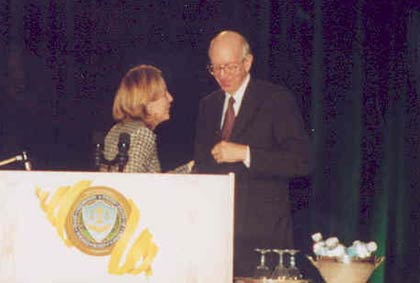
American federal judge and legal scholar (born 1939)
| Field | Value |
|---|---|
| name | Richard Posner |
| image | Richard Posner at Harvard University.jpg |
| caption | Posner speaking at the Federalist Society of Harvard Law School, 2017 |
| office | Chief Judge of the United States Court of Appeals for the Seventh Circuit |
| term_start | August 1, 1993 |
| term_end | August 1, 2000 |
| predecessor | William J. Bauer |
| successor | Joel Flaum |
| office1 | Judge of the United States Court of Appeals for the Seventh Circuit |
| appointer1 | Ronald Reagan |
| term_start1 | December 1, 1981 |
| term_end1 | September 2, 2017 |
| predecessor1 | Philip Willis Tone |
| successor1 | Michael Y. Scudder |
| birth_name | Richard Allen Posner |
| birth_date | |
| birth_place | New York City, New York, U.S. |
| spouse | Charlene Horn |
| children | 2, including Eric |
| education | Yale University (BA) |
| Harvard University (LLB) | |
| awards | Henry J. Friendly Medal (2005) |
Harvard University (LLB) Richard Allen Posner (; born January 11, 1939) is an American legal scholar and retired United States circuit judge who served on the U.S. Court of Appeals for the Seventh Circuit from 1981 to 2017. Posner was appointed by President Ronald Reagan, and he served as the chief judge of the Seventh Circuit from 1993 to 2000. A former law professor at the University of Chicago, Posner was identified in The Journal of Legal Studies as the most-cited legal scholar of the 20th century. As of 2021, he is also the most-cited American legal scholar of all time. He is widely considered to be one of the most influential legal scholars in the United States.
Posner is known for his scholarly range and for writing on topics outside of law. In his various writings and books, he has addressed animal rights, feminism, drug prohibition, same-sex marriage, Keynesian economics, law and literature, and academic moral philosophy, among other subjects.
Posner is the author of nearly 40 books on jurisprudence, law and economics, antitrust law, and several other topics, such as Economic Analysis of Law, The Economics of Justice, The Problems of Jurisprudence, Sex and Reason, Law, Pragmatism and Democracy, and The Crisis of Capitalist Democracy. Posner has generally been identified as being politically conservative; in recent years, however, he has distanced himself from the positions of the Republican Party, authoring more liberal rulings involving same-sex marriage and abortion. In A Failure of Capitalism, he writes that the 2008 financial crisis caused him to question the rational-choice, laissez-faire economic model that lies at the heart of his law and economics theory.
Early life and education
Richard Allen Posner was born on January 11, 1939, in New York City, to Blanche (Hofrichter) and Max Posner. His father's family were of Romanian Jewish descent, and his mother's family were Ashkenazi Jews from Galicia in the Austrian Empire.
After high school, Posner studied English literature at Yale University, graduating in 1959 with a B.A., summa cum laude, and membership in Phi Beta Kappa. He then attended Harvard Law School, where he was president of the Harvard Law Review. He graduated in 1962 ranked first in his class with an LL.B., magna cum laude.
Legal career
After law school, Posner was a law clerk to Justice William J. Brennan Jr. of the U.S. Supreme Court from 1962 to 1963. He then served as an attorney-advisor to Commissioner Philip Elman of the Federal Trade Commission (FTC); he would later argue that the FTC ought to be abolished. Posner went on to work in the Office of the Solicitor General in the United States Department of Justice, under Solicitor General Thurgood Marshall.
In 1968, Posner accepted a position teaching at Stanford Law School. In 1969, Posner moved to the faculty of the University of Chicago Law School. He was a founding editor of The Journal of Legal Studies in 1972.
On October 27, 1981, Posner was nominated by President Ronald Reagan to a seat on the United States Court of Appeals for the Seventh Circuit vacated by Judge Philip Willis Tone.{{cite news | access-date =October 17, 2008
Posner is a pragmatist in philosophy and an economist in legal methodology. He has written many articles and books on a wide range of topics including law and economics, law and literature, the federal judiciary, moral theory, intellectual property, antitrust law, public intellectuals, and legal history. He is also well known for writing on a wide variety of current events including the 2000 presidential election recount controversy, Bill Clinton's affair with Monica Lewinsky and his resulting impeachment procedure, and the 2003 invasion of Iraq.
His analysis of the Lewinsky scandal cut across most party and ideological divisions. Posner's greatest influence is through his writings on law and economics; The New York Times called him "one of the most important antitrust scholars of the past half-century." In December 2004, Posner started a joint blog with Nobel Prize-winning economist Gary Becker, titled simply "The Becker-Posner Blog".{{cite news | access-date =October 17, 2008 }} Both men contributed to the blog until shortly before Becker's death in May 2014, after which Posner announced that the blog was being discontinued. He also had a blog at The Atlantic, where he discussed the then-current Great Recession.
Posner was mentioned in 2005 as a potential nominee to replace Sandra Day O'Connor because of his prominence as a scholar and an appellate judge. Robert S. Boynton wrote in The Washington Post that he believed Posner would never sit on the Supreme Court because despite his "obvious brilliance," he would be criticized for his occasionally "outrageous conclusions," such as his contention "that the rule of law is an accidental and dispensable element of legal ideology," his argument that buying and selling children on the free market would lead to better outcomes than the present situation, government-regulated adoption, and his support for the legalization of marijuana and LSD.
Posner on Posner Series
Judge Posner was the focus of a "series" of posts (many Q&A interviews with the Judge) done by University of Washington Law Professor Ronald K. L. Collins. The twelve posts—collectively titled "Posner on Posner"—began on November 24, 2014, and ended on January 5, 2015, and appeared on the Concurring Opinions blog.
Legal and philosophical positions
In Posner's youth and in the 1960s as law clerk to William J. Brennan, he was generally counted as a liberal. However, in reaction to some of the perceived excesses of the late 1960s, Posner developed a strongly conservative bent. He encountered Chicago School economists Aaron Director and George Stigler while a professor at Stanford. Posner summarized his views on law and economics in his 1973 book The Economic Analysis of Law.
Today, although generally viewed as to the right in academia, Posner's pragmatism, his qualified moral relativism and moral skepticism, and his affection for the thought of Friedrich Nietzsche set him apart from most American conservatives. As a judge, with the exception of his rulings with respect to the sentencing guidelines and the recording of police actions, Posner's judicial votes have always placed him on the moderate-to-liberal wing of the Republican Party, where he has become more isolated over time. In July 2012, Posner stated, "I've become less conservative since the Republican Party started becoming goofy." Among Posner's judicial influences are the American jurists Oliver Wendell Holmes Jr. and Learned Hand; he has written that "Holmes is the greatest jurist ... because the sum of his ideas, metaphors, decisions, dissents and other contributions exceeds the sum of contributions of any other jurist of modern times", and he has applied the Hand formula in a number of his opinions.
Legal value of Constitution and Supreme Court precedents
In June 2016, Posner was criticized by right-wing media organizations for a column he wrote for Slate in which he stated, "I see absolutely no value to a judge of spending decades, years, months, weeks, day, hours, minutes, or seconds studying the Constitution, the history of its enactment, its amendments, and its implementation."
He has called his approach to judging pragmatic. "I pay very little attention to legal rules, statutes, constitutional provisions. ... A case is just a dispute. The first thing you do is ask yourself—forget about the law—what is a sensible resolution of this dispute? The next thing ... is to see if a recent Supreme Court precedent or some other legal obstacle stood in the way of ruling in favor of that sensible resolution. And the answer is that's actually rarely the case. When you have a Supreme Court case or something similar, they're often extremely easy to get around."
Abortion
Posner has written several opinions sympathetic to abortion rights, including a decision that held that late term abortion was constitutionally protected in some circumstances.
In November 2015, Posner authored a decision in Planned Parenthood of Wisconsin v. Schimel striking down regulations on abortion clinics in Wisconsin. He rejected the state's argument that the laws were written to protect the health of women and not to make abortion more difficult to obtain. Accusing the state of indirectly trying to ban abortions in the state Posner wrote, "They [Wisconsin] may do this in the name of protecting the health of women who have abortions, yet as in this case the specific measures they support may do little or nothing for health, but rather strew impediments to abortion."
Animal rights
Posner rejects an ethic of strong animal rights on pragmatic grounds (where such an ethic posits the moral irrelevance of species membership). He recognizes the philosophical force of arguments for strong animal rights, but maintains that human intuition about the paramount value of human life makes it impossible to accommodate an ethic of strong animal rights. Posner, a self-avowed moral anti-realist, does not present his critique of strong animal rights as a deductive proof. Instead, he highlights the practical importance of intuition and emotion over abstract argument.
In a 2000 Yale Law Journal book review on the title "Rattling the Cage" by Steven M. Wise, Posner again criticized the legal notion of animal rights. In the review, Posner argues that Wise's approach, using the cognitive ability of animals compared to that of very young normal human beings as a basis for rights-worthiness, is arbitrary and in contrast with major traditional and contemporary philosophies (including the theology of Thomas Aquinas for one and utilitarianism for another). In addition, he points out that this basis for rights has problematic implications—including that it might soon make some computers more worthy of rights than some humans, a conclusion he calls absurd. Posner goes on to reason that granting human-like rights to animals is fraught with implications which could radically disrupt or devalue the rights of human beings. He alludes to Hitler's fondness for animals as evidence that respect for animals and humaneness toward human beings are not necessarily associated. Arguing that the analogy of animal rights to the civil rights movement lacks imagination and is not very apt, Posner posits that animal welfare might be better protected by other legal models, one example of which would be stronger laws making animals property, since, he asserts, people tend to protect what they own.
Posner engaged in a debate with the philosopher Peter Singer in 2001 at Slate magazine. He agrees that "gratuitous cruelty to and neglect of animals is wrong and that some costs should be incurred to reduce the suffering of animals raised for food or other human purposes or subjected to medical or other testing and experimentation," but rejects grounding this view in an ethic of strong animal rights, contending that such a premise entails conclusions inconsistent with the reality of human society and psychology. He further states that people whose opinions were changed by consideration of the philosophical arguments presented in Singer's book Animal Liberation failed to see the "radicalism of the ethical vision that powers [their] view on animals, an ethical vision that finds greater value in a healthy pig than in a profoundly retarded child, that commands inflicting a lesser pain on a human being to avert a greater pain to a dog, and that, provided only that a chimpanzee has 1 percent of the mental ability of a normal human being, would require the sacrifice of the human being to save 101 chimpanzees."
Posner emphasizes the importance of facts over arguments in creating social change. He states that his moral intuition says that "it is wrong to give as much weight to a dog's pain as to an infant's pain," and that "[this] is a moral intuition deeper than any reason that could be given for it and impervious to any reason that you or anyone could give against it." Instead, Posner claims that "[expanding and invigorating] the laws that protect animals will require not philosophical arguments for reducing human beings to the level of the other animals but facts, facts that will stimulate a greater empathetic response to animal suffering and facts that will alleviate concern about the human costs of further measures to reduce animal suffering."
Antitrust
Along with Robert Bork, Posner helped shape the antitrust policy changes of the 1970s through his idea that 1960s antitrust laws were in fact making prices higher for the consumer rather than lower, while he viewed lower prices as the essential end goal of any antitrust policy. Posner's and Bork's theories on antitrust evolved into the prevailing view in academia and at the Justice Department in the George H. W. Bush administration; they have remained the consensus view in both the Justice Department and among legal academics of antitrust.
''The Bluebook''
The Bluebook is the style guide that prescribes the most widely used legal citation system in the United States. Posner is "one of the founding fathers of Bluebook abolitionism, having advocated it for almost twenty-five years, ever since his 1986 University of Chicago Law Review article on the subject." In a 2011 Yale Law Journal article, he wrote:
The Bluebook: A Uniform System of Citation exemplifies hypertrophy in the anthropological sense. It is a monstrous growth, remote from the functional need for legal citation forms, that serves obscure needs of the legal culture and its student subculture.
He describes those needs as unrelated to practical legal activity but instead as social and political.
In the same article, Posner gives an excerpt of the entire citation style guide included (as an appendix) in the short manual he gives his own law clerks (whom he describes as "very smart"); the appendix is about 2–3 pages long, and he says the entire manual is about 1% as long as the Bluebook.
Drugs
Posner opposes the U.S. "war on drugs" and called it "quixotic". In a 2003 CNBC interview he discussed the difficulty of enforcing criminal marijuana laws, and asserted that it is hard to justify the criminalization of marijuana when compared to other substances. In a talk at Elmhurst College in 2012, Posner said that "I don't think that we should have a fraction of the drug laws that we have. I think it's really absurd to be criminalizing possession or use or distribution of marijuana."
National security
At the Cybercrime 2020: The Future of Online Crime and Investigations conference held at Georgetown University Law Center on November 20, 2014, Posner, in addition to further reinforcing his views on privacy being over-rated, stated that "If the NSA wants to vacuum all the trillions of bits of information that are crawling through the electronic worldwide networks, I think that's fine. ... Much of what passes for the name of privacy is really just trying to conceal the disreputable parts of your conduct," Posner added. "Privacy is mainly about trying to improve your social and business opportunities by concealing the sorts of bad activities that would cause other people not to want to deal with you." Posner also criticized mobile OS companies for enabling end-to-end encryption in their newest software. "I'm shocked at the thought that a company would be permitted to manufacture an electronic product that the government would not be able to search" he said.
Patent and copyright law
Posner has expressed concerns, on the blog he contributed to with Gary Becker, that both patent and copyright protection, though particularly the former, may be excessive. He argues that the cost of inventing must be compared to the cost of copying in order to determine the optimal patent protection for an inventor. When patent protection is too strongly in favor of the inventor, market efficiency is decreased. He illustrates his argument by comparing the pharmaceutical industry (where the cost of invention is high) with the software industry (where the cost of invention is relatively low).{{cite web | access-date =October 2, 2012}} However, Posner suggested that strengthening copyright law, including a possible bar on linking to or paraphrasing copyrighted materials, may be necessary as a means to prevent what he views as free riding on newspaper journalism.{{cite web | access-date =April 2, 2012}} His co-blogger Gary Becker simultaneously posted a contrasting opinion that while the Internet might hurt newspapers, it will not harm the vitality of the press, but rather embolden it.
Police recording
In 2011, a three-judge panel on the 7th Circuit was weighing a challenge to the Illinois Eavesdropping Act, which barred the secret recording of conversations without the consent of all the parties to the conversation. At issue was the constitutionality of the Illinois wiretapping law, as it prevented the filming of arrests that took place in public. Posner interrupted the ACLU after just 14 words, stating, "Yeah, I know. But I'm not interested, really, in what you want to do with these recordings of peoples' encounters with the police" and that "Once all this stuff can be recorded, there's going to be a lot more of this snooping around by reporters and bloggers. [...] I'm always suspicious when the civil liberties people start telling the police how to do their business." The 7th Circuit upheld the challenge, 2–1, striking down the Eavesdropping Act, but Posner wrote a dissenting opinion.
Prisoners
In a dissent from an earlier ruling by his protégé Frank Easterbrook, Posner wrote that Easterbrook's decision that female guards could watch male prisoners while in the shower or bathroom must stem from a belief that prisoners are "members of a different species, indeed as a type of vermin, devoid of human dignity and entitled to no respect. ... I do not myself consider the 1.5 million inmates of American prisons and jails in that light."
Race and public education
Posner's views of public education policy are informed by his view that groups of students differ in intellectual ability, and therefore, that it is faulty to impose uniform educational standards on all schools. His view in this regard is undergirded by his view that different races differ in intelligence. (However, Posner says that he thinks it is "highly unlikely" that these differences are rooted in genetics, rather than environment.)
In a blog post, Posner wrote, "I suggest that the only worthwhile reforms of teacher compensation are raising teacher wages uniformly, providing recognition and modest bonuses for outstanding teachers, and increasing hiring standards." In the same post, he wrote, "I am not clear what we should think the problem of American education (below the college level) is. Most children of middle-class ... Americans are white or Asian and attend good public or private schools, usually predominantly white. The average white IQ is of course 100 and the Asian (like the Jewish) almost one standard deviation higher, that is, 115. The average black IQ is 85, a full standard deviation below the white average, and the average Hispanic IQ has been estimated recently at 89. Black children in particular often come from disordered households, which has a negative effect on ability to learn and perhaps indeed on IQ. ... Increasingly, black and Hispanic students find themselves in schools with few white or Asian students. The challenge to American education is to provide a useful education to the large number of Americans who are unlikely to benefit from a college education or from high school courses aimed at preparing students for college."
Same-sex marriage
In September 2014, Posner authored the opinions in the consolidated cases of Wolf v. Walker and Baskin v. Bogan challenging Wisconsin and Indiana's state level same-sex marriage bans. The opinion of the three-judge panel on the 7th Circuit Court of Appeals ruled that Indiana and Wisconsin's bans on same-sex marriage were unconstitutional, affirming a lower court ruling. During oral arguments, Wisconsin's attorney general cited tradition as a reason for maintaining the ban, prompting Posner to note that: "It was tradition to not allow blacks and whites to marry—a tradition that got swept away." Though Posner argued in his 1992 book Sex and Reason that prohibitions against gay marriage were rationally justified, he held in the 2014 cases that the same-sex marriage bans were both "a tradition of hate" and "savage discrimination". Posner wrote the opinion for the unanimous panel, finding the laws unconstitutional under the Equal Protection Clause. The Supreme Court then denied a writ of certiorari and left Posner's ruling to stand.
Torture
When reviewing Alan Dershowitz's book, Why Terrorism Works: Understanding the Threat, Responding to the Challenge, Posner wrote in the September 2002 The New Republic, "If torture is the only means of obtaining the information necessary to prevent the detonation of a nuclear bomb in Times Square, torture should be usedand will be usedto obtain the information.... No one who doubts that this is the case should be in a position of responsibility."
Voter identification laws
In 2007, Posner wrote the majority opinion upholding Indiana's photo identification law in the Crawford v. Marion County Election Board case. He wrote that "absence of prosecutions" for voter fraud is explained in part by "the extreme difficulty of apprehending a voter impersonator," and that such impersonators are "almost impossible to catch without a voter ID requirement". The law was subsequently upheld at the United States Supreme Court. In 2013, Posner disavowed support for the ruling due to concerns about voter suppression caused by the law. He stated that judges "weren't given the information that would enable that balance to be struck" between preventing fraud and protecting voters' rights. In 2014, Posner wrote a 30-page dissent opposing the upholding of a Wisconsin voter ID law.
Judicial career
Posner is one of the most prolific legal writers, through both the number and topical breadth of his opinions, to say nothing of his scholarly and popular writings.{{cite news | access-date =October 17, 2008 | access-date =April 30, 2011
In 1999, Posner was welcomed as a private mediator among the parties involved in the Microsoft antitrust case.
A 2000 study published by Fred Shapiro in the University of Chicago's Journal of Legal Studies found that Posner is the most-cited legal scholar of all time by a considerable margin, as Posner's work has generated 7,981 cites compared to the runner-up Ronald Dworkin's 4,488 cites. In 2021, using a modified methodology (including the HeinOnline database and searches for citations to books), Shapiro found that Posner was the most-cited United States legal scholar, generating 48,852 cites to runner-up Cass Sunstein's 35,584.
Notable cases
In his decision in the 1997 case State Oil Co. v. Khan, Posner wrote that a ruling 1968 antitrust precedent set by the Supreme Court was "moth-eaten", "wobbly", and "unsound". Nevertheless, he abided by the previous decision in his ruling. The Supreme Court granted certiorari and overturned the 1968 ruling unanimously; Sandra Day O'Connor wrote the opinion and spoke positively of both Posner's criticism and his decision to abide by the ruling until the Court decided to change it.{{cite news | access-date =October 17, 2008
Tort law
In U.S. Fidelity & Guaranty Co. v. Jadranska Slobodna Plovidba, 683 F.2d 1022 (7th Cir. 1982), Posner revived Learned Hand's economic efficiency theory of negligence law.
In Indiana Harbor Belt Railroad Co. v. American Cyanamid Co. (1990), Posner lowered the standard of legal liability a railroad faced for a hazardous waste spill. The case became a staple of first year torts courses taught in American law schools, where the case is used to address the question of when it is better to use negligence liability or strict liability.
In 1999, Posner applied the lex loci delicti commissi rule on choice of law rather than the Restatement of Torts, Second when rejecting a claim by an Illinois dentist who slipped and fell in Acapulco, Mexico. In 2003, Posner affirmed a punitive damages award of 37.2 times the compensatory damages guests won from a bedbug infested Motel 6. In 2003, Posner found that co-workers who did not prevent a hypoglycemic diabetic's fatal attempt to drive himself home violated no duty to rescue.
Contract law
In Morin Building Products Co. v. Baystone Construction, Inc. (1983), Posner held that the Uniform Commercial Code presumes contracts impose an objective standard upon what would subjectively be illusory promises. In 1987, Posner dissented when Judge Frank H. Easterbrook, joined by Richard Dickson Cudahy, found that a stockbroker could sue his former employer under SEC Rule 10b-5 after he quit shortly before the firm's lucrative unannounced merger. In 1990, Posner found that Delaware corporate law did not permit an airline's board to adopt a poison pill provision that encouraged its machinists to take strike action if its pilots' takeover attempt succeeded. In 1991, Posner held that good faith performance is a factual question of the defendant's state of mind that must be proven at trial.
Civil rights
In 1984, Posner wrote for the en banc circuit when it held that a consent decree regulating law enforcement Red Squads did not apply to FBI terrorism investigations, over the dissent of Judge Richard Dickson Cudahy. In January 2001, Posner loosened that consent decree to allow the Chicago Police Department to conduct counterterrorism operations.
In United States v. Marshall (1990), Posner dissented when Frank H. Easterbrook, writing for the en banc circuit, held that the punishment for possession of LSD is determined by the weight of the carrier it is found within. The circuit's judgment was affirmed, under the name Chapman v. United States (1991), by the Supreme Court of the United States.
In 1995, Posner, joined by Judge Walter J. Cummings Jr., affirmed an injunction blocking Illinois from closing schools on Good Friday as a violation of the Establishment Clause, over the dissent of Judge Daniel Anthony Manion. In 2000, Posner found that partners at a big law firm could be considered employees with regard to the Age Discrimination in Employment Act of 1967. Posner found that secondary liability attaches to a file sharing service for contributory copyright infringement in In re Aimster Copyright Litigation (2003).
Awards and honors
A 2004 poll by Legal Affairs magazine named Posner as one of the top twenty legal thinkers in the U.S.
In March 2007, the Harvard Law Review dedicated an issue of faculty written case comments in tribute of Judge Posner. In 2008, the University of Chicago Law Review published a commemorative issue: "Commemorating Twenty-five Years of Judge Richard A. Posner."{{cite news | access-date =October 17, 2008 | access-date = October 17, 2008 | archive-date = October 15, 2012 | archive-url = https://web.archive.org/web/20121015161602/http://lessig.org/blog/2006/10/project_posner.html | url-status = dead
Personal life
Posner and his wife lived in Hyde Park, Chicago, for many years. His son Eric Posner is also a prominent legal scholar and teaches at the University of Chicago Law School. Posner is a self-described "cat person" and is devoted to his Maine Coon, Pixie.{{cite news | access-date =November 13, 2013 He has been known to illustrate legal points in his opinions with elaborate cat-related metaphors and examples.
Posner was diagnosed with Alzheimer's disease in early 2018, approximately six months after leaving the bench, and as of 2022 resides in a nursing facility.
Selected works
Books
- 1973 Economic Analysis of Law, 1st ed.
- 2007 Economic Analysis of Law, 7th ed.,
- 2010 Economic Analysis of Law, 8th ed.,
- 2014 Economic Analysis of Law, 9th ed.
- 1978 Antitrust Law: An Economic Perspective
- 2001 Antitrust Law, 2nd ed.,
- 1981 The Economics of Justice,
- 1985 The Federal Courts: Crisis and Reform
- 1996 The Federal Courts: Challenge and Reform (2d ed.),
- 1988 Law and Literature: A Misunderstood Relation,
- 1998 Law and Literature (revised and enlarged ed.),
- 2009 Law and Literature, 3rd. ed.,
- 1990 The Problems of Jurisprudence,
- 1990 Cardozo: A Study in Reputation,
- 1992 Sex and Reason,
- 1995 Overcoming Law, , Among the topics is a critique of Robert Bork's constitutional theories, review of books about the legal system in the Third Reich, and a discussion of the legal culture reflected in the works of Tom Wolfe and E.M. Forster.
- 1995 Aging and Old Age,
- 1996 Law and Legal Theory in England and America,
- 1999 The Problematics of Moral and Legal Theory,
- 1999 An Affair of State: The Investigation, Impeachment, and Trial of President Clinton. Cambridge, Mass.: Harvard University Press, .
- 2001 Frontiers of Legal Theory,
- 2001 Breaking the Deadlock: The 2000 Presidential Election and the Courts,
- 2002 Public Intellectuals: A Study of Decline,
- 2003 Law, Pragmatism and Democracy,
- 2003 The Economic Structure of Intellectual Property Law (Harvard Univ. Press) (with William Landes),
- 2004 Catastrophe: Risk and Response,
- 2005 Preventing Surprise Attacks: Intelligence Reform in the Wake of 9/11,
- 2006 Uncertain Shield: The U.S. Intelligence System in the Throes of Reform,
- 2006 Not a Suicide Pact: The Constitution in a Time of National Emergency,
- 2007 The Little Book of Plagiarism,
- 2007 Countering Terrorism: Blurred Focus, Halting Steps,
- 2008 How Judges Think,
- 2009 A Failure of Capitalism: The Crisis of '08 and the Descent into Depression,
- 2009 Uncommon Sense: Economic Insights, from Marriage to Terrorism (with Gary Becker)
- 2010 The Crisis of Capitalist Democracy,
- 2013 Reflections on Judging
- 2013 The Behavior of Federal Judges, (with Lee Epstein and William Landes)
- 2016 Divergent Paths: The Academy and the Judiciary
- 2017 The Federal Judiciary: Strengths and Weaknesses
Articles
References
References
- Meisner, Jason. (September 1, 2017). "Richard Posner announces sudden retirement from federal appeals court in Chicago". Chicago Tribune.
- Shapiro, Fred R.. (2000). "The Most-Cited Legal Scholars". Journal of Legal Studies.
- Shapiro, Fred R.. (2021). "The Most-Cited Legal Scholars Revisited".
- Witt, John Fabian. (October 7, 2016). "The Provocative Life of Judge Richard Posner". The New York Times.
- (September 9, 2017). "The judicial philosophy of Richard Posner". The Economist.
- "Judge Richard Posner explains why we should "burn all copies of the Bluebook"". The Washington Post.
- (May 13, 2019). "Swan Song of a Great Colossus: The Latest from Richard Posner".
- (September 2017). "Federal Judge Richard Posner, A Leading Legal Voice, Retiring From Bench". NPR.
- Warren, James. (July 14, 2012). "Richard Posner Bashes Supreme Court's Citizens United Ruling".
- "Judge Appointed by Ronald Reagan Strikes Down Wisconsin Abortion Law". Huffington Post.
- "Appeals Court Rules Indiana and Wisconsin Gay Marriage Bans Unconstitutional". South Bend Voice.
- Domnarski, William. (2016). "Richard Posner". Oxford University Press.
- (2004). "Contemporary Authors". Gale.
- MacFarquhar, Larissa. (December 3, 2001). "Richard Posner, The Bench Burner". [[The New Yorker]].
- Parloff, Roger. (January 10, 2000). "The Negotiator: No one doubts that Richard Posner is a brilliant judge and. ...". Fortune Magazine.
- (October 4, 2016). "Richard Posner". [[C-SPAN]].
- [https://www.law.uchicago.edu/coase-sandor/publications "Journal of Law and Economics" The University of Chicago. Retrieved December 9, 2022.]
- Manson, Patricia. (September 6, 2017). "Posner says friction on 7th Circuit bench led to his retirement". Chicago Daily Law Bulletin.
- Witt, John Fabian. (October 7, 2016). "The Provocative Life of Judge Richard Posner". The New York Times.
- See {{smallcaps. Richard A. Posner, An Affair of State: The Investigation, Impeachment, and Trial of President Clinton (2000), {{ISBN. 978-0674003910.
- (November 1, 2002). "Debates on the War with Iraq". Columbia School of Law.
- (May 16, 2014). "Becker-Posner Blog shutters after Gary Becker's death". ABA Journal.
- (July 12, 2012). "Richard A. Posner – Authors – The Atlantic". Correspondents.theatlantic.com.
- link. (March 15, 2017 , ''The Washington Post Book World'', January 20, 2002.)
- Collins, Ronald K. L.. (January 9, 2015). "The Complete Posner on Posner Series".
- Posner, Richard. (1998). "The Problematics of Moral and Legal Theory". [[Harvard Law Review]].
- Nina Totenberg, [https://www.npr.org/blogs/itsallpolitics/2012/07/05/156319272/federal-judge-richard-posner-the-gop-has-made-me-less-conservative Federal Judge Richard Posner: The GOP Has Made Me Less Conservative] [[NPR]], July 5, 2012
- Domnarski, William. (2016). "Richard Posner". Oxford University Press.
- Wright, Richard W.. (2003). "Hand, Posner, and the Myth of the 'Hand Formula'". Theoretical Inquiries in Law.
- Posner, Richard A.. (June 24, 2016). "Supreme Court Breakfast Table". Slate.
- "Federal Judge: U.S. Constitution Is Outdated, Judges Should Stop Studying It".
- (September 11, 2017). "An Exit Interview With Richard Posner, Judicial Provocateur (Published 2017)". The New York Times.
- [[Alissa J. Rubin. Rubin, Alissa]] (February 11, 1999) [https://www.latimes.com/archives/la-xpm-1999-feb-11-mn-7143-story.html Anti-Abortion Advocates Gain Ground in Late-Term Debate], ''[[Los Angeles Times]]''
- "Planned Parenthood of Wisconsin v. Brad Schimel".
- (June 12, 2001). "Animal Rights".
- Watts, Jade E.. (2019). "An exploration of Peter Singer and Richard Posner’s ethical arguments regarding the moral status of animals, with a specific focus on the use of animals for the consumption of food". Student Journal of Professional Practice and Academic Research.
- Posner, Richard. (1998). "The Problematics of Moral and Legal Theory". Harvard Law Review.
- "Animal Rights".
- "Animal Rights Debate: Peter Singer vs Richard Posner".
- Posner, Richard A.. (July 29, 1986). "Goodbye to the Bluebook". The University of Chicago Law Review.
- Somin, Ilya (January 25, 2011) [http://volokh.com/2011/01/25/richard-posner-on-the-bluebook/ Richard Posner on the Bluebook], ''[[Volokh Conspiracy]]''
- [http://www.yalelawjournal.org/review/the-bluebook-blues "The ''Bluebook'' Blues", 120 ''Yale L.J.'' 850 (2011)]
- {{YouTube
- (December 4, 2014). "Judge: Give NSA unlimited access to digital data".
- (June 28, 2009). "Judge Thinks Linking To Copyrighted Material Should Be Illegal".
- Schonfeld, Erick. (June 28, 2009). "How To Save The Newspapers, Vol. XII: Outlaw Linking – TechCrunch".
- (June 23, 2009). "The Social Cost of the Decline of Newspapers?". Gary Becker.
- Justin Silverman. "Tell Us, Judge Posner, Who Watches the Watchmen?". suffolkmedialaw.com.
- ''Johnson v. Phelan'', 69 F.3d 144, 151 (7th Cir. 1995) (Posner, J., dissenting).
- "Rating Teachers – Posner".
- "Appeals Court Judge Calls Indiana's Same-Sex Marriage Ban 'Tradition of Hate'". South Bend Voice.
- Posner, Richard A.. (September 5, 2002). "Review-a-Day – Why Terrorism Works Understanding The by Alan M Dershowitz, reviewed by The New Republic Online – Powell's Books". powells.com.
- Gilbert, Michael D.. (September 5, 2014). "The Problem of Voter Fraud". Columbia Law Review.
- Schwartz, John. (October 16, 2013). "Judge in Landmark Case Disavows Support for Voter ID".
- Hiltzik, Michael. (October 13, 2014). "A conservative judge's devastating take on why voter ID laws are evil".
- [https://web.archive.org/web/20231203210619/https://casetext.com/case/us-fid-guar-v-jadranska-s-plovidba case opinion]
- (2007). "The Judicial Posner on Negligence versus Strict Liability: Indiana Harbor Belt Railroad Co. v. American Cyanamid Co.". [[Harvard Law Review]].
- (2007). "Strict Liability versus Negligence in Indiana Harbor". [[University of Chicago Law Review]].
- Rosenberg, David. (2007). "The Judicial Posner on Negligence Versus Strict Liability: ''Indiana Harbor Belt Railroad Co. v. American Cyanamid Co.''". [[Harvard Law Review]].
- (2007). "''Lex Loci Delictus'' and Global Economic Welfare: ''Spinozzi v. ITT Sheraton Corp.''". [[Harvard Law Review]].
- (2007). "On the Proper Magnitude of Punitive Damages: ''Mathias v. Accor Economy Lodging, Inc.''". [[Harvard Law Review]].
- [https://scholar.google.com/scholar_case?case=8847918381019273170&hl=en&as_sdt=6&as_vis=1&oi=scholarr ''Stockberger v. US'', 332 F. 3d 479 (7th Cir. 2003)]
- (2007). "Satisfaction and Posner's ''Morin'' Opinion: ''Aliquando Bonus Dormitat Posnerus''?". [[Harvard Law Review]].
- (2007). "Not-so-Ordinary Judges in Ordinary Courts: Teaching ''Jordan v. Duff & Phelps, Inc.''". [[Harvard Law Review]].
- (2007). "Deconstructing ''Duff and Phelps''". [[University of Chicago Law Review]].
- (2007). "The Emerging Problem of Embedded Defenses: Lessons from ''Air Line Pilots Ass'n, International v. UAL Corp.''". [[Harvard Law Review]].
- (2007). "Good Faith in Contract Performance: ''Market Associates Ltd. Partnership v. Frey''". [[Harvard Law Review]].
- (2007). "Posner on Security and Liberty: ''Alliance to End Repression v. City of Chicago''". [[Harvard Law Review]].
- (2007). "Statutory Pragmatism and Constitutional Structure". [[Harvard Law Review]].
- "Chapman v. United States, 500 U.S. 453 (1991)".
- (2007). "Religion and the Burdon of Proof: Posner's Economics and Pragmatism in ''Metzl v. Leininger''". [[Harvard Law Review]].
- (2007). "Partner, Shmartner! ''EEOC v. Sidley Austin Brown & Wood''". [[Harvard Law Review]].
- (2007). "''Aimster'' and Optimal Targeting". [[Harvard Law Review]].
- "Who Are the Top 20 Legal Thinkers in America?". Legal Affairs.
- (2007). "Richard Posner, the Judge". [[Harvard Law Review]].
- Janssen, Kim. (March 15, 2017). "Cat-loving judge makes case that has nothing to do with cats all about cats". Chicago Tribune.
- (March 29, 2022). "After Posner retired from 7th Circuit, a grim diagnosis and a brewing battle". Reuters.
- Posner, Richard. (1978). "Antitrust Law: An Economic Perspective". University of Chicago Press.
This article was imported from Wikipedia and is available under the Creative Commons Attribution-ShareAlike 4.0 License. Content has been adapted to SurfDoc format. Original contributors can be found on the article history page.
Ask Mako anything about Richard Posner — get instant answers, deeper analysis, and related topics.
Research with MakoFree with your Surf account
Create a free account to save articles, ask Mako questions, and organize your research.
Sign up freeThis content may have been generated or modified by AI. CloudSurf Software LLC is not responsible for the accuracy, completeness, or reliability of AI-generated content. Always verify important information from primary sources.
Report