From Surf Wiki (app.surf) — the open knowledge base
Rice Stadium (Rice University)
Stadium in Houston, Texas, US

Stadium in Houston, Texas, US
| Field | Value | |
|---|---|---|
| name | Rice Stadium | |
| image | [[File:Aerial view of Rice Stadium in Houston, Texas 2024.jpg | 250px]] |
| caption | The stadium in 2024 | |
| location | 6100 South Main Street | |
| Houston, Texas, U.S. | ||
| coordinates | ||
| pushpin_map | USA#USA Texas | |
| pushpin_relief | 1 | |
| pushpin_map_caption | Location in the United States##Location in Texas | |
| pushpin_label | Houston | |
| pushpin_label_position | top | |
| broke_ground | February 1950 | |
| opened | ||
| owner | Rice University | |
| operator | Rice University | |
| surface | Natural grass (1950–1969) | |
| AstroTurf (1970–2005) | ||
| FieldTurf (2006–2014) | ||
| AstroTurf GameDay Grass 3D60H (2014–present) | ||
| construction_cost | $3.295 million | |
| ($ in dollars) | ||
| architect | Hermon Lloyd & W.B. Morgan and Milton McGinty | |
| structural_engineer | Walter P Moore | |
| general_contractor | Brown & Root Constructors | |
| former_names | Houston Stadium | |
| tenants | Rice Owls (NCAA) (1950–present) | |
| Houston Cougars (NCAA) (1951–1964) | ||
| Texas Southern Tigers (NCAA) (1971–2000) | ||
| Bluebonnet Bowl (1959–1967, 1985-1986) | ||
| Houston Oilers (AFL) (1965–1967) | ||
| Houston Roughnecks (UFL) (2024) | ||
| seating_capacity | 47,000 | |
| (expandable to 59,000) | ||
| Super Bowl VIII (68,142) |
the current football stadium at Rice University
Houston, Texas, U.S. AstroTurf (1970–2005) FieldTurf (2006–2014) AstroTurf GameDay Grass 3D60H (2014–present) ($ in dollars) Houston Cougars (NCAA) (1951–1964) Texas Southern Tigers (NCAA) (1971–2000) Bluebonnet Bowl (1959–1967, 1985-1986) Houston Oilers (AFL) (1965–1967) Houston Roughnecks (UFL) (2024) (expandable to 59,000) Super Bowl VIII (68,142) Rice Stadium is an American football stadium located on the Rice University campus in Houston, Texas. It has been the home of the Rice Owls football team since its completion in 1950, and hosted John F. Kennedy's "We choose to go to the Moon" speech in 1962 and Super Bowl VIII in early 1974.
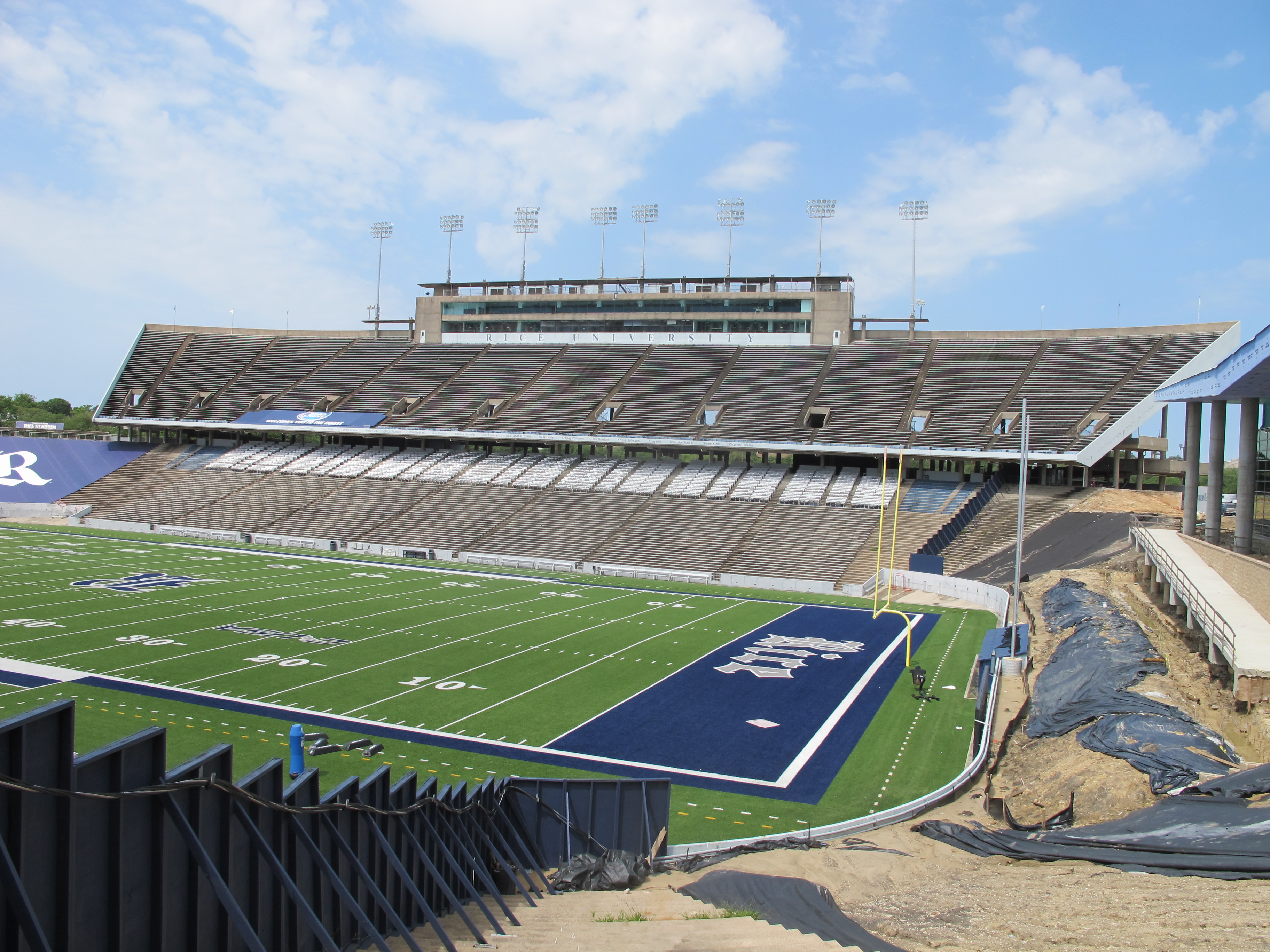
Architecturally, Rice Stadium is an example of modern architecture, with simple lines and an unadorned, functional design. The lower seating bowl is located below the surrounding ground level. Built solely for football, the stadium has excellent sightlines from almost every seat. To achieve this, the running track was eliminated so that spectators were closer to the action and each side of the upper decks was brought in at a concave angle to provide better sightlines. It is still recognized in many circles as the best stadium in Texas for watching a football game. Entrances and aisles were strategically placed so that the entire stadium could be emptied of spectators in nine minutes.
In 2006, Rice University upgraded the facility by switching from AstroTurf to FieldTurf and adding a modern scoreboard above the north concourse. Seating in the upper deck is in poor condition, which led the university to move home games for which large crowds were expected to nearby NRG Stadium.
High school football games, especially neutral-site playoff games, are frequently played at Rice Stadium. It can also be used as a concert venue.
History
Rice Stadium replaced Rice Field (now Wendel D. Ley Track and Holloway Field), which had a total capacity of less than 37,000, in 1950. The new stadium was subsidized by the City of Houston, and it was designed by Hermon Lloyd & W. B. Morgan and Milton McGinty and built by Brown and Root.
In addition to Rice, the University of Houston Cougars played at Rice Stadium from 1951 through 1964, and the former Bluebonnet Bowl was played there from 1959 to 1967, and in 1985 and 1986. The Houston Oilers of the American Football League (AFL) played in the stadium for three seasons (1965–1967), then moved to the Astrodome in 1968.
In January 1974, the venue hosted Super Bowl VIII, the first played in Texas, in which the defending champion Miami Dolphins defeated the Minnesota Vikings 24–7 with 68,142 in attendance. The game returned to Houston thirty years later in February 2004, for Super Bowl XXXVIII at Reliant Stadium.
John F. Kennedy speech
Main article: We choose to go to the Moon
On September 12, 1962, Rice Stadium hosted the speech in which President John F. Kennedy challenged Americans to meet his goal, set the previous year, to send a man to the Moon by the end of the decade. In the Wednesday afternoon speech, he used a reference to Rice University football to help frame his rhetoric:
"But why, some say, the Moon? Why choose this as our goal? And they may well ask, why climb the highest mountain? Why, 35 years ago, fly the Atlantic? Why does Rice play Texas? We choose to go to the Moon. We choose to go to the Moon. We choose to go to the Moon in this decade and do the other things, not because they are easy, but because they are hard, because that goal will serve to organize and measure the best of our energies and skills, because that challenge is one that we are willing to accept, one we are unwilling to postpone, and one which we intend to win, and the others, too."
Kennedy's comments implied Rice had a history of losing to Texas; however, the two football teams had split 5–5 in their previous ten meetings and tied the following month. On the other hand, Kennedy's comments about Rice-Texas might have been as forward-looking as his statements about going to the Moon (which did occur in 1969): Since 1963, Rice has gone just against Texas, including 28 straight losses between 1966 and 1993 and 16 straight from 1995 to the present.
Year by year
| Rice Owls | color=white}}" | Season | Rice Owls | color=white}}" | Head Coach | Rice Owls | color=white}}" | Conference | Rice Owls | color=white}}" | Avg. Crowd | Rice Owls | color=white}}" | Home Record |
|---|---|---|---|---|---|---|---|---|---|---|---|---|---|---|
| 2017 | David Bailiff | Conference USA | 19,354 | 0-5 | ||||||||||
| 2018 | Mike Bloomgren | 20,172 | 2-4 | |||||||||||
| 2019 | 18,845 | 1-5 | ||||||||||||
| 2020 | 1,000 | 0-2 | ||||||||||||
| 2021 | 18,613 | 3-3 | ||||||||||||
| 2022 | 19,011 | 4-2 | ||||||||||||
| 2023 | American Athletic Conference | 20,542 | 4-3 | |||||||||||
| 2024 | 18,143 | 4-2 | ||||||||||||
| 2025 | Scott Abell | 23,423 | 3-4 |
Capacity reduction
As originally built, Rice Stadium seated 70,000, the second-largest stadium in the Southwest Conference (behind the Cotton Bowl). Rice Stadium was built before professional football came to Houston and while Rice was still competitive in the Southwest Conference. It was reasonable to expect 70,000 fans to attend a college football game there. However, as Rice declined on the field from the 1960s onward, the Owls found it increasingly difficult to fill the stadium. Even crowds of 30,000 were swallowed up in the environment.
In 2006, the end zone seats were covered with tarps, reducing the regular seating capacity to 47,000. The northern end zone was later demolished. , the school continued exploring options for a modern seating arrangement with a reduced capacity.
In November 2025, the university announced the Gateway Project, a $120 million project to better connect the Rice campus to the adjacent Rice Village shopping and restaurant district. As part of the project, Rice Stadium will be further downsized to slightly over 30,000 capacity. On the stadium's west side, the upper level and existing press box will be demolished and replaced with a new west concourse building, consisting mostly of premium seating but including a new media center, coaches' booths, and athletic department offices. About half of the east side upper level will be removed. The overall project is currently set for completion in 2028.
Features
Brian Patterson Sports Performance Center

Around July 2015, construction began on the Brian Patterson Sports Performance Center. This building makes up the north end of the stadium, and contain a weight room, a home team locker room, coaching and staff offices. This replaced the north end seating that consisted of crude concrete steps and was unused. The building was named for donor and former Rice University football player and alumnus Brian Patterson.

Robert L. Waltrip Training Center
On May 9, 2019, the Rice University Board of Trustees approved a proposal for an air-supported multipurpose facility on the west side of Rice Stadium that will offer climate-protected space for varsity athletics training, campus recreation and Rice student events, activities and community partner events. The 80,000 square foot inflatable structure rose up from the infield area of the bike track west of Rice Stadium for the first time in late July 2020, creating a facility to house practices, intramurals and other events when weather put those events in peril.
References
References
- "AIA 50 Year Award: Rice Stadium".
- (March 22, 2016). "First Major Sports Facility". Walter P Moore.
- "Rice Stadium".
- (January 14, 1974). "Machine-like Dolphins repeat". Eugene Register-Guard.
- (December 1, 1961). "Rice Stadium -- home of the Bluebonnet Bowl". Lawrence Daily Journal-World.
- "Rice Stadium a remarkable gridiron arena of ingenuity - Houston Business Journal".
- "Rice Stadium Renovations". Rice University Athletics.
- "Old Rice Field".
- (September 13, 1962). "JFK urges U.S. to take lead in space". Victoria Advocate.
- "Winsipedia - Texas Longhorns vs. Rice Owls football series history games list".
- (5 July 2023). "As Rice Stadium undergoes minor renovations, university still eyes capacity-reduction project". Houston Business Journal.
- (November 8, 2025). "Rice University Gateway Project to connect campus with Rice Village, modernize Rice Stadium". Rice Owls.
- "Rice Owls".
This article was imported from Wikipedia and is available under the Creative Commons Attribution-ShareAlike 4.0 License. Content has been adapted to SurfDoc format. Original contributors can be found on the article history page.
Ask Mako anything about Rice Stadium (Rice University) — get instant answers, deeper analysis, and related topics.
Research with MakoFree with your Surf account
Create a free account to save articles, ask Mako questions, and organize your research.
Sign up freeThis content may have been generated or modified by AI. CloudSurf Software LLC is not responsible for the accuracy, completeness, or reliability of AI-generated content. Always verify important information from primary sources.
Report