From Surf Wiki (app.surf) — the open knowledge base
Ribonuclease L
Enzyme found in humans
Enzyme found in humans
Ribonuclease L or RNase L (for latent), known sometimes as ribonuclease 4 or 2'-5' oligoadenylate synthetase-dependent ribonuclease, is an interferon (IFN)-induced ribonuclease which, upon activation, destroys all RNA within the cell (both cellular and viral) as well as inhibiting mRNA export. RNase L is an enzyme that in humans is encoded by the RNASEL gene.
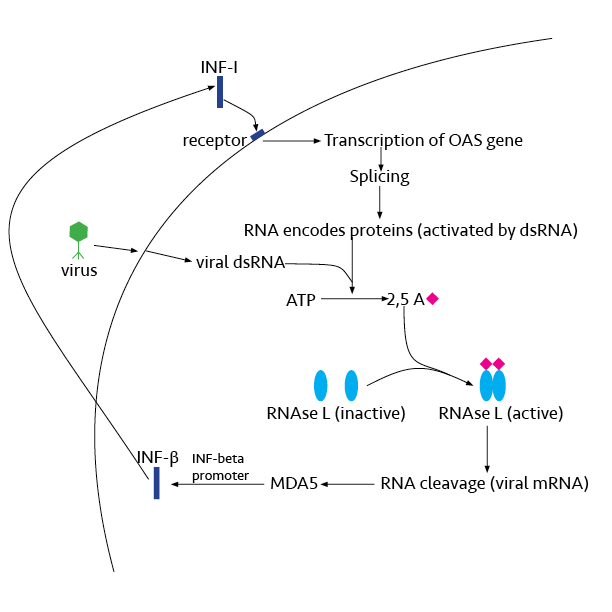
This gene encodes a component of the interferon-regulated 2'-5'oligoadenylate (2'-5'A) system that functions in the antiviral and antiproliferative roles of interferons. RNase L is activated by dimerization, which occurs upon 2'-5'A binding, and results in cleavage of all RNA in the cell. This can lead to activation of MDA5, an RNA helicase involved in the production of interferons.
Synthesis and activation
RNase L is present in very minute quantities during the normal cell cycle. When interferon binds to cell receptors, it activates transcription of around 300 genes to bring about the antiviral state. Among the enzymes produced is RNase L, which is initially in an inactive form. A set of transcribed genes codes for 2'-5' Oligoadenylate Synthetase (OAS). The transcribed RNA is then spliced and modified in the nucleus before reaching the cytoplasm and being translated into an inactive form of OAS. The location of OAS in the cell and the length of the 2'-5' oligoadenylate depends on the post-transcriptional and post-translational modifications of OAS.
OAS is only activated under a viral infection, when a tight binding of the inactive form of the protein with a viral dsRNA, consisting of the retrovirus' ssRNA and its complementary strand, takes place. Once active, OAS converts ATP to pyrophosphate and 2'-5'-linked oligoadenylates (2-5A), which are 5' end phosphorylated. 2-5 A molecules then bind to RNase L, promoting its activation by dimerization. In its activated form RNase L cleaves all RNA molecules in the cell leading to autophagy and apoptosis. Some of the resulting RNA fragments can also further induce the production of IFN-β as noted in the Significance section.
This dimerization and activation of RNase L can be recognized using Fluorescence Resonance Energy Transfer (FRET), as oligoribonucleotides containing a quencher and a fluorophore on opposite sites are added to a solution with inactive RNase L. The FRET signal is then recorded as the quencher and the fluorophore are very close to each other. Upon the addition of 2-5A molecules, RNase L becomes active, cleaving the oligoribonucleotides and interfering in the FRET signal.
In vitro, RNase L can be inhibited by curcumin.
Significance
RNase L is part of the body's innate immune defense, namely the antiviral state of the cell. When a cell is in the antiviral state, it is highly resistant to viral attacks and is also ready to undergo apoptosis upon successful viral infection. Degradation of all RNA within the cell (which usually occurs with cessation of translation activity caused by protein kinase R) is the cell's last stand against a virus before it attempts apoptosis.
Interferon beta (IFN-β), a type I interferon responsible for antiviral activity, is induced by RNase L and melanoma differentiation-associated protein 5 (MDA5) in the infected cell. The relationship between RNase L and MDA5 in the production of IFNs has been confirmed with siRNA tests silencing the expression of either molecule and noting a marked decline in IFN production. MDA5, an RNA helicase, is known to be activated by complex high molecular weight dsRNA transcribed from the viral genome. In a cell with RNase L, MDA5 activity may be further enhanced. When active, RNase L cleaves and identifies viral RNA and feeds it into MDA5 activation sites, enhancing the production of IFN-β. The RNA fragments produced by RNase L have double stranded regions, as well as specific markers, that allow them to be identified by the RNase L and MDA5. Some studies have suggested that high levels of RNase L may actually inhibit IFN-β production, but a clear linkage still exists between RNase L activity and IFN-β production.
Furthermore, it has been shown that RNase L is involved in many diseases. In 2002, the "hereditary prostate cancer 1" locus (HPC1) was mapped to the RNASEL gene, indicating that mutations in this gene cause a predisposition to prostate cancer. Impairments of the OAS/RNase L pathway in chronic fatigue syndrome (CFS) have been investigated.
References
References
- (April 2014). "RNase-L Control of Cellular mRNAs: Roles in Biologic Functions and Mechanisms of Substrate Targeting". Journal of Interferon & Cytokine Research.
- (2021-06-04). "RNase L limits host and viral protein synthesis via inhibition of mRNA export". Science Advances.
- (January 1994). "Localization of the interferon-induced, 2-5A-dependent RNase gene (RNS4) to human chromosome 1q25". Genomics.
- (2005). "Interferon Methods and Protocols". Human Press Inc..
- (September 2006). "RNase L: its biological roles and regulation". IUBMB Life.
- (February 2014). "Cell-type-specific effects of RNase L on viral induction of beta interferon". mBio.
- (2005). "Interferon Methods and Protocols". Human Press Inc..
- (2014). "Curcumin, a natural antioxidant, acts as a noncompetitive inhibitor of human RNase L in presence of its cofactor 2-5A in vitro". BioMed Research International.
- (February 2011). "Activation of IFN-β expression by a viral mRNA through RNase L and MDA5". Proceedings of the National Academy of Sciences of the United States of America.
- (October 2009). "Activation of MDA5 requires higher-order RNA structures generated during virus infection". Journal of Virology.
- (Nov 1996). "Major susceptibility locus for prostate cancer on chromosome 1 suggested by a genome-wide search". Science.
- "Entrez Gene: RNASEL ribonuclease L (2',5'-oligoisoadenylate synthetase-dependent)".
- (February 2002). "Germline mutations in the ribonuclease L gene in families showing linkage with HPC1". Nature Genetics.
- (Nov–Dec 2005). "Impairments of the 2-5A synthetase/RNase L pathway in chronic fatigue syndrome". In Vivo.
- (July 1997). "Biochemical evidence for a novel low molecular weight 2-5A-dependent RNase L in chronic fatigue syndrome". Journal of Interferon & Cytokine Research.
This article was imported from Wikipedia and is available under the Creative Commons Attribution-ShareAlike 4.0 License. Content has been adapted to SurfDoc format. Original contributors can be found on the article history page.
Ask Mako anything about Ribonuclease L — get instant answers, deeper analysis, and related topics.
Research with MakoFree with your Surf account
Create a free account to save articles, ask Mako questions, and organize your research.
Sign up freeThis content may have been generated or modified by AI. CloudSurf Software LLC is not responsible for the accuracy, completeness, or reliability of AI-generated content. Always verify important information from primary sources.
Report