From Surf Wiki (app.surf) — the open knowledge base
Ribbon (rhythmic gymnastics)
Performing apparatus
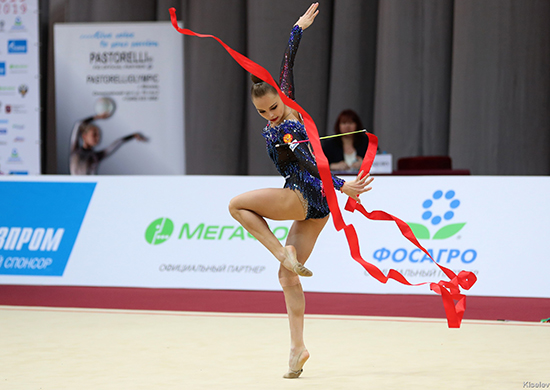
Performing apparatus
The ribbon is an apparatus used in the sport of rhythmic gymnastics. It is one of the five apparatuses utilized in this discipline, alongside the ball, clubs, hoop, and rope.
History
The ribbon was popularized by dancer Asaf Messerer, who was inspired by seeing Chinese acrobats dance with silk ribbons. In the 1940s, he began incorporating a ribbon into his choreography. The ribbon became a rhythmic gymnastics apparatus in 1971. From 2001-2012, each apparatus had a compulsory body group of movements that had to predominate in the exercise; for ribbon, this was pivots (turns).
Specifications and technique

The official specifications for the ribbon are as follows:
- Length: 6m
- Width: 4-6cm
The handle can be of any color and may be made of wood, bamboo, metal, or a synthetic material, such as fiberglass. It has a maximum diameter of 1 cm (2/5") at its widest, a cylindrical or conical shape, and may have an anti-slip grip with a maximum length of 10 cm (4"). The ribbon itself is made of satin or another similar cloth, and can be of any color. It may be multicolored and have designs on it, and it is doubled over for a length of 1m and sewn down along both edges at the end that attaches to the handle. A thread or ring swivel attaches the ribbon to the handle.
Rhythmic gymnastics routines require the ribbon to constantly be in motion and create defined shapes. The ribbon is generally held by the handle with the thumb and pointer finger extended. Because of the ribbon's length, the gymnast can easily become tangled in it or cause knots to form; juniors and beginner gymnasts may use shorter ribbons. The length also makes it sensitive to currents in the air, so air conditioning is typically turned off while the ribbon is being competed; temperatures in the arena at the 2023 World Championships reached 35 C during the qualification round that included ribbon. Penalties are taken for continuing to perform after a knot has formed without undoing the knot or for allowing the end of the ribbon to lie static on the floor.
Elements
Gymnasts perform a variety of elements with the ribbon, including throwing the ribbon high in the air, throwing the ribbon stick and then pulling it back by the end of the ribbon fabric, and creating different patterns with the movement of the ribbon. During the exercise, the gymnast should primarily perform elements that are specific to the ribbon. The elements that are considered to be particular to the ribbon are:
- Spirals:
- Small, tight circles of the ribbon
- A "swordsman" where the gymnast passes an arm and stick through a spiral pattern
- Rotational movements:
- Rotating the ribbon stick around a hand
- Wrapping or unwrapping the ribbon around the body
- Holding the stick with a body part other than the hands during movements or rotations to create a full circle of fabric around the body
- Snakes: Small, tight waves of the ribbon back and forth
- Boomerangs: Throwing the ribbon stick, then pulling the end of the ribbon fabric while it is extended and catching the stick again
- Rolling the ribbon handle along part of the body
- Small throws where the stick rotates during flight before the gymnast catches it
- Passing the body through or over the ribbon while it is making a defined shape
Photo gallery
File:2018-10-16 Gymnastics at 2018 Summer Youth Olympics – Rhythmic Gymnastics - Ribbon final (Martin Rulsch) 270.jpg|Spirals during a balance (Talisa Torretti) File:Incheon AsianGames Gymnastics Rhythmic 29.jpg|Spirals in motion (Son Yeon Jae) File:Ekaterina Volkova 2016 Olympics Test Event 2.jpg|A "swordsman" (Ekaterina Volkova) File:Andreea Verdes 2024 Sofia World Cup Ribbon QF 1.jpg|Snakes performed horizontally (Andreea Verdes) File:Viktoriia Onopriienko 2024 Sofia World Cup Ribbon Final 0.jpg|Snakes performed diagonally (Viktoriia Onopriienko) File:2018-10-16 Gymnastics at 2018 Summer Youth Olympics – Rhythmic Gymnastics - Ribbon final (Martin Rulsch) 028.jpg|Preparing to throw the ribbon with a foot (Aino Yamada) File:Vera Tugolukova 2024 Sofia World Cup Ribbon QF 3.jpg|Passing through a large circle (Vera Tugolukova) File:Boryana Kaleyn 2024 Sofia World Cup Ribbon QF 1.jpg|Holding the ribbon handle with a foot during a rotational element (Boryana Kaleyn) File:2018-10-16 Gymnastics at 2018 Summer Youth Olympics – Rhythmic Gymnastics - Ribbon final (Martin Rulsch) 084.jpg|Performing a boomerang with a walkover, using a foot to help pull the ribbon (Tatyana Volozhanina)
References
References
- (March 19, 2021). "Hoop, Ball, Clubs, Ribbon and Rope: The making of the apparatus that make Rhythmic Gymnastics unique".
- Toledo, Eliana de. (March 2016). "The appreciation of artistic aspects of the Code of Points in rhythmic gymnastics: an analysis of the last three decades". Revista Brasileira de Educação Física e Esporte.
- "Rhythmic Gymnastics - Apparatus".
- (17 August 2023). "Apparatus Norms".
- Jastrjembskaia, Nadejda. (1999). "Rhythmic gymnastics". Human Kinetics.
- Schmid, Andrea Bodó. (1976). "Modern rhythmic gymnastics". Mayfield Pub. Co.
- Gunston, Jo. (19 October 2023). "Judging the judges – how statistical analysis evaluates fairness and accuracy in gymnastics scoring".
- (26 April 2024). "Rhythmic Gymnastics Code of Points 2025-2028".
This article was imported from Wikipedia and is available under the Creative Commons Attribution-ShareAlike 4.0 License. Content has been adapted to SurfDoc format. Original contributors can be found on the article history page.
Ask Mako anything about Ribbon (rhythmic gymnastics) — get instant answers, deeper analysis, and related topics.
Research with MakoFree with your Surf account
Create a free account to save articles, ask Mako questions, and organize your research.
Sign up freeThis content may have been generated or modified by AI. CloudSurf Software LLC is not responsible for the accuracy, completeness, or reliability of AI-generated content. Always verify important information from primary sources.
Report