From Surf Wiki (app.surf) — the open knowledge base
Ribblehead Viaduct
Railway viaduct in North Yorkshire, England
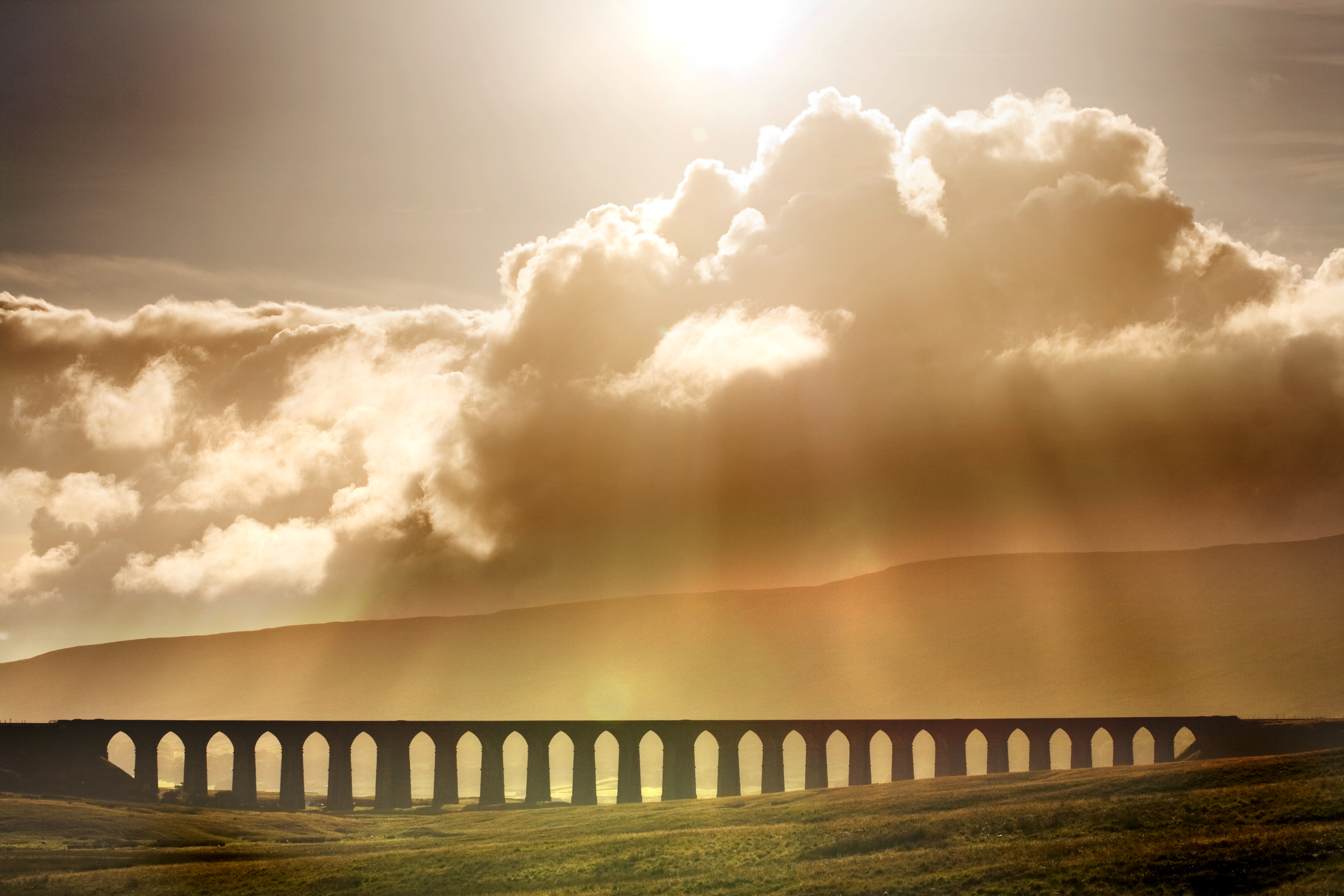
Railway viaduct in North Yorkshire, England
| Field | Value |
|---|---|
| bridge_name | Ribblehead Viaduct |
| image | Ribblehead Viaduct 1.jpg |
| caption | Ribblehead Viaduct |
| crosses | Batty Moss |
| owner | Network Rail |
| maint | Network Rail |
| designer | John Sydney Crossley |
| length | 440 yd |
| height | 104 ft |
| spans | 24 |
| begin | 12 October 1870 |
| open | 3 August 1875 |
| coordinates |
The Ribblehead Viaduct or Batty Moss Viaduct carries the Settle–Carlisle railway across Batty Moss in the Ribble Valley at Ribblehead, in North Yorkshire, England. The viaduct, built by the Midland Railway, is 28 mi north-west of Skipton and 26 mi south-east of Kendal. It is a Grade II* listed structure. Ribblehead Viaduct is the longest and the third tallest structure on the Settle–Carlisle line.
The viaduct was designed by John Sydney Crossley, chief engineer of the Midland Railway, who was responsible for the design and construction of all major structures along the line. The viaduct was necessitated by the challenging terrain of the route. Construction began in late 1869. It necessitated a large workforce, up to 2,300 men, most of whom lived in shanty towns set up near its base. Over 100 men lost their lives during its construction. The Settle to Carlisle line was the last main railway in Britain to be constructed primarily with manual labour.
By the end of 1874, the last stone of the structure had been laid; on 1 May 1876, the Settle–Carlisle line was opened for passenger services. During the 1980s, British Rail proposed closing the line. In 1989, after lobbying by the public against closure, it was announced that the line would be retained. Since the 1980s, the viaduct has had multiple repairs and restorations and the lines relaid as a single track. The land underneath and around the viaduct is a scheduled ancient monument; the remains of the construction camp and navvy settlements (Batty Wife Hole, Sebastopol, and Belgravia) are located there.
History
Background
In the 1860s, the Midland Railway, keen to capitalise on the growth in rail traffic between England and Scotland, proposed building a line between Settle and Carlisle. The line was intended to join the Midland line between Skipton and Carnforth to the city of Carlisle. On 16 July 1866, the Midland Railway (Settle to Carlisle) Act was passed by Parliament, authorising the company "to construct Railways from Settle to Hawes, Appleby, and Carlisle; and for other Purposes".
After the Act passed, the Midland Railway came to an agreement with the London & North Western Railway, to run services on the LNWR line via Shap. The company applied for a bill of abandonment for its original plan but Parliament rejected the bill on 16 April 1869 and the Midland Railway was compelled to build the Settle to Carlisle line.
The line passed through difficult terrain that necessitated building several substantial structures.
On 6 November 1869, a contract to construct the Settle Junction (SD813606) to Dent Head Viaduct section including Ribblehead Viaduct was awarded to contractor John Ashwell. The estimated cost was £343,318 and completion was expected by May 1873. Work commenced at the southern end of the 116 km line.
Construction
By July 1870, work had started on the foundations for Ribblehead Viaduct. On 12 October 1870, contractor's agent William Henry Ashwell laid the first stone. Financial difficulties came to greatly trouble John Ashwell; on 26 October 1871, his contract was cancelled by mutual agreement. From this date, the viaduct was constructed by the Midland Railway who worked on a semi-contractual basis overseen by William Ashwell.
The viaduct was built by a workforce of up to 2,300 men.
In December 1872, the design for Ribblehead Viaduct was changed from 18 arches to 24, each spanning 13.7 m.
Structure
Ribblehead Viaduct is 440 yd long, and 104 ft above the valley floor at its highest point, it was designed to carry a pair of tracks aligned over the sleeper walls.
The viaduct is faced with limestone masonry set in hydraulic lime mortar and the near-semicircular arches are red brick, constructed in five separate rings, with stone voussoirs.
Ribblehead Viaduct is 300 m above sea level on moorland exposed to the prevailing westerly wind. Its height, from foundation to rails is 50.3 m. It is 404.8 m long on a lateral curve with a radius of 1.37 km.
The viaduct is the longest structure on the Settle–Carlisle Railway which has two taller viaducts, Smardale Viaduct at 131 ft near Crosby Garrett, and Arten Gill at 117 ft. Ribblehead railway station is less than half a mile to the south and to the north is Blea Moor Tunnel, the longest on the line, near the foot of Whernside.
Operations
During 1964, several Humber cars were blown off their wagons while being carried over the viaduct on a freight train.
By 1980, the viaduct was in disrepair and many of its piers had been weakened by water ingress. Between 1981 and 1984, repairs were undertaken as a cost of roughly £100,000. Repairs included strengthening the piers by the addition of steel rails and concrete cladding. For safety reasons, the line was reduced to single track across the viaduct to avoid the simultaneous loading from two trains crossing, and a 30 mph speed limit was imposed. During 1988, minor repairs were carried out and trial bores were made into several piers. In 1989, a waterproof membrane was installed.
In the 1980s, British Rail proposed closing the line, citing the high cost of repairs to its major structures.
In November 1988, Ribblehead Viaduct was Grade II* listed. The surrounding land where the remains of its construction camps are located has been recognised as a scheduled monument.
Between 1990 and 1992, Ribblehead Viaduct underwent major restoration. Between September 1999 and March 2001, a programme of improvements was implemented involving renewal of track, replacement of ballast and the installation of new drainage. Restoration has allowed for increased levels of freight traffic assuring the line's viability.
The Settle–Carlisle Line is one of three north–south main lines, along with the West Coast Main Line through Penrith and the East Coast Main Line via Newcastle. During 2016, the line carried seven passenger trains from Leeds to Carlisle per day in each direction, and long-distance excursions, many hauled by preserved steam locomotives.
Regular heavy freight trains use the route avoiding congestion on the West Coast Main Line. Timber trains, and stone from Ingleton quarry, pass over the viaduct when they depart from the yard opposite Ribblehead railway station. The stone from Ingleton is ferried to the terminal at Ribblehead by road. Limestone aggregate trains from Arcow quarry sidings (near ) run to various stone terminals in the Leeds and Manchester areas on different days – these trains reverse in the goods loop at Blea Moor signal box because the connection from the quarry sidings faces north. Sidings at Horton quarry, also facing north, opened in May 2025.
Major restoration work started in November 2020 as a £2.1 million project to re-point mortar joints and replace broken stones got underway. Network Rail released a timelapse video of the works in June 2021.
In popular culture
Building the viaduct was the inspiration behind the ITV period drama series Jericho. The viaduct appears in the 1970 film No Blade of Grass and also in the 2012 film Sightseers. A number of other films and television programmes have also included the viaduct.
References
Citations
Bibliography
References
- The company's chief engineer, [[John Sydney Crossley]] and its general manager, [[James Joseph Allport]], surveyed the line. Crossley was responsible for the design and construction of the major works, including Ribblehead Viaduct.{{National Heritage List for England|num=1132228|desc=Batty Moss railway viaduct|grade=II*, scheduled|accessdate=20 August 2013}}
- "Chapel-le-Dale: St Leonard, Ingleton". Church of England.
- Kapp, Alexander P. (28 March 2010). "St Leonard's Church Chapel le Dale, Memorial". [[Geograph]] Project.
- Taylor, Ian. (6 June 2010). "Millennium gravestone, Chapel le Dale". [[Geograph]] Project.
- (1965). "The Story of the Settle-Carlisle Line". Advertiser Press Ltd.
- "Ribblehead Viaduct". Engineering Timelines.
- Garrat, Colin. (2003). "Illustrated Encyclopedia of Steam And Rail". Barnes & Noble Books.
- (1 November 2008). "Craven Through The Years". Telegraph & Argus.
- {{NRtimes. December 2016. 42
- (7 June 2017). "Steam train excursions".
- (2 January 2020). "Freight flows of the famous S&C". Bauer Media.
- [https://www.railengineer.uk/2016/01/05/connected/ "Connected."] ''Rail Engineer'', 5 January 2016. Retrieved: 7 April 2017.
- "Ribblehead Viaduct: Major restoration work begins". BBC News.
- "Network Rail: Ribblehead Viaduct - Remote Site Security". WCCTV.
- (6 January 2016). "JERICHO - Big hopes for major new drama series filmed in Huddersfield". Huddersfield Examiner.
- (2019). "I Hate the Lake District". Goldsmith Press.
- (28 November 2012). "Sightseers: Not-so-happy campers". BBC News.
- "Filming Location Matching Ribblehead Viaduct". IMDB.
This article was imported from Wikipedia and is available under the Creative Commons Attribution-ShareAlike 4.0 License. Content has been adapted to SurfDoc format. Original contributors can be found on the article history page.
Ask Mako anything about Ribblehead Viaduct — get instant answers, deeper analysis, and related topics.
Research with MakoFree with your Surf account
Create a free account to save articles, ask Mako questions, and organize your research.
Sign up freeThis content may have been generated or modified by AI. CloudSurf Software LLC is not responsible for the accuracy, completeness, or reliability of AI-generated content. Always verify important information from primary sources.
Report