From Surf Wiki (app.surf) — the open knowledge base
Rhynie chert
Early Devonian sedimentary deposit exhibiting extraordinary fossil detail or completeness
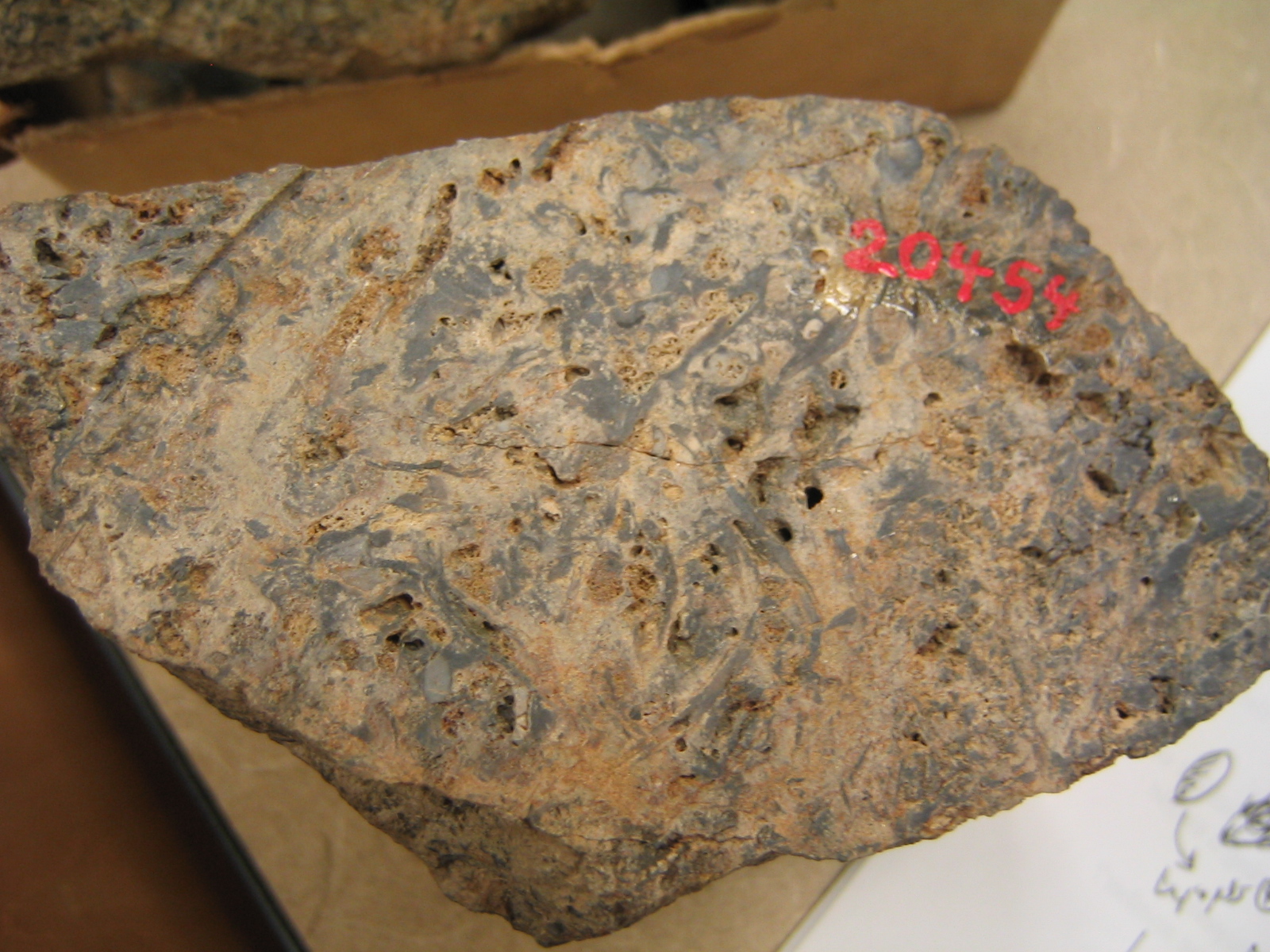
Early Devonian sedimentary deposit exhibiting extraordinary fossil detail or completeness
The Rhynie chert is a Lower Devonian sedimentary deposit exhibiting extraordinary fossil detail or completeness (a Lagerstätte). It is exposed near the village of Rhynie, Aberdeenshire, Scotland; a second unit, the Windyfield chert, is located some 700 m away.
The Rhynie chert contains exceptionally preserved plant, fungus, lichen and animal material preserved in place by an overlying volcanic deposit. The bulk of the Devonian fossil bed consists of primitive plants (which had water-conducting cells and sporangia, but no true leaves), along with arthropods, lichens, algae and fungi.
This fossil bed is remarkable for two reasons. First, the age of the site (Pragian, Early Devonian, formed about ) places it at an early stage in the colonisation of land. Second, these cherts are famous for their exceptional state of ultrastructural preservation, with individual cell walls easily visible in polished specimens. Stomata have been counted and lignin remnants detected in the plant material, and the breathing apparatus of trigonotarbids—of the class Arachnida—(known as book lungs) can be seen in cross-sections. Fungal hyphae can be seen entering plant material, acting as decomposers and mycorrhizal symbionts.
Location
The bed is under at least 1 metre of overburden, in a small field near the village of Rhynie, so is effectively inaccessible to collectors; besides which, the site is a Site of Special Scientific Interest. A second unit, the Windyfield chert, is some 700 m from the Rhynie. The Rhynie chert extends for at least 80 m along strike and 90 m down-dip.
History of research
The chert was discovered by William Mackie while mapping the western margin of the Rhynie basin in 1910–1913.
Until recently, the Rhynie chert was the only such deposit known from the geological record, although recent work has turned up other localities from different time periods and continents.
Conditions of formation
The chert was formed when silica-rich water from volcanic springs rose rapidly and petrified the early terrestrial ecosystem, in situ and almost instantaneously, in much the same fashion that organisms are petrified by hot springs today interbedded with sands, shales and tuffs - which speak of local volcanic activity.{{cite journal | access-date = 2008-05-15
Fossils were formed as silica formed in the hot springs themselves; when silica-rich water flooded the surrounding areas; and when it permeated into the surrounding soil. The texture of the sinter formed resemble those found today in freshwater streams at Yellowstone which are typically alkaline (pH 8.7) and tepid 20 to. The springs were periodically active, and flowed into an alluvial plain containing small lakes. By analogy with Yellowstone, the chert itself probably formed in a marshy area towards the latter end of the extent of outwash from the springs. Living vegetation covered around 55% of the land area, with litter covering 30% and the remaining 15% of the ground being bare. A braided :Contains useful reconstructions of both the plant associations, and the regional setting. river flowing to the north periodically deposited the sandy layers found in cores when it flooded its banks.{{cite journal
Sedimentary textures which appear to have formed in the hydrothermal vents themselves are preserved with a brecciated texture;
Preservation
Plants


The preservation of plants varies from perfect three-dimensional cellular permineralisation to flattened charcoal films. On occasion, plants may have their vertical axes preserved in growth position, with rhizoids still attached to rhizomes; even the plant litter is preserved.
Plants were only found on the land - none lived in the water of lakes or hot springs. Rhynia typically grew on sandy surfaces, and is often preserved there in life position; Horneophyton grew on sinter, the sediment formed by the hot springs. These two colonisers were subsequently joined by other genera. The time between sinter deposition events was too short to allow the populations to develop to climax communities, and correspondingly early colonisers appear most frequently, pseudo-randomly, in logged sequences.
Plants demonstrate best the great value of the exceptional preservation of the Rhynie chert. The presence of soft tissue, including parenchyma, is not observed elsewhere in the fossil record until the advent of amber in the Triassic. This allows the study of structures such as the air spaces behind stomata, whereas the conventional record at its best allows no more than the counting of stomata. It has also enabled paleobotanists to firmly deduce that plants such as Aglaophyton were* not* aquatic, as once believed.
Further, as plants are preserved in situ, the study of exactly how and why the branching patterns of the early plants emerged is possible, whereas typical fossils only show that branching was present. The analysis of rhizomes and rhizoids makes it possible to discern which plants had an active water uptake system (e.g. Horneophyton), and which were likely to have colonised waterlogged surfaces (Asteroxylon). In some cases, it is possible to see different mechanisms of repairing wounds, and to deduce that they were caused by fungal or bacterial infection.
The preservation of spores attached to sporangia allows spore genera to be matched with their producers - something that is otherwise very difficult to do. The chert also allows the identification of the gametophyte phases of taxa such as Aglaophyton.
Analysis of spores shows that the flora was lacking in some elements common elsewhere at this time, likely due to its setting in a mountainous region, rather than in a lowland flood plain like most other fossil deposits. However, the spores, which are distinctive enough to permit their producing organism to be identified - are identical to those found elsewhere in "normal" environments. There is no clear-cut evidence that the plants of the Rhynie assemblage were specifically adapted to stressed environments, and it is likely that the flora in fact represents those members of the global fauna that happened to be capable of colonising and surviving a hot spring environment by virtue of fortuitous preadaptations.

Seven land plant taxa have been identified in the Rhynie and Windyfield cherts:
- Aglaophyton
- Asteroxylon
- Horneophyton
- Nothia
- Rhynia
- Trichopherophyton
- Ventarura
Another group, Nematophytes, remains enigmatic, but may represent aquatic land plants.
Algae
Several putative chlorophytes have been discovered in the Rhynie assemblage (Mackiella and Rhynchertia). A well-preserved charophyte, Palaeonitella,
Arthropods
As a result of its exquisite preservation, the Rhynie chert boasts the most diverse non-marine fauna of its time, Typical members of the Rhynie chert arthropod fauna include the crustacean Lepidocaris, the euthycarcinoid Heterocrania,{{cite journal |access-date = 2008-05-15 |archive-url = https://archive.today/20121216075305/http://article.pubs.nrc-cnrc.gc.ca/ppv/RPViewDoc?handler=HandleInitialGet&articleFile=e03-065.pdf&journal=cjes&volume=40 |archive-date = 2012-12-16 |url-access= subscription
The oldest known hexapod (Rhyniella praecursor), which resembles the modern springtails, was found in the Rhynie chert, pushing dates for the origination of hexapods (a group that includes the insects) back to the Silurian period.
Fungi
Fungi known from the Rhynie chert include the chytridiomycetes,{{cite journal | hdl-access=free
The Chytridiomycetes, or Chytrids, are a basal group of fungi, closely related to the true fungi.
The chytrids display a range of behaviour in the Rhynie chert. Eucarpic and holocarpic forms are known - i.e. some forms grew specialised fruiting bodies while others did not show specialisation in this fashion. Saprotrophy may be present, and parasitism is common; one individual has even been found parasitising a germinating gametophyte. The fungi were aquatic, and grew in both plants and algae; they are also found preserved "loose" in the chert matrix. Their flagellate spores are preserved.
The largest organism present in Rhynie was probably a fungus, the enigmatic Prototaxites, growing as a mound a metre or more taller than anything in the community, whose isotopic composition varied like a saprotroph and whose septate pores resemble those of fungi.
Cyanobacteria
In the rare instances that cyanobacteria are found in the fossil record, their presence is usually the subject of much controversy, for their simple form is difficult to distinguish from inorganic structures such as bubbles.
However, bona fide cyanobacteria are preserved in the Rhynie chert. The aquatic organisms are thought to belong to the Oscillatoriales section on the basis of biomarker absence. The fossils are filamentous, around 3 μm in diameter, and grew on plants and the sediment itself. They occasionally form structured colonies which go on to create microbial mats.
Lichens
A new genus of lichen, Winfrenatia, has been recovered from the Rhynie chert. The lichen comprises a thallus, made of layered, aseptate hyphae; a number of depressions are formed on its top surface. Each depression contains a net of hyphae holding a sheathed cyanobacterium. The fungus appears to be related to the Zygomycetes, and the photobiont resembles the coccoid Gloeocapsa and Chroococcidiopsis.
Paleobiota
Animals
| Animals | Genus | Species | Higher taxon | Notes | Images | ||||||||||||||||
|---|---|---|---|---|---|---|---|---|---|---|---|---|---|---|---|---|---|---|---|---|---|
| Palaeocharinus | Trigonotarbida | Likely a predatory liquid-feeder | [[File:20201205 Palaeocharinus rhyniensis.png | thumb | center | P. rhyniensis reconstruction]] | |||||||||||||||
| Palaeocteniza | Trigonotarbida | Only fossil material comes from a moulted juvenile | |||||||||||||||||||
| Eophalangium | Tetrophthalmi | Preserves oldest tracheae in fossil record | |||||||||||||||||||
| Saccogulus | Arachnida incertae sedis | Bears an unusual pharynx-like structure | |||||||||||||||||||
| last1=Dunlop | first1=Jason A. | last2=Garwood | first2=Russell J. | title=Terrestrial invertebrates in the Rhynie chert ecosystem | journal=Philosophical Transactions of the Royal Society B: Biological Sciences | date=5 February 2018 | volume=373 | issue=1739 | article-number=20160493 | doi=10.1098/rstb.2016.0493 | pmid=29254958 | pmc=5745329 }} | Alycidae | All other mites in the Rhynie chert have been synonymised with this species | |||||||
| Crussolum | Scutigeromorpha | last1=Anderson | first1=Lyall I. | last2=Trewin | first2=Nigel H. | title=An Early Devonian arthropod fauna from the Windyfield cherts, Aberdeenshire, Scotland | journal=Palaeontology | date=May 2003 | volume=46 | issue=3 | pages=467–509 | doi=10.1111/1475-4983.00308 | bibcode=2003Palgy..46..467A }} | [[File:Crussolum crusserratum leg reconstruction.png | thumb | center | Reconstruction of a Crussolum leg]] | ||||
| Rhynimonstrum | Arthropoda incertae sedis | Possibly a myriapod, if so likely a millipede | |||||||||||||||||||
| Rhyniella | Collembola | Earliest known hexapod | |||||||||||||||||||
| Rhyniognatha | Myriapoda or Insecta | last1=Haug | first1=Carolin | last2=Haug | first2=Joachim T. | title=The presumed oldest flying insect: more likely a myriapod? | journal=PeerJ | date=30 May 2017 | volume=5 | article-number=e3402 | doi=10.7717/peerj.3402 | doi-access=free | pmid=28584727 | pmc=5452959 | bibcode=2017PeerJ...5e3402H }} | [[File:Rhyniognatha specimen.png | thumb | center | Specimen of Rhyniognatha]] | ||
| Leverhulmia | Myriapoda or Hexapoda | Affinities controversial | |||||||||||||||||||
| Heterocrania | Euthycarcinoidea | Oldest non-Cambrian euthycarcinoid | |||||||||||||||||||
| Lepidocaris | Branchiopoda | Only member of Lipostraca | [[File:Lepidocaris rhyniensis.jpg | thumb | center | Reconstruction of Lepidocaris]] | |||||||||||||||
| Castracollis | Branchiopoda | Stem-calmanostracan (related to tadpole shrimp) | [[File:Castracollis wilsonae.jpg | thumb | center | Reconstruction of Castracollis]] | |||||||||||||||
| Ebullitiocaris | Diplostraca? | Soft tissue unknown, only known from valves | |||||||||||||||||||
| Palaeonema | Enoplida | Earliest nematode in the fossil record | |||||||||||||||||||
| Rotifera indet. | Unapplicable | Gnathifera | Undescribed |
Plants and Multicellular Algae
| Plants and Algae | Genus | Species | Higher taxon | Notes | Images | |||
|---|---|---|---|---|---|---|---|---|
| Asteroxylon | Drepanophycales | Infected by parasitic root fungi | [[File:Asteroxylon life restoration.jpg | thumb | center | Asteroxylon life restoration]] | ||
| Aglaophyton | Polysporangiophytes | Preserves earliest known mycorrhizal fungi | [[File:Aglaophyton major reconstruccion en.jpg | thumb | center | Aglaophyton reconstruction]] | ||
| Horneophyton | Horneophytopsida | Female gametophyte also preserved, named Langiophyton | [[File:Horneophyton.svg | thumb | center | Schematic reconstruction of Horneophyton]] | ||
| Nothia | Zosterophylls? | May have been poisonous to fend off arthropods? | [[File:Nothia.png | thumb | center | Reconstruction of Nothia]] | ||
| Rhynia | Rhyniophytina | Gametophyte preserved, named Remyophyton (although another form may exist) | [[File:Rhynia reconstruction.jpg | thumb | center | Reconstruction of Rhynia]] | ||
| Trichopherophyton | Zosterophylls? | Unusually bore spines on its stems. | ||||||
| Ventarura | Zosterophylls? | Affinities unclear due to poor preservation. | [[File:Ventarura lyonii reconstruccion.jpg | thumb | center | Reconstruction of Ventarura]] | ||
| Zosterophylls? indet. | Lycophyta | Poorly preserved and only known from one specimen, yet noticeably distinct from all other Rhynie plants | ||||||
| Palaeonitella | Charales | Fungi preserved colonising this alga | ||||||
| Charophyta indet. | Streptophyta | Many Palaeonitella specimens may be juveniles of this species. | ||||||
| Mackiella | Ulotrichaceae | Preserves possible chloroplasts | ||||||
| Rhynchertia | Ulotrichaceae | Some specimens preserved with zoospores inside cells | ||||||
| Harpericystis | Chlorophyta | Microscopic alga which forms small multicellular colonies | ||||||
| Cymatiosphaera | Pyramimonadales? | Not assigned to a species, may be an indeterminate chlorophyte alga. | ||||||
| Pyramimonales indet? | Pyramimonadophyceae | Similar to the phycoma of extant Pterosperma, may be an indeterminate chlorophyte alga. | ||||||
| Anechosoma | Chlorophyta or Glaucophyta | Occasionally infected by Rhyniovexator, a chytrid or aphelid | ||||||
| Hagenococcus | Viridiplantae incertae sedis | Preserved in numerous different colony types | ||||||
| Xanthophyta indet. | Ochrophytina | First definitive xanthophyte in the fossil record? | ||||||
| Phaeophyceae indet? | Ochrophytina | Possible oldest brown alga in the fossil record | ||||||
| Characrhynium | Diaphoretickes incertae sedis | Resembles both modern Characium and Characiopsis |
Fungi
| Fungi | Genus | Species | Higher taxon | Notes | Images |
|---|---|---|---|---|---|
| Archaeosporites | Archaeosporaceae | Incredibly similar to Archaeospora | |||
| Brijax | Chytridiomycota | Placement within the group uncertain, colonises glomeromycote spores | |||
| Cultoraquaticus | Chytridiomycota | Epibiotic on enigmatic round structures | |||
| Frankbaronia | Oomycetes? | Second known oomycete fossil | |||
| Globicultrix | Chytridiomycota | Is itself a parasite of larger fungal spores | |||
| Glomites | Glomerales | Formed mycorrhizae in various land plants | |||
| Hassiella | Oomycetes | First known oomycete fossil | |||
| Helmutella | Fungi incertae sedis | Resembles Carboniferous "sporocarps" | |||
| Illmanomyces | Chytridiomycota | Grows on various other spores, fungal matter, plants and algae. | |||
| Krispiromyces | Endochytriaceae | Parasite of Palaeonitella, grows inside cells | |||
| Kryphiomyces | Fungi incertae sedis | Preserved inside a glomeromycote spore | |||
| Lyonomyces | Fungi incertae sedis | Grows on cells of Palaeonitella | |||
| Milleromyces | Endochytriaceae? | Grows on cells of Palaeonitella | |||
| Mycocarpon | Fungi incertae sedis | Earliest sporocarp fossil known | |||
| Mycokidstonia | Ambisporaceae | Previously thought to be an ascomycete | |||
| Nimbosphaera | Chytridiomycota | Likely zoosporangia of chytrids | |||
| Palaeoendogone | Mucoromycotina | Endophyte of Horneophyton | |||
| Palaeoglomus | Glomeromycota | Endophyte of Horneophyton | |||
| Palaeomyces | Mucoromycota | Grows on/within land plant stems | |||
| Paleopyrenomycites | Sordariomycetes | Also found growing on Asteroxylon | |||
| Palaeozoosporites | Chytridiomycota? | Root parasite of Asteroxylon | |||
| Paleoblastocladia | Blastocladiomycota | Oldest blastoclad fungus known, has sexual reproduction | |||
| Perexiflasca | Chytridiomycota | Grew on land plant remains | |||
| Potteromyces | Ascomycota incertae sedis | Plant pathogen of Asteroxylon | |||
| Prototaxites | Fungi incertae sedis | Affinities debated in a 2025 preprint | |||
| Retesporangicus | Blastocladiomycota incertae sedis | Earliest known fungus with multiple sporangia per hyphae | |||
| Rhizophidites | Chytridiomycota | Grew within Horneophyton and glomeromycote spores | |||
| Rhyniomycelium | Ascomycota? | Oldest fossil evidence of endoconidia in fungi. | |||
| Rhyniovexator | Chytridiomycota or Aphelida | Parasitic on unicellular algae | |||
| Scepasmatocarpion | Fungi incertae sedis | One of the oldest hyphal investments found | |||
| Scutellosporites | Gigasporaceae | Bears a germination shield, a feature shared only with the extant Scutellospora | |||
| Trewinomyces | Fungi incertae sedis | Grew on decaying plant matter | |||
| Veterisphaera | Fungi incertae sedis | Has a two-layered hyphal mantle | |||
| Windipila | Fungi incertae sedis (Glomeromycota?) | Bears unusual spines and projections from the mantle | |||
| Zwergimyces | Fungi incertae sedis | Only "mantled" fungal fossil with preserved development |
Other taxa
| Other taxa | Genus | Species | Higher taxon | Notes | Images | |||
|---|---|---|---|---|---|---|---|---|
| Palaeoleptochlamys | Arcellinida | One of the earliest known testate amoebae | ||||||
| Triskelia | Eukaryota incertae sedis | Either a green algae or a fungus. | ||||||
| Rhyniotaenium | Mesotaeniaceae | Likely a saccoderm desmid | ||||||
| Anechosoma | Archaeplastida incertae sedis | Unclear whether it belongs to Glaucophyta or Chlorophyta, hosts the fungus Rhyniovexator | ||||||
| Glaphyrobalantium | incertae sedis | May either be a cyanobacterium or coccoid alga? | ||||||
| Langiella | Hapalosiphonaceae | Synonymised with Kidstonia and Rhyniella | ||||||
| Archaeothrix | Oscillatoriales | Colonised lesions on Aglaophyton | ||||||
| Rhyniococcus | Chroococcaceae | Forms sheets one cell thick, | ||||||
| Eoentophysalis | Entophysalidaceae | Otherwise only known from the Proterozoic | ||||||
| Rhyniosarcina | Chroococcales | Forms sarcinoid colonial structures | ||||||
| Palaeolyngbya | Oscillatoriaceae | Other species within the genus are known from the Precambrian | ||||||
| Croftalania | Oscillatoriales incertae sedis | Common mat-forming cyanobacterium | ||||||
| Rhyniotaxillus | Cyanobacteria incertae sedis | Small coccoid cyanobacteria, resembles Entophysalis | ||||||
| Rhystigonema | Stigonemataceae | May be assignable to Stigonema itself | ||||||
| Winfrenatia | Zygomycota, Chroococcaceae | Lichen composed of a fungus, coccoid cyanobacterium | [[File:Winfrenatia reticulata reconstrucción.jpg | thumb | center | Reconstructed transverse view of Winfrenatia]] | ||
| Nematoplexus | Nematophyta | Member of the enigmatic nematophytes | ||||||
| Nematothallus | Nematophyta | Only known from one specimen, previously only known from compressions |
Interactions
The Rhynie chert, by preserving a snapshot of an ecosystem in situ in high fidelity, gives a unique opportunity to observe interactions between species and kingdoms. There is evidence of parasitic behaviour by fungi on algae Palaeonitella, provoking a hypertrophic response. wounds in various states of repair, and the mouthparts of arthropods.{{cite book | access-date = 2008-05-16
Coprolites - fossilised droppings - give a useful insight of what animals ate, even if the animals cannot be identified. Coprolites found in the Rhynie chert are typically between 0.5 and 3 mm in size, and contain a variety of contents.{{cite journal
Plants responded to fungal colonisation in different ways, depending on the fungus. The rhizoids of Nothia displayed three responses to fungal infestation: the hyphae of some (mutualistic) colonists were encased by plant cell walls; other (parasitic) fungi were met with typical host responses of increased rhizome cell size; while yet other fungi solicited an increase in thickness and pigmentation of cell walls. Once inside a plant cell, fungi produced spores, which are found in decaying plant cells; the cells may have decayed as a defence mechanism to prevent the fungi from spreading.
Fungal interactions are known to promote speciation in modern plants, and presumably also affected Devonian diversity by providing a selection pressure.
Mycorrhizae are also found in the Rhynie chert.
References
References
- (2019). "An introduction to the Rhynie chert". Geological Magazine.
- Nunn, Elizabeth. "The Rhynie Chert". Department of Earth Sciences, University of Bristol.
- Rice, C. M., Ashcroft, W. A., Batten, D. J., Boyce, A. J., Caulfield, J. B. D., Fallick, A. E., Hole, M. J., Jones, E., Pearson, M. J., Rogers, G., Saxton, J. M., Stuart, F. M., Trewin, N. H. & Turner, G.. (1995). "A Devonian auriferous hot spring system, Rhynie, Scotland". Journal of the Geological Society, London.
- Parry, S.F.. (2011). "A high-precision U–Pb age constraint on the Rhynie Chert Konservat-Lagerstätte: time scale and other implications". Journal of the Geological Society.
- Trewin. (2003). "History of research on the geology and palaeontology of the Rhynie area, Aberdeenshire, Scotland". Transactions of the Royal Society of Edinburgh: Earth Sciences.
- Channing. (2007). "A new Middle – Late Jurassic flora and hot spring chert deposit from the Deseado Massif, Santa Cruz province, Argentina". Geological Magazine.
- Powell, C. L.. (2000). "Palaeoecology and plant succession in a borehole through the Rhynie cherts, Lower Old Red Sandstone, Scotland". Geological Society of London, Special Publications.
- (1996). "Ciba Foundation Symposium 202: Evolution of Hydrothermal Ecosystems on Earth (and Mars?)".
- Edwards, Dianne. (2003). "Embryophytic sporophytes in the Rhynie and Windyfield cherts". Transactions of the Royal Society of Edinburgh: Earth Sciences.
- (2003). "Spores of the Rhynie chert plant ''Horneophyton lignieri'' (Kidston and Lang) Barghoorn and Darrah, 1938". Transactions of the Royal Society of Edinburgh: Earth Sciences.
- (2005). "Life history biology of early land plants: Deciphering the gametophyte phase". [[Proceedings of the National Academy of Sciences]].
- [http://www.abdn.ac.uk/rhynie/intro.htm University of Aberdeen], The Biota of Early Terrestrial Ecosystems: The Rhynie Chert.
- Kelman, Ruth. (2003). "Charophyte algae from the Rhynie chert". Transactions of the Royal Society of Edinburgh: Earth Sciences.
- (2011). "Early Terrestrial Animals, Evolution, and Uncertainty". Evolution: Education and Outreach.
- (1998). "Centiped legs (Arthropoda, Chilopoda, Scutigeromorpha) from the Silurian and Devonian of Britain and the Devonian of North America". American Museum Novitates.
- Whalley, Paul. (1981). "A new assessment of ''Rhyniella'', the earliest known insect, from the Devonian of Rhynie, Scotland". Nature.
- Engel, Michael S.. (2004). "New light shed on the oldest insect". Nature.
- Krings, Michael. (2007). "Fungal endophytes in a 400-million-yr-old land plant: infection pathways, spatial distribution, and host responses". New Phytologist.
- Krings. (2007). "A filamentous cyanobacterium showing structured colonial growth from the Early Devonian Rhynie chert". Review of Palaeobotany and Palynology.
- (September 2019). "Palaeolyngbya kerpii sp. nov., a large filamentous cyanobacterium with affinities to Oscillatoriaceae from the Lower Devonian Rhynie chert". PalZ.
- (1997). "A cyanolichen from the Lower Devonian Rhynie chert". Am J Bot.
- (July 2024). "Mouthpart morphology and feeding structures in the palaeocharinid trigonotarbids of the Rhynie chert: insights from comparisons to modern arachnids". Palaeontology.
- (1991). "A spider and other arachnids from the Devonian of New York, and reinterpretations of Devonian Araneae". [[Palaeontology (journal).
- (September 2006). "A new arthropod from the early Devonian Rhynie chert, Aberdeenshire (Scotland), with a remarkable filtering device in the mouthparts". Paläontologische Zeitschrift.
- (5 February 2018). "Terrestrial invertebrates in the Rhynie chert ecosystem". Philosophical Transactions of the Royal Society B: Biological Sciences.
- (19 April 2025). "The evolutionary history and timeline of mites in ancient soils". Scientific Reports.
- (May 2003). "An Early Devonian arthropod fauna from the Windyfield cherts, Aberdeenshire, Scotland". Palaeontology.
- (30 May 2017). "The presumed oldest flying insect: more likely a myriapod?". PeerJ.
- (January 1926). "V. On a new type of crustacean from the old red sandstone (Rhymie Chert Bed, Aberdeenshire) — Lepidocaris rhyniensis, gen. et sp. nov". Philosophical Transactions of the Royal Society of London. Series B, Containing Papers of a Biological Character.
- (December 2002). "A new crustacean from the Early Devonian Rhynie chert, Aberdeenshire, Scotland". Transactions of the Royal Society of Edinburgh: Earth Sciences.
- (December 2003). "A new univalve crustacean from the Early Devonian Rhynie chert hot-spring complex". Transactions of the Royal Society of Edinburgh: Earth Sciences.
- "Rotifer attack preserved in Rhynie chert".
- (September 2015). "Fungal colonization of the rooting system of the early land plant Asteroxylon mackiei from the 407-Myr-old Rhynie Chert (Scotland, UK): Fungi in an early rooting system". Botanical Journal of the Linnean Society.
- (2001). "Plants invade the Land: Evolutionary & Environmental Perspectives". Columbia University Press.
- "Herbivore deterrence by early land plants".
- "Another type of Rhynia gametophyte?".
- "A faint glimpse of another Rhynie chert plant?".
- "Questionable Devonian charophyte Palaeonitella".
- (January 1983). "Algae from the Rhynie Chert". Botanical Journal of the Linnean Society.
- (December 2024). "Algae from the Lower Devonian Rhynie chert: Harpericystis verecunda gen. et sp. nov., a probable green alga (Chlorophyta) that forms few-celled colonies". Review of Palaeobotany and Palynology.
- (December 2007). "A prasinophycean alga of the genus Cymatiosphaera in the Early Devonian Rhynie chert". Review of Palaeobotany and Palynology.
- (1 December 2014). "Microfossils With Suggested Affinities To The Pyramimonadales (Pyramimonadophyceae, Chlorophyta) From The Lower Devonian Rhynie Chert". Acta Palaeobotanica.
- (1 August 2017). "Hagenococcus aggregatus nov. gen. et sp., a microscopic, colony-forming alga from the 410-million-yr-old Rhynie chert". Nova Hedwigia.
- "A Lower Devonian alga resembling the xanthophyte Botrydium".
- "A Devonian plant that would not fit in".
- (May 2024). "Further observations on stalked microfossils from the Lower Devonian Rhynie cherts that resemble the algae Characiopsis (Eustigmatophyceae) and Characium (Chlorophyceae)". Review of Palaeobotany and Palynology.
- (6 October 2020). "Archaeosporites rhyniensis gen. et sp. nov. (Glomeromycota, Archaeosporaceae) from the Lower Devonian Rhynie chert: a fungal lineage morphologically unchanged for more than 400 million years". Annals of Botany.
- (October 2020). "Deciphering interfungal relationships in the 410-million-yr-old Rhynie chert: Brijax amictus gen. et sp. nov. (Chytridiomycota) colonizing the walls of glomeromycotan acaulospores". Review of Palaeobotany and Palynology.
- (14 December 2016). "A New Chytridiomycete Fungus Intermixed with Crustacean Resting Eggs in a 407-Million-Year-Old Continental Freshwater Environment". PLOS ONE.
- (2013). "Frankbaronia velata nov. sp., a putative peronosporomycete oogonium containing multiple oospores from the Lower Devonian Rhynie chert". Zitteliana.
- (2012). "Microfossils from the Lower Devonian Rhynie Chert with Suggested Affinities to the Peronosporomycetes". Journal of Paleontology.
- (2009). "Globicultrix nugax nov. gen. et nov. spec.(Chytridiomycota), an intrusive microfungus in fungal spores from the Rhynie chert". Zitteliana.
- (September 2006). "Species of the genus Glomites as plant mycobionts in Early Devonian ecosystems". Paleontological Journal.
- (June 2006). "Hassiella monospora gen. et sp. nov., a microfungus from the 400 million year old Rhynie chert". Mycological Research.
- (1 August 2014). "A mantled fungal reproductive unit from the Lower Devonian Rhynie chert that demonstrates Carboniferous "sporocarp" morphology and development". Neues Jahrbuch für Geologie und Paläontologie - Abhandlungen.
- (1 November 2014). "An unusual fossil microfungus with suggested affinities to the Chytridiomycota from the Lower Devonian Rhynie chert". Nova Hedwigia.
- (1992). "Devonian Fungi: Interactions with the green algae Palaeonitella". Mycologia.
- (19 July 2010). "An unusual microfungus in a fungal spore from the Lower Devonian Rhynie chert: AN UNUSUAL MICROFUNGUS IN A FUNGAL SPORE". Palaeontology.
- (June 2014). "First record of a fungal "sporocarp" from the Lower Devonian Rhynie chert". Palaeobiodiversity and Palaeoenvironments.
- (April 2021). "The Early Devonian fungus Mycokidstonia sphaerialoides from the Rhynie chert is a member of the Ambisporaceae (Glomeromycota, Archaeosporales), not an ascomycete". Review of Palaeobotany and Palynology.
- (July 2019). "Nimbosphaera Rothwellii Nov. Gen. et Sp., an Enigmatic Microfossil Enveloped in a Prominent Sheath from the Lower Devonian Windyfield Chert, Scotland". International Journal of Plant Sciences.
- (August 2014). "Fungal associations in Horneophyton ligneri from the Rhynie Chert ( c . 407 million year old) closely resemble those in extant lower land plants: novel insights into ancestral plant–fungus symbioses". New Phytologist.
- (2005). "Perithecial Ascomycetes from the 400 Million Year Old Rhynie Chert: An Example of Ancestral Polymorphism". Mycologia.
- (June 1994). "Early Devonian fungi: a blastocladalean fungus with sexual reproduction". American Journal of Botany.
- (October 2019). "A new species of Perexiflasca, enigmatic microfossils with suggested affinities to Chytridiomycota (Fungi) from the Lower Devonian Rhynie and Windyfield cherts". Geobios.
- (5 February 2018). "Fungi and fungal interactions in the Rhynie chert: a review of the evidence, with the description of Perexiflasca tayloriana gen. et sp. nov. †". Philosophical Transactions of the Royal Society B: Biological Sciences.
- (1 December 2023). "A fungal plant pathogen discovered in the Devonian Rhynie Chert". Nature Communications.
- (17 March 2025). "Prototaxites was an extinct lineage of multicellular terrestrial eukaryotes".
- (5 February 2018). "New insights into the evolutionary history of Fungi from a 407 Ma Blastocladiomycota fossil showing a complex hyphal thallus". Philosophical Transactions of the Royal Society B: Biological Sciences.
- (2024). "Deciphering interfungal relationships in the 410-million-yr-old Rhynie chert: Rhizophydites shutei sp. nov. (fossil Chytridiomycota) on glomeromycotan acaulospores". Fossil Imprint.
- (1 February 2021). "Rhizophydites matryoshkae gen. et sp. nov. (Fossil Chytridiomycota) on Spores of the Early Land Plant Horneophyton lignieri from the Lower Devonian Rhynie Chert". International Journal of Plant Sciences.
- (June 2023). "A fungal mycelium containing abundant endoconidia from the Lower Devonian Rhynie cherts of Scotland". Review of Palaeobotany and Palynology.
- (December 2019). "A tiny parasite of unicellular microorganisms from the Lower Devonian Rhynie and Windyfield cherts, Scotland". Review of Palaeobotany and Palynology.
- (November 2015). "A fungal reproductive unit from the Lower Devonian Rhynie chert (Aberdeenshire, Scotland) that demonstrates an unusual hyphal investment pattern". Scottish Journal of Geology.
- (September 2006). "Germination shields in Scutellospora (Glomeromycota: Diversisporales, Gigasporaceae) from the 400 million-year-old Rhynie chert". Mycological Progress.
- (2016). "An enigmatic fossil fungus from the 410 Ma Rhynie chert that resembles Macrochytrium (Chytridiomycota) and Blastocladiella (Blastocladiomycota)". Mycologia.
- (16 February 2025). "Morphological diversity of fungal reproductive units in the Lower Devonian Rhynie cherts of Scotland: a new type with a two-layered hyphal mantle". Neues Jahrbuch für Geologie und Paläontologie - Abhandlungen.
- (1 June 2018). "Additional observations on the fungal reproductive unit Windipila spinifera from the Windyfield chert, and description of a similar form, Windipila pumila nov. sp., from the nearby Rhynie chert (Lower Devonian, Scotland)". Neues Jahrbuch für Geologie und Paläontologie - Abhandlungen.
- (December 2020). "Morphological diversity of fungal reproductive units in the Lower Devonian Rhynie and Windyfield cherts, Scotland: a new species of the genus Windipila". PalZ.
- (1 August 2017). "A mantled fungal reproductive unit from the Lower Devonian Windyfield chert, Scotland, with prominent spines and otherwise shaped projections extending out from the mantle". Neues Jahrbuch für Geologie und Paläontologie - Abhandlungen.
- (May 2016). "Morphology and ontogenetic development of Zwergimyces vestitus, a fungal reproductive unit enveloped in a hyphal mantle from the Lower Devonian Rhynie chert". Review of Palaeobotany and Palynology.
- (February 2019). "Testate Amoebae in the 407-Million-Year-Old Rhynie Chert". Current Biology.
- (May 2021). "The overlooked aquatic green algal component of early terrestrial environments: Triskelia scotlandica gen. et sp. nov. from the Rhynie cherts". Papers in Palaeontology.
- (March 2021). "Triskelia scotlandica, an enigmatic Rhynie chert microfossil revisited". PalZ.
- (September 2022). "Algae from the Lower Devonian Rhynie chert: Populations of a probable saccoderm desmid (Mesotaeniaceae, Zygnematales) preserved in a microbial mat". Review of Palaeobotany and Palynology.
- (1 July 2022). "Glaphyrobalantium hueberi gen. et sp. nov., a Cryptic Microbial Fossil, Presumably a Cyanobacterium or Microscopic Alga, from the Lower Devonian Rhynie Chert". International Journal of Plant Sciences.
- (August 2023). "Hapalosiphonacean cyanobacteria (Nostocales) thrived amid emerging embryophytes in an early Devonian (407-million-year-old) landscape". iScience.
- (28 June 2021). "The Rhynie chert land plant Aglaophyton majus harbored cyanobacteria in necrotic local lesions". Neues Jahrbuch für Geologie und Paläontologie - Abhandlungen.
- (15 February 2019). "A microfossil resembling Merismopedia (Cyanobacteria) from the 410-million-yr-old Rhynie and Windyfield cherts – Rhyniococcus uniformis revisited". Nova Hedwigia.
- (October 2023). "Entophysalis in the Rhynie chert (Lower Devonian, Scotland): implications for cyanobacterial evolution". Geological Magazine.
- (August 2015). "A colony-forming microorganism with probable affinities to the Chroococcales (cyanobacteria) from the Lower Devonian Rhynie chert". Review of Palaeobotany and Palynology.
- (September 2019). "Palaeolyngbya kerpii sp. nov., a large filamentous cyanobacterium with affinities to Oscillatoriaceae from the Lower Devonian Rhynie chert". PalZ.
- (September 2007). "A filamentous cyanobacterium showing structured colonial growth from the Early Devonian Rhynie chert". Review of Palaeobotany and Palynology.
- (20 August 2021). "Rhyniotaxillus minutulus n. sp., a pico-sized colonial cyanobacterium from the 410-million-yr-old Windyfield chert of Scotland". Nova Hedwigia.
- (September 2019). "A coccoid, colony-forming cyanobacterium from the Lower Devonian Rhynie chert that resembles Eucapsis (Synechococcales) and Entophysalis (Chroococcales)". Review of Palaeobotany and Palynology.
- (December 2021). "Stigonema (Nostocales, Cyanobacteria) in the Rhynie chert (Lower Devonian, Scotland)". Review of Palaeobotany and Palynology.
- (January 2009). "The most ancient terrestrial lichen Winfrenatia reticulata: A new find and new interpretation". Paleontological Journal.
- (1962). "IV.—On the Fragmentary Remains of an Organism Referable to the Nematophytales, from the Rhynie Chert, Nematoplexus rhyniensis gen. et sp. nov.". Transactions of the Royal Society of Edinburgh.
- "Nematothallus and Nematoplexus in one chert sample".
- Labandeira, CONRAD. (2007). "The origin of herbivory on land: Initial patterns of plant tissue consumption by arthropods". Insect Science.
- (2008). "Palaeonema phyticum gen. n., sp. n. (Nematoda: Palaeonematidae fam. n.), a Devonian nematode associated with early land plants". Nematology.
- (2015). "The walking dead: Blender as a tool for paleontologists with a case study on extinct arachnids". Journal of Paleontology.
- (2017). "Terrestrial invertebrates in the Rhynie chert ecosystem". Philosophical Transactions of the Royal Society B: Biological Sciences.
- Berbee, Mary L.. (2007). "Rhynie chert: a window into a lost world of complex plant?fungus interactions". New Phytologist.
- (1994). "4 hundred million year old vesicular-arbuscular mycorrhizae". Proc. Natl. Acad. Sci. U.S.A..
This article was imported from Wikipedia and is available under the Creative Commons Attribution-ShareAlike 4.0 License. Content has been adapted to SurfDoc format. Original contributors can be found on the article history page.
Ask Mako anything about Rhynie chert — get instant answers, deeper analysis, and related topics.
Research with MakoFree with your Surf account
Create a free account to save articles, ask Mako questions, and organize your research.
Sign up freeThis content may have been generated or modified by AI. CloudSurf Software LLC is not responsible for the accuracy, completeness, or reliability of AI-generated content. Always verify important information from primary sources.
Report