From Surf Wiki (app.surf) — the open knowledge base
Rhode Island College
Public college in Providence and North Providence, Rhode Island, U.S.
.jpg)
Public college in Providence and North Providence, Rhode Island, U.S.
| Field | Value |
|---|---|
| name | Rhode Island College |
| image | Forman Center, Rhode Island College admissions.jpg |
| image_size | 200 |
| type | Public college |
| academic_affiliations | |
| endowment | $16.4 million |
| established | |
| city | Providence and North Providence, Rhode Island |
| country | U.S. |
| coordinates | |
| students | 6,158 |
| campus | Suburban, 180 acre |
| website | |
| motto | Reach. Inspire. Connect. |
| president | Jack R. Warner |
| former_names | Rhode Island State Normal School (1854–1871) |
| Rhode Island Normal School (1871–1920) | |
| Rhode Island College of Education (1920–1959) | |
| colors | Burgundy, gold, white |
| logo | Rhodeisland college logo.svg |
| logo_size | 150 |
| sports_nickname | Anchormen |
| mascot | Anchorman |
| undergrad | 5,157 |
| postgrad | 1,001 |
| free_label | Newspaper |
| free | The Anchor |
the current institution that has used this name since 1960
Rhode Island Normal School (1871–1920) Rhode Island College of Education (1920–1959)
Rhode Island College (RIC) is a public college in Rhode Island, United States, with much of the land in Providence, and other parts in North Providence. The college was established in 1854 as the Rhode Island State Normal School, making it the second-oldest institution of higher education in Rhode Island after Brown University. Located on a 180 acre campus, the college has a student body of 6,000. RIC is a member of the NCAA and has 17 Division III teams.
History
Rhode Island College was first established as the "Rhode Island State Normal School" by the Rhode Island General Assembly in 1854. Its creation can be attributed to the labors of Henry Barnard, the first state agent for education in Rhode Island who had established the Rhode Island Teachers Institute at Smithville Seminary in 1845, and his successor, Elisha Potter. The Rhode Island State Normal School was one of the nation's first normal schools (teacher preparatory schools), which grew out of the humanitarian groundswell of the mid-19th century spurred by educational missionaries like Horace Mann. The school attracted hard working young people who came chiefly from ordinary backgrounds.
Not yet thoroughly convinced of the school's value, the General Assembly curtailed its financial support in 1857 and the school was moved to Bristol where it lingered until 1865 before closing. However, in 1869, the newly appointed state commissioner of education, Thomas W. Bicknell, began a vigorous personal campaign to revive the school. His efforts were rewarded in 1871 when the General Assembly unanimously voted a $10,000 appropriation for the school's re-opening in Providence.
Renamed the "Rhode Island Normal School", the institution settled into a period of steady growth punctuated by periodic moves to larger quarters. The general favor won by the school, after its first difficult years had passed, was confirmed in 1898 when it moved into a large building specially constructed for it on Providence's Capitol Hill near the State House.
In 1920, the Rhode Island Normal School was renamed "Rhode Island College of Education" by order of the General Assembly. The college now offered a four-year program which upon a student's completion would grant a Bachelor of Education degree. At this time the observation school, which dated back to the 1890s, was renamed the Henry Barnard School. The college's graduate program also originated in the early 1920s and the first master's degrees were conferred in 1924.
For the next three decades the college remained a teachers' college with a student body of four to six hundred men and women. Early in the 1950s that calm was shattered by intense debate that arose over the college's role in the state system of higher education and for a time serious doubt was cast on its continued existence. There were plans to merge the institution with Rhode Island's other four-year college, the University of Rhode Island. After careful consideration, the Board of Trustees of State Colleges decided to keep the college independent and strengthen it overall.
In 1958, the college was moved to its current campus in the Mount Pleasant section of Providence. In 1959, the Rhode Island Commission to Study Higher Education recommended the development of the institution into a general college which was approved by the General Assembly. Reflecting the broadening of purpose, the institution's name was changed to its current name "Rhode Island College" in 1959.
The East Campus includes the former grounds of the Rhode Island State Home and School for Dependent and Neglected Children, the first post-Civil War orphanage in the country. In recent years, many efforts have been undertaken by Rhode Island College and its benefactors to preserve the Yellow Cottage (or Cottage C), one of the original structures from the State Home.
Principals and presidents
The president is the chief executive officer; prior to 1920, the chief academic officer of the college was known as the principal. Jack R. Warner is the eleventh president, and 19th chief officer of Rhode Island College, starting his position in 2022. On January 6, 2022, previous president Frank Sánchez announced that he would not seek a third term as president of the college; his term ended on June 30, 2022 and was replaced by Jack R. Warner.
| Principal | Years in office |
|---|---|
| Dana P. Colburn | 1854–1859 |
| Joshua Kendall | 1860–1864 |
| James C. Greenough | 1871–1883 |
| Thomas J. Morgan | 1883–1888 |
| George A. Littlefield | 1889–1892 |
| William E. Wilson | 1892–1898 |
| Fred Gowing | 1898–1901 |
| Charles S. Chapin | 1901–1907 |
| John L. Alger | 1908–1920 |
| John L. Alger | 1920–1938 |
| Principal | Years in office |
|---|---|
| Lucius A. Whipple | 1939–1950 |
| William C. Gaige | 1952–1966 |
| Joseph Kauffman | 1968–1973 |
| Charles B. Willard | 1973–1977 |
| David E. Sweet | 1977–1984 |
| Carol J. Guardo | 1986–1989 |
| John Nazarian | 1990–2008 |
| Nancy Carriuolo | 2008–2016 |
| Frank Sánchez | 2016–2022 |
| Jack R. Warner | 2022– |
Academics
Academic programs at Rhode Island College are divided into five colleges: the Faculty of Arts and Sciences, the Feinstein School of Education and Human Development, the School of Business, the School of Nursing, and the School of Social Work. These schools offer more than 90 undergraduate and 30 graduate programs for students. Rhode Island College is accredited by the New England Commission of Higher Education. Among the five colleges, individual departments have received additional accreditation from the following associations: Council on Social Work Education, National Association of Schools of Art and Design, National Association of Schools of Music, National Association of State Directors of Teacher Education and Certification, National Council for Accreditation of Teacher Education, and the Commission on Collegiate Nursing Education. Forbes magazine ranked the college 618th.
Student life
| Race and ethnicity | Total | Economic diversity | |||
|---|---|---|---|---|---|
| White | {{bartable | 49 | % | 2 | background:cyan}} |
| Hispanic | {{bartable | 26 | % | 2 | background:green}} |
| Black | {{bartable | 12 | % | 2 | background:purple}} |
| Unknown | {{bartable | 7 | % | 2 | background:grey}} |
| Asian | {{bartable | 3 | % | 2 | background:orange}} |
| Two or more races | {{bartable | 2 | % | 2 | background:violet}} |
| American Indian/Alaska Native | {{bartable | 1 | % | 2 | background:yellow}} |
| Low-income | {{bartable | 43 | % | 2 | background:red}} |
| Affluent | {{bartable | 57 | % | 2 | background:black}} |
Enrollment is predominantly from Rhode Island, Massachusetts and Connecticut. Of the students, 67% are female.
The school's newspaper, The Anchor, has been running since 1928 as an independent, student-run publication. Its radio station is 90.7 WXIN Rhode Island College Radio.
Student activities and clubs on campus are governed and funded by Student Community Government, Inc., a semi-autonomous organization financed by the college's student activity fee, consisting of an executive board, parliament, and several committees. Student Parliament consists of 34 student positions and a number of by-lawed positions. Those positions include seats taken by administrators, faculty, staff and alumni. All student representatives of Student Parliament represent a constituency whose concerns they are supposed to represent throughout the academic year.
The James P. Adams Library is the main library. Students, faculty, staff, and the community have access to a wide variety of knowledge resources including electronic reference resources, e-books, databases, audiovisual materials, and special collections. The library is also the academic, social, and intellectual center of the campus, hosting a variety of lectures, exhibits and performances to the benefit of the campus community.
RIC has six residence halls which house 1,194 undergraduate students. Penfield Hall, a new $30 million, energy efficient, LEED-certified residence hall opened in 2007. The 125000 ft2 building expanded the institution's existing housing capacity by 44%.
The Unity Center is non-denominational with many religions, ethnic groups, and academic concentrations represented.
Greek life
Rhode Island College has recently seen an increase in Greek life on campus. The Greek Council consists of two fraternities and three NPC sororities, as well as numerous multicultural organizations. Fraternities at Rhode Island College include Alpha Sigma Phi and Kappa Sigma. Sororities at Rhode Island College are Alpha Sigma Tau, Delta Phi Epsilon, Theta Phi Alpha, and Zeta Phi Beta.
Athletics

Rhode Island College teams, the Anchormen, participate in the National Collegiate Athletic Association's Division III as a member of the Little East Conference. Men's sports include baseball, basketball, cross country, golf, soccer, swimming & diving, tennis, track & field and wrestling; while women's sports include basketball, cross country, golf, gymnastics, lacrosse, soccer, softball, swimming & diving, tennis, track & field, and volleyball.
The Intercollegiate Athletic Arena, an 8,000-seat facility, is the home of the Rhode Island College Anchormen basketball teams.
Arts
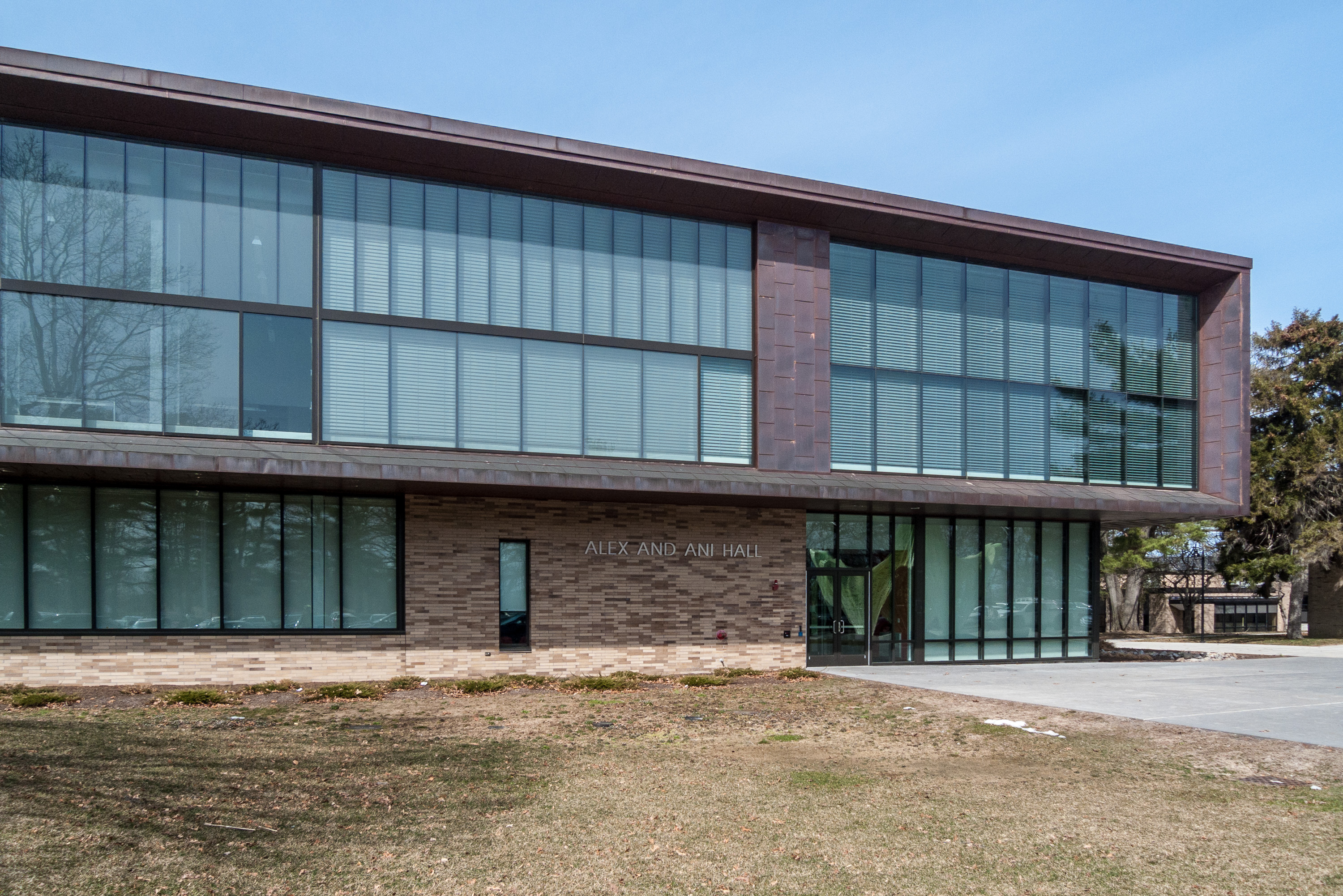
The Rhode Island College Department of Music, Theatre, and Dance was established in 1972.
Theatre students in the program have been top competitors at the Region I American College Theatre Festival, either winning first, second or honorable distinction. The department's faculty have included pianist, composer, and filmmaker Judith Lynn Stillman, who serves as Artist-in-Residence and Professor of Music.
Gallery
File:Rhode Island College Student Union.jpg|The Student Union opened in 1968 File:Rhode Island College Horace Mann Hall.jpg|Horace Mann Hall, built in 1971, houses the Feinstein School of Education and Human Development File:Rhode Island College Guardo Hall School of Social Work.jpg|Guardo Hall, School of Social Work File:Superintendent's home at the former State Home and School for Dependent and Neglected Children.jpg|Former superintendent's residence of the State Home and School for Dependent and Neglected Children Image:Nazarian center.JPG|The facade of the John Nazarian Center for the Performing Arts incorporates columns from the original Normal School Building File:Rhode_Island_College_Murray_Center.jpg|Murray Center is home to the school's health and athletics facilities
Notable alumni
Notable alumni of Rhode Island College in arts and media include Grammy-, Tony-, Emmy-, and Oscar-winning actress, Viola Davis (Class of 1988); actor and playwright, Ron McLarty (Class of 1969); visual artist, Patricia Cronin (Class of 1986); Grammy-nominated composer, Peter Boyer (Class of 1991); Jefferson Award-winning music producer, Al Gomes (Class of 1986); figurative painter, Ann Gale (Class of 1988); and Family Guy producer Danny Smith (Class of 1981). Alumni in journalism and reporting include news anchor, Anaridis Rodriguez, and sports anchor, Jim Rose.
Alumni who have served as members of the Rhode Island House of Representatives include Maria Cimini (Class of 2002), Raymond Gallison (Class of 1974), Karen MacBeth, Mary Messier, Patricia Morgan, William O'Brien, Thomas Palangio, Harold Metts, David Bennett. Graduates in the Rhode Island State Senate include Maryellen Goodwin, Nicholas Kettle, Daniel Issa, J. Michael Lenihan, Roger Picard, Juan Pichardo, Leonidas Raptakis, James Sheehan, Adam Satchell, and Frank Lombardo. Other alumni in politics include Allan Fung (Class of 1992), former congressman James Langevin (D-RI-2, Class of 1990), 70th Lieutenant Governor of RI Sabina Matos (Class of 2001), and Robert J. Healey (Class of 1979).
Other notable graduates include 1995 US Women's Chess Champion, Sharon Ellen Burtman; mountaineer, educator, and suffragist, Annie Smith Peck; and pioneering African-American educator and chemist, Josephine Silone Yates (Class of 1879). File:Josephine Silone Yates, c1902 (cropped).jpg|Educator and chemist, Josephine Silone Yates (Class of 1879) File:Viola Davis by Gage Skidmore.jpg|Oscar-winning actress, Viola Davis (Class of 1988) File:James Langevin official portrait (cropped).jpg|Congressman James Langevin (D-RI-2, Class of 1990) File:Allan Fung.jpg|First Asian-American mayor of Cranston, Allan Fung (Class of 1992) File:Sabina Matos 11.21.jpg|70th Lieutenant Governor of Rhode Island, Sabina Matos (Class of 2001)
Notes
References
References
- "U.S. and Canadian Institutions Listed by Fiscal Year 2009 Endowment Market Value and Percentage Change in Endowment Market Value from FY 2008 to FY 2009". National Association of College and University Business Officers.
- "2020 CENSUS - CENSUS BLOCK MAP: Providence city, RI". [[U.S. Census Bureau]].
- "2020 CENSUS - CENSUS BLOCK MAP: North Providence town, RI". [[U.S. Census Bureau]].
- "About RIC - College History".
- "NEA: Luminaries, NEA History, Leaders".
- "Rhode Island Colleges".
- (January 6, 2022). "Rhode Island College to search for new president as Frank Sanchez won't seek another term". Boston Globe.
- (January 6, 2022). "Rhode Island College President Frank Sanchez plans to depart". The Providence Journal.
- "Rhode Island College Sesquicentennial".
- (September 2017). "I25511: Alva Jerome Vincent (14 Jul 1868 - 9 Mar 1905)".
- (September 18, 1984). "Dr. David E. Sweet, 51, Dies; Head of Rhode Island College". The New York Times.
- (October 20, 1985). "College President Named". The New York Times.
- [http://www.ric.edu/about/office_bio.htm]{{dead link. (May 2017)
- "Rhode Island College".
- "College Scorecard: Rhode Island College". [[United States Department of Education]].
- "News and Events".
- "Student Activities - Student Activities (SA) Greek Life".
- (February 4, 2013). "7 RIC Students Earn Honors at Kennedy Center Theater Festival". GoLocalProv.
- Rappleye, Bill. (2017-01-23). "Political rise and fall of Ray Gallison".
- Gregg, Katherine. "Will lieutenant governor's office be next stop on Sabina Matos's political journey?".
- (1996). "'Yours for the Race': The Life and Work of Josephine Silone Yates". Missouri Historical Review.
This article was imported from Wikipedia and is available under the Creative Commons Attribution-ShareAlike 4.0 License. Content has been adapted to SurfDoc format. Original contributors can be found on the article history page.
Ask Mako anything about Rhode Island College — get instant answers, deeper analysis, and related topics.
Research with MakoFree with your Surf account
Create a free account to save articles, ask Mako questions, and organize your research.
Sign up freeThis content may have been generated or modified by AI. CloudSurf Software LLC is not responsible for the accuracy, completeness, or reliability of AI-generated content. Always verify important information from primary sources.
Report