From Surf Wiki (app.surf) — the open knowledge base
Rhinesuchus
Extinct genus of temnospondyls

Extinct genus of temnospondyls
- R. beaufortensis Boonstra, 1940
- R. broomianus von Huene, 1931
- Muchocephalus muchos Watson, 1962
Rhinesuchus (meaning "rasp crocodile" for the ridged surface texture on its skull bones) is a large temnospondyl. Remains of the genus are known from the Permian of the South African Karoo Basin's Tapinocephalus and Cistecephalus assemblage zones, both belonging to the Beaufort Group. The skull of Rhinesuchus had a flat triangular shape with blunt snout similar to some of the other large temnospondyls, and had a palate filled with small sharp teeth, suggesting that it hunted fish. Also, the small eyes were on top of the head suggesting that it approached its prey from below.
Etymology
The name Rhinesuchus comes from Greek ῥίνη (rhinē) "file, rasp" plus σούχος (soukhos) "crocodile" for the skull surface texture: "The upper cranial bones are ornamented by a rather fine reticulation of sharp ridges". (The name does not mean "nose crocodile" (as if from Greek rhis, rhinos "nose") or refer to the Rhine River in Germany.)
Description
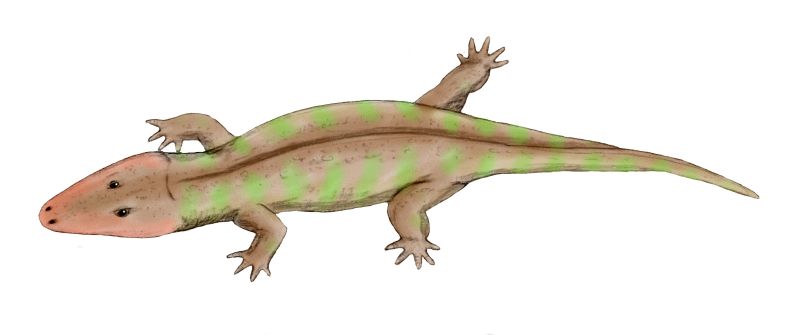
Rhinesuchus whaitsi probably reached a mass of 100 kg. Counts of lines of arrested growth (LAG) indicate that like many amphibians, Rhinesuchus grew seasonally and was able to live more than 30 years. They also indicate that Rhinesuchus was able to sustain prolonged periods of stress, either climatic or nutritional, and that portions of its skeleton may have experienced more sustained growth.
Taxonomy
The type species is Rhinesuchus whaitsi. Two more species, R. africanus and R. wadiai, are considered to be nomina dubia. R. broomianus and R. beaufortensis have been synonymized with R. whaitsi, while R. capensis has been moved out of the genus into Rhinesuchoides. Muchocephalus has also been synonymized with R. whaitsi.
Rhinesuchus major (Broom, 1911) from the Free State was later synonymized with Uranocentrodon senekalensis.
The first rhinesuchid from outside southern Africa was described as Rhinesuchus wolgodvinensis (Yacovlev, 1916). The specimen, collected from Early Triassic beds from Russia, was considered the first Rhinesuchus from the Triassic, although currently it is considered, instead, a wetlugasaurid.
References
References
- Broom, R.. (1908). "On a new Labyrinthodont ''Rhinesuchus whaitsi'' from the Permian beds of South Africa". Annals of the South African Museum.
- "Rhinesuchids & Capitosaurs".
- McHugh, J.B.. (2014). "Paleohistology and histovariability of the Permian stereospondyl ''Rhinesuchus''". Journal of Vertebrate Paleontology.
- (2017). "The Rhinesuchidae and early history of the Stereospondyli (Amphibia: Temnospondyli) at the end of the Palaeozoic". Zoological Journal of the Linnean Society.
- E. M. Latimer, P. J. Hancox, B. S. Rubidge, M. A. Shishkin, and J. W. Kitching. (2002). "The temnospondyl amphibian ''Uranocentrodon'', another victim of the end-Permian extinction event". South African Journal of Science.
This article was imported from Wikipedia and is available under the Creative Commons Attribution-ShareAlike 4.0 License. Content has been adapted to SurfDoc format. Original contributors can be found on the article history page.
Ask Mako anything about Rhinesuchus — get instant answers, deeper analysis, and related topics.
Research with MakoFree with your Surf account
Create a free account to save articles, ask Mako questions, and organize your research.
Sign up freeThis content may have been generated or modified by AI. CloudSurf Software LLC is not responsible for the accuracy, completeness, or reliability of AI-generated content. Always verify important information from primary sources.
Report