From Surf Wiki (app.surf) — the open knowledge base
Revolutionary Armed Forces of the People (Guinea-Bissau)
National army of Guinea-Bissau
National army of Guinea-Bissau
| Field | Value |
|---|---|
| name | Revolutionary Armed Forces of the People |
| native_name | Forças Armadas Revolucionárias do Povo |
| image | Military flag of Guinea-Bissau.svg |
| caption | Military flag of Guinea-Bissau |
| founded | 1964 (as the military branch of PAIGC) |
| current_form | 1973 (as the national armed forces of Guinea-Bissau) |
| branches | Army |
| Navy | |
| Air Force | |
| headquarters | Bissau |
| website | |
| commander-in-chief | General Horta Inta-A Na Man |
| chief minister | Ilídio Vieira Té |
| chief minister_title | Prime Minister |
| minister | General Stive Lassana Manssaly |
| minister_title | Minister of National Defense |
| chief_of_staff | General Biague Na Ntan |
| chief_of_staff_title | Chief of General Staff |
| conscription | Selective compulsory military service |
| manpower_age | 16 to 49 |
| active | 4,000 |
| deployed | |
| amount | $23.3 million |
| percent_GDP | 1.7% |
| foreign_suppliers | |
| Czech Republic | |
| exports | |
| history | Guinea-Bissau War of Independence |
| Guinea-Bissau Civil War | |
| 2010 Guinea-Bissau military unrest | |
| 2012 Guinea Bissau coup d'état | |
| 2025 Guinea-Bissau coup d'état | |
| ranks | Military ranks of Guinea-Bissau |
Navy Air Force | commander-in-chief = General Horta Inta-A Na Man Czech Republic
Guinea-Bissau Civil War 2010 Guinea-Bissau military unrest 2012 Guinea Bissau coup d'état 2025 Guinea-Bissau coup d'état The Revolutionary Armed Forces of the People (, abbr. FARP) is the national military of Guinea-Bissau. It consists of an army, a navy, an air force, and paramilitary forces. In 2022 the World Bank estimated that there were around 4,000 personnel in the armed forces. The estimated military expenditure is $23.3 million, and military spending as a percentage of GDP is 1.7%.
The World Fact Book reports that the military service age is 18–25 years of age for selective compulsory military service, and 16 years of age or younger for voluntary service, with parental consent.
Origins
Main article: Guinea-Bissau War of Independence, Revolutionary Armed Forces of the People
Unlike other European powers during the cold war which engaged in the policy of decolonization the Portuguese Estado Novo instead adopted the policy of Lusotropicalism, arguing that Portugal's colonies in Africa; Angola, Cape Verde, Guinea, Mozambique, and São Tomé and Príncipe, where integral parts of Portugal, inseparable from the mainland. As such, each of Portugal's colonial possessions suffered from major insurgencies in the form of the Portuguese Colonial Wars, as African Nationalist and Socialist groups where backed by the Soviet Union, Cuba, and other Communist states to secure their independence, and their geopolitical allegiance to the Second World. These African forces in Guinea and Cape Verde collaborated, forming the African Party for the Independence of Guinea and Cape Verde (PAIGC), with a militant wing, the Revolutionary Armed Forces of the People (FARP), seeking the independence of both nations as a unified state Guiné e Cabo Verde. However, the Guinea-Bissau War of Independence was fought exclusively in Guinea-Bissau, as Cape Verde remained a major Portuguese base supporting their armed forces fighting on the mainland.
The colonial war's unpopularity, and extensive cost in both men and materials on the Portuguese state, eventually led to the Carnation Revolution in Lisbon which saw the Estado Novo overthrown in favor of a socialist government, as such, one of the new government's first acts was to end the colonial wars by surrendering to the liberation movements. Despite their political and military leadership being united, PAIGC's goal of a unified state between Guinea-Bissau and Cape Verde failed as Portugal granted both colonies independence, Guinea-Bissau in 1974, and Cape Verde in 1975. PAIGC would rule both Guinea-Bissau and Cape Verde until a coup in Guinea-Bissau in 1980 where FARP elements there argued that the government was dominated by Cape Verde interests. As such, the Cape Verde wing of PAIGC would split, forming the African Party for the Independence of Cape Verde (PAICV) with its militant wing becoming the Cape Verdean Armed Forces effectively ending any prospective unification of the two states while PAIGC and FARP continued to rule in Guinea-Bissau.
History
1980 coup d'état
Main article: 1980 Guinea-Bissau coup d'état
Following independence in 1974, Luís Cabral, the half brother of PAIGC leader Amílcar Cabral who was assassinated just months prior to independence, became the first President of Guinea-Bissau. A Cape Verdean and a mestiço, Cabral's rule would be resented by black nationalist elements of the FARP who viewed Cabral as the embodiment of mestiço economic and political dominance over black Guineans who retained leadership of FARP. João Bernardo Vieira, a black FARP officer who had been named Prime Minister in 1978, staged a bloodless coup against Cabral and seize control over Guinea-Bissau with FARP elements loyal to him. Vieira's new government would quickly be recognized by other West African nations, as a nine-member military Council of the Revolution approved a new constitution restoring governance back to PAIGC in 1984. A single-party "election" where only the PAIGC members could stand was held shortly after to establish a new civilian government. As a result of the coup Cape Verde cut ties and any prospective talk of unification with Guinea-Bissau on January 20, 1981. Aristides Pereira, President of Cape Verde, formally split from PAIGC forming the PAICV alongside several former high-ranking members of PAIGC's political bureau.
1982 coup attempt
Main article: 1982 Guinea-Bissau coup attempt
1983 coup attempt
Main article: 1983 Guinea-Bissau coup attempt
1984 coup attempt
Main article: 1984 Guinea-Bissau coup attempt
1985 coup attempt
Main article: 1985 Guinea-Bissau coup attempt
In 1986 the government of Guinea-Bissau announced the trial of 12 high ranking politicians and generals, including Vice-President Paulo Correia for plotting to stage a coup. However, some observers claim that the "coup plot" was just a justification for President João Bernardo Vieira to purge dissidents in the African Party for the Independence of Guinea and Cape Verde (PAIGC) and FARP.
1993 coup attempt
Main article: 1993 Guinea-Bissau coup attempt
Civil war
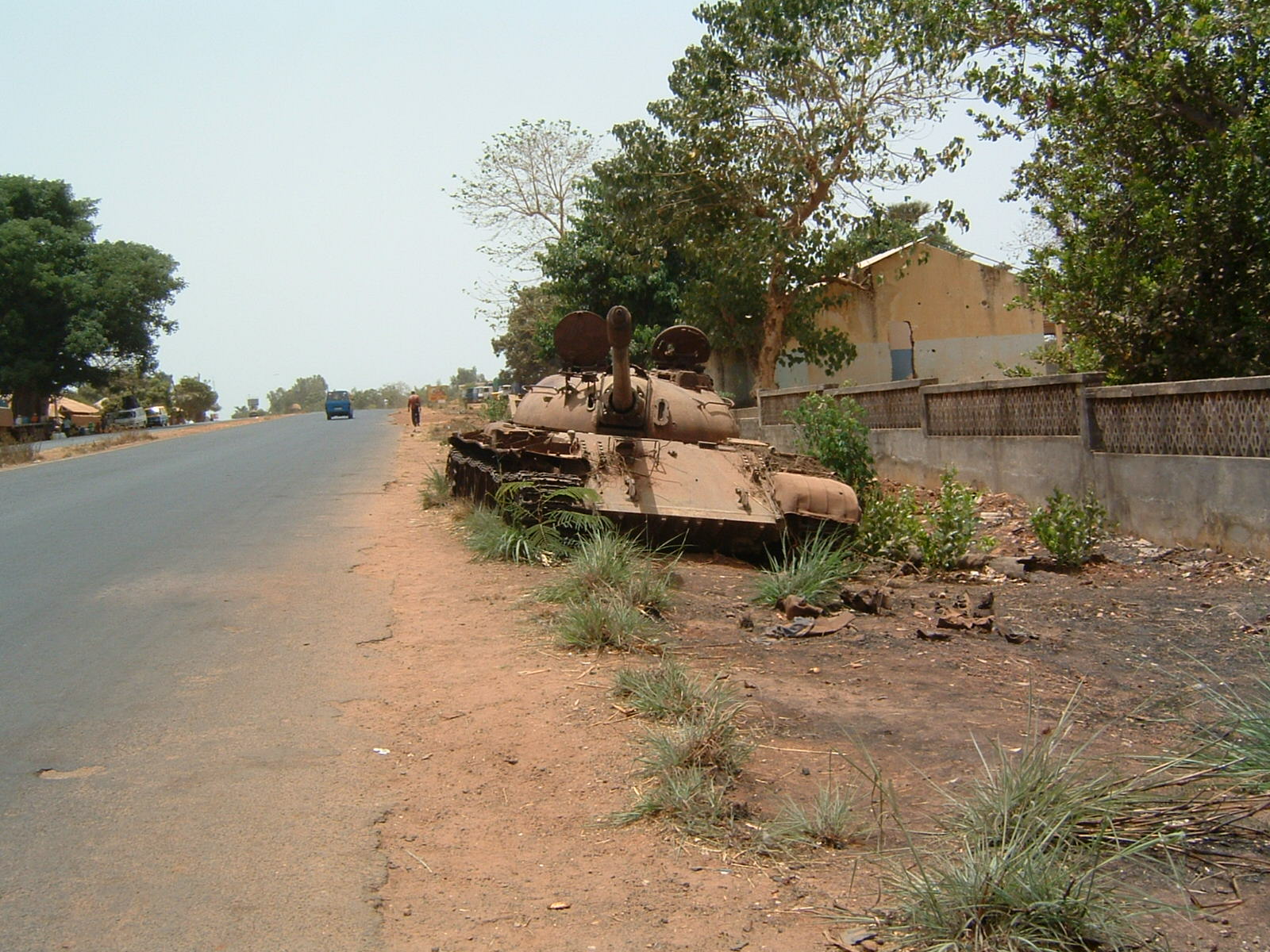
Main article: 1998 Guinea-Bissau coup attempt, Guinea-Bissau civil war
2003 coup d'état
Main article: 2003 Guinea-Bissau coup d'état
The 2003 Guinea-Bissau coup d'état was a bloodless military coup that took place in Guinea-Bissau on 14 September 2003, led by General Veríssimo Correia Seabra against incumbent President Kumba Ialá. Seabra referred to the "incapacity" of Ialá's government as justification for the takeover, together with a stagnant economy, political instability, and military discontent over unpaid salaries. Ialá publicly announced his resignation on 17 September, and a political agreement signed that month prohibited him from participating in politics for five years. A civilian-led transitional government led by businessman Henrique Rosa and PRS secretary general Artur Sanhá was set up at the end of September.
2010 military unrest
Main article: 2010 Guinea-Bissau military unrest
Major General Batista Tagme Na Waie was chief of staff of the Guinea-Bissau armed forces until his assassination in 2009.
Military unrest occurred in Guinea-Bissau on 1 April 2010. Prime Minister Carlos Gomes Júnior was placed under house arrest by soldiers, who also detained Army Chief of Staff Zamora Induta. Supporters of Gomes and his party, PAIGC, reacted to the move by demonstrating in the capital, Bissau; Antonio Indjai, the Deputy Chief of Staff, then warned that he would have Gomes killed if the protests continued.
The EU ended its mission to reform the country's security forces, EU SSR Guinea-Bissau, on 4 August 2010, a risk that may further embolden powerful generals and drug traffickers in the army and elsewhere. The EU mission's spokesman in Guinea-Bissau said the EU had to suspend its programme when the mastermind of the mutiny, General Antonio Indjai, became army chief of staff. "The EU mission thinks this is a breach in the constitutional order. We can't work with him".
2011 coup attempt
Main article: 2011 Guinea-Bissau coup attempt
The 2011 Guinea-Bissau coup attempt was a failed coup d'état by a group of renegade soldiers. Taking place on the morning of December 26, 2011, fighting broke out between two factions in the armed forces with sounds of automatic weapons and rocket fire erupting in the Santa Luzia army base which alarmed residents in the country's capital of Bissau. Officials claim it started when Navy Chief Jose Americo Bubo Na Tchuto sent orders to arrest Army Chief Antonio Injai, who was later freed by his men. Afterwards, the Army Chief in turn arrested the Navy Chief for his involvement in the incident however he denied issuing such orders to his troops. The coup failed, and 30 perpetrators were arrested, among them being the Navy Chief for "masterminding the coup."
International drug trade
The multitude of small offshore islands and a military able to sidestep government with impunity has made it a favourite trans-shipment point for drugs to Europe. Aircraft drop payloads on or near the islands, and speedboats pick up bales to go direct to Europe or onshore. UN chief Ban Ki-moon has called for sanctions against those involved in Guinea-Bissau's drugs trade.
Air Force head Ibraima Papa Camara and former navy chief Jose Americo Bubo Na Tchuto have been named "drug kingpins".
Angolan assistance
Angola, at the presidency of the Community of Portuguese Language Countries (CPLP) since 2010, has since 2011 participated in a military mission in Guinea-Bissau (MISSANG) to assist in the reform of defence and security. MISSANG had a strength of 249 Angolan men (both soldiers and police officers), following an agreement signed between the defence ministers of both countries, as a complement to a Governmental accord ratified by both parliaments.
The Angolan assistance mission included a programme of technical and military cooperation focused on a reform of the Guinean armed forces and police, including the repair of barracks and police stations, organisation of administrative services and technical and military training locally and in Angolan institutions. The mission was halted by the Angolan Government, following a politico-military crisis that led to the ousting of the interim president of Guinea-Bissau, Raimundo Pereira, and the prime minister, Gomes Júnior. By 22 June 2012, the Angolan vessel Rio M'bridge, carrying the mission's equipment, had arrived back in Luanda.
2023 coup attempt
Main article: 2023 Guinea-Bissau coup attempt
On 30 November 2023, clashes broke out in Bissau, the capital of Guinea-Bissau, between government forces and units of the National Guard who had released two ministers accused of corruption from detention. The clashes led to the arrest of National Guard commander Colonel Victor Tchongo. President Umaro Sissoco Embaló described the events as an attempted coup. Following the clashes, Embaló ordered the dissolution of the country's legislature.
American assistance
On November 24, 2024 it was announced that the United States Army was sending the 478th Civil Affairs Battalion to Guinea-Bissau as part of a SETAF-AF mission to aid their Guinean counterparts with medical readiness exercises, humanitarian activities, and join training sessions for a nine-month rotation.
2025 coup d'état
Main article: 2025 Guinea-Bissau coup d'état
On 26 November 2025, the president of Guinea-Bissau, Umaro Sissoco Embaló, was arrested as part of a coup d'état carried out by Head of the Military Office of the Presidency Brigadier General Dinis Incanha. Military officers declared "total control" over the country and established the High Military Command for the Restoration of National Security and Public Order. The coup occurred a day before the results of the 2025 Guinea-Bissau general election held on 23 November, in which Embaló was running for re-election, were expected to be officially announced.
Equipment
Main article: List of equipment of the Guinea-Bissau Army
Large parts of the equipment of the army of Guinean-Bissau are of Warsaw Pact origin.
Air Force
Main article: Guinea-Bissau Air Force
After achieving independence from Portugal, the air force was formed by officers returning from training in Cuba and the Soviet Union. The FAGB was re-equipped by the Soviets with a limited aid package in which its first combat aircraft were introduced.
References
- The Two Faces of War
- World Aircraft Information Files. Brightstar Publishing, London. File 338 Sheet 02
References
- "Guinea-Bissau Transition Leader Installs New 27-Member Government".
- "Portugal sends military equipment to Guinea".
- "Armed forces personnel, total – Guinea-Bissau {{!}} Data".
- "Military expenditure (current USD) – Guinea-Bissau {{!}} Data".
- "Military expenditure (% of GDP) – Guinea-Bissau {{!}} Data".
- (5 March 2013). "O luso-tropicalismo e o colonialismo português tardio".
- link. (2009-06-24 , Alice Dinerman)
- Peter Karibe Mendy (2013) ''Historical Dictionary of the Republic of Guinea-Bissau'', Scarecrow Press, p305
- Ly, Aliou. (2015-09-01). "Revisiting the Guinea-Bissau liberation war: PAIGC, UDEMU and the question of women's emancipation, 1963–74". Portuguese Journal of Social Science.
- (1970-11-23). "Guinea Reports Invasion From Sea by Portuguese". The New York Times.
- Stewart Lloyd-Jones, [[ISCTE]] (Lisbon), [http://www1.ci.uc.pt/cd25a/media/Textos/portugal-since-1974.pdf Portugal's history since 1974], Centro de Documentação 25 de Abril, [[University of Coimbra]]
- Johnson. (11 September 1974). "Portugal Formally Grants Guinea-Bissau Freedom". The New York Times.
- MacQueen, Norrie. (February 1, 2006). "Widening trajectories: Guinea Bissau and Cape Verde since independence". Relações Internacionais.
- (October 17, 2013). "Historical Dictionary of the Republic of Guinea-Bissau". Scarecrow Press.
- ''Political Parties of the World'' (6th edition, 2005), ed. Bogdan Szajkowski, page 113.
- "Tobias Engel, A sina da instabilidade, biblioteca diplo".
- "Bloodless Coup in Guinea-Bissau". ''The Sunday People'' [[[Monrovia]], [[Liberia]]] 1980-11-16: 1/8.
- "1980 Coup in Guinea Bissau".
- [http://africanelections.tripod.com/gw.html Elections in Guinea-Bissau] African Elections Database
- IRIN]]'', 14 September 2003.
- [https://news.bbc.co.uk/2/hi/africa/3113572.stm Bissau junta set to step down], ''[[BBC News Online]]'', 18 September 2003.
- [https://news.bbc.co.uk/1/hi/world/africa/3147570.stm "Interim government takes over Bissau"], ''[[BBC News Online]]'', 28 September 2003.
- IRIN]]'', 23 September 2003.
- (2010-04-02). "Soldiers put Guinea-Bissau prime minister under house arrest".
- [https://www.bbc.co.uk/news/world-europe-10871260 EU pull-out hits Guinea-Bissau reforms] ''BBC''
- "Coup attempt 'fails' in Guinea-Bissau".
- (2011-12-27). "Guinea-Bissau coup attempt: Navy chief arrested". BBC News.
- [https://news.bbc.co.uk/2/hi/africa/6274590.stm Africa – new front in drugs war] ''BBC''
- BBC, [https://news.bbc.co.uk/2/hi/africa/7650063.stm G Bissau drugs sanctions threat]
- [[British Broadcasting Corporation]], [https://news.bbc.co.uk/2/hi/africa/8610924.stm US names two Guinea-Bissau military men 'drug kingpins']
- link. (2013-05-17 , July 25, 2011)
- "Military equipment used in Guinea-Bissau in Luanda". ANGOP.
- (2 December 2023). "Guinea-Bissau president says this week's violence was 'attempted coup'". Al Jazeera.
- (4 December 2023). "Guinea-Bissau: Attempted coup was foiled, says President Embaló".
- (5 December 2023). "Guinea-Bissau's president issues a decree dissolving the opposition-controlled parliament". Associated Press.
- "US civil affairs soldiers build partnerships in Guinea-Bissau".
This article was imported from Wikipedia and is available under the Creative Commons Attribution-ShareAlike 4.0 License. Content has been adapted to SurfDoc format. Original contributors can be found on the article history page.
Ask Mako anything about Revolutionary Armed Forces of the People (Guinea-Bissau) — get instant answers, deeper analysis, and related topics.
Research with MakoFree with your Surf account
Create a free account to save articles, ask Mako questions, and organize your research.
Sign up freeThis content may have been generated or modified by AI. CloudSurf Software LLC is not responsible for the accuracy, completeness, or reliability of AI-generated content. Always verify important information from primary sources.
Report