From Surf Wiki (app.surf) — the open knowledge base
RER D
Railway service in France

Railway service in France
| Field | Value | |
|---|---|---|
| name | RER D | |
| color | ||
| logo | ||
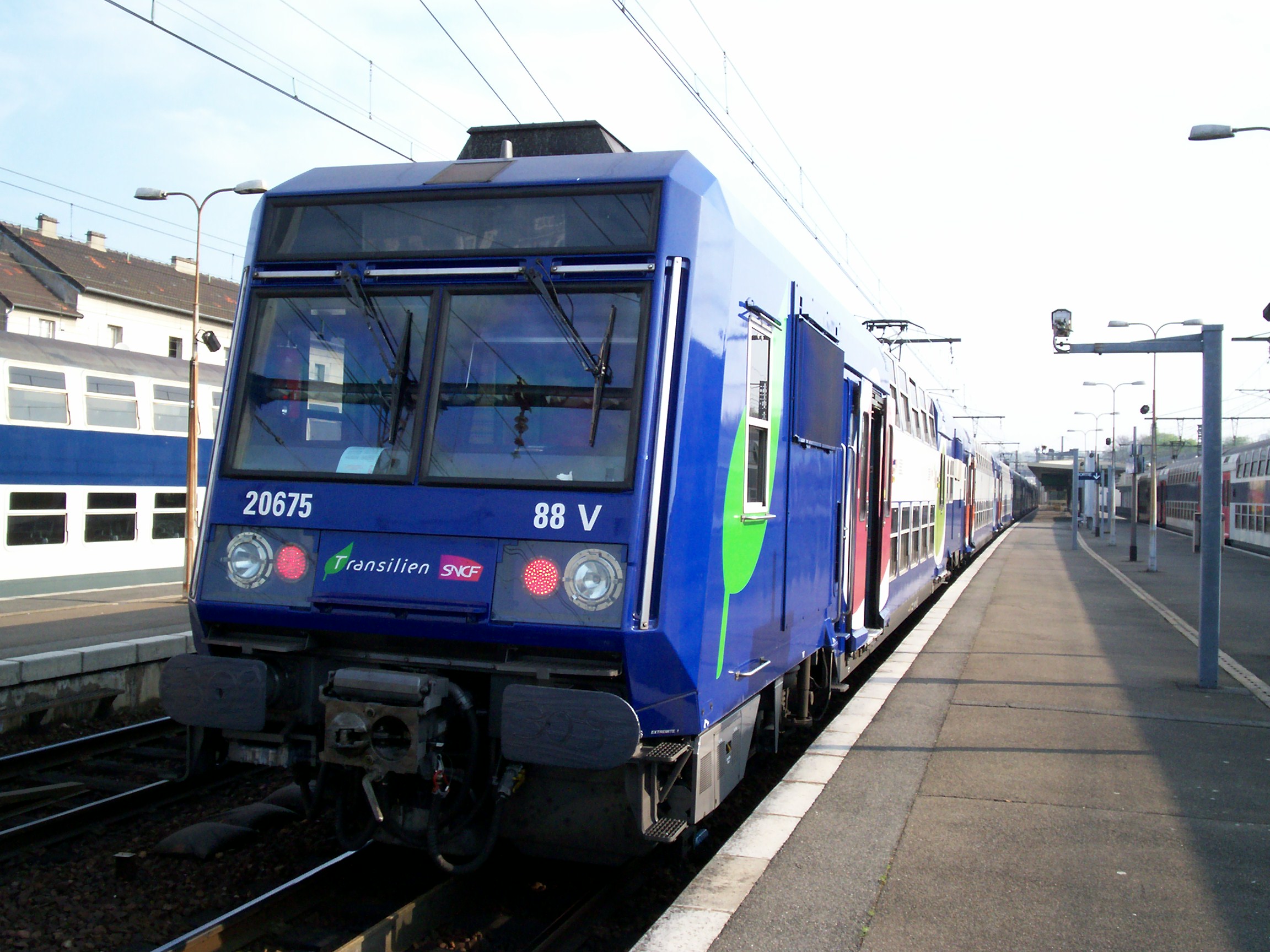
| image | File:Gare Malesherbes Malesherbois 2.jpg | |
| caption | RER D train at Malesherbes station | |
| type | Rapid transit/commuter rail | |
| system | Réseau Express Régional | |
| connectinglines | {{Unbulleted list | |
| status | Active | |
| stations | 59 | |
| ridership2 | 145 million journeys per year | |
| open | 27 September 1987 | |
| (last extension in 1996) | ||
| operator | SNCF | |
| start | Creil (D3) | |
| end | Melun (D2), Malesherbes (D4) | |
| stock | Z 20500, Z 57000, Z 58500 | |
| linelength_km | 190 | |
| gauge | ||
| map | {{switcher | |
| {{RER D | inline | yes}} |
| map_state | collapsed |
|
|
|
|
(last extension in 1996)
| speed_km/h =
| [[File:RER D.svg|265px|center]]
| Show geographically accurate map
|
| Show diagram map
RER D is one of the five lines in the Réseau Express Régional (English: Regional Express Network), a hybrid commuter rail and rapid transit system serving Paris and its suburbs. The 190 km line crosses the region from north to south, with all trains serving a group of stations in central Paris, before branching out towards the ends of the line.
The line connects Creil in the north to Melun and Malesherbes in the south, passing through the heart of Paris. Line D also links Gare du Nord with Gare de Lyon via Châtelet-Les Halles.
Opened in stages from 1987 to 1996, it is the longest RER line by distance, and the busiest SNCF line in France, carrying up to 615,000 passengers and operating 466 trains each working day.
Almost all of the line is located in the Île-de-France region, that is, within the jurisdiction of the Île-de-France Mobilités, but some of the branch lines at the north and south of the line are outside the region.
Chronology
- 27 September 1987: Inauguration of Line D. Operated Villiers-le-Bel – Gare du Nord – Châtelet-Les Halles, 19 km, using the Line B Tunnel to Châtelet–Les Halles
- 1988: Extension north towards Goussainville.
- September 1990: Extension north towards Orry-la-Ville.
- September 1995: Inauguration of "Interconnexion Sud-Est". The line is extended from Châtelet to Melun and La Ferté-Alais then Malesherbes (the following year, 1996) in the south of Paris.
- 25 January 1998: New station, , opened. Located between Gare du Nord and St-Denis.
- 29 January 2007: First renovated Z 20500 stock in service.
- 19 March 2008: Start of the "D Maintenant" programme by Guillaume Pepy, the president of SNCF.
- 14 December 2008: Reduced "Interconnexion Nord-Sud" service, with 8 interconnected trains per hour.
- Late 2009: End of the "D Maintenant" programme.
- 7 December 2011: Start of studies for the doubling of the Châtelet-Gare du Nord tunnel.
- 15 December 2013: New station, , opened and replaced Villeneuve – Prairie.
- 13 December 2024: First Z 58500 (RER NG) enter service on the RER D
History
Conception
Initially, the "métro régional", the ancestor to the RER, was conceived of three lines, one going from east to west (the future RER A), a new line built from existing lines (the future RER C), the extension of the Ligne de Sceaux and with its interconnection with an SNCF line, along with a supplementary interconnected north–south (the future RER D). The operation of renovating "les Halles" gave the occasion to build Châtelet-Les Halles with a cut-and-cover method, in order to reduce costs.
Inauguration
On 27 September 1987, the RER D was officially created, by extending existing suburban trains from Villiers-le-Bel to Gare du Nord, towards Châtelet-Les Halles. Initially 19 km long, it was equipped with bi-current Z 8800 stock trains, while newer Z 20500 stock trains were still being built. At Châtelet-Les Halles, the RER D terminated on the three central tracks, already built from the conception of Châtelet-Les Halles station.
In 1988, existing suburban trains terminating at Goussainville now integrate with the RER D. On the same year, the first bi-mode Z 20500 trains are in service. They were initially composed of 4 cars until the north–south interconnection was inaugurated in 1995, when they became 5-car trains (where they're coupled to make 10-car trains).
In September 1990, the RER D again extended north to Orry-la-Ville. At the same time, one-man operation started on the RER D.
Central tunnel opening
On 11 September 1995, the north–south interconnection of the RER D was put into service by building a dedicated 2.5 km long tunnel between Châtelet-Les Halles and the Gare de Lyon.
In 1996, the RER D was extended south from La Ferté-Alais to Malesherbes. On 15 January 1998 for the 1998 FIFA World Cup, Stade de France – Saint-Denis station opened, in order to serve the Stade de France.
Enhancements
On 22 November 2006 the STIF approved a master plan for the RER D in order to establish short, mid and long-term goals for its reliability.
On 29 January 2007, the first renovated Z 20500 train was presented, the first of 137 trains. Renovated trains feature a new blue livery, uniform 2+3 seats, new lighting and new floor covering. The renovation programme cost over €100 million.
Delays

Service nomenclature
Like all other lines of the RER system, every train is assigned a four letter code, called a name of service or a mission code. Train timetables, passenger information display systems and the front of the trains all display names of services.
New system
The first letter corresponds to the final destination, which is essentially the train's terminus.
- A: Gare du Nord
- B:
- D: Gare de Lyon (Underground)
- E:
- F:
- J:
- K:
- L:
- M:
- N:
- P: or Gare de Lyon (Surface)
- R:
- S:
- T:
- U:
- V:
- X:
- Z:
The second letter indicates the stations served by the train in the section spanning from Gare de Lyon to Villeneuve-Saint-Georges.
- A: Stops only at and Créteil-Pompadour
- I: Express between Gare de Lyon and Villeneuve-Saint-Georges
- O: All stops on this section
- U: Stops only at .
The third letter indicates the branch the train takes.
- C: Branch from Gare de Lyon to Combs-la-Ville–Quincy
- P: Branch from Gare de Lyon to Corbeil-Essonnes via Évry-Courcouronnes (plateau)
- S: Branch from Corbeil-Essonnes to Melun (littoral)
- V: Branch from Juvisy to Corbeil-Essonnes, or even Malesherbes or Melun, via Ris-Orangis (valley)
The fourth letter indicates whether the train would serve Viry-Châtillon or not, and it also indicates the direction the train is running.
- A: This train runs from the south part to the north part and stops at Viry-Châtillon.
- E: This train does not stop at Viry-Châtillon (irrespective of direction).
- O: This train runs from the north part to the south part and stops at Viry-Châtillon.
| Destination | Names of services |
|---|---|
| Malesherbes | BOVO |
| Gare de Lyon (underground) | DACA, DICA, DOCA, DOPA, DOPE, DUPA |
| Goussainville | FACA |
| Juvisy | JAVA, JOVA, JUVA |
| Orry-la-Ville - Coye | LOPA, LOPE |
| Gare de Lyon (surface) | PACA, PICA |
| Corbeil-Essonnes | ROPE, ROPO, ROSA, ROVO, RUPO |
| Creil | SOPA, SOPE |
| Stade de France – Saint-Denis | UACA, UOPA, UOPE, UUPA |
| Villiers-le-Bel–Gonesse–Arnouville | VOPA, VOPE, VUPA |
| Melun | ZACO, ZICO, ZOSO, ZOVO |
Old system
In the old system used until 2008, the last letter did not indicate whether the train would serve Viry-Châtillon or not, and the first letters for Creil, Orry-la-Ville-Coye and Villeneuve-Saint-Georges were different.
First letter: destination of the train
- A: Gare du Nord
- B:
- C:
- D: Gare de Lyon
- F:
- H:
- J:
- M:
- N:
- Q:
- R:
- T:
- U:
- V:
- Z:
Third letter: the branch
- C: Branch from Gare de Lyon to Combs-la-Ville–Quincy
- P: Branch from Gare de Lyon to Corbeil-Essonnes via Évry-Courcouronnes (plateau)
- L: Branch from Gare de Lyon to Orry-la-Ville
- S: Branch from Corbeil-Essonnes to Melun
- V: Branch from Juvisy to Corbeil-Essonnes, or even Malesherbes or Melun, via Ris-Orangis (valley)
| Destination | Names of services |
|---|---|
| Gare du Nord | AUCH, AUPA, AUVA |
| Malesherbes | BIPA, BIPE, BOPA |
| Creil | CIVA, COVA, COVO |
| Gare de Lyon | DAPA, DECA, DICA, DIPA, DOCA, DOLE, DOPA, DOVA, DUCA |
| Goussainville | FACE, FIPE, FOVI |
| Orry-la-Ville - Coye | HIPA, HIVA, HOPA, HOVI |
| Juvisy | JAPA |
| Châtelet–Les Halles | MOLE |
| Combs-la-Ville–Quincy | NACE, NICE, NOCE |
| Corbeil-Essonnes | REPI, RIPA, RIPE, RIPO, RIPA, ROPA, ROSA, ROSU, ROVA |
| La Ferté-Alais | TYPA, TYPE, TYPO |
| Stade de France – Saint-Denis | UIPE, ULCO, ULPE, UPPE |
| Villiers-le-Bel–Gonesse–Arnouville | VICK, VIPA, VIPE, VOPE |
| Melun | ZACK, ZAPE, ZIPE, ZOCK, ZOPA, ZOVA, ZUCK, ZYCK |
Incidents
On 20 September 2003, an unusual incident occurred near Villeneuve-Triage station. A southbound train stopped at 18:50 on the central track near the station due to an incident. Passengers aboard were invited to step off the train by the left, as track 2M has been neutralised by the regulators. However, due to a misuse of the alarm signal by nervous passengers, some doors opened on the right. Ignoring the driver's orders, numerous passengers stepped off on the right, and were confronted with a northbound train, travelling at around 110 km/h.
The driver of the train had the time to activate his emergency brakes and slowed the train to around 70 km/h, which permitted to passengers to brace against the stopped train or jump into the ditch. Thankfully, no one was injured. This near miss, filmed by a passenger with a mobile phone, was broadcast the night of the incident, and created a large controversy.
On 9 July 2004, an alleged anti-semitic assault provoked a public and political reaction, with immediate declarations from the Ministry of the Interior Dominique de Villepin and the President of France Jacques Chirac. However, the allegations were proven false after the investigation, as the person behind the assault suffered from pathological lying. The event provoked a controversy on the treatment of information by the media.
References
References
- [http://horaires2019.sadur.org/wp-content/uploads/2016/12/Prsentation-Ballancourt.pdf "RER D : Qualité de services et projets"], Dossier de réunion publique SNCF, 5 décembre 2016, page 3 (consulté le 28 décembre 2016).
- Jean Robert, Notre métro, p. 386
- "RER lines D and E".
- Bernard Collardey, Les Trains de banlieue, tome II, p. 227
- Les Trains de Banlieue. Tome II. De 1938 à 1999, op. cit., p. 227.
- [https://web.archive.org/web/20080422005605/http://www.ina.fr/archivespourtous/index.php?vue=notice&id_notice=PAC9826327507 INA - Report on the new RER D]
- "Conseil du STIF du 22 novembre 2006".
- [http://www.stif.org/IMG/pdf/DP_-_Des_trains_renoves_pour_le_RER_D-2.pdf STIF - "Dès aujourd’hui, des trains rénovés : le STIF et Transilien SNCF s’engagent pour l’amélioration du RER D "]
- ortferroviaire. "RER D : simplifier, moderniser, transformer".
- (2023-12-05). "Ponctualité des métros et RER : "une dégradation inquiétante", s'agace Île de France Mobilités - France Bleu".
- (18 October 2018). "Les codes missions du RER D à partir du 9 décembre 2018". SNCF.
- (12 December 2013). "RER D : Décodons les codes missions". SNCF.
- "Codes Missions [anciens] (ligne D)". SaDur.
- [http://portail.documentation.developpement-durable.gouv.fr/documents/cgedd/2003-0231-01.pdf Conseil général des Ponts et Chaussées - ''Enquête sur les circonstances de l'incident survenu le 20 septembre 2003 sur la ligne D du RER en gare de Villeneuve-Triage''] {{Webarchive. link. (20 November 2011 , novembre 2003)
- (23 September 2003). "On l'a échappé belle, pour parler clair". metro-pole.net, via web.archive.org.
- (5 November 2003). "Villeneuve-Triage, rapport d'enquête définitif". metro-pole.net, via web.archive.org.
- [http://www.lemonde.fr/cgi-bin/ACHATS/acheter.cgi?offre=ARCHIVES&type_item=ART_ARCH_30J&objet_id=861132 ''Le Monde'', ''Stupeur après l'agression antisémite d'une femme dans le RER'', article du 13.07.2004]
- [http://www.rfi.fr/actufr/articles/055/article_29221.asp RFI - La France sous le choc]
- [http://www.rfi.fr/actufr/articles/055/article_29249.asp RFI - Antisémitisme : le doute]
This article was imported from Wikipedia and is available under the Creative Commons Attribution-ShareAlike 4.0 License. Content has been adapted to SurfDoc format. Original contributors can be found on the article history page.
Ask Mako anything about RER D — get instant answers, deeper analysis, and related topics.
Research with MakoFree with your Surf account
Create a free account to save articles, ask Mako questions, and organize your research.
Sign up freeThis content may have been generated or modified by AI. CloudSurf Software LLC is not responsible for the accuracy, completeness, or reliability of AI-generated content. Always verify important information from primary sources.
Report