From Surf Wiki (app.surf) — the open knowledge base
RER A
Hybrid suburban commuter railway line in Paris, France
_par_Cramos.jpg)
Hybrid suburban commuter railway line in Paris, France
| Field | Value | |
|---|---|---|
| name | RER A | |
| color | ||
| logo | ||
| image | File:Rame MI09 du RER A - DEF - IMG 1557.jpg | |
| caption | RER A train at the underground La Défense station | |
| type | Rapid transit/commuter rail | |
| system | Réseau Express Régional | |
| stations | 46 | |
| ridership2 | 300 million journeys per year | |
| open | 8 December 1977 | |
| (last extension in 1994) | ||
| operator | RATP/SNCF | |
| start | (A1), (A3), (A5) | |
| end | (A2), (A4) | |
| stock | MI 2N, MI 09 | |
| linelength_km | 108.5 | |
| gauge | ||
| electrification | {{unbulleted list | |
| connectinglines | {{unbulleted list | |
| map | {{switcher | |
| {{RER A | inline | yes}} |
(last extension in 1994)
| Overhead line:
|
|
| speed_km/h =
|
|
|
|
| [[File:RER A.svg|265px|center]]
| Show geographically accurate map
|
| Show diagram map
RER A is one of the five lines in the Réseau Express Régional (English: Regional Express Network), a hybrid commuter rail and rapid transit system serving the city and suburbs of Paris, France. The 108.5 km line crosses the region from east to west, with all trains serving a group of stations in central Paris, before branching out towards the ends of the line.
The initial portion of the line was built in stages between December 1969 and December 1977 by connecting two existing suburban commuter rail lines with a new tunnel under Paris: the line between Vincennes and Boissy-Saint-Léger in the east (which formerly terminated at the now-closed Gare de la Bastille), and the line between Saint-Germain-en-Laye and Nanterre in the west (which formerly used a surface alignment to the Gare Saint-Lazare that is still in use as Transilien L). The viaduct between Vincennes and the former Gare de la Bastille terminus was redeveloped into the Promenade plantée elevated park in 1993.
Since its opening, three additional branches have been added: one in the east serving Marne-la-Vallée and Disneyland Paris, and two to the west serving Poissy and Cergy.
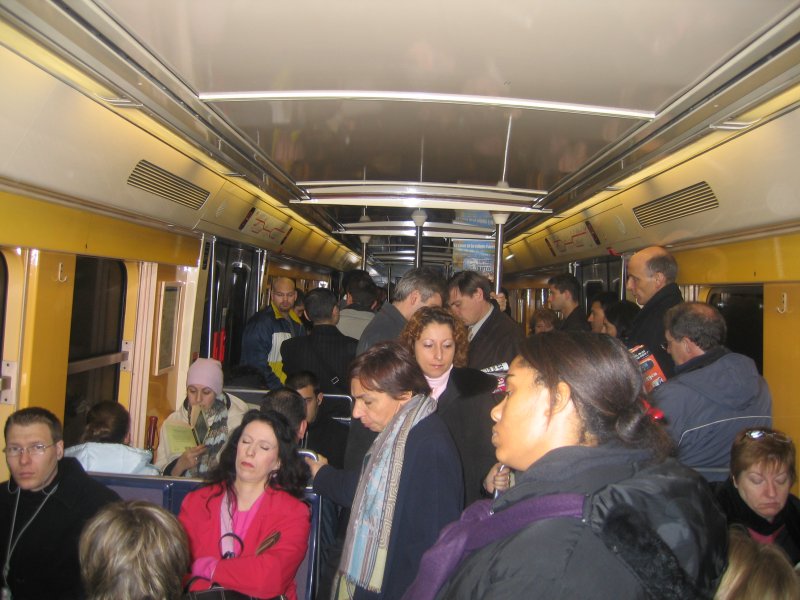
The RER A has had a significant social impact on Paris and the surrounding region by speeding up trips across central Paris (by making far fewer stops than the Paris Métro) and by bringing far-flung suburbs within easy reach of the city centre. The line has far exceeded all traffic expectations, currently serving over 1.2 million passengers per day, on about 300 million journeys per year. It is one of the busiest rapid transit lines in Europe.
Popular success and responses
The line has far exceeded all traffic expectations, currently serving over 1.2 million passengers per day, on about 300 million journeys per year. It has been argued that this makes the RER A the busiest single rail line outside of East Asia. Ever-increasing traffic volume and the need to ward off imminent saturation have been major factors in RATP and SNCF's planning since the inauguration of the line.
Several major capital investments have been made to relieve overcrowding on the line:
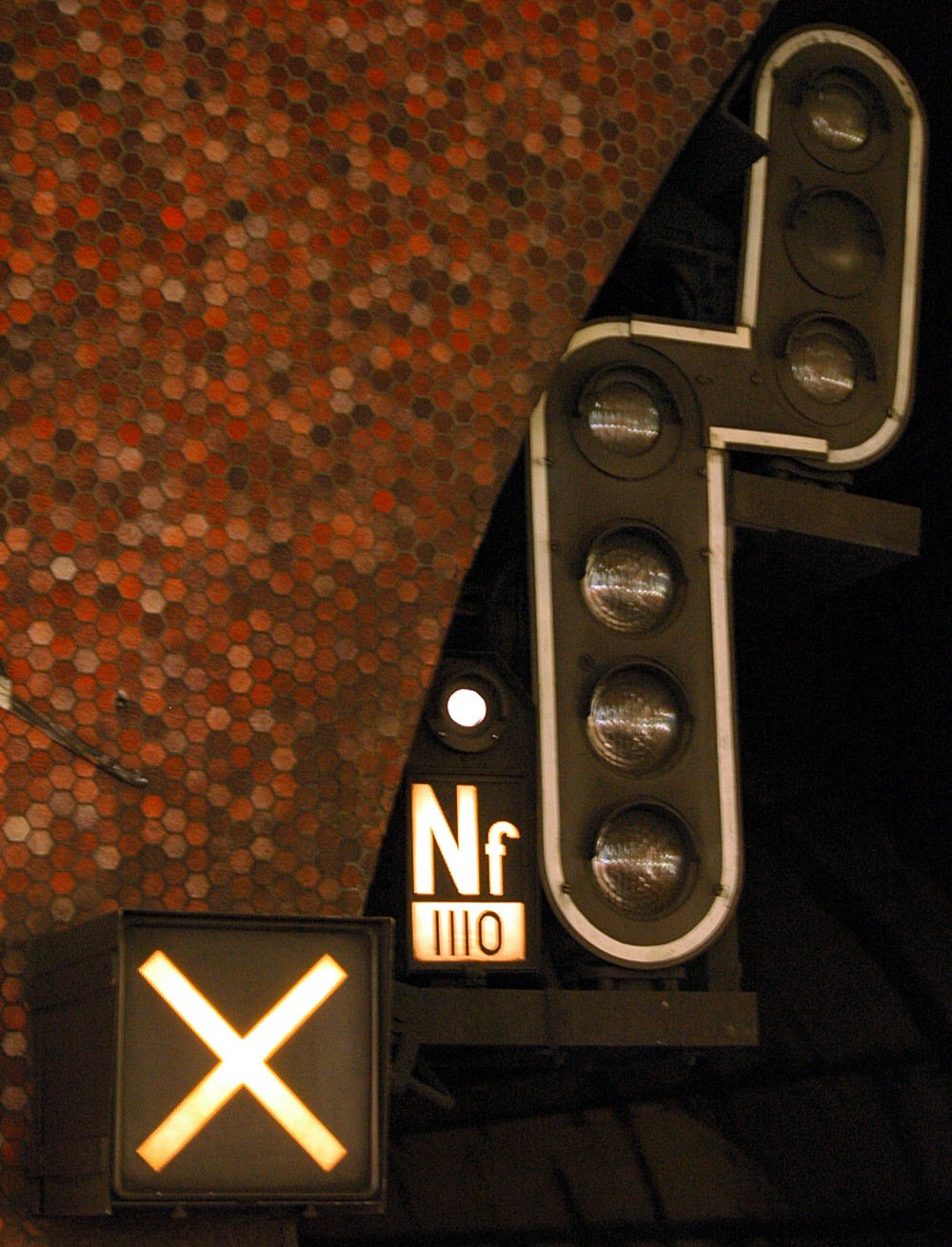
- The line's traditional signalling block system, which allowed only one train to occupy a "block" of track, was replaced in September 1989 with a dynamic traffic control system. The Système d'aide à la conduite, à l'exploitation et à la maintenance or SACEM (English: Driver Assistance, Operation, and Maintenance System) enables extremely short spacing between trains, increasing capacity on the line. The SACEM system is scheduled to be replaced in the mid-to-late 2020s with an even more advanced communications-based train control system.
- Paris Métro Line 14, which opened on 15 October 1998, was built on a route that would relieve congestion on the segment of RER A that passes through central Paris.
- RER E, which opened on 14 July 1999, was built on a route that would also serve the eastern suburbs of Paris, and an 8 km tunnel has been built under central Paris that connects the RER E to La Défense. The extension will continue past La Défense to allow the RER E to take over the branch of the RER A to Poissy. The project is expected to reduce the load on the central section of the RER A by 10-15%.
- Double-deck trains (MI 2N series) entered service in 1998 to increase the passenger-carrying capacity on each run of the RER A. The 43 double-deck trains can carry up to 2,600 people per train, compared to 1,887 people on the older single-deck MS 61 trains. The double-deck trains proved so successful and popular that RATP placed an order for 140 MI 09 double-deck trains that entered service in 2011, and has replaced all the remaining single-deck trains on the RER A.
Chronology
- 6 July 1961: The first planning begins for a tunnel under Paris to connect Étoile to the new La Défense business district. These plans would go on to become the much more ambitious RER A.
- 14 December 1969: The first Regional Metro segment begins service after RATP purchases the Ligne de Vincennes between Bastille and Boissy-Saint-Léger from SNCF and connects it to a new 2.5 km tunnel under Paris between Vincennes and Nation, which replaces Bastille as the terminus. This creates a 17.5 km eastern line between Nation and Boissy-Saint-Léger.
- 19 January 1970: A 4 km tunnel opens between Étoile and La Défense. Since this tunnel is isolated from the other section, it is operated as a navette (shuttle) service.
- 23 November 1971: The tunnel is extended 2 km east to Auber. The shuttle service is extended to operate between and .
- 1 October 1972: The second Regional Metro segment opens as RATP purchases the Ligne de Saint-Germain between and Saint-Germain-en-Laye from SNCF and connects it to a new 2 km tunnel to La Défense. This creates a 13 km western line between Saint-Germain-en-Laye and Auber.
- 1 October 1973: The new infill underground Nanterre–Préfecture station opens.
- 8 December 1977: The Regional Metro becomes RER A as the final 6 km segment under Paris is completed, adding two new underground stations: Gare de Lyon and Châtelet–Les Halles. A portion of this new tunnel is shared with the Ligne de Sceaux, which becomes RER B. The newly linked segments create a 42.5 km line between Saint-Germain-en-Laye and Boissy-Saint-Léger. At the same time, the first segment of the Ligne nouvelle de Marne-la-Vallée (English: New line of Marne-la-Vallée) opens. This new 8.5 km branch extends the line east to Noisy-le-Grand-Mont d’Est.
- 19 December 1980: The Ligne nouvelle de Marne-la-Vallée is extended 9 km to Torcy.
- 29 May 1988: An "Interconnexion Ouest" (English: West Interconnection) branch is added, extending trains 15.5 km northwest on SNCF tracks from Nanterre-Préfecture to Cergy-Saint-Christophe.
- 29 May 1989: A 8.5 km branch is added off the "Interconnexion Ouest" connecting Maisons-Laffitte and Poissy.
- 1 April 1992: The Ligne nouvelle de Marne-la-Vallée is completed with a 11 km extension to Marne-la-Vallée–Chessy, creating a link to Disneyland Paris – which opens on 12 April 1992.
- 29 August 1994: The line is extended 2.5 km west to Cergy-le-Haut, new Neuville-Université station opens.
- 10 June 2001: The new Val d'Europe station opens.
List of RER A stations


A1
A3
A5
A2
A4
Operation
Branches
Line A provides two groups of services:
- St Germain branch – common trunk line – Marne-la-Vallée branch
- Cergy or Poissy branches – common trunk line – Boissy-saint-léger branch.
During off-peak hours, the Poissy – Noisy services operate every 20 minutes plus a La Défense – Noisy service every 20 minutes, and the St-Germain – Boissy and Cergy – Chessy services operate every 10 minutes.
Operations are very complex during peak periods, with an average of one train every 2 minutes (30 trains / hour) on the common trunk line in the busier direction (east to west in the morning, west to east in the evening), and one train every 2 min 30 sec in the other direction (24 trains / hour). The Marne la Vallée branch has the most intensive service.
Names of services
RER trains display a "nom de mission" or "name of service", not the name of the destination station. These are invented names designating (and distinguishing) individual services ("runs"), and are accompanied by a two-digit number, for example ZARA59 or DJIB72.
The first letter corresponds to the destination (gare d'arrivée):
| Letter | To | Examples of names of services |
|---|---|---|
| B | La Défense | BYLL, BORA, BTON |
| D | Noisy-le-Grand – Mont d'Est | DYNO, DJIN, DOMI |
| N | Boissy-St-Léger | NELY, NAGA |
| O | Torcy | OKEY, ORKA, OFRE |
| Q | Marne-la-Vallée – Chessy | QUDO, QIKY, QBIK, QAHA |
| R | La Varenne-Chennevières | RHIN, RUDI |
| T | Poissy | TERI, TJAC, TIKY |
| U | Cergy-le-Haut | UPAL, UDON, UXOL |
| W | (empty train) | WQWZ |
| X | Le Vésinet – Le Pecq | XUTI, XOUD |
| Y | Rueil-Malmaison | YCAR, YVAN |
| Z | Saint-Germain-en-Laye | ZARA, ZEUS, ZINC |
The second letter corresponds to the stations served and the origin station: a letter can have different meanings, depending on the destination. For instance, second letter "E" indicates:
- with first letter "N" or "Z", all stations Saint-Germain-in-Laye – Boissy-St-Léger (NELY or ZEUS);
- with first letter "Q", Poissy to Marne-la-Vallée – Chessy, all stations except Neuilly-Plaisance and Bry-sur-Marne (QENO).
The third and fourth letters are used to form a pronounceable name, changed when the service number (odd 01–99 eastward, even 02–98 westward) reaches the maximum. For example, successive trains to Boissy-St-Léger are called NEGE96, NEGE98, then NELY02, NELY04, etc. Each service is uniquely identifiable, as there cannot be two "NEGE" services with the same number in the same day.
Services with the same first two letters serve the same stations, e.g. ZEBU, ZEUS and ZEMA (to Saint-Germain-en-Laye), or NEGE, NELY and NEMO (to Boissy-Saint-Léger). The letters ZZ generally indicate that the established service pattern was changed for an unspecified reason, generally a technical problem which disrupted operations.
Morning Peak
Every 10 minutes:
- Boissy – Le Vésinet-Le Pecq, all stations except Nanterre-Ville.
- La Varenne – St-Germain, all stations except Chatou-Croissy and Le Vésinet-Centre.
- Marne-la-Vallée – Chessy – Cergy-le-Haut, all stations except Lognes, Noisiel, Bry-sur-Marne, Houilles and Maisons-Laffitte.
- Marne-la-Vallée – Chessy – Poissy, all stations except Val d'Europe, Bussy-St-Georges, Lognes, Noisy-Champs and Sartrouville.
- Torcy – Rueil-Malmaison, all stations except Bry, Neuilly-Plaisance and Nanterre-Préfecture.
- Cergy – Torcy, all stations except Maisons-Laffitte, Houilles, Noisiel and Lognes.
- Poissy – Chessy, all stations except Neuilly-Plaisance and Bry.
- St-Germain – Boissy, all stations except Le Vésinet-Centre and Chatou-Croissy.
- Le Vésinet-Le Pecq – La Varenne, all stations except Nanterre-Préfecture, Vincennes and Fontenay.
Evening Peak
Every 10 minutes:
- Cergy – Noisy-le-Grand, all stations except Maisons-Laffitte and Houilles.
- Poissy – Chessy, all stations except Sartrouville, Bry, Noisiel and Lognes.
- St-Germain – Boissy, all stations except Nanterre-Ville and Nanterre-Préfecture.
- Le Vésinet-Le Pecq – La Varenne, all stations except Vésinet-Centre and Chatou-Croissy.
- La Défense – Torcy, all stations except Neuilly-Plaisance and Bry.
- Chessy – Poissy, all stations except Bry and Neuilly-Plaisance.
- Boissy – Le Vésinet-Le Pecq, all stations.
- Noisy – Cergy-le-Haut, all stations except Houilles and Maisons-Laffitte.
- La Varenne – St-Germain, all stations except Fontenay, Vincennes, Nanterre-Préfecture, Chatou-Croissy and Le Vésinet-Centre.
Off Peak
In both directions every 10 minutes:
- St-Germain-en-Laye – Boissy-St-Léger.
- Cergy-le-Haut – Marne la Vallée-Chessy.
In both directions every 20 minutes:
- Poissy – Noisy-le-Grand – Mont d'Est.
- La Défense – Noisy-le-Grand – Mont d'Est.
Off-peak, a train is scheduled every 3 minutes 20 seconds between La Défense and Vincennes in both directions.
References
References
- Campbell, Robert. (12 March 2002). "Viaduc des Arts and Promenade Plantée: A Paris match?". Boston.com.
- {{in lang. fr [http://tf1.lci.fr/infos/immobilier-transport-emploi-paris/0,,4443691,00-10-secondes-de-retard-15-000-voyageurs-affectes-.html LCI.fr: RER A – "10 secondes de retard, 15.000 voyageurs affectés !"] {{webarchive. link. (12 October 2009)
- RATP. "Schéma directeur du RER A".
- (2003). "La Saga du RER et le maillon manquant". Presse de l'École nationale des ponts et chaussées.
- (5 December 2011). "MI 09 tout neuf". MetroPole.
This article was imported from Wikipedia and is available under the Creative Commons Attribution-ShareAlike 4.0 License. Content has been adapted to SurfDoc format. Original contributors can be found on the article history page.
Ask Mako anything about RER A — get instant answers, deeper analysis, and related topics.
Research with MakoFree with your Surf account
Create a free account to save articles, ask Mako questions, and organize your research.
Sign up freeThis content may have been generated or modified by AI. CloudSurf Software LLC is not responsible for the accuracy, completeness, or reliability of AI-generated content. Always verify important information from primary sources.
Report