From Surf Wiki (app.surf) — the open knowledge base
Republican in name only
Pejorative term to describe Republican politicians
Pejorative term to describe Republican politicians
_-_No_More_RINOs!.jpg)
In American politics, "Republican in name only" is a pejorative used to describe politicians of the Republican Party deemed insufficiently loyal to the party, or misaligned with the party's ideology. Similar terms have been used since the early 1900s. The acronym RINO became popular in the 1990s, and both the acronym and the full spelling have become commonly used by President Donald Trump and his supporters to refer to his critics within the Republican Party.
Origins
The phrase Republican in name only emerged as a popular political pejorative in the 1920s, 1950s, and 1980s.
The earliest known print appearance of the acronym RINO was in 1992 in the Manchester, New Hampshire, newspaper then called The Union Leader. RINO is pronounced like the word "rhino", and can be used to associate disloyal Republicans with the large, thick-skinned animal.
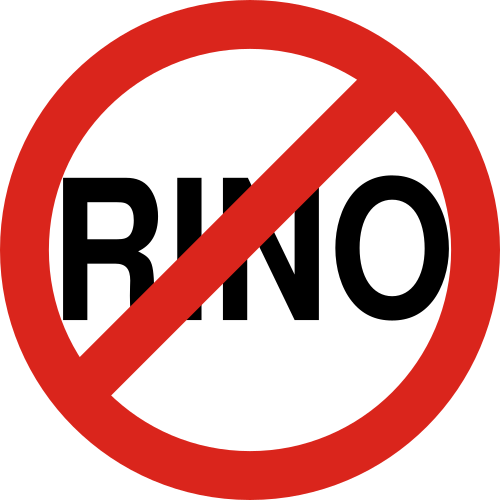
Buttons featuring a red slash through an image of a rhinoceros were spotted in the New Hampshire State House as early as 1992. In 1993, future California Republican Assembly President Celeste Greig distributed buttons featuring a red slash over the word RINO to express opposition to Los Angeles mayor Richard Riordan. The term came into widespread usage during subsequent election cycles.
Usage
During Republican primary campaign season, some conservative organizations target Republicans who fail to adopt their stances by referring to them as RINOs. A "RINO Hunters Club" formed by the National Federation of Republican Assemblies has taken political action against those they considered RINOs. The fiscally conservative 501(c)4 organization Club for Growth started the "RINO Watch" list to monitor "Republican office holders around the nation who have advanced egregious anti-growth, anti-freedom or anti-free market policies"; other conservative groups published similar lists.
Donald Trump
Donald Trump and his closest supporters have frequently used the term to describe anyone within the Republican Party he deems to be disloyal. During the 2020 presidential election in the United States, Donald Trump used the term to refer to Georgia governor Brian Kemp and Georgia Secretary of State Brad Raffensperger, due to their refusal to challenge the election results in Georgia during his attempts to overturn the 2020 United States presidential election. He also used the term to refer to Maryland governor Larry Hogan in a tweet, as well as House and Senate Republicans who either voted to impeach and convict him during his second impeachment following the January 6 United States Capitol attack or who voted for the Bipartisan Infrastructure Bill supported by President Joe Biden. Recently, the term has been used to describe Republican critics of President Donald Trump, with Trump himself tweeting that Congressional Republicans who recognized Joe Biden as the winner of the 2020 US Presidential election are RINOs. Some Republicans critical of Trump occasionally used the epithet to describe Trump himself, due to his history as a registered Democrat.
After former Secretary of State Colin Powell died in 2021, Trump described him as a "classic RINO". After former Vice President Dick Cheney endorsed Democrat Kamala Harris in the 2024 presidential election, Trump referred him as an "irrelevant RINO".
After Tom Emmer failed to get the nomination to Speaker of the House, Trump blasted him as a RINO before the press and on Truth Social. Four hours after the failed vote, Emmer withdrew the nomination and lost.
Similar terms
The concept of being an inauthentic member of the Republican Party by not representing its more conservative faction is a recurring theme in party history.
Me-too Republicans
In the 1930s and 1940s, the term Me-too Republicans described those running on a platform of agreeing with the Democratic Party, proclaiming only minor or moderating philosophical differences. An example is two-time presidential candidate Thomas E. Dewey, who ran against the popular Franklin D. Roosevelt and his successor Harry Truman. Dewey did not oppose Roosevelt's New Deal programs altogether, but merely campaigned on the promise that Republicans would run them more efficiently and less corruptly.
From 1936 to 1976, the more centrist members of the Republican Party frequently won the national nomination with candidates such as Alf Landon, Wendell Willkie, Thomas E. Dewey, Dwight D. Eisenhower, and Gerald Ford. The mainstream of the Republican Party was generally supportive of the New Deal. In the 1950s, conservatives such as Robert A. Taft and Barry Goldwater, who rallied against "me-too Republicans", were considered outside of the mainstream; serious consideration was given to leaving the then GOP and forming a new ultra-conservative party in coalition with the "states' rights" Democrats of the South.
Nixonians and Rockefeller Republicans
In the 1960s and 1970s, Republicans considered liberal on economic issues but hawkish on foreign policy and social issues were sometimes called "Nixonian", or "Rockefeller Republicans".
Gypsy moth Republican
In the 1980s, the term gypsy moth Republican described Republicans from the Northeast and Midwest who voted against the Ronald Reagan administration's proposed cuts in aid to economically distressed people, contrasting with boll weevil Democrats, who voted for these cuts. The gypsy moth is an invasive species destructive to trees in the Northeastern United States.
Cuckservative
In 2015 the term cuckservative, a portmanteau of cuckold and conservative, was popularized on the online forum 4chan, and embraced by both internet trolls and the nativist alt-right. The metaphorical "" is represented in a genre of pornography as a masochistic husband who allows his wife to have sex with a stronger man, thereby participating in his own symbolic emasculation. In white supremacist vernacular, the term is an accusation of yielding to non-white interests on issues such as immigration or modern display of the Confederate flag; however, the term gained use (with some controversy) by more mainstream conservatives to denounce Republicans whose compromises included vote trading, rhetorical restraint in deference to donors, cooperation with Democrats on any particular initiative, or attempting to court voters by making appeals to supposedly liberal ideals.
References
References
- Popik, Barry. "RINO (Republican In Name Only)". Big Apple Corner.
- McFedries, Paul. "RINO". Logophilia Limited.
- "RINO – Neologisms".
- Landrigan, Kevin. (December 16, 1992). "Spirou's 'commitments' could disappear in February". Terrence Williams.
- Nichols, John. (August 27, 2004). "Republican Cannibals: Hunting for RINOs". [[The Nation]].
- Brooks, David. (October 22, 2006). "Thinning the Herd".
- Cillizza, Chris. (November 17, 2020). "Analysis: How this Republican became the most hated man in his party".
- "Bill Weld: Donald Trump is a RINO - Washington Times".
- (July 19, 2016). "Trump: RINO or Gray Rhino? {{!}} HuffPost null".
- Garrison, Joey. (October 18, 2021). "'Country before self ... before all else': US presidents remember Colin Powell as American hero".
- Benen, Steve. (October 19, 2021). "Trump admonishes Colin Powell the day after his death".
- Jackson, David. "Amid tributes to Colin Powell, Donald Trump disparages former secretary of state".
- Irwin, Lauren. (September 7, 2024). "Trump slams Dick Cheney as 'irrelevant' after he backed Harris".
- Singman, Brooke. (2023-10-24). "Trump blasts Emmer as 'globalist RINO,' warns Republicans it would be 'tragic mistake' to elect him speaker".
- (2023-10-24). "Tom Emmer Flames Out Hours After Winning GOP Speaker Nomination".
- Shapiro, Walter. (October 29, 2002). "Suspense, contrast missing in election countdown". [[USA Today]].
- Blankley, Tony. (October 25, 2006). "Assessing Last Week's Column". [[Human Events]].
- Smith, Richard Norton. "Roosevelt and Reagan: Eternal Optimists". [[Gleaves Whitney#Hauenstein Center for Presidential Studies.
- (1936). "FDR 'Let Me Warn You'".
- (November 10, 1986). "Farewell to a Quartet of Kings of the Hill". [[Time, Inc.]].
- Perlstein, Rick. (March 21, 2001). "Before the Storm". [[Hill and Wang]].
- (2004). "Bill's Run: Overview: Mommy, What's a RINO?". PBS.
- McManus, Michael J.. (September 21, 1981). "'Gypsy Moth Republicans' ". [[Bangor Daily News]].
- Goddard, Taegan. "Gypsy moth".
- "Gypsy Moth". Wisconsin Department of Agriculture, Trade and Consumer Protection.
- . (August 7, 2015). ["Getting Cucky: A Brief Primer On The Radical Right's Newest 'Cuckservative' Meme"](https://www.splcenter.org/hatewatch/2015/08/07/getting-cucky-brief-primer-radical-right%E2%80%99s-newest-%E2%80%98cuckservative%E2%80%99-meme). *Southern Poverty Law Center*.
- Kovacs, Kasla. (February 14, 2017). "What Is A Cuckservative? Alt-Right Insult Used By White Nationalists To Describe The Republican Establishment".
- Nordlinger, Jay. (February 19, 2017). "What Is a Conservative?".
- Heer, Jeet. (July 26, 2015). "Conservatives Are Holding a Conversation About Race". New Republic.
- (August 3, 2015). "The GOP crack-up continues".
- (July 27, 2015). "Behind The Racist Hashtag That Is Blowing Up Twitter".
- Weigel, David. (July 29, 2015). "'Cuckservative' – the conservative insult of the month, explained". The Washington Post.
- Rappeport, Alan. (August 13, 2015). "From the Right, a New Slur for G.O.P. Candidates". New York Times.
- Yuhas, Alan. (August 13, 2015). "'Cuckservative': the internet's latest Republican insult hits where it hurts". The Guardian.
This article was imported from Wikipedia and is available under the Creative Commons Attribution-ShareAlike 4.0 License. Content has been adapted to SurfDoc format. Original contributors can be found on the article history page.
Ask Mako anything about Republican in name only — get instant answers, deeper analysis, and related topics.
Research with MakoFree with your Surf account
Create a free account to save articles, ask Mako questions, and organize your research.
Sign up freeThis content may have been generated or modified by AI. CloudSurf Software LLC is not responsible for the accuracy, completeness, or reliability of AI-generated content. Always verify important information from primary sources.
Report