From Surf Wiki (app.surf) — the open knowledge base
Renaissance in Poland
none
none
The Renaissance in Poland ( , ; ) lasted from the late 15th to the late 16th century and is widely considered to have been the Golden Age of Polish culture. Ruled by the Jagiellonian dynasty, the Crown of the Kingdom of Poland (from 1569 part of the Polish–Lithuanian Commonwealth) actively participated in the broad European Renaissance. The multinational Polish state experienced a period of cultural growth thanks in part to a century without major wars, aside from conflicts in the sparsely populated eastern and southern borderlands. The Reformation spread peacefully throughout the country (giving rise to the Polish Brethren), and living conditions improved, cities grew, and exports of agricultural products enriched the population, especially the nobility (szlachta), who gained dominance in the new political system of Golden Liberty.
Overview
The Renaissance movement, whose influence originated in Italy, spread throughout Poland roughly in the 15th and 16th century. Many Italian artists arrived in the country welcomed by Polish royalty, including Francesco Fiorentino, Bartolomeo Berecci, Santi Gucci, Mateo Gucci, Bernardo Morando, Giovanni Battista di Quadro and others, including thinkers and educators such as Filip Callimachus, merchants such as the Boner family and the Montelupi family, and other prominent personalities who immigrated to Poland since the late 15th century in search of new opportunities. Most of them settled in Kraków, the Polish capital until 1611.
The Renaissance values of the dignity of man and power of his reason were applauded in Poland. Many works were translated into Polish and Latin from classical Latin, Greek and Hebrew, as well as contemporary languages like Italian.
_(cropped).jpg)
Young Poles, especially sons of nobility (szlachta), who graduated from any one of over 2,500 parish schools, gymnasiums and several academies (Cracow Academy, Wilno Academy, Zamość Academy), often traveled abroad to complete their education. For example, printing process, Latin and art with the syllabic versification in poetry, especially in Belarus and Ukraine (through Kyiv-Mohyla Academy), from where it was transmitted to Russia (Duchy of Moscow), The first four printed Cyrillic books in the world were published in Kraków, in 1491, by printer Szwajpolt Fiol.
Art

Incentives for development of art and architecture were many. King Sigismund I the Old, who ascended to the throne in 1507, was a sponsor of many artists, and began a major project – under Florence architect Bartolommeo Berrecci – of remaking the ancient residence of the Polish kings, the Wawel Castle, into a modern Renaissance residence. Sigismund's zeal for Renaissance was matched not only by his son, Sigismund II Augustus, but by many wealthy nobles and burghers who also desired to display their wealth, influence and cultural savvy. In 1578, chancellor Jan Zamoyski begun construction of the ideal Renaissance city, sponsoring the creation of Zamość (a city named after him), which soon became an important administrative, commercial and educational town of Renaissance Poland. The two largest contemporary Polish cities – Kraków (which attracted many Italian architects) and Danzig (which attracted mostly architects from Germany and the Netherlands) – likely gained the most in the era, but many other cities also spotted new Renaissance constructions.
Renaissance painting was introduced in Poland by many immigrant artists, such as Lucas Cranach, Hans Dürer and Hans von Kulmbach, and practiced by such Polish painters as Marcin Kober (a court painter of king Stefan Batory). The works of the portraitists created an impressive gallery, particularly representative of those who could afford to be immortalized in them.

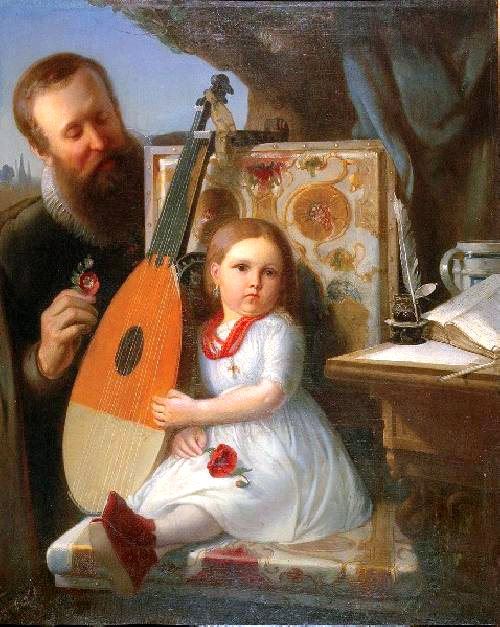
The centre of musical culture was the royal residence at Kraków, where the royal court welcomed many foreign and local performers. The most significant works of the Renaissance in Poland include compositions, usually for lute and organs, both vocal and instrumental, from dances, through polyphonic music, to religious oratorios and masses. In 1540 by Jan of Lublin released the Tablature, in which he collected most known European organ pieces. Nicolaus Cracoviensis (Mikołaj of Kraków) composed many masses, motets, songs, dances and preludes. Mikołaj Gomółka was the author of musical rendition of Kochanowski's poems (Melodies for the Polish Psalter). The most famous Polish composer was Wacław z Szamotuł, recognized as one of the outstanding Renaissance composers.
Notable Polish Renaissance artists
Among the most prominent Polish Renaissance writers and artists, whose accomplishments have become a salient part of Polish curriculum are poets Mikołaj Rej, Jan Kochanowski, Szymon Szymonowic, Mikołaj Sęp Szarzyński, Andrzej Krzycki and Johannes Dantiscus, writer Łukasz Górnicki, composer Wacław z Szamotuł, composer and singer Mikołaj Gomółka, sculptor and painters Stanisław Samostrzelnik and Marcin Kober. The artists and architects who settled into Poland and had achieved considerable recognition for their work in the country are: Hans Dürer, Hans (Süss) von Kulmbach, Mateo Gucci, Santi Gucci, Bartolomeo Berecci, Bernardo Morando, Giovanni Battista di Quadro and others.
Literature
The first printing press was set up in Kraków in 1473 by the German printer Kasper Straube of Bavaria. Between 1561 and 1600, seventeen printing houses in Poland published over 120 titles a year, with an average edition of 500 copies. The first complete translation of the Bible into Polish was made in 1561 by (Leopolita's Bible). About that time, the first Polish orthographic dictionary was published (by Stanisław Murzynowski, 1551); grammars and dictionaries also proliferated. The Polish Renaissance was bilingual, the ''szlachta'''s speech being a mixture of Polish and Latin, and various authors oscillating among Polish, Latin, and a mixture of the two (macaronic language).
Literature progressed beyond being dominated by religious themes. They were still present, as seen in numerous bible translations, the most famous being the Wujek's Bible by Jakub Wujek, published in 1599. The nobility, however, cared about more than just religious themes, and the works of Polish renaissance reflected their material and spiritual values (see sarmatism). Contemporary poetry extolled the virtue of manorial life. For example, Rej celebrated life and the position of country's noble, while Kochanowski wrote about the pleasures and beauty of life in the countryside, surrounded by nature. Literary forms varied, from ode, pastorals and sonnets to elegy, satire and romance.
Science and technology
Scientific scholars of the period include Jan Łaski (John Lasco), evangelical reformer, Maciej of Miechów (Maciej Miechowita), writer and university teacher, Nicolaus Copernicus, astronomer known in Polish as Mikołaj Kopernik, Wawrzyniec Grzymała Goślicki (Laurentius Grimaldius Gosliscius), political thinker and philosopher; Marcin Kromer, writer and geographer; Andrzej Frycz Modrzewski, writer and philosopher; Piotr Skarga, Jesuit political reformer; Józef Struś, doctor, scientist, mayor of Poznań; and many others.
Architectural trends and periods
Polish Renaissance architecture is divided into three main periods. The first period (1500–1550) is often called "Italian", because most of the Renaissance buildings in this time were built by Italian architects invited by Polish nobility mainly from Florence. During the second period (1550–1600), Renaissance style became common, and included influences from Dutch version of the Renaissance as well as beginnings of the Mannerist style. In the third period (1600–1650), Mannerism became popular, with first notable examples of Baroque (see also, Baroque in Poland).
First period

In 1499 Wawel Castle was partially consumed by fire. King Alexander Jagiellon in 1504 appointed Eberhard Rosemberger as the main architect for the renovation. Later, he was replaced by Italian-born Francesco Florentino and, after his death, by Bartolomeo Berrecci and by Benedykt of Sandomierz. As a result of their work the Royal Castle was transformed into a Renaissance residence in Florentine style. In the same period other castles and residences were built or rebuilt in the new style, including Drzewica (built in 1527–1535), Szydłowiec (rebuilt 1509–1532), Ogrodzieniec (rebuilt 1532–1547) and most notably, Pieskowa Skała, rebuilt 1542–1580.
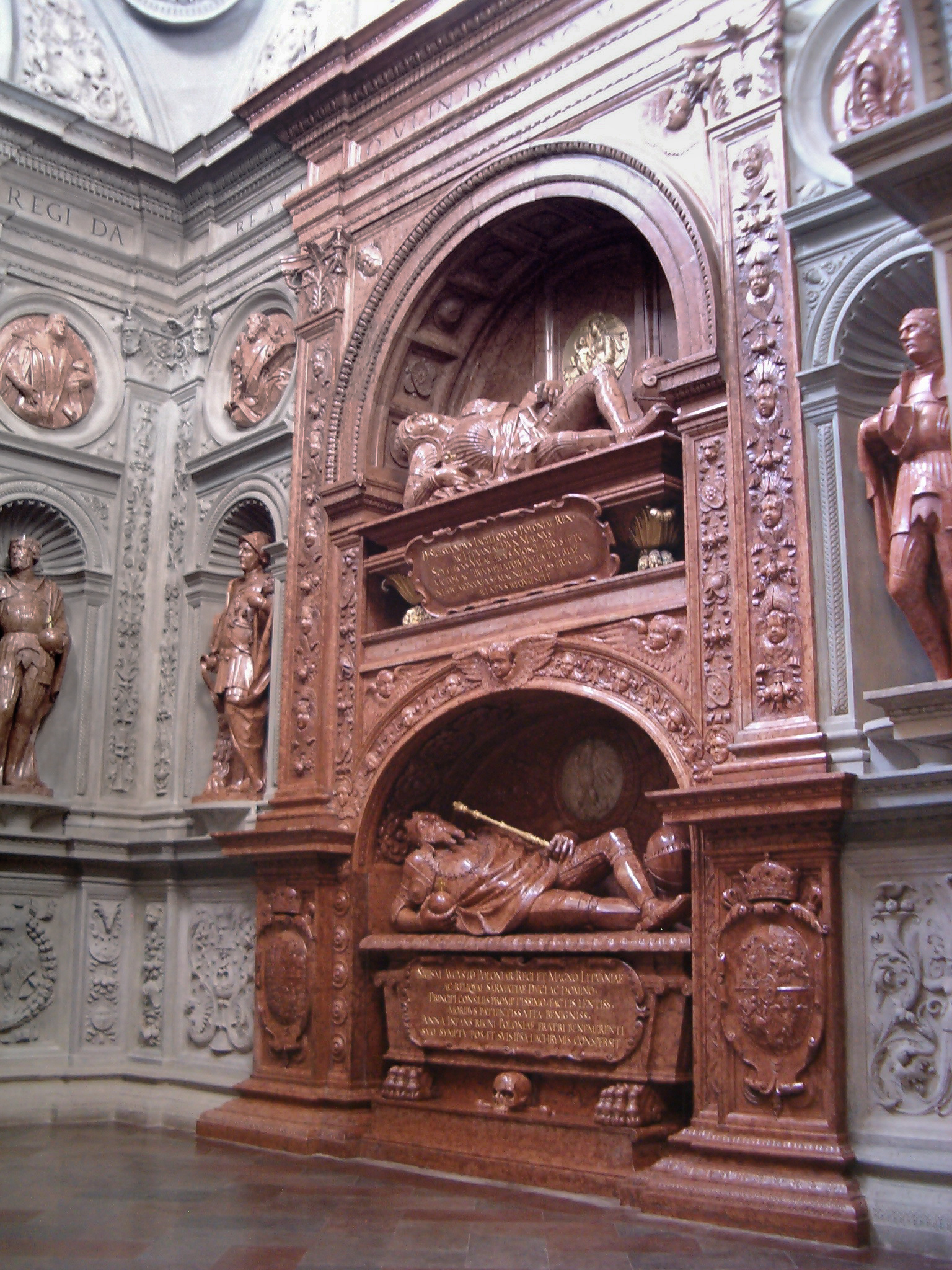
In the first period of the Polish Renaissance, churches were still build mostly in the Gothic style. In this time, only new chapels surrounding the old churches were sometimes built in the new style. The most prominent of them, the Sigismund's Chapel at the Wawel Cathedral, was built in 1519–33 by Bartolomeo Berecci.
Second period
.jpg)
The Renaissance style became most common throughout Poland in its second period. In the northern part of the country, especially in Pomerania and in Danzig (Gdańsk), there worked a large group of Dutch-born artists. Renaissance style in other parts of Poland varied under local conditions, producing different substyles in each region. Also, some elements of the new Mannerist style were present. Architecture of this period is divided into three regional substyles: "Italian" – mostly in the southern part of Poland, with the most famous artist there being Santi Gucci, the "Dutch" – mostly in Pomerania, and the "Kalisz–Lublin style" () (or the "Lublin Renaissance") in central Poland – with most notable examples built in Kalisz, Lublin, and Kazimierz Dolny.
All over Poland, new castles were constructed, bearing the new quadrilateral shape enclosing a courtyard, with four towers at the corners. Prominent examples include: the castle at Płakowice (16th century), the castle at Brzeg, (rebuilt from a Gothic stronghold in 1544–60), the castle at Niepołomice (rebuilt after a fire in 1550–71), the castle at Baranów Sandomierski (built in 1591–1606 by Santi Gucci), and the castle at Krasiczyn.
Many cities erected new buildings in the Renaissance style. New Cloth Hall (Sukiennice) in Kraków was built. City halls were built or rebuilt in: Tarnów, Sandomierz, Chełm (demolished) and in Poznań. Also, entire towns were often redesigned. Examples of Renaissance urban planning survived into modern times in Szydłowiec and Zamość.

Examples of Pomeranian Renaissance which developed under the influence of Northern Europe rather than Italy were: Green Gate in Gdańsk (built in 1564–1568 by Hans Kramer), Upland Gate in Gdańsk (finished by Willem van den Blocke in 1588), Great Arsenal in Gdańsk (built in 1602–1606 by Anthonis van Obbergen), and the Old City Hall in Gdańsk (built in 1587–1595, probably by Anthonis van Obbergen).
Characteristic laicization of life during Renaissance and Reformation resulted in only minor development in sacral architecture. Mainly chapels were being built in the Renaissance style, but some churches were also rebuilt including: Cathedral in Płock (rebuilt after fire by architects Bernardino de Gianotis, Cini, Filippo di Fiesole and later again by Giovanni Battista di Quadro); and, the Collegiate in Pułtusk (rebuilt by John Batista of Venice). Only a few new churches were founded, such as the collegiate church of St. Thomas in Zamość.
Third period

A fire at Wawel and the moving of the capital to Warsaw in 1596 halted the development of Renaissance in Kraków, as well as in Danzig. Also, the rising power of the Jesuits and the Counterreformation gave impetus to the development of Mannerist architecture and a new style – the Baroque (see also, Baroque in Poland). The most important example of the ascending Mannerist architecture in Poland is a complex of houses in Kazimierz Dolny and in Zamość.
Notes
References
- "Montelupi". encyklopedia.interia.pl.
- [[Michael J. Mikoś]], ''Polish Renaissance Literature: An Anthology''. Ed. Michael J. Mikoś. Columbus, Ohio/Bloomington, Indiana: Slavica Publishers. 1995. {{ISBN. 978-0-89357-257-0 [http://staropolska.pl/ang/renaissance/Mikos_renaissance/Cultural_r.html Cultural Background]
- heliocentric]] theory of the universe, [[Maciej of Miechów]], author of ''Tractatus de duabus Sarmatis...'' – the most accurate up to date [[geography. geographical]] and [[ethnography. ethnographical]] account of [[Eastern Europe]]; [[Bernard Wapowski]], a [[cartographer]] whose maps of that region appeared in [[Ptolemy]]'s ''[[Geography (Ptolemy). Geography]]''; [[Marcin Kromer]] who in his ''De origine et rebus gestis Polonorum libri...'' described both the [[history of Poland. history]] and [[geography of Poland]]; [[Andrzej Frycz Modrzewski]], a philosopher concerned with [[governance]]; [[Mikołaj Rej]] who has popularized the use of [[Polish language. Polish]] in poetry; and [[Jan Kochanowski]], whose poems in Polish elevated him to the ranks of the most prominent [[Polish people. 978-0-89357-257-0 [http://staropolska.pl/ang/renaissance/Mikos_renaissance/Literary_r.html Literary Background]
- "Mikołaj Rej i Jan Kochanowski - najwybitniejsi przedstawiciele polskiego odrodzenia".
- Elaine Rusinko. (2003). "Straddling borders: literature and identity in Subcarpathian Rus". University of Toronto Press.
- Kamenskii, Aleksandr B.. (1997). "The Russian Empire in the Eighteenth Century: Searching for a Place in the World". M.E. Sharpe.
- (2007). "LACONA 6 proceedings".
- Joseph Slabey Rouček. (1949). "Slavonic encyclopaedia". Philosophical Library.
- (1989). "Renaissance Culture in Poland: The Rise of Humanism, 1470-1543". Cornell University Press.
- (2012). "Acta Conventus Neo-Latini Upsaliensis". BRILL.
- (14 December 2016). "Made in Poland: The Women and Men Who Changed the World". Xlibris Corporation.
- Harald Busch, Bernd Lohse, Hans Weigert, ''Baukunst der Renaissance in Europa. Von Spätgotik bis zum Manierismus'', Frankfurt af Main, 1960
Wilfried Koch, ''Style w architekturze'', Warsaw 1996
Tadeusz Broniewski, ''Historia architektury dla wszystkich'' Wydawnictwo Ossolineum, 1990
Mieczysław Gębarowicz, ''Studia nad dziejami kultury artystycznej późnego renesansu w Polsce'', Toruń 1962 - "PIESKOWA SKAŁA – CASTLE".
- (December 2003). "The Fall of Stara Ves". Infinity.
- "Odkrywamy Lublin: Szlakiem renesansu".
- "KRASICZYN – THE CASTLE AND PARK COMPLEX".
- "THE COMPLEX OF THE COLLEGIATE CHURCH (CURRENTLY HAVING THE STATUS OF A CATHEDRAL) OF THE RESURRECTION OF OUR LORD AND OF ST THOMAS THE APOSTLE".
- "Lubelskie".
This article was imported from Wikipedia and is available under the Creative Commons Attribution-ShareAlike 4.0 License. Content has been adapted to SurfDoc format. Original contributors can be found on the article history page.
Ask Mako anything about Renaissance in Poland — get instant answers, deeper analysis, and related topics.
Research with MakoFree with your Surf account
Create a free account to save articles, ask Mako questions, and organize your research.
Sign up freeThis content may have been generated or modified by AI. CloudSurf Software LLC is not responsible for the accuracy, completeness, or reliability of AI-generated content. Always verify important information from primary sources.
Report