From Surf Wiki (app.surf) — the open knowledge base
Religious violence in India
none

none
Religious violence in India includes acts of violence by followers of one religious group against followers and institutions of another religious group, often in the form of rioting. Religious violence in India has generally involved Hindus and Muslims.
Despite the secular and religiously tolerant Constitution of India, broad religious representation in various aspects of society including the government, the active role played by autonomous bodies such as National Human Rights Commission of India and National Commission for Minorities, and the ground-level work being done by non-governmental organisations, sporadic and sometimes serious acts of religious violence tend to occur as the root causes of religious violence often run deep in history, religious activities, and politics of India.
Along with domestic organisations, international human rights organisations such as Amnesty International and Human Rights Watch publish reports on acts of religious violence in India. From 2005 to 2009, an average of 130 people died every year from communal violence, or about 0.01 deaths per 100,000 population. The state of Maharashtra reported the highest total number of religious violence related fatalities over that five-year period, while Madhya Pradesh experienced the highest fatality rate per year per 100,000 population between 2005 and 2009. Over 2012, a total of 97 people died across India from various riots related to religious violence.
The US Commission on International Religious Freedom classified India as Tier-2 in persecuting religious minorities, the same as that of Iraq and Egypt. In a 2018 report, USCIRF charged Hindutva groups for their campaign to "Saffronise" India through violence, intimidation, and harassment against non-Hindus. Approximately one-third of state governments enforced anti-conversion and/or anti-cattle slaughter laws against non-Hindus, and mobs engaged in violence against Muslims whose families have been engaged in the dairy, leather, or beef trades for generations, and against Christians for proselytizing. "Gau Rakshak" (Cow Protection) lynch mobs killed at least 10 victims in 2017.
Many historians argue that religious violence in independent India is a legacy of the policy of divide and rule pursued by the British colonial authorities during the era of Britain's control over the Indian subcontinent, in which local administrators pitted Hindus and Muslims against one another, a tactic that eventually culminated in the partition of India.
Ancient India
Ancient text Ashokavadana, a part of the Divyavadana, mention a non-Buddhist in Pundravardhana drew a picture showing the Buddha bowing at the feet of Nirgrantha Jnatiputra (identified with Mahavira, 24th Tirthankara of Jainism). On complaint from a Buddhist devotee, Ashoka, the Maurya Emperor of India, issued an order to arrest him, and subsequently, another order to kill all the Ājīvikas in Pundravardhana. Around 18,000 followers of the Ajivika sect were executed as a result of this order. Sometime later, another Nirgrantha follower in Pataliputra drew a similar picture. He was burnt alive with his entire family in their house under the orders of Ashoka. He also announced an award of one dinara (silver coin) for the head of a Nirgrantha. According to Ashokavadana, as a result of this order, his own brother, Vitashoka, was mistaken for a heretic and killed by a cowherd. Their ministers advised that "this is an example of the suffering that is being inflicted even on those who are free from desire" and that he "should guarantee the security of all beings". After this, Ashoka stopped giving orders for executions. According to K. T. S. Sarao and Benimadhab Barua, stories of persecutions of rival sects by Ashoka appear to be a clear fabrication arising out of sectarian propaganda.
The Divyavadana (divine stories), an anthology of Buddhist mythical tales on morals and ethics, many using talking birds and animals, was written in about 2nd century AD. In one of the stories, the razing of stupas and viharas is mentioned with Pushyamitra. This has been historically mapped to the reign of Emperor Pushyamitra of the Shunga Empire about 400 years before Divyavadana was written. Archeological remains of stupas have been found in Deorkothar that suggest deliberate destruction, conjectured to be one mentioned in Divyavadana about Pushyamitra. It is unclear when the Deorkothar stupas were destroyed, and by whom. The fictional tales of Divyavadana is considered by scholars
Medieval India
There is a tendency among some historians to view the Muslim conquests and Muslim empires as a prolonged period of violence against Hindu culture, with Will Durant calling the Muslim conquest of India "probably the bloodiest story in history."
Following his quest for Jihad against the infidels of India, Mahmud of Ghazni not only ruined the Somnath temple and plundered its treasures but also killed every devotee present in the town.
Mughal Empire
The reign of Aurangzeb (1658–1707) witnessed one of the strongest campaigns of religious violence in the Mughal Empire's history. Aurangzeb is a controversial figure in modern India, often remembered as a "vile oppressor of Hindus". During his rule Aurangzeb expanded the Mughal Empire, conquering much of southern India through long bloody campaigns against non-Muslims. He forcibly converted Hindus to Islam and destroyed Hindu temples.
Colonial Era
Goa Inquisition (1560–1774)
Main article: Goa Inquisition, Portuguese India
The first inquisitors, Aleixo Dias Falcão and Francisco Marques, established themselves in what was formerly the king of Goa's palace, forcing the Portuguese viceroy to relocate to a smaller residence. The inquisitor's first act was forbidding Hindus from the public practice of their faith through fear of imprisonment. Sephardic Jews living in Goa, many of whom had fled the Iberian Peninsula to escape the excesses of the Spanish Inquisition to begin with, were also targeted. During the Goa Inquisition, described as "contrary to humanity" by anti-clerical Voltaire, conversion efforts were practiced en masse and tens of thousands of Goan people converted to Catholicism between 1561 and 1774. The few records that have survived suggest that around 57 were executed for their religious crime, and another 64 were burned in effigy because they had already died in jail before sentencing.
The adverse effects of the inquisition forced hundreds of Hindus, Muslims and Catholics to escape Portuguese hegemony by migrating to other parts of the subcontinent. Though officially repressed in 1774, it was nominally reinstated by Queen Maria I in 1778.
Indian Rebellion of 1857
Main article: Indian Rebellion of 1857
In 1813, the East India Company charter was amended to allow for government sponsored missionary activity across British India. The missionaries soon spread almost everywhere and started criticizing Hindu and Islamic practices like Sati and child marriage, as well as promoting Christianity. Many officers of the British East India Company, such as Herbert Edwardes and Colonel S.G. Wheeler, openly preached to the sepoys. Such activities caused a great deal of resentment and a fear of forced conversions among Indian soldiers of the company and civilians alike.
There was a perception that the company was trying to convert Hindus and Muslims to Christianity, which is often cited as one of the causes of the revolt. The revolt is considered by some historians as a semi-national and semi-religious war seeking independence from British rule though Saul David questions this interpretation. The revolt started, among the Indian sepoys of British East India Company, when the British introduced new rifle cartridges, rumoured to be greased with pig and cow fat—an abhorrent concept to Muslim and Hindu soldiers, respectively, for religious reasons. 150,000 Indians and 6,000 Britons were killed during the 1857 rebellion.{{Citation |last=Marshall |first=P. J. |title=The Cambridge Illustrated History of the British Empire |page=50 |year=2001 |editor-last=P. J. Marshall
Partition of Bengal (1905)
The British colonial era, since the 18th century, portrayed and treated Hindus and Muslims as two divided groups, both in cultural terms and for the purposes of governance. The British favoured Muslims in the early period of colonial rule to gain influence in Mughal India, but underwent a shift in policies after the 1857 rebellion. A series of religious riots in the late 19th century, such as those of 1891, 1896 and 1897 religious riots of Calcutta, raised concerns within British Raj. The rising political movement for independence of India, and colonial government's administrative strategies to neutralize it, pressed the British to make the first attempt to partition the most populous province of India, Bengal.
Bengal was partitioned by the British colonial government, in 1905, along religious lines—a Muslim majority state of East Bengal and a Hindu majority state of West Bengal. The partition was deeply resented, seen by both groups as evidence of British favoritism to the other side. Waves of religious riots hit Bengal through 1907. The religious violence worsened, and the partition was reversed in 1911. The reversal did little to calm the religious violence in India, and Bengal alone witnessed at least nine violent riots, between Muslims and Hindus, in the 1910s through the 1930s.
Malabar rebellion (1921)
Main article: Malabar rebellion
Moplah Rebellion was an anti-Jenmi rebellion conducted by the Muslim Mappila community of Malabar District in 1921. Inspired by the Khilafat movement and the Karachi resolution; Moplahs murdered, pillaged, and forcibly converted thousands of Hindus. 100,000 Hindus{{cite book
According to one view, the reasons for the Moplah rebellion was religious revivalism among the Muslim Moplahs, and hostility towards the landlord Hindu Nair, Nambudiri and Jenmi community and the British administration that supported the latter. Adhering to view, British records call it a British-Muslim revolt. The initial focus was on the government, but when the limited presence of the government was eliminated, Moplahs turned their full attention on attacking Hindus. Mohommed Haji was proclaimed the Caliph of the Moplah Khilafat and flags of Islamic Caliphate were flown. Ernad and Walluvanad were declared Khilafat kingdoms.
Partition of British India (1947)
Main article: Partition of India
Direct Action Day, which started on 16 August 1946, left approximately 3,000 Hindus dead and 17,000 injured.
After the Indian Rebellion of 1857, the British colonial government followed a divide-and-rule policy, exploiting existing differences between communities, to prevent similar revolts from taking place. In that respect, Indian Muslims were encouraged to forge a cultural and political identity separate from the Hindus. In the years leading up to Independence, Mohammad Ali Jinnah became increasingly concerned about minority position of Islam in an independent India largely composed of a Hindu majority.
Although a partition plan was accepted, no large population movements were contemplated. As India and Pakistan become independent, 14.5 million people crossed borders to ensure their safety in an increasingly lawless and communal environment. With British authority gone, the newly formed governments were completely unequipped to deal with migrations of such staggering magnitude, and massive violence and slaughter occurred on both sides of the border along communal lines. Estimates of the number of deaths range around roughly 500,000, with low estimates at 200,000 and high estimates at one million.
Modern India
Partition of India
Large-scale religious violence and riots have periodically occurred in India since its independence from British colonial rule. The aftermath of the Partition of India in 1947 to create a separate Islamic state of Pakistan for Muslims, saw large scale religious violence and bloodshed throughout the nation. According to Government of India's estimates, Around 80 lakh Hindus and Sikhs have moved from Pakistan to India and around 75 lakh Muslims have moved from India to Pakistan as refugees. An estimated one million people have been killed in the violence. Since then, India has witnessed sporadic large-scale violence sparked by underlying tensions between sections of the Hindu and Muslim communities. These conflicts also stem from the ideologies of hardline right-wing groups versus Islamic fundamentalists and prevalent in certain sections of the population. Since independence, India has always maintained a constitutional commitment to secularism. The major incidences include the 1961 Jabalpur riots, 1969 Gujarat riots, 1984 Sikh massacre, the 1989 Bhagalpur riots, 1989 Kashmir violence, Godhra train burning, 2002 Gujarat riots, 2013 Muzaffarnagar riots and 2020 Delhi riots.
Jabalpur riots (1961)
Main article: 1961 Jabalpur riots
The 1961 Jabalpur Riots were the first major-scale riots between Hindus and Muslims in post-Partition India, which erupted in the city of Jabalpur in the state of Madhya Pradesh. This riot was linked to the emergence of a small class of successful Muslim entrepreneurs who created a new economic rivalry between Hindu and Muslim communities.
These riots shook Jawaharlal Nehru as he never expected communal riots of such intensity in independent India. Hindutva organisations including the ABVP and the Rashtriya Swayamsevak Sangh played a major role in this riot. Officially 55 were killed, though according to unofficial accounts, 200 were killed. Nehru responded by lambasting the Bhopal Congress government which was being headed by Chief Minister Kailash Nath Katju. He angrily noted that Congress leaders were found to be 'sitting inside their houses like purdah ladies' during riots.
Gujarat communal riots (1969)
Main article: 1969 Gujarat riots
Religious violence broke out between Hindus and Muslims during September–October 1969, in Gujarat. It was the most deadly Hindu-Muslim violence since the 1947 partition of India.
The violence included attacks on Muslim chawls by their Dalit neighbours. The violence continued over a week, then the rioting restarted a month later. Some 660 people were killed (430 Muslims, 230 Hindus), 1074 people were injured and over 48,000 lost their property.
Anti-Sikh riots/massacre (1984)
Main article: 1984 anti-Sikh riots
In the 1970s, Sikhs in Punjab had sought autonomy and complained about domination by the Hindu. The Indira Gandhi government arrested thousands of Sikhs for their opposition and demands particularly during Indian Emergency. In Indira Gandhi's attempt to "save democracy" through the Emergency, India's constitution was suspended, 140,000 people were arrested without due process, of which 40,000 were Sikhs.
After the Emergency was lifted, during elections, she supported Jarnail Singh Bhindranwale, Jathedar (leader) of the Damdami Taksal, in an effort to undermine the Akali Dal, the largest Sikh political party. However, Bhindranwale began to oppose the central government and moved his political base to the Darbar Sahib (Golden temple) in Amritsar, demanding creation on Punjab as a new country. In June 1984, under orders from Indira Gandhi, the Indian Army attacked the Golden temple with Vijayanta tanks and armoured vehicles, due to the presence of Sikh Khalistanis armed with weapons inside. Thousands of Sikhs died during the attack. In retaliation for the storming of the Golden temple, Indira Gandhi was assassinated on 31 October 1984 by two Sikh bodyguards.
The assassination provoked mass rioting against Sikh. During the 1984 anti-Sikh pogroms in Delhi, government and police officials aided Indian National Congress party worker gangs in "methodically and systematically" targeting Sikhs and Sikh homes. As a result of the pogroms 10,000–17,000 were burned alive or otherwise killed, Sikh people suffered massive property damage, and at least 50,000 Sikhs were displaced.
The 1984 riots fueled the Sikh insurgency movement. In the peak years of the insurgency, religious violence by separatists, government-sponsored groups, and the paramilitary arms of the government was endemic on all sides. Human Rights Watch reports that separatists were responsible for "massacre of civilians, attacks upon Hindu minorities in the state, indiscriminate bomb attacks in crowded places, and the assassination of a number of political leaders". Human Rights Watch also stated that the Indian Government's response "led to the arbitrary detention, torture, extrajudicial execution, and enforced disappearance of thousands of Sikhs". The insurgency paralyzed Punjab's economy until peace initiatives and elections were held in the 1990s. Allegations of coverup and shielding of political leaders of Indian National Congress over their role in 1984 riot crimes, have been widespread.
Religious involvement in North-East India militancy
Religion has begun to play an increasing role in reinforcing ethnic divides among the decades-old militant separatist movements in north-east India.
The Christian separatist group National Liberation Front of Tripura (NLFT) has proclaimed bans on Hindu worship and has attacked animist Reangs and Hindu Jamatia tribesmen in the state of Tripura. Some resisting tribal leaders have been killed and some tribal women raped.
According to The Government of Tripura, the Baptist Church of Tripura is involved in supporting the NLFT and arrested two church officials in 2000, one of them for possessing explosives. In late 2004, the National Liberation Front of Tripura banned all Hindu celebrations of Durga Puja and Saraswati Puja.
Anti-Hindu violence

There have been a number of attacks on Hindu temples and Hindus by Muslim militants and Christian evangelists. Prominent among them are the 1998 Chamba massacre, the 2002 fidayeen attacks on Raghunath temple, the 2002 Akshardham Temple attack by Islamic terrorist outfit Lashkar-e-Taiba and the 2006 Varanasi bombings (also by Lashkar-e-Toiba), resulting in many deaths and injuries. Recent attacks on Hindus by Muslim mobs include the Marad massacre.
In August 2000, Swami Shanti Kali, a popular Hindu priest, was shot to death inside his ashram in the Indian state of Tripura. Police reports regarding the incident identified ten members of the Christian terrorist organisation NLFT, as being responsible for the murder. On 4 Dec 2000, nearly three months after his death, an ashram set up by Shanti Kali at Chachu Bazar near the Sidhai police station was raided by Christian militants belonging to the NLFT. Eleven of the priest's ashrams, schools, and orphanages around the state were burned down by the NLFT.
In September 2008, Swami Laxmanananda, a popular regional Hindu Guru was murdered along with four of his disciples by unknown assailants (though a Maoist organisation later claimed responsibility for that{{cite press release | archive-url = https://web.archive.org/web/20121022093039/http://articles.timesofindia.indiatimes.com/2008-10-06/india/27909177_1_maoists-swami-laxmanananda-saraswati-riots | url-status = live | archive-date = 22 October 2012 | access-date = 5 October 2008
Lesser incidents of religious violence happen in many towns and villages in India. In October 2005, five people were killed in Mau in Uttar Pradesh during Muslim rioting, which was triggered by the proposed celebration of a Hindu festival.
On 3 and 4 January 2002, eight Hindus were killed in Marad, near Kozhikode due to scuffles between two groups that began after a dispute over drinking water. On 2 May 2003, eight Hindus were killed by a Muslim mob, in what is believed to be a sequel to the earlier incident. One of the attackers, Mohammed Ashker was killed during the chaos. The National Development Front (NDF), a right-wing militant Islamist organisation, was suspected as the perpetrator of the Marad massacre.
In the 2010 Deganga riots after hundreds of Hindu business establishments and residences were looted, destroyed and burnt, dozens of Hindus were killed or severely injured and several Hindu temples desecrated and vandalised by the Islamist mobs allegedly led by Trinamul Congress MP Haji Nurul Islam. Three years later, during the 2013 Canning riots, several hundred Hindu businesses were targeted and destroyed by Islamist mobs in the Indian state of West Bengal.
Religious violence has led to the death, injuries and damage to numerous Hindus. For example, 254 Hindus were killed in 2002 Gujarat riots out of which half were killed in police firing and rest by rioters. During 1992 Bombay riots, 275 Hindus died.
In October 2018, a Christian personal security officer of an additional sessions judge assassinated his 38-year-old wife and his 18-year-old son for not converting to Christianity.
In October 2020, a 20-year old Nikita Tomar was shot by Tausif, a Muslim, for not converting to Islam and marrying to him. Tausif was imprisoned for life.
Some cases of murder because of blasphemy have also taken place. Kamlesh Tiwari was murdered for his allegedly blasphemous comments on Muhammad in October 2019. A similar case took place in Gujrat in January 2022 where Kishan Bharvad was murdered for making an allegedly blasphemous social media post on Muhammad on the directive of a Muslim cleric. A Hindu man named Nagaraju was murdered by a Muslim man for marrying a Muslim woman.
;Exodus of Kashmiri Hindus Main article: Exodus of Kashmiri Hindus
In the Kashmir region, approximately 300 Kashmiri Pandits were killed between September 1989 to 1990 in various incidents. In early 1990, local Urdu newspapers Aftab and Al Safa called upon Kashmiris to wage jihad against India and ordered the expulsion of all Hindus choosing to remain in Kashmir. Notices were placed on the houses of all Hindus, telling them to leave within 24 hours or die.
Since March 1990, estimates of between 300,000 and 500,000 pandits have migrated outside Kashmir due to persecution by Islamic fundamentalists in the largest case of ethnic cleansing since the partition of India.
Many Kashmiri Pandits have been killed by Islamist militants in incidents such as the Wandhama massacre and the 2000 Amarnath pilgrimage massacre. The incidents of massacring and forced eviction have been termed ethnic cleansing by some observers.
Anti-Muslim violence
Main article: Violence against Muslims in India, Persecution of Muslims}} {{see also, Anti-Mosque campaign in India
The history of modern India has many incidents of communal violence. During the 1947 partition there was religious violence between Muslim-Hindu, Muslim-Sikhs and Muslim-Jains on a gigantic scale. Hundreds of religious riots have been recorded since then, in every decade of independent India. In these riots, the victims have included many Muslims, Hindus, Sikhs, Jains, Christians and Buddhists.
On 6 December 1992, members of the Vishva Hindu Parishad and the Bajrang Dal destroyed the 430-year-old Babri Mosque in Ayodhya—it was claimed by the Hindus that the mosque was built over the birthplace of the deity Rama (and a 2010 Allahabad High Court ruled that the site was indeed a Hindu monument before the mosque was built there, based on evidence submitted by the Archaeological Survey of India). The resulting religious riots caused at least 1200 deaths.{{cite news | access-date = 29 November 2007 | archive-url = https://web.archive.org/web/20090130023310/http://www.time.com/time/magazine/article/0,9171,977311,00.html | url-status = dead | archive-date = 30 January 2009 | newspaper = New York Times | access-date = 29 November 2007
In the aftermath of the destruction of the Babri Mosque in Ayodhya by a Hindutva mob on 6 December 1992, riots took place between Hindus and Muslims in the city of Mumbai. Four people died in a fire in the Asalpha timber mart at Ghatkopar, five were killed in the burning of Baiganwadi; shacks along the harbour line track between Sewri and Cotton Green stations were gutted; and a couple was pulled out of a rickshaw in Asalpha village and burnt to death. The riots changed the demographics of Mumbai greatly, as Hindus moved to Hindu-majority areas and Muslims moved to Muslim-majority areas.

The Godhra train burning incident in which Hindus were burned alive allegedly by Muslims by closing door of train, led to the 2002 Gujarat riots in which mostly Muslims were killed. According to the death toll given to the parliament on 11 May 2005 by the United Progressive Alliance government, 790 Muslims and 254 Hindus were killed, and another 2,548 injured. 223 people are missing. The report placed the number of riot widows at 919 and 606 children were declared orphaned. According to hone advocacy group, the death tolls were up to 2000.*
- Why is Narendra Modi in Wembley? ,The Guardian
- According to the Congressional Research Service, up to 2000 people were killed in the violence.
Tens of thousands were displaced from their homes because of the violence. According to New York Times reporter Celia Williams Dugger, witnesses were dismayed by the lack of intervention from local police, who often watched the events taking place and took no action against the attacks on Muslims and their property. Sangh leaders as well as the Gujarat government maintain that the violence was rioting or inter-communal clashes—spontaneous and uncontrollable reaction to the Godhra train burning.
The Sachar Committee Report was setup by the then Prime Minister of India Manmohan Singh to study the socio-economic condition of Muslims in India.
The 2020 Delhi riots, which left more than 40 dead and hundreds injured, were triggered by protests against a Citizenship (Amendment) Act, 2019 seen by many critics as anti-Muslim and part of Prime Minister Narendra Modi's Hindutva agenda.
In recent years, anti-Muslim violence in India has increased seriously due to the Hindutva ideology where citizens with other religious beliefs are tolerated but have second‐class status.
Anti-Christian violence
Main article: Violence against Christians in India
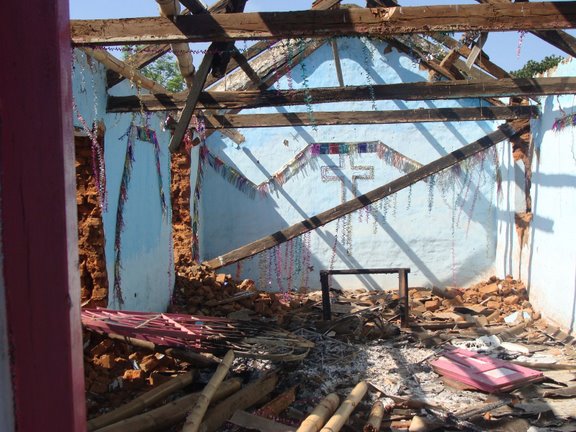
A 1999 Human Rights Watch report states increasing levels of religious violence on Christians in India, perpetrated by Hindu organisations.{{cite book According to a 2008 report by Hudson Institute, "extremist Hindus have increased their attacks on Christians, until there are now several hundred per year. But this did not make news in the U.S. until a foreigner was attacked." In Odisha, starting December 2007, Christians have been attacked in Kandhamal and other districts, resulting in the deaths of two Hindus and one Christian, and the destruction of houses and churches. Hindus claim that Christians killed a Hindu saint Laxmananand, and the attacks on Christians were in retaliation. However, there was no conclusive proof to support this claim. |access-date=31 December 2007 |archive-url=https://web.archive.org/web/20071231084555/http://www.financialexpress.com/news/Church-Attack-Indefinite-curfew-in-Orissa/254439/ |archive-date=31 December 2007 |url-status=dead Twenty people were arrested following the attacks on churches. Similarly, starting 14 September 2008, there were numerous incidents of violence against the Christian community in Karnataka.
Graham Stuart Staines (1941 – 23 January 1999) an Australian Christian missionary who, along with his two sons Philip (aged 10) and Timothy (aged 6), was burnt to death by a gang of Hindu Bajrang Dal fundamentalists while sleeping in his station wagon at Manoharpur village in Kendujhar district in Odisha, India on 23 January 1999. In 2003, a Bajrang Dal activist, Dara Singh, was convicted of leading the gang that murdered Graham Staines and his sons, and was sentenced to life in prison. V. Venkatesan, Frontline Magazine, 11–23 Oct 2003
In its annual human rights reports for 1999, the United States Department of State criticised India for "increasing societal violence against Christians." The report listed over 90 incidents of anti-Christian violence, ranging from damage of religious property to violence against Christian pilgrims.
In Madhya Pradesh, unidentified persons set two statues inside St Peter and Paul Church in Jabalpur on fire. In Karnataka, religious violence was targeted against Christians in 2008.
Anti-atheist violence
According to Jaswant Zirakh of the Tarksheel Society, Indians are usually comfortable with atheist concepts, but usually it's popular religious leadership and godmen tend to attack atheism since they tend to worry about losing their power and income. Among Indian Muslim communities, atheists worry of backlash, they and their families may face social boycott and ostracism including stopping them in participation of funerary rites of their dear ones.
Narendra Nayak, President of the Federation of Indian Rationalist Associations (FIRA) and an advocate of atheism, has claimed to have been attacked three times and had his scooter damaged twice, with one of the attacks leaving him with head injuries. This compelled him to take self-defence lessons and carry a nunchaku. Megh Raj Mitter's house was surrounded by a mob after he debunked the Hindu milk miracle, forcing him to call the police.
On 15 March 2007, a bounty of was announced on atheist Bangladeshi author Taslima Nasrin, while living in India, by a Muslim cleric named Maulana Tauqeer Raza Khan for allegedly writing derogatory statements about Muhammad in her work. In December 2013, an FIR was filed against Nasrin in Bareilly by a cleric named Hasan Raza Khan, for hurting religious sentiments. Nasrin had allegedly tweeted on Twitter that "In India, criminals who issue fatwas against women don't get punished." Raza Khan said that by accusing clerics of being criminals, Nasrin had hurt religious sentiments.
On 2 July 2011, the house of U. Kalanathan, secretary of the Kerala Yukthivadi Sangham, was attacked in Vallikunnu after he suggested on television that the temple treasures of Padmanabhaswamy Temple should be used for public welfare. On 20 August 2013, Narendra Dabholkar, a rationalist and anti-superstition campaigner, was assassinated.
On 16 February 2015, rationalist Govind Pansare and his wife were attacked by unknown gunmen. He later died from the wounds on 20 February. On 30 August 2015, M. M. Kalburgi, a scholar and rationalist, was shot dead at his home. He was known for his criticism of superstition and idol worship. Soon afterwards, another rationalist and author, K. S. Bhagwan, received a threatening letter. He had offended religious groups by criticizing the Gita.
In March 2017, 31-year-old A Farooq, an Indian Muslim youth from Coimbatore who became an atheist, was killed by members of a Muslim radical group.
Statistics
| Year | Incidents | Deaths | Injured |
|---|---|---|---|
| 2005 | 779 | 124 | 2066 |
| 2006 | 698 | 133 | 2170 |
| 2007 | 761 | 99 | 2227 |
| 2008 | 943 | 167 | 2354 |
| 2009 | 849 | 125 | 2461 |
| 2010 | 701 | 116 | 2138 |
| 2011 | 580 | 91 | 1899 |
| 2012 | 668 | 94 | 2117 |
| 2013 | 823 | 133 | 2269 |
| 2014 | 644 | 95 | 1921 |
| 2015 | 751 | 97 | 2264 |
| 2016 | 703 | 86 | 2321 |
| 2017 | 822 | 111 | 2384 |
From 2005 to 2009, an average of 130 people died every year from communal riots, and 2,200 were injured. In pre-partitioned India, over the 1920–1940 period, numerous communal violence incidents were recorded, an average of 381 people died per year during religious violence, and thousands were injured.
According to PRS India,
For 2012,
International human rights reports
The 2007 United States Department of State International Religious Freedom Report noted The Constitution provides for freedom of religion, and the National Government generally respected this right in practice. However, some state and local governments limited this freedom in practice.
The 2008 Human Rights Watch report notes: India claims an abiding commitment to human rights, but its record is marred by continuing violations by security forces in counterinsurgency operations and by government failure to rigorously implement laws and policies to protect marginalised communities. A vibrant media and civil society continue to press for improvements, but without tangible signs of success in 2007.
The 2007 Amnesty International report listed several issues concern in India and noted Justice and rehabilitation continued to evade most victims of the 2002 Gujarat communal violence.
The 2007 United States Department of State Human Rights Report noted that the government generally respected the rights of its citizens; however, numerous serious problems remained. The report which has received a lot of controversy internationally, as it does not include human rights violations of United States and its allies, has generally been rejected by political parties in India as interference in internal affairs, including in the Lower House of Parliament.
In a 2018 report, United Nations Human Rights office expressed concerns over attacks directed at minorities and Dalits in India. The statement came in an annual report to the United Nations Human Rights Council's March 2018 session where Zeid Ra’ad al-Hussein said,
"In India, I am increasingly disturbed by discrimination and violence directed at minorities, including Dalits and other scheduled castes, and religious minorities such as Muslims. In some cases this injustice appears actively endorsed by local or religious officials. I am concerned that criticism of government policies is frequently met by claims that it constitutes sedition or a threat to national security. I am deeply concerned by efforts to limit critical voices through the cancellation or suspension of registration of thousands of NGOs, including groups advocating for human rights and even public health groups."
In film and literature
Religious violence in India have been a topic of various films and novels.
- Firaaq, a film set in the aftermath of the 2002 Gujarat riots
- Garam Hawa, a film by M. S. Sathyu based on a story on partition written by Ismat Chugtai
- Gandhi, a 1982 film which included portrayal of the Direct Action Day and Partition riots
- Tamas, a film on partition based on a book by Bhisham Sahni
- Bombay, a 1995 film centred on events during the period of December 1992 to January 1993 in India, and the controversy surrounding the Babri Mosque in Ayodhya
- Maachis, a film by Gulzar about Punjab terrorism
- Earth, a 1998 film portraying Partition violence in Lahore
- Fiza, a 2000 film set amidst the Bombay riots
- Hey Ram, a 2002 film with a semi-fictional plot centred around Partition of India and related religious violence
- Mr. and Mrs. Iyer, a 2002 film about the relationship between two lead characters Meenakshi Iyer and Raja amidst Hindu-Muslim riots in India
- Final Solution, a 2003 documentary film about the 2002 Gujarat violence, banned in India
- Hawayein, a 2003 film about the struggles of Sikhs during the 1984 anti-Sikh riots
- Black Friday, a Hindi film on the 1993 serial bomb blasts in Mumbai, directed by Anurag Kashyap
- Amu, a film about a girl orphaned during the 1984 anti-Sikh riots
- Parzania, a 2007 film about the riots in Gujarat in 2002 The film was purposely not released in Gujarat. Cinema owners and distributors in Gujarat refused to screen the film out of fear of retaliation by Hindu activists. Hindutva groups in Gujarat threatened to attack theatres that showed the film.
- Slumdog Millionaire, a 2008 British crime drama film that is a loose adaptation of the novel Q & A (2005) by Indian author Vikas Swarup, telling the story of 18-year-old Jamal Malik from the Juhu slums of Mumbai. The violence of the Bombay riots is an instrumental part of the plot of the film as the protagonist, Jamal Malik's mother is among those killed in the riots, and he later remarks "If it wasn't for Rama and Allah, we'd still have a mother."
- Train to Pakistan, a novel by Khushwant Singh set during the Partition of India, and a movie by the same name, based on the book
- "Toba Tek Singh", a satirical story by Saadat Hasan Manto set during the Partition of India
- Muzaffarnagar Abhi Baki Hai, a documentary on the 2013 Muzaffarnagar riot
- Punjab 1984, a 2014 Indian Punjabi period drama film based on the 1984–86 Punjab insurgency's impact on social life
- Man with the White Beard, 2018 fiction by Dr Shah Alam Khan set in the backdrop of three major riots of India: the anti Sikh riots of 1984, the anti Muslim riots of Gujarat in 2002 and the anti Christian riots of Kandhamal in 2008
References
References
- (2001). "Census of India: Population by religious communities".
- (15 July 2013). "Hindu-Muslim Communal Riots in India I (1947{{ndash}}1986)". [[Sciences Po]].
- (20 August 2013). "Hindu-Muslim Communal Riots in India II (1986{{ndash}}2011)". [[Sciences Po]].
- (12 February 2007). "Should religions try to convert others?".
- Tomek, Vladimir. (2006-09-23). "Teachings of religious tolerance and intolerance in world religions". [[Ontario Consultants on Religious Tolerance.
- (6 November 2003). "Ayodhya: India's endless curse".
- (2005-04-01). "A new breed of missionary: A drive for conversions, not development, is stirring violent animosity in India". [[The Christian Science Monitor]].
- "India:Events of 2007".
- (June 15, 2011). "Vital Stats Communal Violence in India". PRS Legislative Research.
- (April 2018). "Annual Report of the U.S. Commission on International Religious Freedom". [[United States Commission on International Religious Freedom.
- (26 May 2017). "States Where Cow Slaughter is Banned So Far, and States Where it Isn't". News18.
- (3 July 2018). "Tracking mob lynching in two charts".
- "India's Got Beef With Beef: What You Need To Know About The Country's Controversial 'Beef Ban'".
- (14 September 2007). "World Regional Geography". [[Macmillan Publishers.
- John S. Strong. (1989). "The Legend of King Aśoka: A Study and Translation of the Aśokāvadāna". Motilal Banarsidass Publ..
- Beni Madhab Barua. (5 May 2010). "The Ajivikas". General Books.
- (22 December 2010). "Popular Controversies in World History: Investigating History's Intriguing Questions: Investigating History's Intriguing Questions". ABC-CLIO.
- Le Phuoc. (March 2010). "Buddhist Architecture". Grafikol.
- (4 April 2001). "Article on Deorkothar Stupas possibly being targeted by Pushyamitra". Archaeology.org.
- 0-86171-295-1, Introduction, [http://www.wisdompubs.org/sites/default/files/preview/Divine%20Stories%20Book%20Preview_0.pdf Preview summary of book] {{Webarchive. link. (5 August 2017)
- Durant, Will. (2014). "The Complete Story of Civilization: Our Oriental Heritage". Simon and Schuster.
- Mehta, Jaswant Lal. (1979). "Advanced Study in the History of Medieval India". Sterling Publishers.
- (2017). "Aurangzeb: The Life and Legacy of India's Most Controversial King". Stanford University Press.
- Ayalon, David. (1986). "Studies in Islamic History and Civilisation". Brill.
- Eaton, Richard. (2000). "Aurangzeb, as he was according to Mughal Records". [[François Gautier]].
- Voltaire, ''Lettres sur l'origine des sciences et sur celle des peuples de l'Asie'' (first published Paris, 1777), letter of 15 December 1775
- Salomon, H.P. and Sassoon, I.S.D., in Saraiva, Antonio Jose. ''The Marrano Factory. The Portuguese Inquisition and Its New Christians, 1536–1765'' (Brill, 2001), pp. 345–47.
- Hunter, William W., The Imperial Gazetteer of India, Trubner & Co, 1886
- ANTÓNIO JOSÉ SARAIVA (1985), Salomon, H. P. and Sassoon, I. S. D. (Translators, 2001), ''The Marrano Factory. The Portuguese Inquisition and Its New Christians, 1536–1765'' (Brill Academic), pp. 107, 345-351
- (2017). "Judging Faith, Punishing Sin". Cambridge University Press.
- Shirodhkar, P P., ''Socio-Cultural life in Goa during the 16th century'', p. 123
- Seth, Vijay. "Secular Enlightenment and Christian Conversion: Missionaries and Education in Colonial India".
- Mahajan, V.D.. (2001). "Modern Indian History". S Chand & Company Limited.
- A.N. Wilson. (2003). "The Victorians". W.W. Norton & Company.
- Hukum Chand. "History of Medieval India". Anmol Publications PVT LTD..
- Stephen Neill. (2002). "A history of Christianity in India". Cambridge University Press.
- The Indian Mutiny, Saul David, Viking 2002, p. 398
- Chopra, P. N.. (2003). "A Comprehensive History of India". Sterling Publishers.
- Richard C. Martín et al (2003), Encyclopedia of Islam & the Muslim World, Macmillan Reference USA, {{ISBN. 978-0028656038, pp. 640–641
- B. Fraser (2008), Bengal Partition Stories: An Unclosed Chapter, Anthem South Asian Studies, {{ISBN. 978-1843312994, pp. 7–11
- Jerald D. Gort, Henry Jansen and Hendrik M. Vroom (2004), Religion, Conflict and Reconciliation, {{ISBN. 978-9042011663, pp. 41–47
- Suranjan Das. (1993). "Communal Riots in Bengal 1905–1947". Oxford University Press.
- (1994). "Hindu culture during and after Muslim rule: survival and subsequent challenges". M.D. Publications Pvt..
- (9 May 2003). "Moplah Rebellion, Part II: Hindus killed in Kerala". Rediff.com.
- O.P. Ralhan. (1996). "Encyclopaedia of Political Parties: India, Pakistan, Bangladesh : National, Regional, Local". Anmol Publications PVT. LTD..
- Stanley Wolpert, Shameful Flight: The Last Years of the British Empire in India, Oxford University Press, {{ISBN. 978-0195393941
- Wavell to Pethick Lawrence, 21 August 1946, Mansergh, Transfer of Power, Vol. VIII, p. 274
- Lal, Vinay. "The Partition of India".
- "Death toll in the partition". Users.erols.com.
- (14 August 2022). "Explained: The Partition Horrors Remembrance Day, The Toll Of The Partition And What Critics Say".
- Christophe Jaffrelot. (1999). "The Hindu Nationalist Movement and Indian Politics 1925 to the 1990s : Strategies of Identity-building, Implantation and Mobilisation". Penguin Books India.
- "History of Communal Violence in Gujarat". Concerned Citizens Tribunal - Gujarat 2002.
- Christophe Jaffrelot. (2010). "Religion, Caste, and Politics in India". Primus Books.
- (30 May 2012). "Muslims in Indian Cities: Trajectories of Marginalisation". Columbia University Press.
- Richard Edmund Ward. (1992). "India's Pro-Arab Policy: A Study in Continuity". Greenwood Publishing Group.
- Subrata Kumar Mitra. (2006). "The Puzzle of India's Governance: Culture, Context And Comparative Theory". Routledge.
- Yasmeen Peer. (September 2023). "Communal Violence in Gujarat: Rethinking the Role of Communalism and Institutionalized Injustices in India".
- Charny, Israel W.. (1999). "Encyclopedia of genocide". ABC-CLIO.
- J.S. Grewal, The Sikhs of the Punjab, (Cambridge, Cambridge University Press, 1990) p. 213
- J.S. Grewal, The Sikhs of the Punjab, (Cambridge, Cambridge University Press, 1990) p. 214; Inder Malhotra, Indira Gandhi: A Personal and Political Biography, (London/Toronto, Hodder and Stoughton, 1989) p. 178
- (2006). "Twenty years of impunity: the November 1984 pogroms of Sikhs in India". Ensaaf.
- (1984). "Who are the Guilty ?". [[People's Union for Civil Liberties]].
- (17 October 2007). "Protecting the Killers: A Policy of Impunity in Punjab, India". [[Human Rights Watch]].
- Mustafa, Seema. (9 August 2005). "1984 Sikhs Massacres: Mother of All Cover-ups". The Asian Age.
- Agal, Renu. (11 August 2005). "Justice delayed, justice denied". BBC News.
- (8 August 2005). "Leaders 'incited' anti-Sikh riots". BBC News.
- Fernandes, Edna. (2006). "Holy Warriors: A Journey Into the Heart of Indian Fundamentalism". Penguin Global.
- Subir Bhaumik. (May 2004). "Religious Radicalism and Security in South Asia". Asia-Pacific Center for Security Studies.
- "Anatomy of an Insurgency Ethnicity & Identity in Nagaland". Satp.org.
- (18 April 2000). "Church backing Tripura rebels". BBC.
- Parratt. (2003). "Christianity, ethnicity and structural violence: The north-east India case". Kangla Online.
- [http://www.tribuneindia.com/2002/20021021/ldh1.htm#6 Bajrang Dal launches campaign] {{Webarchive. link. (12 October 2017 ,''The Tribune'')
- [http://www.hindu.com/thehindu/holnus/001200810051766.htm 'Majority of Maoist supporters in Orissa are Christians'] {{Webarchive. link. (8 October 2008 [[The Hindu]] – 5 October 2008)
- [http://www.indianexpress.com/news/3-arrested-in-Laxmanananda--murder-case/370220 3 arrested in Laxmanananda murder case] {{Webarchive. link. (13 February 2009 Indian Express – 7 October 2008)
- [http://www.indianexpress.com/news/net-closes-in-on-cong-mp-for-orissa-swamis-murder/403507/1 Net closes in on Cong MP for Orissa swami’s murder] {{Webarchive. link. (13 February 2009 Indian Express – 27 December 2008)
- "Human Rights Watch World Report 2006".
- (15 January 2009). "Kerala Communal Clashes: 62 get life for killing 8". [[The Tribune (Chandigarh).
- (July 2003). "India Together: Marad can yet be retrieved: Sreedevi Jacob - 01 July 2003".
- "IMC India - 8 Hindus hacked to death by muslim mob in kerala".
- "NDF behind Marad massacre?". [[The Hindu]].
- Bandyopadhyay, Sabyasachi. (14 September 2010). "Riot-scarred Deganga says Trinamool MP 'main villain'". [[The Indian Express]].
- Caesar Mandal. (20 February 2013). "Violence after villager murder". [[The Times of India]].
- (21 February 2013). "West Bengal: 200 homes torched, shops ransacked in riots". [[Oneindia.in.
- "Govt releases data of riot victims identifying religion - Indian Express". archive.indianexpress.com.
- "Government releases data of riot victims identifying religion - Hindustan Times". hindustantimes.com.
- "Who killed 254 Hindus in Gujarat? - Sify.com".
- (18 March 2002). "Riots hit all classes, all faiths - The Times of India". timesofindia.indiatimes.com.
- "India Today". indiatoday.com.
- "Special: Mumbai riots a planned, perfected pogrom? - IBNLive". ibnlive.in.com.
- (14 October 2018). "[Christian Terror - When refused to accept Christianity, guard shot judge's wife and son] क्रिस्चियन टेरर - ईसाइयत अपनाने से मना किया तो गार्ड ने हिन्दू जज की पत्नी-बेटे को मारी गोली". Dainik Bharat.
- (Mar 26, 2021). "Nikita Tomar murder case: Haryana court awards life imprisonment to two {{!}} Faridabad News - Times of India".
- Pathikrit Chakraborty. (Oct 20, 2019). "Kamlesh Tiwari: Murder of Hindu outfit leader 'blasphemy killing', 6 held {{!}} India News - Times of India".
- Kumar Abhishek. (October 23, 2019). "Kamlesh Tiwari was stabbed 15 times, shot once {{!}} Post-mortem report".
- (2022-01-31). "Kishan Bharvad murder for social media post: Cleric arrested for provocation, what we know so far".
- Henry, Nikhila. (2022-05-10). "'Allah Made Nagaraju for Me': Ashrin Sultana on Hyderabad Murder".
- [http://news.oneindia.in/2009/05/04/kashmirspandits-accuse-election-commission-ofdiscriminati.html Kashmir's Pandits accuse Election Commission of discrimination against them] {{Webarchive. link. (15 January 2014 OneIndia – 4 May 2009)
- (30 March 2003). "Kashmiri Pandits in Nandimarg decide to leave Valley". [[Outlook (Indian magazine).
- (27 January 1998). "I heard the cries of my mother and sisters". [[Rediff]].
- (27 April 2004). "Migrant Pandits voted for end of terror in valley". [[The Tribune (Chandigarh).
- (2 August 2000). "At least 58 dead in 2 attacks in Kashmir". CNN.
- (25 March 2003). "City shocked at killing of Kashmiri Pandits". [[The Times of India]].
- Phil Reeves. (February 2019). "Islamic militants kill 24 Hindus in Kashmir massacre". [[The Independent]].
- "When Kashmiri pandits fled Islamic Terror". Rediff.com.
- Gaborieau, Marc. (June 1985). "From Al-Beruni to Jinnah: Idiom, Ritual and Ideology of the Hindu-Muslim Confrontation in South Asia". Anthropology Today.
- "The Context of Anti-Christian Violence". Hrw.org.
- Tully, Mark. (5 December 2002). "Tearing down the Babri Masjid". BBC News.
- "Issues For Briefing".
- (13 March 2003). "Ayodhya excavation: Digging for trouble".
- [http://www.timesrelieffund.com/riots/Bomriots.htm Bombay Riots (1993)] {{Webarchive. link. (19 February 2001 ,''The Times Group'')
- [https://news.bbc.co.uk/1/hi/world/south_asia/4536199.stm Gujarat riot death toll revealed] ,''BBC''
- link. (26 February 2009 ,''Indian Express'')
- [http://news.indiainfo.com/2005/05/11/1105godhra-rs.html 254 Hindus, 790 Muslims killed in post-Godhra riots] {{webarchive. link. (26 February 2009 ,''Indiainfo.com'')
- "India-U.S. Relations".
- Dugger, Celia W. "Hindu Rioters Kill 60 Muslims in India" ''[[The New York Times]]''. New York, N.Y.:1 March 2002. [https://www.nytimes.com/2002/03/01/world/hindu-rioters-kill-60-muslims-in-india.html] {{Webarchive. link. (20 June 2017)
- (18 March 2002). "People Wanted Revenge And Got It". Outlook.
- (19 March 2002). "Muslim forum flays RSS resolution". [[The Hindu]].
- (1 May 2002). "Sectarian violence in India". The Economist.
- (19 March 2002). "NGO says Gujarat riots were planned". BBC News Online.
- (13 July 2009). "Implementation of Sachar Committee recommendations". Press Information Bureau, Government of India.
- (5 March 2014). "Sachar Committee Report". Ministry of Minority Affairs, Government of India.
- (26 February 2020). "Anti-Muslim violence in Delhi serves Modi well". The Guardian.
- (26 February 2020). "Modi slammed as death toll in New Delhi violence rises". Al-Jazeera.
- (27 February 2020). "Narendra Modi's Reckless Politics Brings Mob Rule to New Delhi". The Wire.
- (June 2020). "Hindutva Violence in India: Trends and Implications". International Centre for Political Violence and Terrorism Research.
- (24 November 2020). "Despite Modi, India Has Not Yet Become a Hindu Authoritarian State". [[CATO Institute]].
- (30 September 1999). "Anti-Christian Violence on the Rise in India".
- Paul Marshall,[https://www.hudson.org/research/4575-hinduism-and-terror] {{Webarchive. link. (22 April 2019,"Hinduism and Terror")
- (30 December 2007). "Orissa carnage: Christian group demands CBI probe". [[The Times of India]].
- (29 December 2007). "India: Stop Hindu-Christian Violence in Orissa".
- "Stop the hate crime".
- "Fresh violence in Orissa, curfew continues".
- (27 February 2014). "Two acquitted in Graham Staines murder case". Timesofindia.indiatimes.com.
- (6 June 1932). "Foreign News: Ex-Butterfly".
- "His faith, our faith - Hindustan Times". hindustantimes.com.
- (27 February 1999). "US rights report slams India for anti-Christian violence".
- (20 September 2008). "150-yr-old church set afire in Madhya Pradesh". [[The Times of India]].
- "Protest in Delhi over violence against Christians - Thaindian News". thaindian.com.
- Torgalkar, Varsha. (2022-05-17). "In India, Hindu nationalists embolden challenges to atheism".
- (22 August 2013). "Rationalists fight superstition with dignity and nunchakus". [[The Times of India]].
- (30 August 2013). "Confrontation in the Twilight zone". Business Standard.
- (18 January 2008). "Taslima on IBNLive chat: 'India is not a theocracy'". [[IBNLive]].
- (15 March 2007). "Muslim body announces Rs 5 lakh for Taslima's head". [[DNA India]].
- (6 December 2013). "Cleric files FIR against Taslima Nasreen's anti-fatwa tweet". [[The Times of India]].
- (4 July 2011). "Rationalist leader's house attacked". [[The Hindu]].
- "Narendra Dabholkar". The Economist.
- (21 February 2015). "Rationalist Pansare is dead". [[Deccan Herald]].
- (31 August 2015). "Rationalist Kalburgi Shot Dead in Dharwad". [[The New Indian Express]].
- (31 August 2015). "Indian Scholar Who Spoke Out Against Idol Worship Is Shot Dead".
- (10 September 2015). "Writer Bhagwan receives threat letter". [[The Hindu]].
- (10 September 2015). "In Karnataka, Another Writer Gets Threat Letter After Scholar MM Kalburgi's Murder". [[NDTV]].
- Janardhanan, Arun. (27 March 2017). "Tamil Nadu youth killed for being an atheist, father says he too will become one". [[The Indian Express]].
- Singh, Rashmi. (27 March 2017). "As long as gods are used for votes, Indian atheists will get killed". DailyO.
- "Annexure referred to in reply to parts (a) to (e) of Rajya Sabha Unstarred Question No. 694 for 5.3.2008".
- "Annexure".
- "PAGE 1 OF 1 of Annexure".
- "Government of India Ministry of Home Affairs Lok Sabha Starred Question No.*35 To Be Answered on the 19th July, 2016/Ashadha 28, 1938 (SAKA)".
- "Government of India Ministry of Home Affairs Lok Sabha Unstarred Question No. 590 To Be Answered on the 06th February, 2018/ Megha 17, 1939 (SAKA)".
- (25 July 2018). "111 people killed in 822 communal violence incidents in 2017: MHA".
- [http://www.prsindia.org/administrator/uploads/general/1308201190_Vital%20Stats%20-%20Communal%20Violence%20in%20India%2014Jun11%20v2.pdf Vital Stats - Communal Violence in India] {{Webarchive. link. (6 March 2020 PRS India, Centre for Policy Research (CPR), New Delhi)
- B.R. Ambedkar, [http://www.columbia.edu/itc/mealac/pritchett/00ambedkar/ambedkar_partition/index.html#contents Pakistan or the Partition of India] {{Webarchive. link. (24 April 2014 Chapter 7, Archived by Columbia University)
- link. (24 September 2015 Chapter 2, Geneva Declaration, Switzerland (2011))
- link. (6 July 2019 The Times of India (September 2013); Note: Indian government calendar reporting period ends in June every year.)
- [https://web.archive.org/web/20130925113405/http://www.hindustantimes.com/India-news/NewDelhi/107-killed-in-riots-this-year-66-Muslims-41-Hindus/Article1-1126579.aspx 107 killed in riots this year; 66 Muslims, 41 Hindus] The Hindustan Times (24 September 2013)
- (2007). "International Religious Freedom Report 2007 – India".
- (2007). "thereport.amnesty.org/document/15".
- (11 March 2008). "Country Reports on Human Rights Practices".
- (5 March 1999). "Annual U.S. Human Rights Report Garners Criticism/Praise, Exposes U.S. 'Double Standard'". "US Office of Research & Media Reaction.
- Andres Oppenheimer. (13 March 2006). "U.S. Rights Report Should Include U.S. Abuses". Salt Lake Tribune.
- (10 March 2006). "US human rights report spares allies". The Age.
- (12 March 2008). "U.S. rights report shows double standards: Russia". Reuters.
- (September 2023). "CPI(M) terms US report on West Bengal 'interference' in India".
- (14 March 2008). "India not bound by Bush administration: Lok Sabha". ExpressIndia.
- Zeid Ra’ad al-Hussein. (March 2018). "High Commissioner's global update of human rights concerns". UN Office of Human Rights.
- [https://www.imdb.com/title/tt0112553/ Bumbai (1995)] {{Webarchive. link. (12 April 2018 ''IMDB'')
- [https://www.imdb.com/title/tt0150433/ Earth (1998)] {{Webarchive. link. (2 August 2018 ''IMDB'')
- [https://www.imdb.com/title/tt0248012/ Fiza (2000)] {{Webarchive. link. (14 April 2018 ''IMDB'')
- [https://www.imdb.com/title/tt0222012/ Hey Ram (2000)] {{Webarchive. link. (6 April 2018 ''IMDB'')
- [https://www.imdb.com/title/tt0329393/ Mr. and Mrs. Iyer (2002)] {{Webarchive. link. (8 April 2018 ''IMDB'')
- [https://www.imdb.com/title/tt0402178/ Final Solution (2003)] {{Webarchive. link. (21 September 2019 ''IMDB'')
- [https://www.imdb.com/title/tt0400234/ Black Friday (2004)] {{Webarchive. link. (14 October 2018 ''IMDB'')
- [https://www.imdb.com/title/tt0433425/ Parzania (2005)] {{Webarchive. link. (17 March 2018 ''IMDB'')
- (26 January 2007). "Parzania not screened in Gujarat". [[The Times of India]].
- "Cinema at its very best... and then some not quite so at all". [[The Hindu]].
- (14 September 2007). "International Religious Freedom Report 2007:India".
- "Muzaffarnagar Abhi Baki Hai remains in the limelight". [[The Hindu]].
- "Dreams, Dictators and Dementia in Shah Alam Khan's "A Man with White Beard" {{!}} The Thumb Print - A magazine from the East".
This article was imported from Wikipedia and is available under the Creative Commons Attribution-ShareAlike 4.0 License. Content has been adapted to SurfDoc format. Original contributors can be found on the article history page.
Ask Mako anything about Religious violence in India — get instant answers, deeper analysis, and related topics.
Research with MakoFree with your Surf account
Create a free account to save articles, ask Mako questions, and organize your research.
Sign up freeThis content may have been generated or modified by AI. CloudSurf Software LLC is not responsible for the accuracy, completeness, or reliability of AI-generated content. Always verify important information from primary sources.
Report