From Surf Wiki (app.surf) — the open knowledge base
Relativistic Heavy Ion Collider
Particle accelerator at Brookhaven National Laboratory in Upton, New York, USA
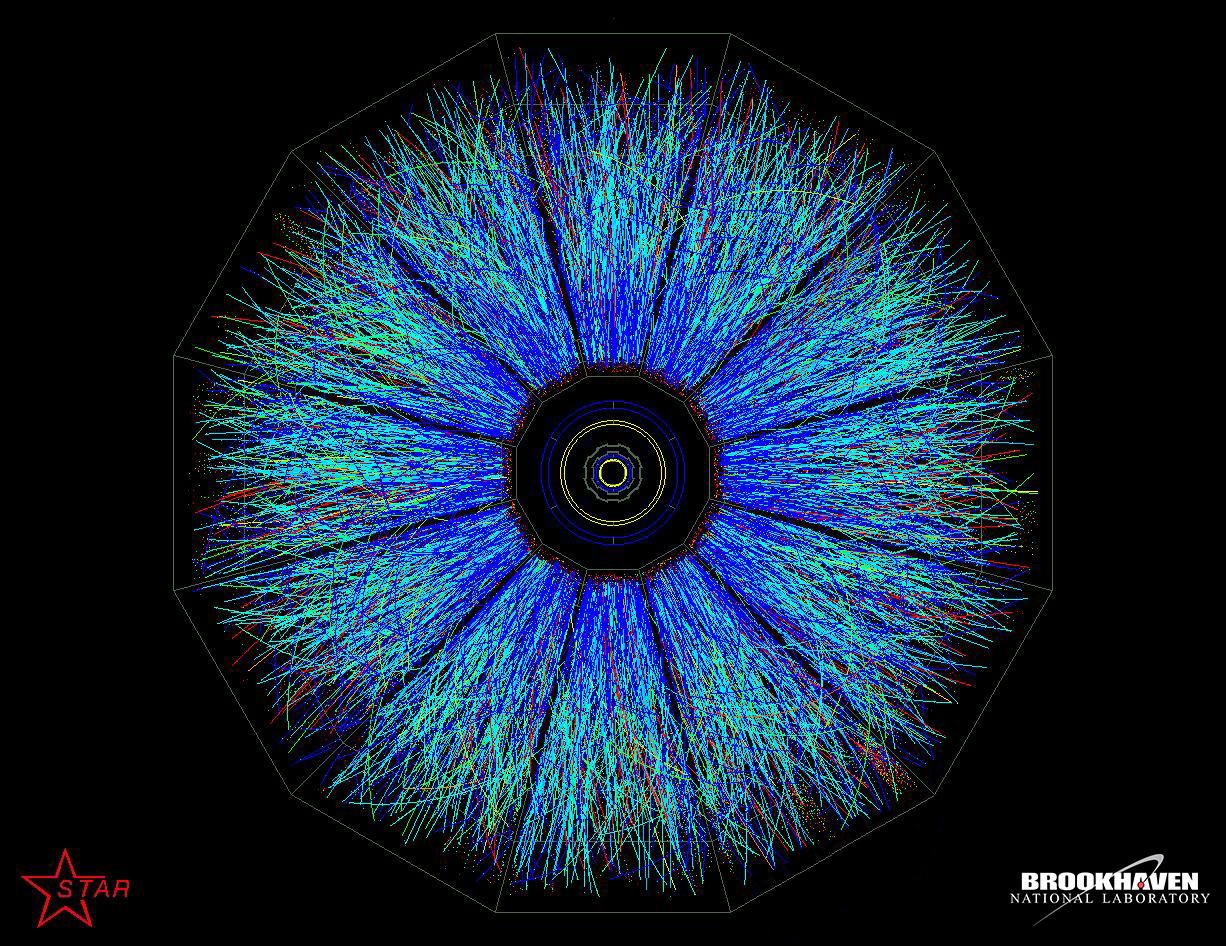
Particle accelerator at Brookhaven National Laboratory in Upton, New York, USA
| Field | Value |
|---|---|
| name | Relativistic Heavy Ion Collider (RHIC) |
| image | A section of Relativistic Heavy Ion Collider.jpg |
| caption | The Relativistic Heavy Ion Collider at Brookhaven National Laboratory. |
| type | synchrotron |
| beam | polarized p to U ion |
| target | collider |
| energy | 255 GeV per beam (p), 100 GeV/nucleon per beam (Au ions) |
| luminosity | (p+p), (Au+Au) |
| circumference | |
| location | Upton, New York |
| coordinates | |
| institution | Brookhaven National Laboratory |
| dates | 2000—2025 |
The Relativistic Heavy Ion Collider (RHIC ) is the first and one of only two operating heavy-ion colliders, and the only spin-polarized proton collider ever built. Located at Brookhaven National Laboratory (BNL) in Upton, New York, and used by an international team of researchers, it is the only operating particle collider in the US. |doi-access=free |access-date=2010-02-16
RHIC is as of 2019 the second-highest-energy heavy-ion collider in the world, with nucleon energies for collisions reaching 100 GeV for gold ions and 250 GeV for protons. As of November 7, 2010, the Large Hadron Collider (LHC) has collided heavy ions of lead at higher energies than RHIC. |access-date=2016-11-23
In 2010, RHIC physicists published results of temperature measurements from earlier experiments which concluded that temperatures in excess of 345 MeV (4 terakelvin or 7 trillion degrees Fahrenheit) had been achieved in gold ion collisions, and that these collision temperatures resulted in the breakdown of "normal matter" and the creation of a liquid-like quark–gluon plasma. |access-date=2017-01-24
In January 2020, the US Department of Energy Office of Science selected the eRHIC design for the future Electron–Ion collider (EIC), building on the existing RHIC facility at BNL.
RHIC will cease to operate in 2025.
The accelerator
RHIC is an intersecting storage ring particle accelerator. Two independent rings (arbitrarily denoted as "Blue" and "Yellow") circulate heavy ions and/or polarized protons in opposite directions and allow a virtually free choice of colliding positively charged particles (the eRHIC upgrade will allow collisions between positively and negatively charged particles). The RHIC double storage ring is hexagonally shaped and has a circumference of , with curved edges in which stored particles are deflected and focused by 1,740 superconducting magnets using niobium-titanium conductors. The dipole magnets operate at . |access-date = 2021-03-21 |access-date=2010-02-16
A particle passes through several stages of boosters before it reaches the RHIC storage ring. The first stage for ions is the electron beam ion source (EBIS), while for protons, the linear accelerator (Linac) is used. As an example, gold nuclei leaving the EBIS have a kinetic energy of per nucleon and have an electric charge Q = +32 (32 of 79 electrons stripped from the gold atom). The particles are then accelerated by the Booster synchrotron to per nucleon, which injects the projectile now with Q = +77 into the Alternating Gradient Synchrotron (AGS), before they finally reach per nucleon and are injected in a Q = +79 state (no electrons left) into the RHIC storage ring over the AGS-to-RHIC Transfer Line (AtR).
To date the types of particle combinations explored at RHIC are p + p, p + Al, p + Au, d + Au, h + Au, Cu + Cu, Cu + Au, Zr + Zr, Ru + Ru, Au + Au and U + U. The projectiles typically travel at 99.995% of the speed of light. For Au + Au collisions, the center-of-mass energy is typically per nucleon-pair, and was as low as per nucleon-pair. An average luminosity of was targeted during the planning. The current average Au + Au luminosity of the collider has reached , 44 times the design value.
One unique characteristic of RHIC is its capability to collide polarized protons. RHIC holds the record of highest energy polarized proton beams. Polarized protons are injected into RHIC and preserve this state throughout the energy ramp. This is a difficult task that is accomplished with the aid of corkscrew magnetics called 'Siberian snakes' (in RHIC a chain 4 helical dipole magnets). The corkscrew induces the magnetic field to spiral along the direction of the beam {{cite journal |access-date=13 September 2006 |archive-date=5 December 2008 |archive-url=https://web.archive.org/web/20081205081201/http://www.cerncourier.com/main/article/42/3/2 Run-9 achieved center-of-mass energy of on 12 February 2009. |access-date=2010-02-16
AC dipoles have been used in non-linear machine diagnostics for the first time in RHIC. |display-authors=etal |doi-access=free
File:Helium refrigeration system at Relativistic Heavy Ion Collider (RHIC).jpg|The 25 MW Helium refrigeration system that cools the superconducting magnets down to the operating temperature of 4.5 K File:Arc dipole magnet of Relativistic Heavy Ion Collider (RHIC).jpg|An arc dipole magnet. Electrical bus slots (top and bottom) and beam tube (middle) at the top section of the vacuum shell File:Curvature of beam tube of Relativistic Heavy Ion Collider arc dipole magnet.jpg|Curvature of beam tube seen through the ends of an arc dipole magnet File:Two main accelerator rings inside the Relativistic Heavy Ion Collider tunnel.jpg|Two main accelerator rings inside the RHIC tunnel File:STAR Detector at Relativistic Heavy Ion Collider.jpg|STAR detector File:A Forward Silicon Vertex Detector (FVTX) sensor on a microscope.jpg|A Forward Silicon Vertex Detector (FVTX) sensor of PHENIX detector on a microscope
The experiments
There are two detectors currently operating at RHIC: STAR (6 o'clock, and near the AGS-to-RHIC Transfer Line) and sPHENIX (8 o'clock), the successor to PHENIX. PHOBOS (10 o'clock) completed its operation in 2005, and BRAHMS (2 o'clock) in 2006.
Among the two larger detectors, STAR is aimed at the detection of hadrons with its system of time projection chambers covering a large solid angle and in a conventionally generated solenoidal magnetic field, while PHENIX is further specialized in detecting rare and electromagnetic particles, using a partial coverage detector system in a superconductively generated axial magnetic field. The smaller detectors have larger pseudorapidity coverage, PHOBOS has the largest pseudorapidity coverage of all detectors, and tailored for bulk particle multiplicity measurement, while BRAHMS is designed for momentum spectroscopy, in order to study the so-called "small-x" and saturation physics. There is an additional experiment, PP2PP (now part of STAR), investigating spin dependence in p + p scattering.{{cite web |access-date=2013-09-18 |archive-date=2013-05-24 |archive-url=https://web.archive.org/web/20130524034902/http://www.rhic.bnl.gov/pp2pp/
The spokespersons for each of the experiments are:
- STAR: Frank Geurts (Rice University) and Lijuan Ruan (Brookhaven National Laboratory)
- PHENIX: Yasuyuki Akiba (Riken)
- sPHENIX: Gunter Roland (MIT) and David Morrison (Brookhaven National Laboratory)
Current results
For the experimental objective of creating and studying the quark–gluon plasma, RHIC has the unique ability to provide baseline measurements for itself. This consists of both the lower energy and also lower mass number projectile combinations that do not result in the density of 200 GeV Au + Au collisions, like the p + p and d + Au collisions of the earlier runs, and also Cu + Cu collisions in Run-5.
Using this approach, important results of the measurement of the hot QCD matter created at RHIC are: |doi-access=free
- Collective anisotropy, or elliptic flow. The major part of the particles with lower momenta is emitted following an angular distribution dn/d\phi \propto 1 + 2 v_2(p_\mathrm{T}) \cos 2 \phi (pT is the transverse momentum, \phi angle with the reaction plane). This is a direct result of the elliptic shape of the nucleus overlap region during the collision and hydrodynamical property of the matter created.
- Jet quenching. In the heavy ion collision event, scattering with a high transverse pT can serve as a probe for the hot QCD matter, as it loses its energy while traveling through the medium. Experimentally, the quantity RAA (A is the mass number) being the quotient of observed jet yield in A + A collisions and Nbin × yield in p + p collisions shows a strong damping with increasing A, which is an indication of the new properties of the hot QCD matter created.
- Color glass condensate saturation. The Balitsky–Fadin–Kuraev–Lipatov (BFKL) dynamics |url-access=limited
- Particle ratios. The particle ratios predicted by statistical models allow the calculation of parameters such as the temperature at chemical freeze-out Tch and hadron chemical potential \mu_B. The experimental value Tch varies a bit with the model used, with most authors giving a value of 160 MeV ch
While in the first years, theorists were eager to claim that RHIC has discovered the quark–gluon plasma (e.g. Gyulassy & McLarren |archive-url=https://web.archive.org/web/20141011130758/http://www.bnl.gov/discover/Spring_04/RHIC_1.asp |archive-date=2014-10-11
A recent overview of the physics result is provided by the RHIC Experimental Evaluations 2004 , a community-wide effort of RHIC experiments to evaluate the current data in the context of implication for formation of a new state of matter. |display-authors=etal |display-authors=etal. |display-authors=etal |display-authors=etal
New results were published in Physical Review Letters on February 16, 2010, stating the discovery of the first hints of symmetry transformations, and that the observations may suggest that bubbles formed in the aftermath of the collisions created in the RHIC may break parity symmetry, which normally characterizes interactions between quarks and gluons. |access-date=2010-02-16 |access-date=2010-02-16
The RHIC physicists announced new temperature measurements for these experiments of up to 4 trillion kelvins, the highest temperature ever achieved in a laboratory. |access-date=2017-01-24 |access-date=2010-02-16
Possible closure under flat nuclear science budget scenarios
In late 2012, the Nuclear Science Advisory Committee (NSAC) was asked to advise the Department of Energy's Office of Science and the National Science Foundation how to implement the nuclear science long range plan written in 2007, if future nuclear science budgets continue to provide no growth over the next four years. In a narrowly decided vote, the NSAC committee showed a slight preference, based on non-science related considerations, |access-date=2013-02-02
By October 2015, the budget situation had improved, and RHIC continued operations into the next decade. |doi-access=free
The future
RHIC began operation in 2000 and until November 2010 was the highest-energy heavy-ion collider in the world. The Large Hadron Collider (LHC) of CERN, while used mainly for colliding protons, operates with heavy ions for about one month per year. The LHC has operated with 25 times higher energies per nucleon. As of 2018, RHIC and the LHC are the only operating hadron colliders in the world.
Due to the longer operating time per year, a greater number of colliding ion species and collision energies can be studied at RHIC. In addition and unlike the LHC, RHIC is also able to accelerate spin polarized protons, which would leave RHIC as the world's highest energy accelerator for studying spin-polarized proton structure.
A major upgrade is the Electron–Ion Collider (EIC), the addition of a 18 GeV high intensity electron beam facility, allowing electron–ion collisions. At least one new detector will have to be built to study the collisions. A review was published by Abhay Deshpande et al. in 2005. A more recent description is at:
On January 9, 2020, It was announced by Paul Dabbar, undersecretary of the US Department of Energy Office of Science, that the BNL eRHIC design has been selected for the future electron–ion collider (EIC) in the United States. In addition to the site selection, it was announced that the BNL EIC had acquired CD-0 (mission need) from the Department of Energy.
Critics of high-energy experiments
Before RHIC started operation, critics postulated that the extremely high energy could produce catastrophic scenarios, such as creating a black hole, a transition into a different quantum mechanical vacuum (see false vacuum), or the creation of strange matter that is more stable than ordinary matter. These hypotheses are complex, but many predict that the Earth would be destroyed in a time frame from seconds to millennia, depending on the theory considered. However, the fact that objects of the Solar System (e.g., the Moon) have been bombarded with cosmic particles of significantly higher energies than that of RHIC and other man-made colliders for billions of years, without any harm to the Solar System, were among the most striking arguments that these hypotheses were unfounded.
The other main controversial issue was a demand by critics for physicists to reasonably exclude the probability for such a catastrophic scenario. Physicists are unable to demonstrate experimental and astrophysical constraints of zero probability of catastrophic events, nor that tomorrow Earth will be struck with a "doomsday" cosmic ray (they can only calculate an upper limit for the likelihood). The result would be the same destructive scenarios described above, although obviously not caused by humans. According to this argument of upper limits, RHIC would still modify the chance for the Earth's survival by an infinitesimal amount.
Concerns were raised in connection with the RHIC particle accelerator, both in the media |access-date=2017-01-24 |title-link=End Day |series-link=Horizon (BBC TV series)
The debate started in 1999 with an exchange of letters in Scientific American between Walter L. Wagner and F. Wilczek, |archive-url = https://web.archive.org/web/20031005104321/https://abcnews.go.com/sections/tech/FredMoody/moody990914.html |archive-date = 2003-10-05 |archive-url=https://web.archive.org/web/20140313040747/http://www.nbcnews.com/id/3077374/ |archive-date=March 13, 2014 |access-date=2017-01-24
On March 17, 2005, the BBC published an article implying that researcher Horaţiu Năstase believes black holes have been created at RHIC. |access-date=2017-01-24
Financial information
The RHIC project was sponsored by the United States Department of Energy, Office of Science, Office of Nuclear physics. It had a line-item budget of 616.6 million U.S. dollars.
For fiscal year 2006 the operational budget was reduced by 16.1 million U.S. dollars from the previous year, to 115.5 million U.S. dollars. Though operation under the fiscal year 2006 federal budget cut |archive-url=https://web.archive.org/web/20131002124554/http://www.aip.org/fyi/2005/168.html |archive-date=2013-10-02 |access-date=2017-01-24 |access-date=2017-01-24}}
In fiction
- The novel Cosm () by the American author Gregory Benford takes place at RHIC. The science fiction setting describes the main character Alicia Butterworth, a physicist at the BRAHMS experiment, and a new universe being created in RHIC by accident, while running with uranium ions.
- The zombie apocalypse novel The Rising by the American author Brian Keene referenced the media concerns of activating the RHIC raised by the article in The Sunday Times of July 18, 1999, by J. Leake. As revealed very early in the story, side effects of the collider experiments of the RHIC (located at "Havenbrook National Laboratories") were the cause of the zombie uprising in the novel and its sequel City of the Dead.
References
References
- (2022-04-29). "NP Relativistic Heavy Ion Collid... {{!}} U.S. DOE Office of Science (SC)".
- (2025-03-28). "Relativistic Heavy Ion Collider enters its final chapter: 25 years of groundbreaking discoveries".
- "Cryogenic Systems Group, Photo Gallery". Brookhaven National Laboratory.
- "RHIC Project". Brookhaven National Laboratory.
- (17 November 2010). "Sensors/FPHX Readout Chip WBS 1.4.1/1.4.2".
- (2005). "Study of the Fundamental Structure of Matter with an Electron–Ion Collider". [[Annual Review of Nuclear and Particle Science]].
- [https://arxiv.org/abs/1409.1633 E. C. Aschenauer et al., "eRHIC Design Study: An Electron–Ion Collider at BNL"], 2014.
- [https://www.energy.gov/articles/us-department-energy-selects-brookhaven-national-laboratory-host-major-new-nuclear-physics, "U.S. Department of Energy Selects Brookhaven National Laboratory to Host Major New Nuclear Physics Facility"] {{Webarchive. link. (2020-01-14 2020.)
- Cf. [[Brookhaven National Laboratory. Brookhaven]] Report mentioned by [[Martin Rees, Baron Rees of Ludlow. Rees, Martin]] (Lord), ''Our Final Century: Will the Human Race Survive the Twenty-first Century?'', U.K., 2003, {{ISBN. 0-465-06862-6; note that the mentioned "1 in 50 million" chance is disputed as being a misleading and played down probability of the serious risks (Aspden, U.K., 2006)
- United States District Court, Eastern District of New York, Case No. 00CV1672, Walter L. Wagner vs. Brookhaven Science Associates, L.L.C. (2000); United States District Court, Northern District of California, Case No. C99-2226, Walter L. Wagner vs. U.S. Department of Energy, et al. (1999)
This article was imported from Wikipedia and is available under the Creative Commons Attribution-ShareAlike 4.0 License. Content has been adapted to SurfDoc format. Original contributors can be found on the article history page.
Ask Mako anything about Relativistic Heavy Ion Collider — get instant answers, deeper analysis, and related topics.
Research with MakoFree with your Surf account
Create a free account to save articles, ask Mako questions, and organize your research.
Sign up freeThis content may have been generated or modified by AI. CloudSurf Software LLC is not responsible for the accuracy, completeness, or reliability of AI-generated content. Always verify important information from primary sources.
Report