From Surf Wiki (app.surf) — the open knowledge base
Reichsstatthalter
1879–1945 German territorial governor office

1879–1945 German territorial governor office
The Reichsstatthalter (, Reich lieutenant) was a title used in the German Empire and later in Nazi Germany.
''Statthalter des Reiches'' (1879–1918)
In 1871, the Prussian-dominated North German Confederation and the south German states of Baden, Württemberg and Bavariain other words, nearly the whole German Confederationdefeated France in the Franco-Prussian War. The French ceded the largely German-speaking Alsace (Elsaß) and Lorraine (Lothringen) to the Hohenzollern dynasty's new-formed German Empire. While the Reich in itself was a federal state, composed of 25 states, the newly annexed area was placed under direct control of Emperor William I. The office of Reichsstatthalter as a form of governor was introduced in 1879 (before it had one Oberpräsident Eduard von Möller, 1 September 1871 – 30 September 1879) in the process of gradually transforming Alsace-Lorraine into a federal state equal to the original 25. The office was abolished when Alsace-Lorraine was ceded to France after losing World War I.
The office of Statthalter des Reiches (otherwise known as Reichsstatthalter) was instituted in 1879 by the German Empire for the areas of Alsace (Elsaß) and Lorraine (Lothringen) that France had ceded to Germany following the Franco-Prussian War. It was a form of governorship intended to exist while Alsace-Lorraine became a federal state of the Empire. It was abolished when Alsace-Lorraine was, in turn, ceded back to France after Germany lost World War I.
| 22 October – 12 November 1918 | Rudolf Schwander (1868–1950) |
|---|
Nazi Germany
During the Third Reich, the Nazis re-created the office of Reichsstatthalter (Reich Governor or Reich Deputy) to gain direct control over all states (other than Prussia) after winning the general elections of 1933. Their independent state governments and parliaments were successively abolished, and the Reich government took over direct control in a process called Gleichschaltung ("coordination"). Prussia's government had already been taken over by the Reich a year earlier in the Preußenschlag under Chancellor Franz von Papen.
Two weeks after the passage of the Enabling Act of 1933, which effectively made Adolf Hitler the dictator of Germany, the Nazi government issued the "Second Law on the Coordination of the States with the Reich" (Zweites Gesetz zur Gleichschaltung der Länder mit dem Reich) on 7 April 1933. This law deployed one Reich Governor in each of Germany's 17 states. The Reich Governors were given the task of overseeing the fulfillment of Hitler's political guidelines in the states. Indeed, the law required them to carry out "the general policy of the Chancellor." In practice, they acted with complete authority over the state governments. The governors' main authorities lay in:
- appointing and dismissing the state minister-president
- dissolving the state parliament and calling new elections
- issuing and announcing state laws
- appointing and dismissing important state agents and judges
- granting amnesty
In Prussia, the largest of the German states, Hitler took direct control by appointing himself as Reichsstatthalter. However, he delegated his authority to Hermann Göring, who had been installed as Minister President of Prussia without an election. The Prussian provinces were administered by an Oberpräsident, usually the local Gauleiter.
Law on the Reconstruction of the Reich (1934)
The Law on the Reconstruction of the Reich (Gesetz über den Neuaufbau des Reichs) passed on 30 January 1934; it formally de-federalized the Reich for the first time in its history. However, Germany had effectively become a highly centralized state with the passage of the Enabling Act and the posting of the Reich Governors. The state parliaments were abolished, and their sovereign powers were transferred to the Reich government. The Reich Governors were made responsible to the Reich Minister of the Interior, Wilhelm Frick. For all intents and purposes, the states were reduced to provinces.
Reich Governors Law (1935)
The Reich Governors Law (Reichsstatthaltergesetz) of 30 January 1935 formally designated the Reich Governors as the representatives of the Reich government, tasked with watching over the execution of Hitler's political guidelines. They received the authority to "inform" the provincial authorities about these guidelines, as well as the measures necessary to fulfill them. In practice, the Führerprinzip meant that this "information" amounted to an order.
The Reichsstatthalter were now also empowered to take over all functions of state government, and also appointed the mayors of all towns and cities with populations fewer than 100,000. This had the effect of giving the Reich Interior Ministry near-complete control over local government. The Interior Minister directly appointed the mayors of all cities with populations greater than 100,000 (though Hitler reserved the right to appoint the mayors of Berlin and Hamburg himself if he deemed it necessary), and as mentioned above, the Reich Governors were responsible to him.
''Anschluss''
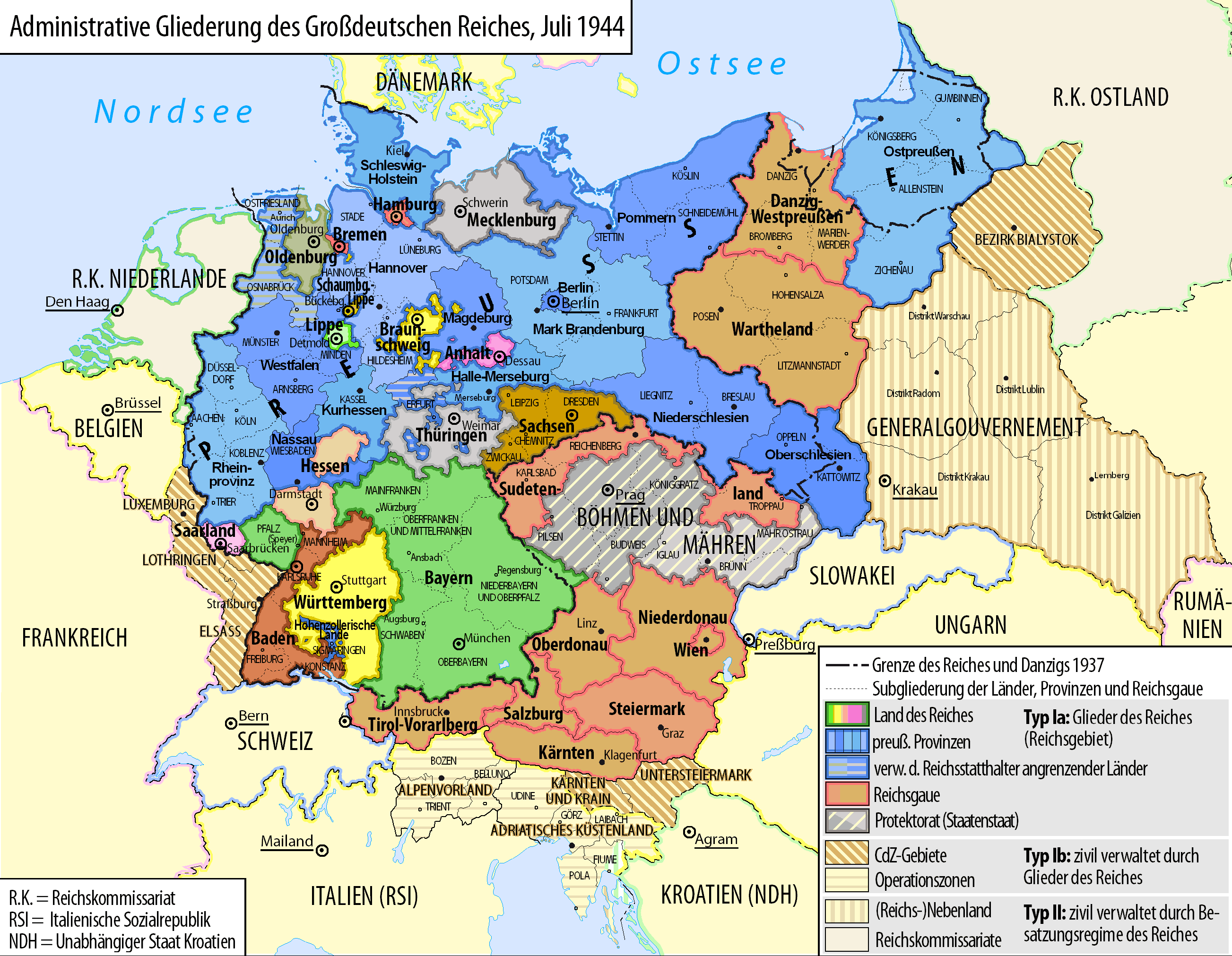
After Austria's Anschluss ("union") with Germany, its last pre-Anschluss Chancellor, Arthur Seyss-Inquart, became its first Reichsstatthalter and Führer der Österreichischen Landesregierung (Leader of the Austrian State Government) from 15 March 1938 to 30 April 1939. Also, Josef Bürckel was appointed Reichskommissar für die Wiedervereiningung Österreichs mit dem Deutschen Reich (Reich Commissioner for Reunification of Austria with the German Reich) from 23 April 1938 to 31 March 1940. At that point, each constitutive Land (with some differences in borders, e.g., Burgenland was partitioned away) was placed under the administration of its own Reichsstatthalter.
| Statthalter district | Seat | Incumbent | 3869414189}}. |
|---|---|---|---|
| Anhalt | |||
| Brunswick (Braunschweig) | Dessau | Wilhelm Friedrich Loeper | |
| Fritz Sauckel (acting) | |||
| Rudolf Jordan | 5 May 1933 | ||
| 29 November 1935 | |||
| 19 April 1937 | |||
| Baden | Karlsruhe | Robert Heinrich Wagner | 5 May 1933 |
| Bavaria (Bayern) | Munich | Franz Ritter von Epp | 10 April 1933 |
| Hamburg | Hamburg | Karl Kaufmann | 16 May 1933 |
| Hesse (Hessen) | Darmstadt | Jakob Sprenger | 5 May 1933 |
| Lippe | |||
| Schaumburg-Lippe | Detmold | Alfred Meyer | 16 May 1933 |
| Mecklenburg-Schwerin | |||
| Mecklenburg-Strelitz | |||
| Lübeck | Schwerin | Friedrich Hildebrandt | 26 May 1933 |
| Oldenburg | |||
| Bremen | Oldenburg | Carl Röver | |
| Paul Wegener | 5 May 1933 | ||
| 27 May 1942 | |||
| Prussia (Preußen) | Berlin | Adolf Hitler | |
| Hermann Göring (acting) | 25 April 1933 | ||
| 30 January 1935 | |||
| Saxony (Sachsen) | Dresden | Martin Mutschmann | 5 May 1933 |
| Thuringia (Thüringen) | Weimar | Fritz Sauckel | 5 May 1933 |
| Württemberg | Stuttgart | Wilhelm Murr | 5 May 1933 |
| Statthalter district | Seat | Incumbent and Dates in Office |
|---|---|---|
| Sudetenland | Reichenberg | Konrad Henlein: 1 May 1939 – May 1945 |
| Wartheland | Posen | Arthur Greiser: 21 October 1939 – 23 February 1945 |
| Danzig-West Prussia (Danzig-Westpreußen) | Danzig | Albert Forster: 26 October 1939 – 2 April 1945 |
| Carinthia (Kärnten) | Klagenfurt | Wladimir von Pawlowski: 1 April 1940 – 27 November 1941 |
| Friedrich Rainer: 27 November 1941 – 7 May 1945 (from April 1941, Head of the Civil Government of Lower Carinthia and Upper Carniola; from 10 September 1943, also Special Commissioner for the Adriatisches Küstenland, i.e. the North Adriatic Littoral) | ||
| Lower Danube (Niederdonau) | Vienna | Hugo Jury: 1 April 1940 – 8 May 1945 |
| Salzburg | Salzburg | Friedrich Rainer: 1 April 1940 – 29 November 1941 |
| Gustav Adolf Scheel: 29 November 1941 – 4 May 1945 | ||
| Styria (Steiermark) | Graz | Siegfried Uiberreither: 1 April 1940 – 8 May 1945 |
| Tyrol-Vorarlberg (Tirol-Vorarlberg) | Innsbruck | Franz Hofer: 1 April 1940 – 3 May 1945 (from 10 September 1943, also Special Commissioner for the Alpenvorland 'Alpine Foothills', i.e. Italian South Tyrol-Belluno, Bozen (Bolzano) and Trentino when integrated into Tyrol) |
| Upper Danube (Oberdonau) | Linz | August Eigruber: 1 April 1940 – 5 May 1945 |
| Vienna (Wien) | Vienna | Josef Bürckel: 1 April 1940 – 10 August 1940 |
| Baldur von Schirach: 10 August 1940 – 12 April 1945 | ||
| Westmark (Palatinate, the Saar, and Lorraine) | Saarbrücken | Josef Bürckel: 11 March 1941 – 28 September 1944 |
| Willi Stöhr: 29 September 1944 – 21 March 1945 |
References
- Alsace-Lorraine at worldstatesmen.org.
References
- Der Gross Ploetz,: Der Enzyklopadie der Welt Geschichte, Verlag Herder, p.978 {{ISBN. 3869414189.
This article was imported from Wikipedia and is available under the Creative Commons Attribution-ShareAlike 4.0 License. Content has been adapted to SurfDoc format. Original contributors can be found on the article history page.
Ask Mako anything about Reichsstatthalter — get instant answers, deeper analysis, and related topics.
Research with MakoFree with your Surf account
Create a free account to save articles, ask Mako questions, and organize your research.
Sign up freeThis content may have been generated or modified by AI. CloudSurf Software LLC is not responsible for the accuracy, completeness, or reliability of AI-generated content. Always verify important information from primary sources.
Report