From Surf Wiki (app.surf) — the open knowledge base
Reichsmark
Currency of Germany from 1924 to 1945
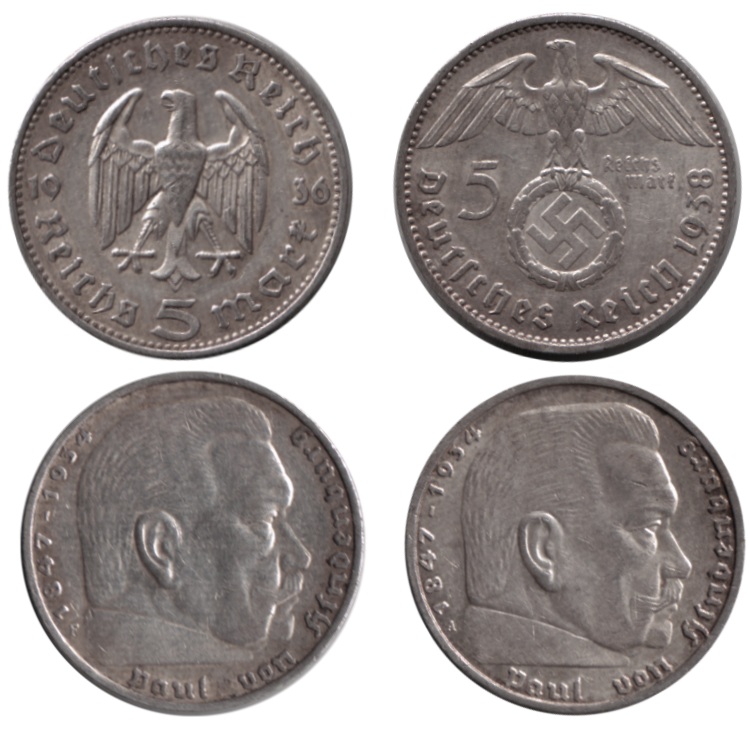
Currency of Germany from 1924 to 1945
| Field | Value | |
|---|---|---|
| currency_name | Reichsmark | |
| image_1 | 2ReichsMark.JPG | |
| image_title_1 | —coin depicting Paul von Hindenburg | |
| image_title_2 | —banknote depicting an allegorical German youth | |
| using_countries | {{plainlist | |
| pegged_by | Belgian franc, Bohemian and Moravian koruna, Bulgarian lev, Danish krone, French franc, Italian lira, Luxembourg franc, Dutch gulden, Norwegian krone, Polish złoty, Serbian dinar, Slovak koruna (1939–1945), Ukrainian karbovanets in World War II as similar rates | |
| subunit_ratio_1 | ||
| subunit_name_1 | Reichspfennig | |
| symbol | ℛ︁ℳ︁ | |
| plural | Reichsmark | |
| plural_subunit_1 | Reichspfennig | |
| used_coins | 1 ℛ︁₰, 2 ℛ︁₰, 5 ℛ︁₰, 10 ℛ︁₰, 50 ℛ︁₰, , , , | |
| used_banknotes | , , , , | |
| issuing_authority | Reichsbank | |
| iso_code | ||
| obsolete | yes | |
| date_of_introduction | 1924 | |
| replaced_currency | German Rentenmark | |
| date_of_withdrawal | {{plainlist | |
| replaced_by_currency | {{plainlist |
- Weimar Republic
- Nazi Germany
- Allied-occupied Germany}}
- June 20, 1948 (Trizone)
- June 23, 1948 (Soviet occupation zone of Germany)}}
- AM-Mark
- Deutsche Mark (West Germany)
- East German mark (East Germany)}}
The Reichsmark (; sign: ℛ︁ℳ︁; abbreviation: RM) was the currency of Germany from 1924 until the fall of Nazi Germany in 1945, and in the American, British and French occupied zones of Germany, until 20 June 1948. The Reichsmark was then replaced by the Deutsche Mark, to become the currency of West Germany and then all of Germany after the 1990 reunification. The Reichsmark was used in the Soviet occupation zone in Germany until 23 June 1948, where it was replaced by the East German mark. The Reichsmark was subdivided into 100 Reichspfennig (Rpf or ℛ︁₰). The Mark is an ancient Germanic weight measure, traditionally a half pound, later used for several coins; Reich (realm in English) comes from the official name for the German state from 1871 to 1945, Deutsches Reich.
History
The Reichsmark was introduced in 1924 as a permanent replacement for the Papiermark. This was necessary due to the 1920s German inflation which had reached its peak in 1923. The exchange rate between the old Papiermark and the Reichsmark was = 1012 ℳ︁ (one trillion in American English and French, one billion in German and other European languages and British English of the time; see long and short scale). To stabilize the economy and to smooth the transition, the Papiermark was not directly replaced by the Reichsmark, but by the Rentenmark, an interim currency backed by the Deutsche Rentenbank, owning industrial and agricultural real estate assets. The Reichsmark was put on the gold standard at the rate previously used by the German mark, with the U.S. dollar worth .
Expansion outside the Reichsmark
Main article: Öffa bills, Mefo bills
During this period a number of shell companies were created and authorized to issue bonds outside the Reichsmark in order to finance state projects. Nominally exchangeable at a 1:1 rate for Reichsmarks but then discounted by the Reichsbank this created secret monetary expansion without formally renouncing the gold standard of the Reichsmark.
World War II
With the annexation of the Federal State of Austria by Germany in 1938, the Reichsmark replaced the Austrian schilling. During the Second World War, Germany established fixed exchange rates between the Reichsmark and the currencies of the occupied and allied countries, often set so as to give economic benefits to German soldiers and civilian contractors, who were paid their wages in local currency. The rates were as follows:
| Currency | Date set | Value per |
|---|---|---|
| Belgian franc | May 1940 | Fr100 |
| July 1940 | Fr125 | |
| Bohemia and Moravia crown | April 1939 | K100 |
| Bulgarian lev | 1940 | Lev333.33 |
| Danish crown | DKr10 | |
| French franc | May 1940 | Fr200 |
| Italian lira | 1943 | Lit100 |
| Luxembourg franc | May 1940 | Fr40 |
| July 1940 | Fr100 | |
| Dutch guilder | 10 May 1940 | ƒ6.66 |
| 17 July 1940 | ƒ7.57 | |
| Norwegian crown | 1940 | NKr13.33 |
| ? | NKr17.50 | |
| Polish złoty | 1939 | zł20 |
| Sterling (Channel Islands) | 1940 | £017sd |
| Croatian kuna | April 1941 | Kn200 |
| Slovak crown | 1939 | Sk100 |
| 1 October 1940 | Sk116.20 | |
| Finnish mark | 1941 | FMk197.44 |
Post-war
After the Second World War, the Reichsmark continued to circulate in Germany, but with new banknotes (Allied Occupation Marks) printed in the US and in the Soviet zones, as well as with coins (without swastikas). Inflation in the final months of the war had reduced the value of the Reichsmark from = $1US to = $1US and a barter economy emerged due to the rapid depreciation.
After V-E Day, the Reichsmark's value decreased to 200 per dollar. While for German civilians one Allied Occupation Mark was equivalent to one Reichsmark, soldiers selling things civilians wanted on the black market could receive Reichsmarks, exchange them for Allied Occupation Marks, then exchange Allied Occupation Marks at ten per dollar. A carton of American cigarettes the post exchange sold to soldiers for $0.50 was worth 150 marks or $15 to German civilians; matches were the change.
The Currency Reform of 1948 replaced the Reichsmark with the Deutsche Mark at a rate of 10:1 (1:1 for cash and current accounts) in June 1948 in the Trizone and later in the same year by the East German mark in the Soviet Occupation Zone (colloquially also "Ostmark", since 1968 officially "Mark der DDR"). The reform under the direction of Ludwig Erhard is considered the beginning of the West German economic recovery; however, the secret plan to introduce the Deutsche Mark in the Trizone was formulated by economist Edward A. Tenenbaum of the US military government, and was executed abruptly on 21 June 1948. Three days later, the new currency also replaced the Reichsmark in the three Western sectors of Berlin. In November 1945, the Reichsmark was superseded by the Second Austrian schilling in Austria. In 1947, the Saar mark, later replaced with the Saar franc, was introduced in the Saar.
Coins


Denominations
In 1924, coins were introduced in denominations of 1 ℛ︁₰, 2 ℛ︁₰, 5 ℛ︁₰, 10 ℛ︁₰, and 50 ℛ︁₰, and 1 ℳ︁ and 3 ℳ︁.
File:1rpback.jpg|Prewar bronze 1 ℛ︁₰ (reverse). Made of pure bronze File:1939a5rprev.jpg|Prewar 5 ℛ︁₰ (reverse). Made of aluminium-bronze File:10rpgoldrev.jpg|Prewar 10 ℛ︁₰ (reverse). Struck in the same aluminium-bronze as the 5 ℛ︁₰. File:10rpgoldobv.jpg|Prewar 10 ℛ︁₰ (obverse)
File:1rp1943back.jpg|Wartime zinc 1 Reichspfennig (reverse) File:5rp1941aback.jpg|Wartime zinc 5 Reichspfennig (reverse) File:10rpzincrev.jpg|Wartime zinc 10 Reichspfennig (reverse) File:50rp1939eback.jpg|Aluminum 50 Reichspfennig coin (reverse)
4 {{lang|de|Reichspfennig}}
4 Reichspfennig coins were issued in 1932 as part of a failed attempt by the Reichskanzler Heinrich Brüning to reduce prices through use of 4 ℛ︁₰ pieces instead of 5 ℛ︁₰ coins. Known as the Brüningtaler or Armer Heinrich ('poor Heinrich'), they were demonetized the following year. See Brüningtaler . The quality of the Reichsmark coins decreased more and more towards the end of World War II and misprints happened more frequently. Since the 4 ℛ︁₰ coin was only slightly larger than the 1 ℳ︁ coin and the imperial eagle looked similar, an attempt was made to pass it off as a 1-reichsmark coin by silvering the 4 ℛ︁₰ coin.
10 {{lang|de|Reichspfennig}}
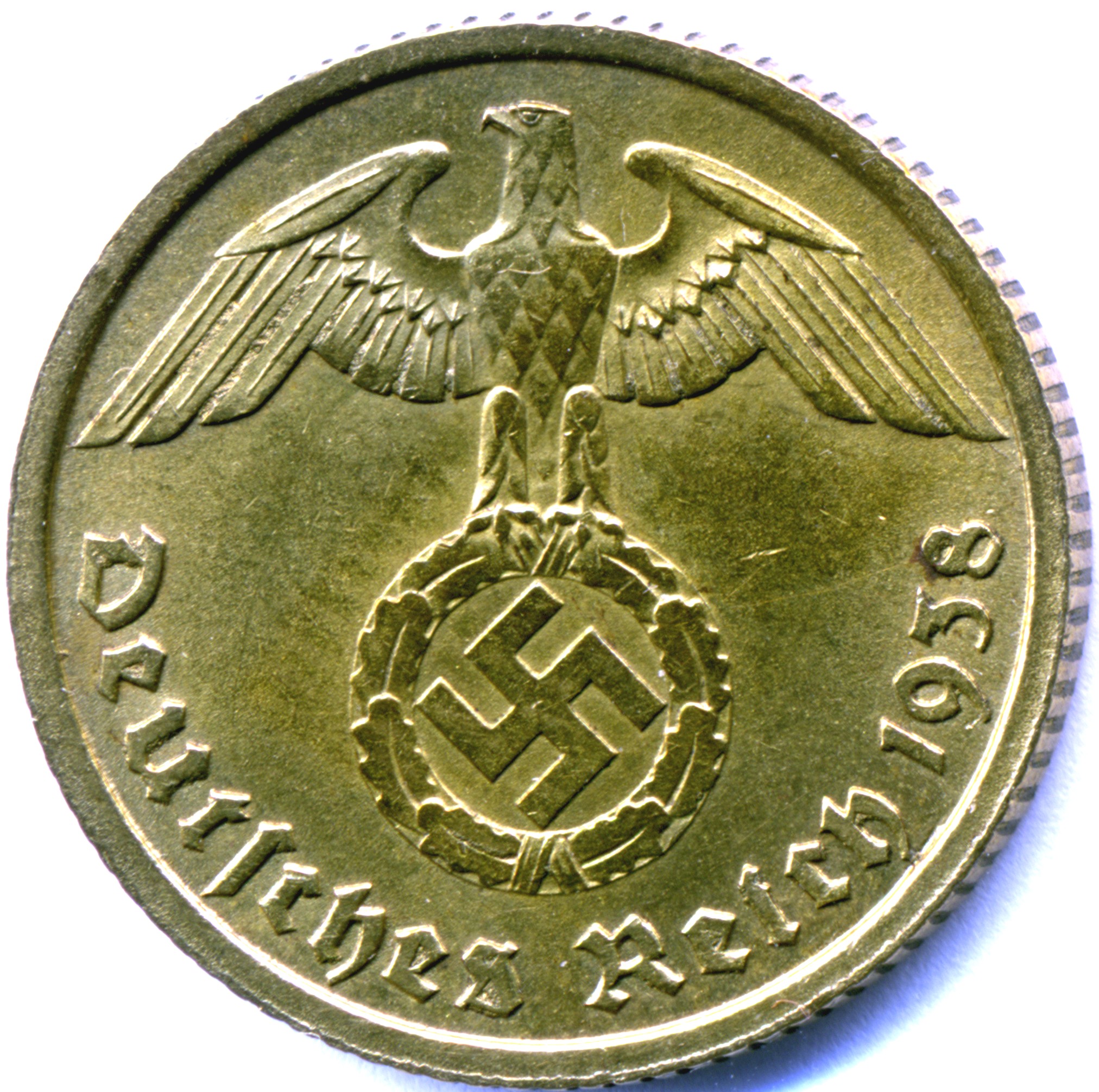
Lettering: Deutsches Reich 1940 Lettering: 10 Reichspfennig J
The zinc 10 Reichspfennig coin was minted by Nazi Germany between 1940 and 1945 during World War II, replacing the aluminium-bronze version, which had a distinct golden colour. It is worth or .10 of a Reichsmark. Made entirely of zinc, the 10 ℛ︁₰ is an emergency issue type, similar to the zinc 1 ℛ︁₰ and 5 ℛ︁₰, and the aluminium 50 ℛ︁₰ coins from the same period.
Mint marks
Nazi Germany had a number of mints. Each mint location had its own identifiable letter. It is therefore possible to identify exactly which mint produced what coin by noting the mint mark on the coin. Not all mints were authorized to produce coins every year. The mints were also only authorized to produce a set number of coins with some mints allocated a greater production than others. Some of the coins with particular mint marks are therefore scarcer than others. With the silver and coins, the mint mark is found under the date on the left side of the coin. On the smaller denomination Reichspfennig coins, the mint mark is found on the bottom center of the coin.
| Mint mark | Mint location | Notes | References |
|---|---|---|---|
| A | State Mint Berlin, Germany | Capital of Germany | |
| B | Austrian Mint Vienna, Austria | Capital of Austria | |
| D | Bavarian Central Mint Munich, Germany | Capital of Bavaria | |
| E | near Dresden, Germany | Capital of Saxony | |
| F | Stuttgart, Germany | Capital of Württemberg | |
| G | Karlsruhe, Germany | Capital of Baden | |
| J | Mint of Hamburg, Germany |
Mintage

| Year | Mintage | Notes |
|---|---|---|
| 1940 A | 212,948,000 | |
| 1940 B | 76,274,000 | |
| 1940 D | 45,434,000 | |
| 1940 E | 34,350,000 | |
| 1940 F | 27,603,000 | |
| 1940 G | 27,308,000 | |
| 1940 J | 41,678,000 |
| Year | Mintage | Notes |
|---|---|---|
| 1941 A | 240,284,000 | |
| 1941 B | 70,747,000 | |
| 1941 D | 77,560,000 | |
| 1941 E | 36,548,000 | |
| 1941 F | 42,834,000 | |
| 1941 G | 28,765,000 | |
| 1941 J | 30,525,000 |
| Year | Mintage | Notes |
|---|---|---|
| 1942 A | 184,545,000 | |
| 1942 B | 16,329,000 | |
| 1942 D | 40,852,000 | |
| 1942 E | 18,334,000 | |
| 1942 F | 32,690,000 | |
| 1942 G | 20,295,000 | |
| 1942 J | 29,957,000 |
| Year | Mintage | Notes |
|---|---|---|
| 1943 A | 157,357,000 | |
| 1943 B | 11,940,000 | |
| 1943 D | 17,304,000 | |
| 1943 E | 10,445,000 | |
| 1943 F | 24,804,000 | |
| 1943 G | 3,618,000 | Rare |
| 1943 J | 1,821,000 |
| Year | Mintage | Notes |
|---|---|---|
| 1944 A | 84,164,000 | |
| 1944 B | 40,781,000 | |
| 1944 D | 30,369,000 | |
| 1944 E | 29,963,000 | |
| 1944 F | 19,639,000 | |
| 1944 G | 13,023,000 |
| Year | Mintage | Notes |
|---|---|---|
| 1945 A | 7,112,000 | Rare |
| 1945 E | 4,897,000 | Rare |
Banknotes
The first Reichsmark banknotes were introduced by the Reichsbank and state banks such as those of Bavaria, Saxony and Baden. The first Reichsbank issue of 1924 came in denominations of , , , , and . This was followed by a second issue in the same denominations, dated between 1929 and 1936. The second issue commemorated persons who made contributions to German agriculture, industry, economy, science, and architecture: issued in 1929 commemorated agronomist Albrecht Thaer; issued in 1929 commemorated engineer, inventor, and industrialist Werner von Siemens; issued in 1933 commemorated Prussian politician and banker David Hansemann; 100 ℛ︁ℳ︁ issued in 1935 commemorated chemist and "father of fertilizer industry" Justus von Liebig; issued in 1936 commemorated Prussian architect Karl Friedrich Schinkel.
A newer version of note was introduced in 1939, using a design taken from an unissued Austrian S100 banknote type. notes were issued in 1942. Throughout this period, the Rentenbank also issued banknotes denominated in Rentenmark, mostly in RM 1 and RM 2 denominations.
In preparation for the occupation of Germany, the United States issued occupation banknotes dated 1944, printed by the Forbes Lithograph Printing Company of Boston. These were printed in similar colours with different sizes for groups of denominations. Notes were issued for ℳ︁, 1 ℳ︁, 5 ℳ︁, 10 ℳ︁, 20 ℳ︁, 50 ℳ︁, 100 ℳ︁, and 1,000 ℳ︁. The issuer was the Alliierte Militärbehörde ('Allied military authorities') with In Umlauf gesetzt in Deutschland ('in legal circulation in Germany') printed on the obverse.
These notes were convertible to US dollars at a rate of 10:1. Seeing an opportunity to procure foreign hard currency, the Soviet Union demanded copies of the engraving plates, ink, and associated equipment in early 1944, and on 14 April 1944 Henry Morgenthau and Harry Dexter White of the U.S. Treasury Department authorized the air transfer of these to the USSR. Using a printing plant in occupied Leipzig, the Soviet authorities printed large runs of occupation marks to fill Soviet coffers with dollars causing inflation and financial instability. An investigation by the United States Congress (Occupation Currency Transactions Hearings before the Committee on Appropriations, Armed Services and Banking and Currency, U.S. Senate, 1947) found that about $380,000,000 "more currency than there were appropriations for" had been circulated.
In 1947 Rhineland-Palatinate issued 5₰ and 10₰ notes with Geldschein on them.
File:20 Reichsmark 1924 Deutsche Reichsbank.png|, 1924 File:10 Reichsmark, Berlin 22. Januar 1929.JPG|, 1929 File:20 Reichsmark, Berlin 22. Januar 1929.JPG|, 1929
Occupation Reichsmark

Coins and banknotes for circulation in the occupied territories during the war were issued by the Reichskreditkassen. Holed, zinc coins in 5 ℛ︁₰ and 10 ℛ︁₰ denominations were struck in 1940 and 1941. Banknotes were issued between 1939 and 1945 in denominations of 50 ℛ︁₰, , , , , and . These served as legal tender alongside the currency of the occupied countries.
The coins were originally planned in great numbers of 100 million and 250 million each of the 5 ℛ︁₰ and 10 ℛ︁₰ coins respectively. The first embossing order, which was issued in April 1940, was about 40 million × 5 ℛ︁₰ and 100 million × 10 ℛ︁₰. The total amount was divided between each of the seven German mints after the embossing key of 1939. The contract was stopped in August 1940 as the Wehrmacht, which had requested the coins for Belgium and France, had no more need of it. When the embossing stopped, only Berlin ("A") and Munich ("D") produced significant quantities, but they still came to only a small extent of original production plans. The majority were melted down due to the limited supply of metal and thus, most mint marks are now quite rare (except for 1940 5 A and D, and 1940 10 A).
File:Nazi Coins 10 Reichskreditkassen-638x326.jpg|Currency of the occupied countries (1940 10 J) File:5 Reichskreditkassen 1940 B.jpg|Currency of the occupied countries (1940 5 B) File:50 Reichspfennig 1938-1945.png|50 ℛ︁₰, 1938–1945 File:1 Reichsmark 1938-1945.png|, 1938–1945 File:2 Reichsmark 1938-1945.png|, 1938–1945 File:5 Reichsmark 1938-1945.png|, 1938–1945 File:20 Reichsmark 1938-1945.png|, 1938–1945 File:50 Reichsmark 1938-1945.png|, 1938–1945
Concentration camp and POW Reichsmark currency
Various special issues of Reichsmark currency were issued for use in concentration and prisoner of war (POW) camps (Stalag). None were legal tender in Germany itself. From 1942 to 1943 tokens were struck for use within the Łódź Ghetto.
Military Reichsmark currency
Main article: AM-Mark
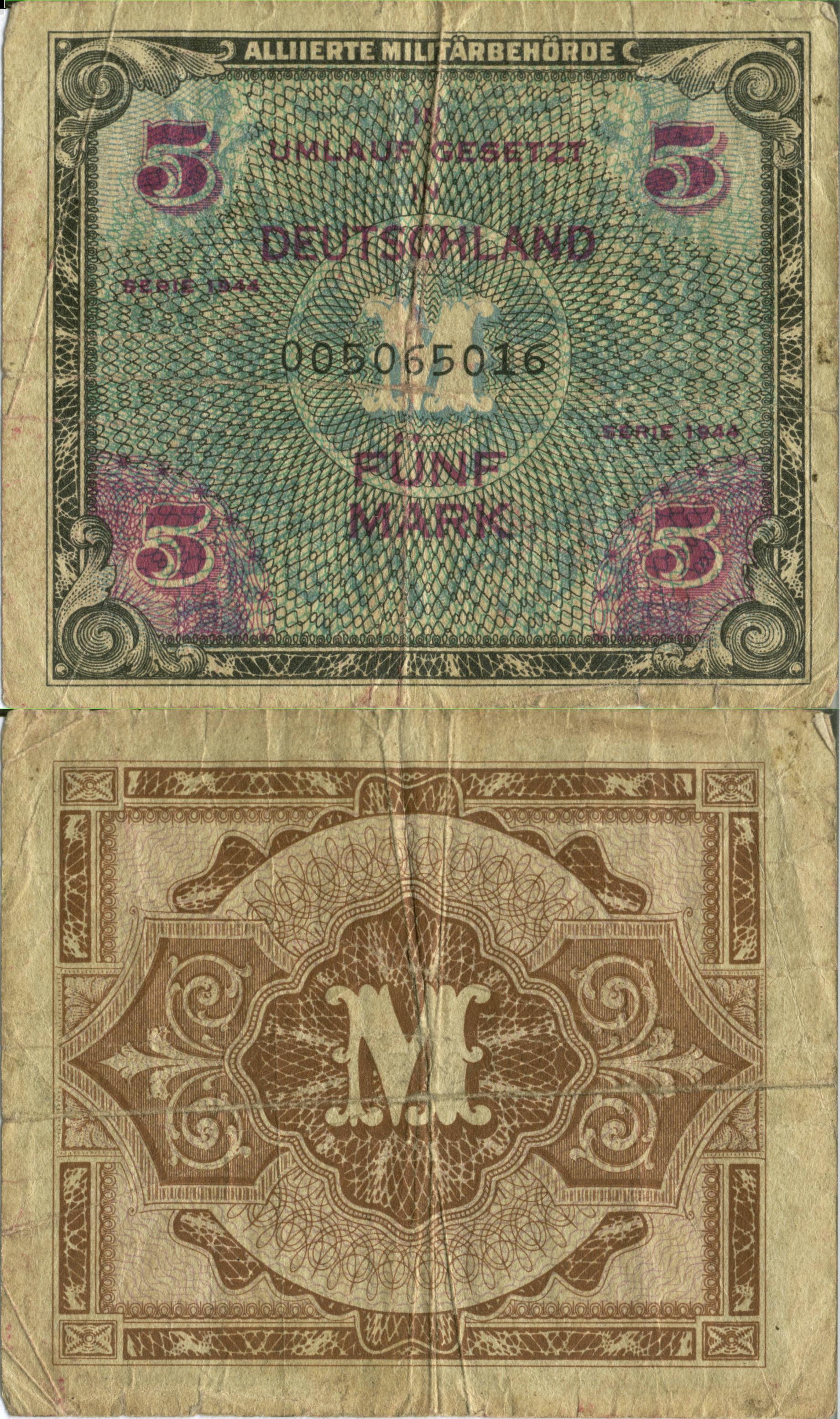
The 5 Mark note pictured, front and back, is Allied military currency ("AMC") printed at Forbes Lithograph Manufacturing Company in Boston for occupied Germany. There were different AMCs for each liberated area of Europe.
References
References
- (2023-02-14). "Reichspfennig – Schreibung, Definition, Bedeutung, Synonyme, Beispiele".
- Kofner, Yuri. (2023-01-03). "MIWI Institute – 150 years of German monetary history".
- Bastisch, Andre. (2007). "Arbeitsbeschaffungsmaßnahmen im Dritten Reich von 1933-1936". GRIN Verlag.
- Kopper, Christopher. (April 1998). "Banking in National Socialist Germany, 1933–39". Financial History Review.
- Ziemke, Earl F.. (1975). "The US Army in the Occupation of Germany, 1944-1946". Center of Military History, United States Army.
- "The Deutsche Mark and its Legacy".
- (15 November 1947). "Law 1947-2158 of 15 November 1947". [[Journal Officiel de la République Française]].
- "worldcoingallery.com/countries/Germany_all3.html".
- Matthias Kordes: ''Die Geschichte der Münzen in Westfalen von 1855–2005.'' In: Sparkasse Vest Recklinghausen (Hrsg.): ''150 Jahre Sparkasse Vest Recklinghausen. Gut für die Region.'' Sparkasse Vest Recklinghausen, Recklinghausen
- Dieter Petzina: ''Hauptprobleme der deutschen Wirtschaftspolitik 1932/33.'' In: ''[[Vierteljahrshefte für Zeitgeschichte]].'' 1967, 15. Jahrgang, Heft 1, S. 18–55 ([https://www.ifz-muenchen.de/heftarchiv/1967_1_2_petzina.pdf PDF]).
- ''Ausgabe neuer Reichskupfermünzen zu 4 Reichspfennig.'' In: ''Die Fahrt'', hrsg: [[Berliner Verkehrsbetriebe. Berliner Verkehrs-Aktiengesellschaft]], 4. Jg., Nr. 7 (1. April 1932), S. 49
- "Nazi Germany Coin Mint Marks".
- "10 Reichspfennig - Germany - 1871-1948 - Numista". Numista.
- "Lodz Ghetto Token Coinage".
- "Allied Military Currency". Strictly G.I..
This article was imported from Wikipedia and is available under the Creative Commons Attribution-ShareAlike 4.0 License. Content has been adapted to SurfDoc format. Original contributors can be found on the article history page.
Ask Mako anything about Reichsmark — get instant answers, deeper analysis, and related topics.
Research with MakoFree with your Surf account
Create a free account to save articles, ask Mako questions, and organize your research.
Sign up freeThis content may have been generated or modified by AI. CloudSurf Software LLC is not responsible for the accuracy, completeness, or reliability of AI-generated content. Always verify important information from primary sources.
Report