From Surf Wiki (app.surf) — the open knowledge base
Regional Assemblies in Ireland
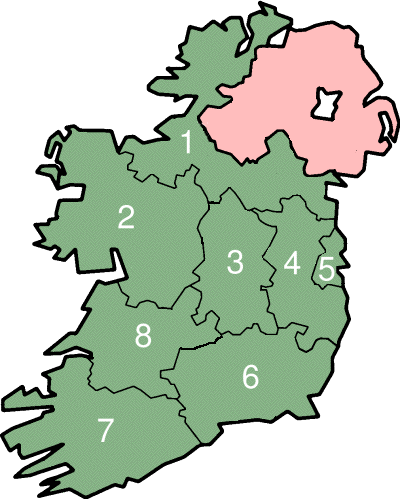
Regional Assemblies in the Republic of Ireland took their current form in 2015. They were established under the Local Government Act 1991, as amended by the Local Government Reform Act 2014. They have two main functions under this statute: to promote the co-ordination of public service provision and to monitor the delivery of European Structural and Investment Funds in the regions.
The Regional Assemblies replaced Regional Authorities, which had been established under the Local Government Act 1991 as enacted and came into existence in 1994. From 1999 to 2014, there were two Regional Assemblies, which existed above the Regional Authority structure.
Current regional assemblies
Following an amendment to the Local Government Act 1991 by the Local Government Reform Act 2014, the Regional Authorities were abolished and replaced by two Regional Assemblies in June 2014. Following a further adjustment, from 1 January 2015, there were three Regional Assemblies, each divided into Strategic Planning Committees. There are 3 regions, each of which is a NUTS 2 statistical region of Ireland. The regions are divided into strategic planning areas (SPAs), which are NUTS 3 statistical regions, roughly corresponding with the former regions under the Regional Authority system.
The areas of the Regional Assemblies:
| Regional Assembly | Strategic planning area | Local authorities |
|---|---|---|
| Northern and Western Regional Assembly | Border | Cavan, Donegal, Leitrim, Monaghan, Sligo |
| West | Mayo, Roscommon, Galway and Galway City | |
| Southern Regional Assembly | Mid-West | Clare, Tipperary, Limerick City & County |
| South-East | Carlow, Kilkenny, Wexford, Waterford City & County | |
| South-West | Kerry, Cork and Cork City | |
| Eastern and Midland Regional Assembly | Dublin | Dublin City, Dún Laoghaire–Rathdown, Fingal and South Dublin |
| Eastern | Kildare, Louth, Meath and Wicklow | |
| Midland | Laois, Longford, Offaly and Westmeath |
Membership
The members of the Regional Assemblies are nominated from the elected members of the local authorities in the region.
Former Regional Authorities and Regional Assemblies
-
Border Regional Authority
-
West Regional Authority
-
Midlands Regional Authority
-
Mid-East Regional Authority
-
Dublin Regional Authority
-
South-East Regional Authority
-
South-West Regional Authority
-
Mid-West Regional Authority ]] The Regional Authorities were established in 1994. In 1999, this structure was supplemented with the addition of Regional Assemblies.
| Regional Assembly Area | Regional Authority Area | Area |
|---|---|---|
| Border, Midland and Western | Border | County Cavan, County Donegal, County Leitrim, County Louth, County Monaghan and County Sligo |
| Midlands | County Laois, County Longford, County Offaly and County Westmeath | |
| West | County Galway, County Mayo, County Roscommon and Galway City | |
| Southern and Eastern | Dublin | Dublin City, Dún Laoghaire–Rathdown, Fingal and South Dublin |
| Mid-East | County Kildare, County Meath and County Wicklow | |
| Mid-West | County Clare, County Limerick, Limerick City and North Tipperary | |
| South-East | County Carlow, County Kilkenny, County Waterford, County Wexford, South Tipperary and Waterford City | |
| South-West | Cork City, County Cork and County Kerry |
The financing of the activities of the Regional Authorities was largely borne by their constituent local authorities. To assist the Regional Authority in undertaking its functions, each has an Operational Committee and an EU Operational Committee. The Operational Committee is chaired by the Cathaoirleach (Chairperson) of the Regional Authority and is composed of senior management from the constituent local authorities and other relevant public sector agencies operating in the region. It helps prepare the work of the Regional Authority and assists and advises it on matters relating to its functions. Also, each Regional Authority has a designated city/county manager (chief executive of a local authority) from one of its local authorities to further enhance the linkages between the local authorities and the Regional Authority.
Each local authority had a certain number of seats on a Regional Authority, based loosely on the population of the local authority area. The size of the Regional Authorities varied from 21 members in the Mid-East region to 37 members in the Border region.
The EU Operational Committee has a similar, but broader, composition and assists the Regional Authority in matters relating to EU assistance and reviewing the implementation of various EU Operational Programmes in a region.
Each Regional Authority had a Director, assisted by a number of policy and administrative staff.
The Regional Authorities had specific responsibility for:
- Reviewing the Development Plans of local authorities in their region and in adjoining regions;
- Preparing Regional Planning Guidelines and Regional Economic and Social Strategies;
- Promoting cooperation, joint actions, arrangements and consultation among local authorities and other public bodies.
On 1 June 2014, the functions of the Regional Authorities were transferred to the two Regional Assemblies as established in 1999, to create a single regional system. From 1 January 2015, these were replaced by three Regional Assemblies, with the former Regional Authority regions being succeeded by strategic planning areas, wholly within the Regional Assemblies.
References
References
- {{Cite Irish legislation. (2014). (27 January 2014)
- {{Cite Irish legislation. (2014). (29 May 2014)
- {{Cite Irish legislation. (2014). (16 December 2014)
- (October 2012). "Putting People First". Department of the Environment, Community and Local Government.
- "Revision to the Irish NUTS2 and NUTS3 regions". cso.ie.
- {{Cite EU regulation. (21 November 2016)
- "Regional assemblies".
- {{Cite Irish legislation. (1993). (20 December 1993)
- {{Cite Irish legislation. (1999). (19 July 1999)
This article was imported from Wikipedia and is available under the Creative Commons Attribution-ShareAlike 4.0 License. Content has been adapted to SurfDoc format. Original contributors can be found on the article history page.
Ask Mako anything about Regional Assemblies in Ireland — get instant answers, deeper analysis, and related topics.
Research with MakoFree with your Surf account
Create a free account to save articles, ask Mako questions, and organize your research.
Sign up freeThis content may have been generated or modified by AI. CloudSurf Software LLC is not responsible for the accuracy, completeness, or reliability of AI-generated content. Always verify important information from primary sources.
Report