From Surf Wiki (app.surf) — the open knowledge base
Red-violet
Overview of color term

Overview of color term
| Field | Value |
|---|---|
| title | Red-Violet / |
| Medium Violet Red (X11) | |
| hex | C71585 |
| source | X11 |
| isccname | Vivid purplish red |
Red-violet is a rich color of high medium saturation about 3/4 of the way between red and magenta, closer to magenta than to red. In American English, this color term is sometimes used in color theory as one of the purple colors—a non-spectral color between red and violet that is a deep version of a color on the line of purples on the CIE chromaticity diagram.
In use by some artists red-violet is equivalent to purple. Since violet and purple vary so much in meaning when comparing speakers from different countries and languages, there is much confusion.
The Munsell color system includes the hue term purple, and for some (especially US) speakers of English at the maximum chroma of 12, this refers to 'Red-Purple". This convention is for chromatic purposes, since Red-Purple lies between violet and printer's magenta (the color regarded as magenta before the invention of the web color magenta for computer displays).
Relationship of red-violet to other colors
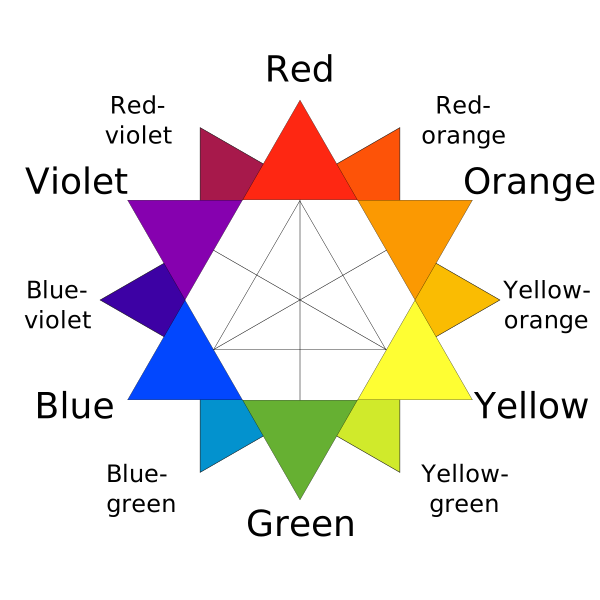
Red-violet is part of the red "analogous color group", which also includes magenta, red, red-orange, orange, gold, and yellow, i.e., those colors classified as "warm colors", or colors that produce a feeling of warmth (as opposed to "cool colors").
The color that is the complement of red-violet, mint green, lies halfway between green and spring green. It is very close to sea green but highly saturated and of a bright hue.
In some traditional usage, red-violet is the name given to an intermediate, or tertiary color that, along with yellow-orange (gold) and also green-blue (cyan), forms a color wheel triad group. Most contemporary usage, however, would list magenta as the name for the tertiary color in question.
Red-violet
Medium Violet Red (X11)
Red-violet or pigment purple (pigment red-violet) represents the way the color purple (red-violet) was normally reproduced in pigments, paints, or colored pencils in the 1950s on an old-fashioned RYB color wheel. This color is displayed at right.
The normalized color coordinates for red-violet are identical to medium violet red, which was first recorded as a color name in English with the formalization of the X11 color names over 1985–1989.
By the 1970s, because of the advent of psychedelic art, artists became used to brighter pigments, and pigments called "purple" or "bright purple" that are the pigment equivalent of electric purple became available in artist's pigments and colored pencils. Reproducing electric purple in pigment requires adding some white and a small amount of blue to red-violet pigment. Even then, the reproduction will not be exact, because it is impossible for pigment colors to be so bright as colors displayed on a computer.
Variations of red-violet
Kobi
At the right is displayed the color kobi.
The color name "kobi" for this light tone of red-violet has been in use since 2001, when it was promulgated as one of the colors on the Xona Color List.
Pink lavender
The color pink lavender is displayed at the right.
The source of this color is the "Pantone Textile Paper eXtended (TPX)" color list, color #14-3207 TPX—Pink Lavender.
Puce
Main article: Puce
Puce is a medium grayish red-violet color.
Pale red-violet===
The color pale red-violet (identical to the web color "pale violet red") is displayed at the right.
This color is a pale tone of red-violet.
Violet-red
The color violet red is displayed at the right. A bright tone of red-violet, it has been a Crayola color since 1958.
Cerise
The color cerise is displayed at the right. It is a deep- to vivid-reddish pink color.
Red-purple
Red-purple is the color that is called Rojo-Purpura (the Spanish word for "red-purple") in the Guía de coloraciones (Guide to colorations) by Rosa Gallego and Juan Carlos Sanz, a color dictionary published in 2005 that is widely popular in the Hispanophone realm.
Although "red-purple" is a seldom-used color name in English, in Spanish it is regarded as one of the major tones of purple.
Blush
The color blush is displayed at the right.
The first recorded use of "blush" as a color name in English was in 1590.
"Blush" has been a Crayola color since 1998. It was originally called "cranberry", until 2005.
Smitten
Displayed at the right is the color smitten.
"Smitten" is one of the colors on the Resene Color List, a color list widely popular in Australia and New Zealand. The color was formulated in 2011.
Medium red-violet
Medium red-violet is the medium tone of the color red-violet that is called "red-violet" in Crayola crayons. It has been a Crayola color since 1930.
Fandango
Displayed at the right is the color fandango.
The first recorded use of "fandango" as a color name in English was in 1919.
Flirt
At the right is displayed the color flirt.
The first recorded use of "flirt" as a color name in English was in 1928.
In 2001, "flirt" was included as one of the colors on the Xona Color List.
Popstar
Displayed at the right is the color popstar.
"Popstar" is one of the colors on the Resene Color List. It was formulated in 2006.
Jazzberry jam
The color jazzberry jam is displayed at the right.
This color, a deep shade of red-violet, was formulated by Crayola in 2003.
Wine
Main article: Wine (color)
At the right is displayed the color wine.
The color "wine" is a representation of the average color of red wine.

The first recorded use of "wine" as a color name in English was in 1705.
Byzantium
Main article: Byzantium (color)
The color Byzantium is displayed at the right.
The first recorded use of "byzantium" as a color name in English was in 1926.
Eggplant
Main article: Eggplant (color)
Eggplant is a dark purple or purplish brown, color that resembles the color of the outer skin of European eggplant. Another name for the color "eggplant" is aubergine (the French and British English word for eggplant).
The first recorded use of "eggplant" as a color name in English was in 1915.

The dark grayish-red-violet color shown in the color box as "eggplant" was introduced by Crayola in 1998.
Violet-red (Per Bang)
Violet-red (Per Bang) is the bright color of red-violet.
Wrapping the spectrum into a color wheel
If the visible spectrum is wrapped to form a color wheel, red-violet appears midway between red and magenta:


References
References
- (2004). "Color - the secret influence". Pearson Education.
- (2005). "Color terms in English: Onomasiological and Semasiological aspects". Onomasiology Online.
- (1989). "The Linguistic Field of Colour Terms in French". Zeitschrift für romanische Philologie.
- [http://xona.com/colorlist/ Xona.com Color List]
- [http://www.pantone.com/pages/pantone/colorfinder.aspx Pantone TPX]
- Type the words "Pink Lavender" into the indicated window on the Pantone Color Finder and the color will appear.
- [http://www.pantone.com/pages/pantone/colorfinder.aspx Pantone TPX Pantone Color Finder--Type the words "Pink Lavender" into the indicated window on the Pantone Color Finder and the color will appear:]
- [http://www.99colors.net/name/puce 99colors.net]
- The color displayed in the color box above matches the color called ''cerise'' in the 1930 book by Maerz and Paul, ''A Dictionary of Color'', New York: 1930, McGraw-Hill; the color ''cerise'' is displayed on Page 31, Plate 4, Color Sample J6.
- Gallego, Rosa; Sanz, Juan Carlos (2005). ''Guía de coloraciones'' (Gallego, Rosa; Sanz, Juan Carlos (2005). ''Guide to Colorations'') Madrid: H. Blume. {{ISBN. 84-89840-31-8
- Maerz and Paul ''A Dictionary of Color'' New York:1930 McGraw-Hill, p. 190; Color Sample of Blush Page 47 Plate 12 Color Sample A7
- [https://www.resene.co.nz/swatches/preview.php?chart=Resene%20The%20Range%202011%2F12&brand=Resene&name=Smitten Resene]
- [http://www.99colors.net/name/fandango]
- This color matches the color called ''Fandango'' in the book by Maerz and Paul ''A Dictionary of Color'' New York:1930 McGraw-Hill--Color Sample of Fandango Page 127 Plate 52 Color Sample L 10
- Maerz and Paul ''A Dictionary of Color'' New York:1930 McGraw-Hill, p. 195; Color Sample of Fandango Page 127 Plate 52 Color Sample L 10
- Maerz and Paul ''A Dictionary of Color'' New York:1930 McGraw-Hill Page 195
- [https://www.resene.co.nz/swatches/preview.php?chart=Resene%20The%20Range%202007&brand=Resene&name=Popstar Resene]
- {{usurped
- Maerz and Paul ''A Dictionary of Color'' New York:1930 McGraw-Hill Page 207
- {{usurped
- Maerz and Paul ''A Dictionary of Color'' New York:1930 McGraw-Hill Page 191; Color Sample of Byzantium: Page 111 Plate 44 Color Sample K7
- David Grambs. (1995). "The Describer's Dictionary: A Treasury of Terms and Literary Quotations". W. W. Norton & Company.
- William Yewdale Adams. (1986). "Ceramic Industries of Medieval Nubia". University Press of Kentucky.
- Mish, Frederic C., Editor in Chief ''Webster's Tenth New Collegiate Dictionary'' Springfield, Massachusetts, U.S.A.:1994--Merriam-Webster Page 369
- Maerz and Paul ''A Dictionary of Color'' New York: 1930 McGraw-Hill Page 194; Color Sample of Eggplant: Page 119 Plate 48 Color Sample H12
- [https://www.perbang.dk/rgb/F0599C/]
This article was imported from Wikipedia and is available under the Creative Commons Attribution-ShareAlike 4.0 License. Content has been adapted to SurfDoc format. Original contributors can be found on the article history page.
Ask Mako anything about Red-violet — get instant answers, deeper analysis, and related topics.
Research with MakoFree with your Surf account
Create a free account to save articles, ask Mako questions, and organize your research.
Sign up freeThis content may have been generated or modified by AI. CloudSurf Software LLC is not responsible for the accuracy, completeness, or reliability of AI-generated content. Always verify important information from primary sources.
Report