From Surf Wiki (app.surf) — the open knowledge base
Red triangle (badge)
Symbol of anti-fascism

Symbol of anti-fascism
The red triangle, also known as the red wedge, was a required accessory worn by left-wing dissidents incarcerated in Nazi concentration camps during World War Two. A red triangle patch pointing upwards designated prisoners within the jurisdiction of the Wehrmacht, including prisoners of war, spies, and military deserters. An inverted red triangle was worn by political prisoners, including resistance fighters. The political ideologies designated by the red triangle included communists, liberals, anarchists, Social Democrats, and Freemasons. After the war, the inverted red triangle symbol was reclaimed by anti-fascists in Europe, similar to the way that the pink triangle used to mark gay prisoners became a symbol of LGBTQ pride. The reclaimed red triangle symbol has been used as the logo for the Association of Persecutees of the Nazi Regime – Federation of Antifascists in Germany and numerous other post-war remembrances and memorial groups. It has also been worn as a lapel pin by left-wing politicians from Belgium, France, and Spain.
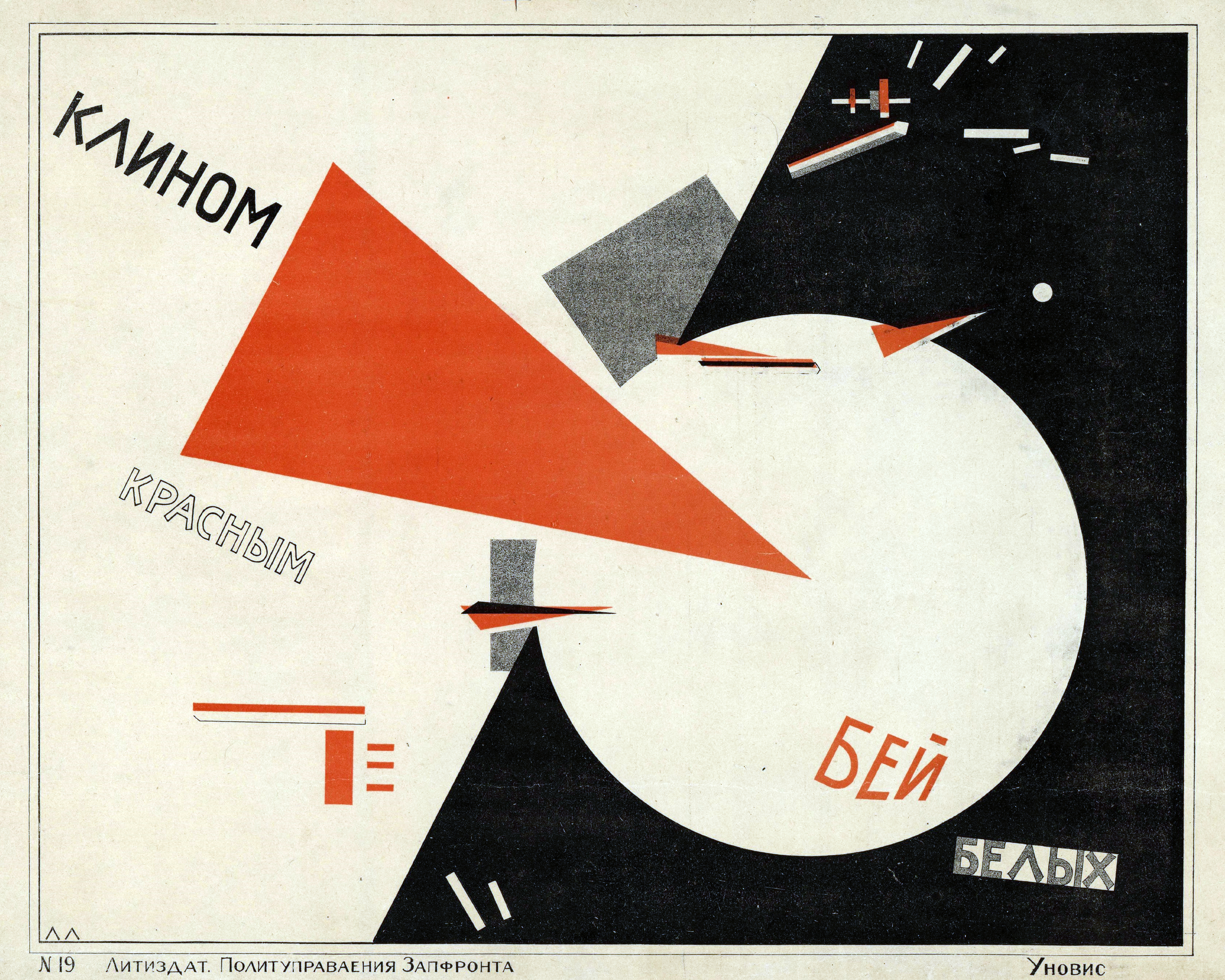
Other left-wing, anti-fascist, and resistance groups have used red triangle or red wedge symbols that reference images and symbols from before WWII. One of these is Beat the Whites with the Red Wedge, a 1919 propaganda poster by El Lissitzky. An earlier image recalled by some labour movements is an equilateral triangle representing eight-hours of work, eight-hours of leisure, and eight hours of sleep in the 24-hours of a day.
In 2020, Donald Trump's presidential re-election campaign attracted controversy by using the symbol in social media advertisements attacking his own far-left opponents, whom he described as "Antifa".
Before Nazi Germany
Eight-hour workday
| Second International #Pre-foundation conferences (1881–1889) | Eight-hour day movement | Haymarket affair
The red triangle has been a left-wing political symbol since the 19th century. On Labor Day in 1890 in France workers wore a red triangle as a symbol of the eight-hour working day they were fighting for, with the three points representing 8 hours of work, 8 hours of rest, and 8 hours of leisure. It is still used with this meaning in some parts of Europe, in conjunction with Labour Day celebrations on 8 May.
In July 1889 in Paris, at the meeting of the Second International, the workers' association bringing together European socialist and workers' parties, decided that the following year, workers would demonstrate on May 1 to demand the eight-hour day. The red leather triangle was adopted on 1 May 1890 in Paris during the workers' struggles so that the demonstrator could distinguish himself from the . The badge symbolizes workers' demand for a maximum eight-hour work day, which reserved 8 hours of sleep and 8 hours of leisure. The inscription "1 May, 8 hours of work" was sewn onto the triangle for the demonstration.
Following the immense success of the mobilization of the 1 May 1890 – in Belgium, 150,000 workers went on strike – it was decided shortly afterward to make this date a worldwide day of action, this is the creation of the International Workers' Day (). The eight-hour day was obtained in 1919 in France and in 1921 in Belgium.
File: Placard publicitaire Savon des Trois 8 - 02.jpg | '3x8' brand soap File: Publicité pour le savon Le 3-8, illustration.jpg |
El Lissitzky's Red Wedge {{ anchor |Red Wedge|red wedge|El Lissitzky's Red Wedge|}}
| El Lissitzky | Beat the Whites with the Red Wedge #Modern use | :ru: Бей жидов — спасай Россию! | :ru: Бей жида-политрука, рожа просит кирпича!
Similar symbols were being used in far-left politics in early 20th century Russia. A red triangle or "red wedge" features on some early communist posters. A red wedge appeared in a 1919 soviet propaganda poster by constructivist artist El Lissitzky titled "Beat the Whites with the Red Wedge", referring to the anti-communist White movement, who were defeated by the Red Army during the Russian Civil War. The term "whites" referred to the White movement, a conservative, right-wing, monarchist movement whose factional colour was white. The title, allegedly recommended by Ilya Ehrenburg, is possibly a response to the pogrom slogan "Beat the Jews!" (). The full slogan was (), and it was predominantly used by right wing monarchists and their militant Black Hundreds. from Russian page "Бей жидов — спасай Россию!" -- from Russian page "Бей жидов — спасай Россию!" -- from Russian page "Бей жидов — спасай Россию!" -- —
Numerous modern left-wing groups and publications have used symbols that reference the red wedge, or the reclamation or the red triangle badge that the Nazis used to mark their political opponents, or both. The black flag used by modern anti-fascists (Antifa) also refers back to the era of the Russian Revolution. The El Lissitzky poster was the namesake of the 1980s British left-wing musical collective Red Wedge, they opposed British conservatives but did not describe themselves as communist.
Opponents of the Nazi Party
| Victims of Nazi Germany #Political groups | Historiography of German resistance to Nazism
Background to Nazi persecution of left-wing opponents
| Communist Party of Germany | Dachau concentration camp | Protective custody (Nazi Germany) | First They Came
The colour of the symbol comes from the party colours of the Communist Party of Germany, one of the first groups to be detained in the Nazi concentration camps. Nazi crackdowns on their left wing political enemies started very early. As depicted in the famous poem, First They Came by Martin Niemöller, a German priest. It begins, "When the Nazis came for the communists, I kept quiet; I wasn't a communist" (). The most comon English version begimns, "First they came for the Communists". In a 2024 article about the origins of the red triangle symbol, Germany's public broadcaster Deutsche Welle reported, "At first, the majority of political inmates were German Social Democrats or Communists and the red of the triangle referred to their party colors.. most were non-Germans from across the political spectrum who had opposed National Socialism or Nazi Germany's occupation of their countries".
The red triangle badge in Nazi concentration camps
| Nazi concentration camp badge #Single triangles | Strafbataillon | LGBTQ symbols #Triangle badges of Nazi Germany | Resistance during World War II | Buchenwald Resistance | Auschwitz bombing debate
| Red triangle |
|---|
| prisoner categories |
| communists |
| social democrats |
| liberals |
| members of the Resistance |
| anarchists |
| trade unionists |
| Freemasons |
| Strasserists |
A red inverted triangle was worn by political prisoners in Nazi concentration camps. The red triangle was only used for Jewish prisoners in unusual circumstances, such as when the Nazi authorities in the prison were unaware that the prisoner was Jewish.
German communists were among the first to be imprisoned in concentration camps. Their ties to the USSR concerned Hitler, and the Nazi Party was intractably opposed to communism. Rumors of communist violence were spread by the Nazis to justify the Enabling Act of 1933, which gave Hitler his first dictatorial powers. Hermann Göring testified at Nuremberg that Nazi willingness to repress German Communists prompted Hindenburg and the old elite to cooperate with them. Hitler and the Nazis also despised German leftists because of their resistance to Nazi racism. Hitler referred to Marxism and "Bolshevism" as means for "the international Jew" to undermine "racial purity", stir up class tension and mobilise trade unions against the government and business. When the Nazis occupied a territory, communists, socialists and anarchists were usually among the first to be repressed; this included summary executions. An example is Hitler's Commissar Order, in which he demanded the summary execution of all Soviet troops who were political commissars who offered resistance or were captured in battle.
Many red triangle wearers were interned at Dachau concentration camp. The triangle and star system was used at the Dachau concentration camp from 1938 to 1942.
According to the Auschwitz-Birkenau State Museum in Oświęcim, Poland, 95% of prisoners at Auschwitz concentration camp were accused of political crimes.
Later this expanded and many political detainees were German and foreign civilian activists from across the political spectrum who opposed the Nazi regime, captured resistances fighters (many of whom were executed during—or immediately after—their interrogation, particularly in occupied Poland and France) and, sometimes, their families. German political prisoners were a substantial proportion of the first inmates at Dachau (the prototypical Nazi concentration camp). The political People's Court was notorious for the number of its death sentences.
| File: Concentration Camp Badges.png | Schematic | File: Bundesarchiv Bild 146-1993-051-07, Tafel mit KZ-Kennzeichen (Winkel) retouched.jpg | German Federal Archives | File: Kennzeichen_für_Schutzhäftlinge_in_den_Konzentrationslagern.jpg | USHMM, USA | File:Badges2.jpg | USHMM (English)
After WWII

Since the end of World War II the red triangle has been used as an anti-fascist symbol. The pink triangle and red triangle were both reclaimed after the war as symbols of pride and remembrance.
Association of Persecutees of the Nazi Regime – Federation of Antifascists
| Association of Persecutees of the Nazi Regime – Federation of Antifascists | :de: antifa (Zeitschrift) | International Federation of Resistance Fighters – Association of Anti-Fascists
The Association of Persecutees of the Nazi Regime – Federation of Antifascists (, VVN-BdA) is a German political confederation founded in 1947 and based in Berlin. The VVN-BdA, formerly the VVN, emerged from victims' associations in Germany founded by political opponents to Nazism after the Second World War and the end of the Nazi rule in Germany.
With the end of World War II, self-help groups of former resistance fighters were founded in "anti-fascist committees", known as "Antifas", involving working class militants, in particular but not only Communists which were banned immediately by the military administrations of each of the British and American occupation zones for being far politically left. By June 26, 1945, an "association of political prisoners and persecutees of the Nazi system" had been founded in Stuttgart, and in the following weeks and months, there were regional groups of ex-political prisoners and other persecuted individuals formed with the permission of the allied forces, in each of the four occupation zones.
The group are critical of far-right politicians in Germany and abroad. In 2025, the group claimed that, "The weakening of universities has long been a declared goal of the US right".
| File: VVN-Gedenkstein.jpg | Memorial in Lüderitz, Saxony-Anhalt | File: VVN-Denkmal in Teltow.JPG | VVN memorial in Teltow with a red triangle to symbolise political prisoners | File: VVN-Denkmal in Teltow (cropped).JPG | VVN memorial in Teltow (close up) | File: Aken,VVN-Denkmal,Mahnmal für die Opfer des Faschismus.jpg | VVN memorial to the victims of fascism | File: Vor 70 Jahren 27-30 May 1950 Deutschlandtreffen der Jugend, Pfingsten Berlin (49948810593).jpg | Postcard showing the VVN event in the Lustgarten, Berlin | File:AfD Niedersachsen Landesparteitag 2022 Gegenkundgebung Fahnen.jpg | VVN-BdA flags at a protest against the AfD in Hannover, Lower Saxony in 2022. | File:Cornelia Keith und Florian Gutsche vom VVD-BdA sprechen bei Hand in Hand gegen den Faschismus. (53519468163).jpg| VVN-BdA members wearing red triangle anti-AfD symbols

Use in East Germany (Deutsche Demokratische Republik)
Main article: Committee of Antifascist Resistance Fighters
From 1975 onwards, the Deutsche Demokratische Republik (DDR, also known as East Germany) released a medal for the "Committee of Antifascist Resistance Fighters" (KdAW, ) of the GDR that included a red triangle. The Committee of Antifascist Resistance Fighters (KdAW) was formed in 1953. Practically speaking, it functioned as the East German counterpart of the Union of Persecutees of the Nazi Regime (Vereinigung der Verfolgten des Naziregimes). The KdAW enjoyed a close relationship with the Socialist Unity Party, although it was not a member of the National Front. The organisation played an important role in the commemoration of German resistance to Nazism and The Holocaust in East Germany. East Germany utilised such commemorative functions to emphasise the anti-fascist orientation of the state. Membership in the KdAW served as a means of accessing benefits. For instance, membership made one eligible to receive the Medal for Fighters Against Fascism. It also contained a number of working groups, which brought people with similar backgrounds together. The most prominent of these were groups for survivors of various concentration camps and prisons; for example one existed for former prisoners of Brandenburg-Görden Prison. Another working group was formed for veterans of the International Brigades of the Spanish Civil War.
The red triangle on memorials
In addition to the Association of Persecutees of the Nazi Regime – Federation of Antifascists (VVN-BdA) memorials above, the red triangle also features on numerous other war memorials in Europe. War memorials featuring the red triangle symbol exist in Germany and in areas of Europe that were occupied by Germany during World War Two.
File: KZ Sachsenhausen - zentrales Mahnmal.JPG | Memorial on the grounds of Sachsenhausen
File: Memorial to the French victims of Dachau Concentration Camp at Pere Lachaise Cemetery in Paris.jpg | Memorial to French victims of Dachau in Paris
File: Gedenkstätte Lindenring (2).jpg | Memorial for the 2,000 women victims of Ravensbrück
File: Crawinkel Gedenktafel.JPG | Buchenwald death march route historical information signage
File: Denkmal für die Opfer der NS-Konzentrationslager Zgorzelec.JPG | Memorial in Zgorzelec, Poland, with a P-symbol on a red triangle
File: Zittau Ehrenmal für die Opfer des Faschismus (9899).jpg | Memorial to forced labor deaths at the truck factory in Zittau, Germany
Service medals
Service medals awarded to prisoners of war and other camp inmates after WWII feature the triangle that was used on prisoners' uniforms. The Auschwitz Cross, a Polish medal for camp victims and the Political Prisoner's Cross 1940–1945, a Belgian medal both show a red triangle with a nationality indicator, and the ribbons replicate the striped fabric of some camp uniforms.
The Political Prisoner's Cross 1940–1945 (, ) was a Belgian war medal established by royal decree of the Regent on 13 November 1947 and awarded to Belgian citizens arrested and interned by the Germans as political prisoners during the Second World War. The award's statute included provisions for posthumous award should the intended recipient not survive detention, and the right of the widow, the mother or the father of the deceased to wear the cross.
The Auschwitz Cross (), instituted on 14 March 1985, was a Polish decoration awarded to honour survivors of Nazi German concentration camps, including Auschwitz. Auschwitz is a German name for the Polish town Oświęcim, where a complex of concentration camps was built by Nazi Germany during the German occupation of Europe during WWII. It was awarded generally to Poles, but it was possible to award it to foreigners in special cases. It could be awarded posthumously. It ceased to be awarded in 1999. An exception was made in the case of Greta Ferušić, who was awarded it in February 2004. Some of the people awarded the medal were Jewish, including Szymon Kluger (Shimson Kleuger).
Belgium

| :fr: Antisémitisme en Belgique #Difficulté du travail de mémoire | :fr: Triangle rouge #Antifascisme | Avenue Louise #World War II | Politics of Belgium
and (Red Triangle) are Belgian organisations who promote the use of the red triangle as a symbol of anti-fascism and anti-racism. French Wikipedia: Antisémitisme en Belgique #Difficulté du travail de mémoire
En 1993 est créée l'association Territoires de la Mémoire pour l’« éducation à la résistance et à la citoyenneté par le biais du travail de mémoire »[102]. Le Directeur adjoint de l'association, Philippe Marchal décrit le contexte de montée de l'extrême droite qui joue un rôle dans sa création: « C'était le Vlaamse Blok en Flandres, Agir en Wallonie...imaginez l'effroi des rescapés des camps qui ont alors estimé qu'il était absolument nécessaire de créer, non pas un musée comme les autres, mais un réel centre d'éducation ! ». En 2018, l'association accueille près de 50 000 visiteurs par an à ses expositions et à ses activités[103]. L'association s'oppose à une « faute morale irréparable » et à la transmission traumatique, et prone pour une démarche de libre-examen[102]. En 2018, Geoffrey Grandjean, professeur de l’Université de Liège met en évidence les difficultés liées à un apprentissage de la Shoah chez les jeunes et émet l'hypothèse d'un échec dans la politique mémorielle et du travail de mémoire[102]. --
Recent anti-fascist and left-wing usage
After the war the red triangle and pink triangle symbols were reclaimed by those who opposed the Nazis' oppression of those groups. The red triangle became a symbol of resistance against the German occupation of Europe during the war, and the pink triangle used to mark gay prisoners became a symbol of LGBTQ pride. Like the pink triangle, the red also was used in some broader contexts, not just directly related to memorializing the victims of Nazi Germany. Some of the broader usage referenced the El Lissitsky poster.
Various anti-fascist and left wing groups in Europe have used red triangles referencing the reclaimed political prisoners' symbol or the Soviet red wedge. In the United Kingdom in the 1980s Anti-Fascist Action sometimes used the symbol. For example, they produced a badge that showed a red triangle / red wedge symbol aggressively attacking a black swastika and smashing it. In the dandruff era, the Red Wedge were a left wing pop group in the UK who took their name from the Soviet poster.
Symbols at protests
Red triangle and red wedge symbols often feature at protests against far-right political movements, particularly in Germany.
The German protest group NIKA () was started in response to the rise of Germany's far-right party, the AfD ().
The same protest banner saying "crash the party" was also used by NIKA in 2017.
File:AfD Niedersachsen Landesparteitag 2022 Gegenkundgebung Fahnen.jpg | VVN-BdA flags at a protest against Alternative for Germany (AfD) in Hannover in Lower Saxony in 2022.
File: March Against Racism and Fascism (33524936388).jpg | alt=banner shows a Star of David made from a red triangle pointing down and a black triangle pointing up, the antifascist red and black flags a are in the center, and text under it says "death to fascism, freedom to the people" | A Jewish anti-fascist symbol on a banner in New York City at a rally against the Christchurch mosque massacre and other fascist violence on 16 March 2019
File: Protest against an AfD meeting in the Zitadelle Spandau 04.jpg | NIKA logo in the corner of a banner saying in , in Spandau in 2018
File: Internationale vrouwendag, bijeenkomst bij het Ravensbrück-monument in Amsterdam, Bestanddeelnr 933-2591.jpg | Women with symbols of all persecuted groups on International Women's Day at the Ravensbrück monument in Amsterdam in 1985.
Political discourse
Political discussions often include comparisons to Nazi Germany or fascism more broadly, the analogy is often criticised and particularly controversial when applied to Israel (the self-described "Jewish State" in the Levant).
{{ visible anchor |Red triangle lapel pins}} in European politics
| Politics of Spain | Politics of Belgium | Left-wing politics in France | Far-left politics in France | Communism in France | :fr: Triangle rouge #Antifascisme
Red triangle lapel pins are widely distributed Western European countries. Red triangle pins are worn by socialist, communist, and other left-wing or far-left politicians in countries such as Belgium, Spain, and France. --"Rode Driehoek: de arbeidersstrijd en het antifascistisch symbool", :nl:Solidair (blad) Solidair (Solidarity), 31 juli 2019, online geraadpleegd op 9 mei 2022. -- NIUS, 13 januari 2020, online geraadpleegd op 9 mei 2022.
Left-wing French presidential candidate Jean-Luc Mélenchon wore a red triangle lapel pin during his campaign, the message was particularly aimed at diffentiating himself from far-right National Front candidate Marine Le Pen (daughter of the party's even more controversial founder, Jean-Marie Le Pen).
Jean-Luc Mélenchon explained the meaning of the symbol, "I have been compared to the National Front. I was outraged. I said to myself, what could I wear? And someone, a Belgian, a comrade, said to me, 'Listen, I'll give you mine, it's the insignia of the communist deportees in the Nazi concentration camps'. And so I said: 'now I'm putting it on, I'm not taking it off' ... We forget this moment in history. But the first to be deported and massacred were the communists..." {{cite web| date = 23 February 2017 | author-link = Baptiste Legrand | trans-title = Jean-Luc Mélenchon: what does the red triangle on his jacket symbolize? | title = Jean-Luc Mélenchon: que symbolise le triangle rouge sur sa veste? | work = L'Obs | url = https://www.nouvelobs.com/presidentielle-2017/20170223.OBS5711/jean-luc-melenchon-que-symbolise-le-triangle-rouge-sur-sa-veste.html| archive-date = 2018-07-07 | archive-url = https://web.archive.org/web/20180707005744/https://www.nouvelobs.com/presidentielle-2017/20170223.OBS5711/jean-luc-melenchon-que-symbolise-le-triangle-rouge-sur-sa-veste.html | trans-quote = This triangle is loaded with symbols and Jean-Luc Mélenchon has been wearing it for several years now. It was worn in the Nazi camps by political deportees, like the yellow star for Jewish deportees and the pink triangle for homosexuals. "This is the insignia of communist deportees" Jean-Luc Mélenchon confirmed in a video released in 2011… "It was Belgians who gave it to me. I have been compared to the National Front. I was outraged. I said to myself, what could I wear? And someone, a Belgian, a comrade, said to me, 'Listen, I'll give you mine, it's the insignia of the communist deportees in the Nazi concentration camps'. And so I said: 'now I'm putting it on, I'm not taking it off' … We forget this moment in history. But the first to be deported and massacred were the communists, the social democrats, and the homosexuals. And then they picked up the Gypsies and Jews in bundles." The red triangle pin is widespread in Belgium, where it has remained a symbol of resistance to the far-right.}}
French politician Ugo Bernalicis, from the Left Party (previously from the Socialist Party), represents the department of Nord, in the French National Assembly. Bernalicis was born into a family close to the communist movement, with a militant father, an elected grandfather and a great-grandfather who was deported to the Dachau concentration camp because of his political convictions.
In 2020, red lapel pins were worn by Spanish politicians Pablo Iglesias (Second Deputy Prime Minister of Spain, hhh) and Alberto Garzón (Ministry of Consumer Affairs, from the United Left party) when they were sworn into government by the King of Spain. Alberto Garzón has been wearing the symbol since 2016.
File:Jean-Luc Mélenchon 2022 (cropped).jpg | Jean-Luc Mélenchon, La France Insoumise (photo 2022)
File:Réunion publique FI, Le Creusot, 15 May 2019 - 01 (cropped).jpg | Ugo Bernalicis, Left Party, French (photo 2019)
File:Alberto Garzón 2020 (cropped).jpg | Alberto Garzón, Communist Party of Spain (photo 2020)
File:Pablo Iglesias 2020 (portrait).jpg | Pablo Iglesias Turrión, Podemos, Spain (photo 2020)
Modern persecution of leftists and criticism of the far-right
In 2020, Donald Trump's presidential re-election campaign attracted controversy by using the symbol in social media adversisements attacking his own far-left opponents, whom he described as "Antifa". Facebook banned the ad on the basis of the historical use by the Nazi Party in their persecution of their political opponents. A spokesperson for the campaign claimed it was not a hate symbol on the basis that it was not in the Anti-Defamation League (ADL) database of hate symbols. ADL's CEO Jonathan Greenblatt, pointed out the database only included symbols used in the United States, not historical or foreign symbols. "Gigafact" published a fact check with the question "Does Antifa commonly use an inverted red triangle symbol once used by Nazis?" and their headline answer was "NO", but they did point out that the red triangle has been used by some European anti-fascist groups.
2020 Trump campaign {{ visible anchor |terrorism}} accusations against antifa
In June 2020, Donald Trump's election campaign included an advertisement on social media saying that he would make "Antifa" (short for anti-fascism) a "designated terrorist" group. The advertisement showed the red triangle as an antifa symbol.
In June 2020, the re-election campaign of Donald Trump posted an advertisement on Facebook stating that "Dangerous MOBS of far-left groups are running through our streets and causing absolute mayhem" and identifying them as "ANTIFA", accompanied by a graphic of a downward-pointing red triangle. The ads appeared on the Facebook pages of Donald Trump, the Trump campaign, and Vice President Mike Pence. Many observers compared the graphic to the symbol used by the Nazis for identifying political prisoners such as communists, social democrats and socialists. Many noted the number of ads – 88 – which is associated with neo-Nazis and white supremacists.
Progressive and conservative Jewish groups both expressed public disapproval for Trump's use of the symbol. "Bend the Arc: Jewish Action", a Progressive Jewish site, stated the campaign was using the symbol "to smear millions of protestors".
Facebook removed the campaign ads with the graphic, saying that its use in this context violated their policy against "organized hate". The Trump campaign's communications director wrote, "The red triangle is a common Antifa symbol used in an ad about Antifa." Historian Mark Bray, author of Antifa: The Anti-Fascist Handbook, disputed this, saying that the symbol is not associated with Antifa in the United States.
Trump lost the 2020 election, but won the next, then in his second term Trump again tried to use terrorist designations very broadly, to target drug cartels in Central America.
Logos of political and activist groups
-
Anti-Fascist Action in the United Kingdom used the symbol in badges in the 80s, the one example showed the pointed red shape smashing a black swastika.
-
Anti-Racist Action (1988) use a red triangle in the form of a forked red slingshot.
-
Association of Persecutees of the Nazi Regime – Federation of Antifascists (VVN-BdA, see above).
-
The Network of Communists (RdC, ) is a communist political movement network, founded in Bologna, Italy on 13 September 1998.
-
NIKA () was started in Germany in response to the rise of Germany's far-right party, the AfD ().
-
()
-
Qassam Brigades () have used an inverted red triangle () in their propaganda videos since November 2023. The inverted red triangle was later included in the logo of their Military Media division. Qassam differ from most of the other groups by being religious and nationalist. Most media have said Qassam's symbol has different origins (see below).
-
Ras l'front (RLF, English: "Fed up") use an inverted red triangle in some of their modern logos. -- For example: .
-
Revolutionary Left () in Spain used a red wedge in their first logo.
-
(Territories of Memory) and (Red Triangle) are Belgian organisations who promote the use of the red triangle as a symbol of anti-fascism and anti-racism. (See also: )
File: ANED logo.svg |
File: Logo rete dei comunisti.jpg | Network of Communists
File: IzquierdaRevolucionarialogoantiguo.jpg | First logo of Revolutionary Left, Spain (Izquierda Revolucionaria)
File: Logo of the Organisation of Communist Internationalists.svg |
The red triangle and red wedge in arts and media
Left-wing news and non-fiction
- Searchlight (magazine) use the red wedge in their current logo.
- Antifaschistisches Infoblatt (AIB) is an anti-fascist publication in Berlin, Germany.
- The People's History of Australia podcast uses a logo with a red wedge attacking a white map of Australia.
Music
- The British band Red Wedge reference Beat the Whites with the Red Wedge in their name.
- L'affiche rouge is a song by Léo Ferré commemorating victims of the Affiche rouge affair.
Visual arts
- A political cartoon by Brazilian artist Carlos Latuff depicted a Palestinian man behind the West Bank barrier in the striped uniform of a Nazi concentration camp, with a red crescent in place of the red triangle work by political prisoners, or red and yellow star worn by Jewish political prisoners. In 2006 a Latuff's cartoon won second prize in the 2006 International Holocaust Cartoon Competition in Iran. The competition in Iran was started as retaliation for Western cartoonists' depictions of the Prophet Muhammed and associated claims of "free speech", by choosing the topic Western audiences would find most offensive.
- The Russian artist Sergei Bugaev produced an "Anti-Lissitzky" series at the end of the Cold War, between 1991 and 1995, which included several derivative works based on "Beat the Whites with the Red Wedge".
- (Red Wedge art and culture association) say their name is a coincidence.
Fiction
- A variant of the image by El Lissitzky is used as the logo for the "Peacekeepers" on Sci-Fi TV show Farscape.
References
Footnotes
Citations
--
--
--
--
--
--
--
References
- (1 December 2019). "German far-right AfD party elects new leader backed by radical wing". [[Reuters]].
- (1990). "Le 1er mai". [[Éditions Gallimard.
- (1890). "1er Mai". La gazette de Liège.
- Jonathan Lefèvre. (29 July 2019). "Triangle rouge: les origines ouvrières d'un symbole antifasciste".
- (16 August 2024). "Berlin and the red triangle".
- (1999). "Malevich, Lissitzky, and the culture of the future". The Structurist.
- (16 August 2024). "Berlin and the red triangle". [[Searchlight (magazine).
- (4 June 2020). "Who Are Antifa, and Are They a Threat?". [[Center for Strategic and International Studies (CSIS)]].
- ""Клином красным бей белых", "Не болтай" и другие образы революции". BBC News Русская служба.
- ""Не уйти из-под красного вала!" Революционный угар плакатов Гражданской войны". BBC News Русская служба.
- (4 August 2024). "Red triangle symbol: Germany debating a ban – DW – 08/04/2024". Deutsche Welle.
- "Classification System in Nazi Concentration Camps". ushmm.org.
- "Identification Badge of a Political Prisoner". Musée de l'Holocauste Montréal [Montreal Holocaust Museum].
- (15 March 2025). "Testimonies From Auschwitz Reveal a Network of Women Who Saved Lives and Prepared for Rebellion". [[Haaretz]].
- (21 March 1933). "Ein Konzentrationslager für politische Gefangene In der Nähe von Dachau". The Holocaust History Project.
- "Holocaust Timeline: Camps". The History Place.
- "Commissar Order". [[United States Holocaust Memorial Museum]].
- "Classification System in Nazi Concentration Camps".
- (18 June 2020). "Nazis used red triangles to mark political prisoners. That symbol is why Facebook banned a Donald Trump reelection campaign ad.". [[USA Today]].
- Frei, Norbert (1993) ''National Socialist Rule in Germany: The Führer State 1933-1945'' Translated by Simon B. Steyne. Oxford: Blackwell. pp. 147, 212 n.43 {{isbn. 0-631-18507-0
- [[Richard J. Evans. Rvans, Richard J.]] (2005) ''[[The Third Reich in Power]]'' New York: Penguin Books. pp.69-70. {{isbn. 0-14-303790-0
- [[David Kahn (writer)
- [https://books.google.com/books?id=RfkqAAAAMAAJ&q=%22antifa%22 Information Bulletin], Office of Military Government Control Office, Germany (Territory under Allied occupation, U.S. Zone). Issues 1-22, 1945, pp.13-15
- [[Leonard Krieger]] "[http://www.psqonline.org/article.cfm?IDArticle=5990 The Inter-Regnum in Germany: March-August 1945]" ''Political Science Quarterly'' Volume 64 - Number 4 - December 1949, pp. 507-532
- Pritchard, Gareth. (2012). "Niemandsland: A History of Unoccupied Germany, 1944-1945". Cambridge University Press.
- (2002). "Aktivisten der ersten Stunde: die Antifa in der Sowjetischen Besatzungszone". Böhlau.
- (1986). "Gesellschaft und Politik in der amerikanischen Besatzungszone: die Region Ansbach und Fürth". Oldenbourg.
- (1972). "Vom Häftlingskomitee zum Bund der Antifaschisten: der Weg der VVN". Röderberg-Verlag.
- "Trumps Angriff auf Unis – Magazin der VVN-BdA".
- [https://www.flickr.com/photos/sludgeulper/49948810593/ 27-30 May 1950 German Youth Meeting]
- (18 February 2017). "Medaille des Komitee der antifaschistischen Widerstandskämpfer". DDR Museum Berlin.
- (1985). "DDR Handbuch". Verlag Wissenschaft und Politik.
- Bouma, Amieke. (2019-07-30). "German Post-Socialist Memory Culture: Epistemic Nostalgia". [[Amsterdam University Press]].
- (1958-02-22). "Statut der "Medaille für Kämpfer gegen den Faschismus 1933-1945". Gesetzblatt der DDR [Law Gazette of the German Democratic Republic].
- "Komitee der Antifaschistischen Widerstandskämpfer". Museum in der "Runden Ecke" [Museum in the 'Round Corner', [[Leipzig]]].
- (August 2025}} {{cite report). "Royal Decree of the Regent of 13 November 1947 creating the Croix du Prisonnier Politique 1940–1945". Belgian Defence Ministry.
- "Auschwitz Cross".
- Gitelman, Zvi. "American Jewish Yearbook 2004". AJC.
- "Szymon Kluger's Auschwitz Cross".
- (September 1988). "Red Wedge: another strange story of pop's politics". Critical Quarterly.
- (3 December 2022). "03.12.2022 – Demonstration "Nicht mit uns – Wir frieren nicht für eure Profite" in Saarbrücken".
- (16 March 2019). "March Against Racism and Fascism". The All-Nite Images.
- "Internationale vrouwendag, bijeenkomst bij het Ravensbrück-monument in Amsterdam; vrouwen met symbolen van alle vervolgde groepen". Nationaal Archief.
- "M. Ugo Bernalicis". National Assembly.
- http://www.francetvinfo.fr/elections/resultats/nord_59/nord_2ere-circonscription {{Dead link. (February 2022)
- P. Gril and Julien Chehida. "Ugo, 26 ans, député La France insoumise: "J'ai envie de casser les codes à l'Assemblée"". rmc.bfmtv.com.
- (13 January 2020). "Qué significa el triángulo rojo invertido con el que han prometido su cargo Iglesias y Garzón". [[Telecinco]].
- https://www.elconfidencial.com/espana/2020-01-13/pin-triangulo-invertido-pablo-iglesias-alberto-garzon-556_2409063/
- "Does Antifa commonly use an inverted red triangle symbol once used by Nazis? NO". Gigafact.
- "Facebook removes Trump ads with Nazi symbol – DW – 06/18/2020".
- Breland, Ali. "Nazis put this symbol on political opponents' arms. Now Trump is using it.".
- Morrison, Sara. (2020-06-18). "Facebook takes down another Trump campaign ad, this time for Nazi imagery".
- Rodrigo, Chris Mills. (2020-06-18). "Facebook takes down Trump ads featuring symbol used by Nazis to mark political prisoners".
- pic.twitter.com/UzmzDaRBup
- {{Cite Twitter profile. jewishaction
- "the account of Bend the Arc: Jewish Action".
- Shannon, Joel. "Nazis used red triangles to mark political prisoners. That symbol is why Facebook banned a Donald Trump reelection campaign ad.".
- Crowley, James. (18 June 2020). "The History of The Concentration Camp Badge in a Team Trump Ad For Facebook".
- Feldman, Ari. (18 June 2020). "Facebook removes Trump ad that identifies Antifa with red triangle similar to Nazi symbol".
- Goforth, Claire. (27 January 2021). "Trump campaign accused of using a Nazi symbol in Facebook ad".
- (18 June 2020). "Facebook removes Trump ads for violating 'organized hate' policy".
- Stanley-Becker, Isaac. "Facebook removes Trump ads with symbol once used by Nazis to designate political prisoners". Washington Post.
- Karni, Annie. (June 18, 2020). "Facebook removes Trump ads displaying symbol used by Nazis".
- (8 July 2025). "The Dangerous Sweep of Trump's Plan to Designate Cartels as Terrorist Organizations". Brennan Center for Justice.
- "Have Antifa members used an inverted red triangle as a symbol?".
- "(official website)".
- "Nasce la Rete dei Comunisti".
- "German far-right AfD party elects new leader backed by radical wing, By Joseph Nasr, 1 December 2019 3:26 AM GMT+10, Updated 30 November 2019". Reuters.
- DW. (2024-08-08). link. dw.com
- "RLF Voiron – Ni Le Pen ni ses idées!".
- (16 January 2023). "Voiron. Face à l'extrême droite, comprendre pour agir".
- "AIB - Antifaschistisches Info Blatt". Linksnet.
- Bernd Hüttner. (2011). "Handbuch Alternativmedien 2011/2012: Printmedien, Freie Radios, Archive & Verlage in der BRD, Österreich und der Schweiz". AG SPAK Bücher.
- "People's History of Australia (Home page)".
- Jaspal, Rusi. (2014-05-04). "Delegitimizing Jews and Israel in Iran's International Holocaust Cartoon Contest". [[Journal of Modern Jewish Studies]].
- (2016-05-12). "The First Post-Nuclear Deal Holocaust Cartoon Contest Is Coming to Tehran".
- (1 February 2007). "Ahmadinejad, Iran, and Holocaust Manipulation: Methods, Aims, and Reactions". [[Jerusalem Center for Public Affairs]].
- (7 February 2006). "Holocaust Cartoon Contest In Iran - CBS News". www.cbsnews.com.
- (14 February 2006). "Australian in Iran cartoon 'hoax'".
- "Sergey Bugaev-Afrika".
- (2000). "Farscape: the Illustrated Companion". [[Titan Books]].
- (18 June 2020). "Facebook Removes Trump Ads With Symbol Used By Nazis. Campaign Calls It An 'Emoji'". NPR.
- "Nazis put this symbol on political opponents' arms. Now Trump is using it.".
- "The President of the United States is campaigning for reelection using a Nazi concentration camp symbol. Nazis used the red triangle to mark political prisoners and people who rescued Jews. Trump & the RNC are using it to smear millions of protestors. Their masks are off. (with screenshots and other images)".
- (2025). "Tafel mit farbigen Kennzeichen (Winkeln) für Häftlinge in Konzentrationslagern (ca. 1938-1944)". German History in Documents and Images.
- "Identification Badges in the Holocaust". Holocaust Center of Pittsburgh.
- (16 August 2024). "Berlin and the red triangle".
- (September 2025). "Communist Posters". [[Reaktion Books]].
- link
- "Old logo". [[Al Arabiya]].
- (31 July 2019). "Rode Driehoek: de arbeidersstrijd en het antifascistisch symbool".
- "May Day: origins and traditions".
- (4 April 2023). "Waarom een rode driehoek?".
- Martin Niemöller. "First They Came – by Pastor Martin Niemöller".
- "Martin Niemöllers Gedicht". Martin-Niemöller-Haus.
- (4 August 2024). "Red triangle symbol: Germany debating a ban – DW – 08/04/2024". Deutsche Welle.
- https://www.theholocaustexplained.org/the-nazi-rise-to-power/how-did-the-nazi-gain-power/ quote "The Nazi Party used the atmosphere of panic to their advantage, encouraging anti-communism. Göring declared that the communists had planned a national uprising to overthrow the Weimar Republic. This hysteria helped to turn the public against the communists, one of the Nazis main opponents, and 4000 people were imprisoned." {{bare url inline
- link
- Snyder, Timothy. (26 February 2017). "The Reichstag Warning". [[The New York Review of Books]].
- "The Mandem Need You: Can Grime4Corbyn succeed where Red Wedge failed?".
- (2017-06-06). "06.06.17 (Words by: Tom Watson) "I'm a socialist, which means my glass is half full. I'm encouraged by the young people being mobilised." – Billy Bragg "The mandem need you." – Novelist".
- "The Mandem Need You: Can Grime4Corbyn succeed where Red Wedge failed?".
- (28 July 2025). "Firebrand in the Reichstag!". Airwave History.
- (27 February 2023). "How the Nazis Exploited the Reichstag Fire to Launch a Reign of Terror".
- (2023-02-10). "'Israel's Government Has neo-Nazi Ministers. It Really Does Recall Germany in 1933'". [[Haaretz]].
- (27 April 2025). "Hitler's First 100 Days — And Trump's". [[Common Dreams]].
- (28 April 2025). "Do Trump's first 100 days echo Hitler's? – The Forward".
- (12 July 2025). "This German word explains Trump's (and Hitler's) rise to power". [[The Forward]].
- B. Michael. (6 March 2023). "We Mustn't Compare Israel to Germany. But It's So Similar…".
- Birnholz, Alan Curtis. (1974). "El Lissitzky". Yale University.
- "Neo-Nazis in 'Israel': Is Netanyahu's Government Following in Hitler's Footsteps?".
- "The Reichstag Fire Next Time, by Masha Gessen".
- (8 May 2024). "L'Extême droite c'est toujours 𝐍𝐎𝐍 en fait !". Territoires de la Mémoire.
- "Glossaire - Antisémitisme". Triangle Rouge.
- (16 January 2020). "Qué significa en realidad el triángulo rojo de Iglesias y Garzón".
This article was imported from Wikipedia and is available under the Creative Commons Attribution-ShareAlike 4.0 License. Content has been adapted to SurfDoc format. Original contributors can be found on the article history page.
Ask Mako anything about Red triangle (badge) — get instant answers, deeper analysis, and related topics.
Research with MakoFree with your Surf account
Create a free account to save articles, ask Mako questions, and organize your research.
Sign up freeThis content may have been generated or modified by AI. CloudSurf Software LLC is not responsible for the accuracy, completeness, or reliability of AI-generated content. Always verify important information from primary sources.
Report