From Surf Wiki (app.surf) — the open knowledge base
Red Line (Baltimore)
Proposed light rail line

Proposed light rail line
| Field | Value |
|---|---|
| name | Red Line |
| color | ea1d27 |
| logo | Logo Red Line.svg |
| logo_width | 200px |
| type | Light rail |
| system | Maryland Transit Administration |
| status | Route selection |
| locale | Baltimore, Maryland |
| start | Center for Medicare/Medicaid Services, Woodlawn, Baltimore County (West) |
| end | Bayview MARC station (East) |
| stations | 20–23 |
| operator | Maryland Transit Administration |
| gauge | |
| map |
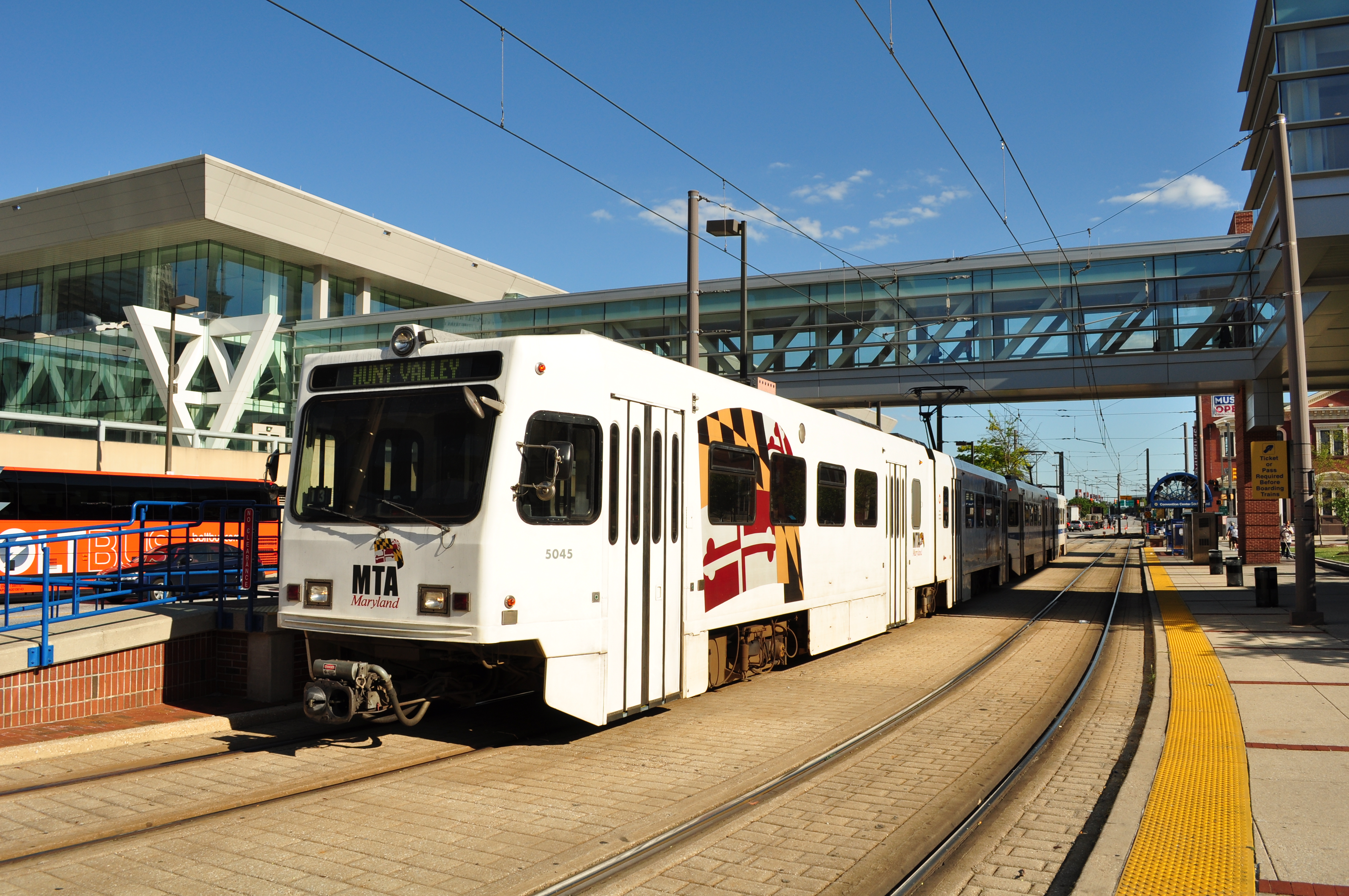
The Red Line is a proposed light rail line for Baltimore, Maryland. The original project was granted federal approval to enter the preliminary engineering phase and the Maryland Transit Administration had spent roughly $300 million in planning, design and land acquisition, until Maryland Governor Larry Hogan declared his intent to not provide state funds for the project and shift state funding to roads in suburban areas. The original Red Line had been projected to cost roughly $1.6 billion, $900 million of which would have been guaranteed federal funding. Its construction had been estimated to begin in late 2015–early 2016, subject to funding, with a completion date set for late 2021–early 2022.
While campaigning for governor, Hogan characterized the project as a "boondoggle". Hogan's shift of state priorities to road funding has resulted in the construction of several major projects near properties owned by his company, leading to allegations of corruption. The Red Line cancellation was briefly investigated by the United States Department of Transportation for being in possible violation of Title VI of the Civil Rights Act of 1964, since his decision shifted a large quantity of state money from predominantly Black and low-income neighborhoods into affluent and predominantly white areas, but the investigation was closed with no finding.
The project was classed as inactive; however, after several groups continued to campaign for its construction, the State, under Governor Wes Moore, brought back the project in June 2023. By that November, it was undergoing updated route evaluations and mode selection. Light rail was selected as the preferred mode in June 2024.
Background
In 2001, then-Maryland Secretary of Transportation John Porcari appointed a 23-member independent commission, the Baltimore Region Rail System Plan Advisory Committee, to make suggestions for new rail lines and expansions of existing lines. The proposals used a unified branding scheme for the existing lines and the proposed new lines, identifying each line by a color, as the Washington Metro and many other transit agencies do.
The suggested system was composed of six color-coded lines with an overall length of 109 mi and 122 stations, including Baltimore's existing Metro SubwayLink and Light RailLink systems. In the commission's report, the Red Line was an east–west line that would begin at the Social Security Administration offices in Woodlawn in Baltimore County, travel through West Baltimore with an intermodal stop at the West Baltimore MARC station, pass through downtown (where transfers to the existing Metro Subway and Light Rail lines would be possible), and pass through East Baltimore with stops in Fells Point, Canton, and Patterson Park. The Red Line was designated by the commission as the starting component for new work on the 6-line system.
Out of the commission's various proposals, the Red Line was taken up with the most enthusiasm by area officials. Progress was slowed by a debate between state Secretary of Transportation Robert Flanagan and the Baltimore City government and Congressional delegation over the mode of transportation; Flanagan favored a bus rapid transit (BRT) solution with separate right-of-way components like Boston's Silver Line, while the city officials favored a light rail or heavy rail line and insisted that both modes of rail transit be included in studies.
Heavy rail was dismissed by Flanagan as an alternative, due to an estimated cost of $2.2 billion to $2.6 billion. With ridership of Baltimore's existing Metro system at only 45,000 at the time of his appointment, he did not expect the Red Line to reach the 140,000 to 150,000 ridership level necessary to attract federal funding for heavy rail.
Red Line alternatives

| No. | Alternative | Length | |||
|---|---|---|---|---|---|
| (miles) | Cost (millions) | ||||
| (2007 prices) | Travel time | ||||
| end to end | |||||
| (minutes) | Average | ||||
| Weekday | |||||
| Ridership | |||||
| 1 | No Build | 13.9 | n/a | 80 | n/a |
| 2 | TSM | 14.3 | $281 | 76 | 17,600 |
| 3A | BRT, surface only | 13.8 | $545 | 62 | 31,400 |
| 3B | BRT, downtown tunnel | 14.9 | $1,019 | 56 | 37,400 |
| 3C | BRT, downtown tunnel, | ||||
| Cooks Lane tunnel | 14.7 | $1,151 | 53 | 37,400 | |
| 3D | BRT, maximum tunnel | 13.7 | $2,404 | 43 | 41,500 |
| 3E | BRT, surface only, | ||||
| Johnnycake Rd. alignment | 14.8 | $571 | 69 | 29,300 | |
| 3F | BRT, TSM surface, | ||||
| downtown tunnel | 14.8 | $755 | 65 | 34,300 | |
| 4A | LRT, surface only | 13.9 | $930 | 55 | 34,600 |
| 4B | LRT, downtown tunnel | 14.6 | $1,498 | 43 | 41,100 |
| 4C | LRT, downtown tunnel, | ||||
| Cooks Lane tunnel | 14.6 | $1,631 | 41 | 42,100 | |
| 4D | LRT, maximum tunnel | 13.7 | $2,463 | 36 | 42,300 |
- TSM: Transportation systems management (using the existing bus system, with modifications to signalling, lane assignments, and controls)
- BRT: Bus rapid transit
- LRT: Light rail transit
Modified alternative 4C selected by governor

.jpg)
In August 2009, then-Governor Martin O'Malley (who was also a former mayor of Baltimore) selected a modified version of the Light Rail Alternative 4C, which became known as the "Locally Preferred Alternative (LPA)." The modification eliminated two stations and a small parking lot from the original Alternative 4C plans, but included an expansion of parking at the West Baltimore MARC station.
Two features of the original Alternative 4C plan, considered important by the Citizens Advisory Council, remained part of the Locally Preferred Alternative:
- Much of the proposed route through West Baltimore ran generally along U.S. Route 40, including the depressed freeway section left over from the cancellation of Interstates 70 and 170 within the city limits. This freeway section was built to accommodate a transit line in the median, and the Red Line would most likely have used this route to achieve grade separation though the area. The western end of former I-170 was demolished in 2010 to allow for additional parking and median access for the Red Line. A similar modification was also planned for the eastern end of former I-70, where the MD 122/Security Boulevard interchange would be converted to an at-grade intersection, and a new Park & Ride lot would have been built to replace the one that sits east of said interchange. At the rebuilt intersection, the Red Line would have gone through the western portal of the Cooks Lane tunnel, MD 122 would have tied directly into Forest Park Avenue, and Cooks Boulevard would have been a westward extension of Cooks Lane, built as a surface road on the old I-70 alignment. Although the modifications have not yet occurred, I-70 from MD 122 to I-695 was decommissioned in 2014 and now ends at its stack interchange with I-695; the freeway east of I-695 carries the unsigned designation of MD 570.
- The LPA provided for the line to go underground along Martin Luther King, Jr. Boulevard and to surface on Boston Street near the Can Company in Canton, bypassing downtown Baltimore's narrow streets and crowded traffic conditions. Another tunnel bypasses Cooks Lane, but the original LPA version reduced the tunnel to a single track alignment. Adjustments to the LPA were later made to allow a second track in the Cooks Lane tunnel.
With the Federal Transit Administration's approval in June 2011 to start preliminary engineering, the project made its first step beyond the concept stage; however, the FTA estimated daily ridership for the completed system at 57,000 and expected it to cost a total of $2.2 billion with inflation included. Henry Kay, MTA's deputy administrator, estimated the cost of preliminary engineering at $65 million. The state would have had to pay preliminary engineering costs, but Kay said that these and other upfront costs would be eligible for federal reimbursement.
Cancellation and federal investigation
Governor Larry Hogan, who was elected in 2014, announced on June 25, 2015 that he had canceled funding for the Red Line. During his 2014 campaign, Hogan had complained about the cost of the proposed Red Line for Baltimore, calling it a "boondoggle", and a proposed Purple Line for the Maryland suburbs of Washington, DC; however, he ultimately allowed the Purple Line to begin construction with reduced funding.
Federal investigation
On December 21, 2015, the National Association for the Advancement of Colored People (NAACP), together with the American Civil Liberties Union of Maryland and Baltimore Regional Initiative Developing Genuine Equality (BRIDGE) filed a complaint pursuant to Title VI of the Civil Rights Act of 1964 with the U.S. Department of Transportation Departmental Office of Civil Rights. The complaint challenged Governor Hogan's decision to cancel the Red Line on the basis of discrimination against Baltimore's predominantly African American population that would have benefited from the infrastructure project. Furthermore, the complaint highlighted that Governor Hogan's decision shifted funding away from public transportation dependent citizens, and instead was dedicated towards highway projects in primarily white rural and suburban areas of the state.
On January 19, 2017, the last day of the Obama Administration, the Department of Transportation announced it expanded its investigation into Governor Hogan's decision to cancel the Red Line, as well as the rest of MDOT's programs to determine whether federal law was violated. In addition, the DOT stated that the state transportation agency did not take the federal law into account or the adverse impact it would have on African-Americans, nor did the Governor seek any input from MDOT in making the decision. In July 2017 the DOT announced that it was closing its investigation with no finding.
Proposed route and stations
The alignment for the Red Line would have followed an east–west path. Starting from the west, the proposed stations were as follows:
| Station Name | Parking | Connection | Station Location | Points of Interest | Tunnel portal at city/county line under Cooks Lane and resurface along Edmondson Avenue | Tunnel portal along Martin Luther King Jr. Boulevard | Tunnel portal along Boston Street | Viaduct between Highlandtown station and Bayview MARC station | Future extension to Dundalk |
|---|---|---|---|---|---|---|---|---|---|
| Centers for Medicare & Medicaid Services | no | 79, 78, 31 | |||||||
| CityLink Blue | Security Blvd / CMS Entrance | CMS, HHS, GSA | |||||||
| Security Square Mall | 79, 31, 37, 107 | ||||||||
| CityLink Blue | Security Blvd / Belmont Av | Security Square Mall, Security Station Shopping Center | |||||||
| Social Security Administration | (A) | 79, 31 | |||||||
| CityLink Blue | Woodlawn Dr / Parallel Dr | SSA, Southwest Academy, Woodlawn | |||||||
| I-70 Park and Ride | 79 | ||||||||
| CityLink Blue | Parallel Dr / Ingleside Av | East SSA, Gwynns Falls Trail | |||||||
| Edmondson Village | 78, 77, 38, 150 | ||||||||
| CityLink Blue | Edmondson Av / Swann Av | Edmondson Village Shopping Center, Library Edmondson Branch, Uplands, Westside Skills Center | |||||||
| Allendale | no | 77, 38 | |||||||
| CityLink Blue | Edmondson Av / Allendale St | Gwynns Falls/Leakin Park, Lyndhurst Park | |||||||
| Rosemont | no | 78, 29, 77, 38, 80 | |||||||
| CityLink Blue | W. Franklin St/Poplar Grove St | Franklintown Road Business Area, Rosemont Park, Western Cemetery | |||||||
| West Baltimore MARC | 77, 80, 40, 163, 150 | ||||||||
| CityLink Blue, Orange, Green, Pink | |||||||||
| MARC Penn Line | W. Mulberry St / N. Smallwood St | Bentalou Recreation Center, Grace Medical Center | |||||||
| Harlem Park | no | CityLink Navy | U.S. Route 40 / Carey St | Edgar Allan Poe House, Franklin Square, Harlem Square Park, Lafayette Square | |||||
| Poppleton | (R) | 80 | N. Fremont Av / W. Baltimore St. | Baltimore Center Medical Examiner Office, Perkins Square, Lexington Terrace, Little Lithuania Park, Lithuanian Hall, UMD BioPark | |||||
| Howard Street/University Center | (P) | 65, 76, 120, 160, 310?, 320?, 410?, 411?, 420? | |||||||
| CityLink Navy, Purple, Red, Yellow, Blue, Orange | |||||||||
| Light Rail | W. Lombard St / S. Howard St | Bromo Arts District, Camden Yards, Royal Farms Arena, UMB, Westside | |||||||
| Inner Harbor | (P) | 65, 51, 54, 91 | |||||||
| CityLink Red, Navy | |||||||||
| Metro Subway | |||||||||
| CCC: Orange, Purple | W. Lombard St / S. Charles St | Downtown Baltimore, Financial District, Harborplace, Market Place, McKeldin Square, National Aquarium, Power Plant Live!, Pratt Street Power Plant, World Trade Center | |||||||
| Harbor East | (P) | 31 | |||||||
| CCC: Orange, Green | Fleet St / S. Central Av | Harbor East Shopping District, Harbor Point, Institute of Marine & Environmental Technology, Little Italy, Pier Six Pavilion, Lewis Museum | |||||||
| Fells Point | no | CityLink Gold, Navy | Fleet St / S. Broadway | Broadway Market, Fells Point, Maritime Park, Thames Street Park, Upper Fell's Point | |||||
| Canton | 65 | ||||||||
| CityLink Navy | Boston St / O'Donnell St | The Can Company, O'Donnell Square, Patterson Park, Saint Casmir's Park | |||||||
| Canton Crossing | 65 | ||||||||
| CityLink Navy | Boston St / Conkling St | Brewers Hill, Canton Crossing Shopping Center, Burns Arena, Canton Waterfront Park, Charm City Skate Park | |||||||
| Highlandtown/Greektown | no | 22 | |||||||
| CityLink Navy | Eastern Av / Janney St | Library Southeast Anchor Branch, Greektown, Highlandtown, Kresson, Markets at Highlandtown | |||||||
| Bayview | (F) | 22 | |||||||
| CityLink Orange, Blue | Alpha Commons Dr / Bayview Blvd | JHBMC, Johns Hopkins Asthma & Allergy Center, National Institute on Aging | |||||||
| East Baltimore/Bayview MARC | 22, 59, 63 | ||||||||
| CityLink Orange, Blue | |||||||||
| MARC Penn Line | E. Lombard St (east of Bioscience Dr) | East Baltimore/Bayview station, Pulaski Industrial Area, Joseph E. Lee Park, Patterson High School | |||||||
| Eastern Avenue | no | 22, 40, 59, 63 | |||||||
| CityLink Orange, Blue | Eastern Av / Dundalk Av | JHBMC | |||||||
| O'Donnell Street | no | 63 | |||||||
| CityLink Navy | Dundalk Av / O'Donnell St | Amazon Warehouse, Mt. Carmel Cemetery | |||||||
| Dundalk Center Place | (R) | 62, 63, 65, 163 | |||||||
| CityLink Navy | Dundalk Av / Center Pl | CCBC Dundalk, Downtown Dundalk, St. Helena Park |
;NOTES:
- A authorized employee parking only
- F facility parking only
- P paid parking
- R residential parking only
_from_the_overpass_for_U.S._Route_1_northbound_(North_Fulton_Avenue)_in_Baltimore_City,_Maryland.jpg)
Red Line system features
| Feature | Proposed alignment |
|---|---|
| Overall length | 14.5 mi |
| Surface length | 9.8 mi |
| Tunnel length | 3.9 mi |
| Aerial length | 0.8 mi |
| Stations | 20 total (15 surface, 5 underground) |
| Parking | 6 stations with parking areas |
| Travel time | 44 minutes (Woodlawn to Bayview) |
| Vehicles | 34 light rail vehicles |
| Service frequency | 8 minutes peak, 10 minutes off peak |
Citizens' Advisory Council
Establishment of Council
The "Citizens' Advisory Council for the Baltimore Corridor Transit Study - Red Line" was established by the Maryland General Assembly in 2006.
Governor Robert Erlich vetoed the bills which originally created the Citizens' Advisory Council on May 26, 2006, and replaced it with the "Red Line Community Advisory Council." This 15-member Council was appointed entirely by the Governor.
At a special session in June 2006, the Legislature overrode the Governor's veto. The Council established by the Legislature also had 15 members, but only two could be appointed by the Governor. Five of the other Council members were appointed by the Senate President, five by the Speaker of the House, two by the Baltimore City Mayor and one by the Baltimore County Executive. Two co-chairs for the Council could be chosen by the Governor or the Maryland Transit Administrator from up to four nominees selected by the Senate President and Speaker of the House.
On July 30, 2007, an executive order by Governor Martin O'Malley restored the name originally selected by the Legislature.
First annual report to General Assembly
On September 9, 2008, the Red Line Citizens' Advisory Council voted unanimously to adopt its first report to the General Assembly, which included the statement that "Preparation of a SDEIS [Supplemental Draft Environmental Impact Statement] should begin now, as a collaborative effort between the MTA and the public in finding the best ways to invest over a billion dollars in Baltimore's transportation infrastructure in keeping with the vision of the 2002 Plan."
Council dispute over Alternative 4C
A recommendation for Alternative 4C (light rail with a downtown tunnel and a Cooks Lane tunnel) was approved by a vote of five to two at the Citizens' Advisory Council meeting on December 11, 2008. Two of the nine members present abstained.
Community opposition to Alternative 4C
Beginning in late 2008, Baltimore City favored the "4C Alternative" selected by Governor O'Malley in 2009, which was endorsed by Mayor Sheila Dixon; however, the 2008 Citizens Advisory Council annual report commented on the opposition of community groups to surface rail alignments through residential neighborhoods.
A letter from the Allendale Community Association, read at a meeting of the Citizens Advisory Council on December 11, 2008, expressed the Association's opposition to Alternative 4C and any surface rail construction along Edmondson Avenue.
The West–East Coalition (WEC) Against Red Line Alternative 4C, established in June 2009, represented community associations, homeowners groups, businesses, and religious groups opposed to the Alternative 4C. Its now-defunct website explained that the organization considered the proposed light rail alignment to be a detriment to communities on both the East and West sides of Baltimore.
In a letter to Governor Martin O'Malley, Senator Barbara Mikulski, Senator Benjamin Cardin, Congressman Elijah Cummings, Congressman John P. Sarbanes, and Mayor Sheila Dixon on July 13, 2009, the WEC described concerns about the effects of double-tracked surface rail, traffic congestion, and safety concerns.
In 2009, the WEC circulated a petition against the surface Red Line in the Canton neighborhood. It delivered 1,350 signed cards to Governor O'Malley on July 31, 2009.
Support for Red Line and Political Action Committee
In the summer of 2011 the Red Line Now Political Action Committee (PAC) was established to voice the support of residents of Baltimore City for the funding and construction of Alternative 4C. Its website stated that the organization was staffed on a volunteer basis and planned to support local politicians that supported the construction of the Red Line. Red Line Now PAC was governed by a nine-member board of directors who were citizen volunteers who lived and/or worked along what would have been the Red Line corridor. The board members represented the Midtown, Edmondson, Canton, Fells Point, Patterson Park, and Greektown communities.
Plans revived
The Infrastructure Investment and Jobs Act contains a provision on project reentry which directs the United States Secretary of Transportation to "provide full and fair consideration to projects that seek an updated rating after a period of inactivity." This provision was sought by Maryland Senator Ben Cardin with the intent to allow for the Red Line and other canceled transit projects to be renewed. On June 15, 2023, Governor Wes Moore announced that he would restart efforts to build the Red Line in a ceremony with Baltimore mayor Brandon Scott. The state Department of Transportation plans to identify possible route alignments, gauge public feedback, and study the project's costs and benefits over the course of the rest of the year. In the meantime, the MTA will provide limited-stop bus service between Catonsville and Essex beginning in August 2023. MTA released six new alternative routes for the project that September – two alternatives featured tunnel segments and alignments similar to the canceled 2009 route. Officials initially did not say if the route would be run by bus rapid transit or light rail, but later announced in June 2024 that it will feature light rail.
References
References
- Campbell, Colin. (11 September 2020). "Five years later, many across Baltimore bitterly lament Gov. Hogan's decision to kill the Red Line light rail". Baltimore Sun.
- Michael Dresser. (2015-06-25). "Hogan says no to Red Line, yes to Purple". The Baltimore Sun.
- Kilgore, Ed. (2020-01-08). "Maryland Governor Accused of Rerouting State Funds to Benefit His Business".
- {{cite letter. link. Rivera. Yvette. (January 19, 2017)
- "Hogan says no to Red Line, yes to Purple".
- Maryland Transit Administration. "Baltimore Region Rail System Plan Final Report".
- [http://www.gobaltimoreredline.com Baltimore Red Line] Mayor's Red Line information site. Retrieved 2010-1-8
- Dori Berman. (January 13, 2006). "New subway back in play?". Daily Record.
- Michael Dresser. (June 28, 2011). "Red Line gets a qualified go-ahead". The Baltimore Sun.
- (2023-06-16). "Wes Moore relaunches Baltimore's Red Line, but big questions remain". Washington Post.
- "BALTIMORE REGIONAL INITIATIVE DEVELOPING GENUINE EQUALITY, INC., and EARL ANDREWS, Individually, vs. STATE OF MARYLAND, MARYLAND DEPARTMENT OF TRANSPORTATION, MARYLAND TRANSIT ADMINISTRATION, and MARYLAND STATE HIGHWAY ADMINISTRATION".
- (2015-12-21). "Civil Rights Groups Challenge Maryland Gov. Hogan's Red Line Cancellation".
- Linderman, Juliet. (2017-01-23). "DOT expands investigation into canceled rail line in MD". Associated Press.
- Duncan, Ian. (23 January 2017). "On last day, Obama administration announced civil rights review of Maryland transportation".
- "Federal officials close civil rights complaint about Baltimore light-rail project". Washington Post.
- [http://mlis.state.md.us/2006rs/billfile/sb0873.htm Senate Bill 873 (2006)] Maryland Department of Legislative Services, Library & Information Service. Retrieved 2010-01-29.
- [http://mlis.state.md.us/2006rs/billfile/hb1309.htm House Bill 1309 (2006)] Maryland Department of Legislative Services, Library & Information Service. Retrieved 2010-01-29.
- [http://mlis.state.md.us/2006rs/veto_letters/sb0873.pdf Governor's veto letter, May 26, 2006] retrieved 2010-1-29
- [http://dlslibrary.state.md.us/publications/OED/A/EO_2006.pdf Executive Orders 2006] Department of Legislative Services archives. See p. 13 for Executive Order 01.01.2006.04. Retrieved 2010-01-29.
- (November 2023). "Red Line Now PAC".
- "Infrastructure bill would boost Metro funding, reopen door to Baltimore's Red Line project". Washington Post.
- (June 15, 2023). "Gov. Moore relaunches planning for Red Line transit in Baltimore". [[Baltimore Banner]].
- (15 June 2023). "Moore relaunches Red Line east-west transit project in Baltimore". WBAL.
- Holt, Alex. (June 21, 2023). "Red Line redemption: What Governor Moore's announcement means for Baltimore".
- (September 28, 2023). "MTA unveils alternative routes for Red Line transit project".
- (15 June 2023). "Governor Moore announces plan to revive Baltimore Red Line project - CBS Baltimore". www.cbsnews.com.
- (June 27, 2024). "Gov. Moore says Baltimore's Red Line will be light rail, not rapid buses". [[The Baltimore Banner]].
This article was imported from Wikipedia and is available under the Creative Commons Attribution-ShareAlike 4.0 License. Content has been adapted to SurfDoc format. Original contributors can be found on the article history page.
Ask Mako anything about Red Line (Baltimore) — get instant answers, deeper analysis, and related topics.
Research with MakoFree with your Surf account
Create a free account to save articles, ask Mako questions, and organize your research.
Sign up freeThis content may have been generated or modified by AI. CloudSurf Software LLC is not responsible for the accuracy, completeness, or reliability of AI-generated content. Always verify important information from primary sources.
Report