From Surf Wiki (app.surf) — the open knowledge base
Red-light district
Urban area with a high concentration of sex-related businesses

Urban area with a high concentration of sex-related businesses
the sex industry term
A red-light district or pleasure district is a part of an urban area where a concentration of prostitution and sex-oriented businesses, such as sex shops, strip clubs, and adult theaters, are found. In most cases, red-light districts are particularly associated with female street prostitution, though in some cities, these areas may coincide with spaces of male prostitution and gay venues. Areas in many big cities around the world have acquired an international reputation as red-light districts.
Origins of the term

Red-light districts are mentioned in the 1882 minutes of a Woman's Christian Temperance Union meeting in the United States. The Oxford English Dictionary records the earliest known appearance of the term "red light district" in print as an 1894 article from the Sandusky Register, a newspaper in Sandusky, Ohio. A usage the year prior was in the Cincinnati Enquirer of Cincinnati, Ohio.
Author Paul Wellman suggests that this and other terms associated with the American Old West originated in Dodge City, Kansas, home to a well-known prostitution district during the 19th century, which included the Red Light House saloon.{{cite book| access-date = December 5, 2025|first=Paul Iselin| isbn=0-8032-9723-8| last = Wellman| page=195|publisher=University of Nebraska Press| quote= Paul Wellman Dodge City red light.| title=The Trampling Herd: The Story of the Cattle Range in America| url=https://archive.org/details/tramplingherd00well| url-access=registration| year=1988 |access-date = October 3, 2010|author=Barbara Mikkelson|date=July 9, 2007| title=Red Light District| url=http://snopes.com/language/colors/redlight.asp
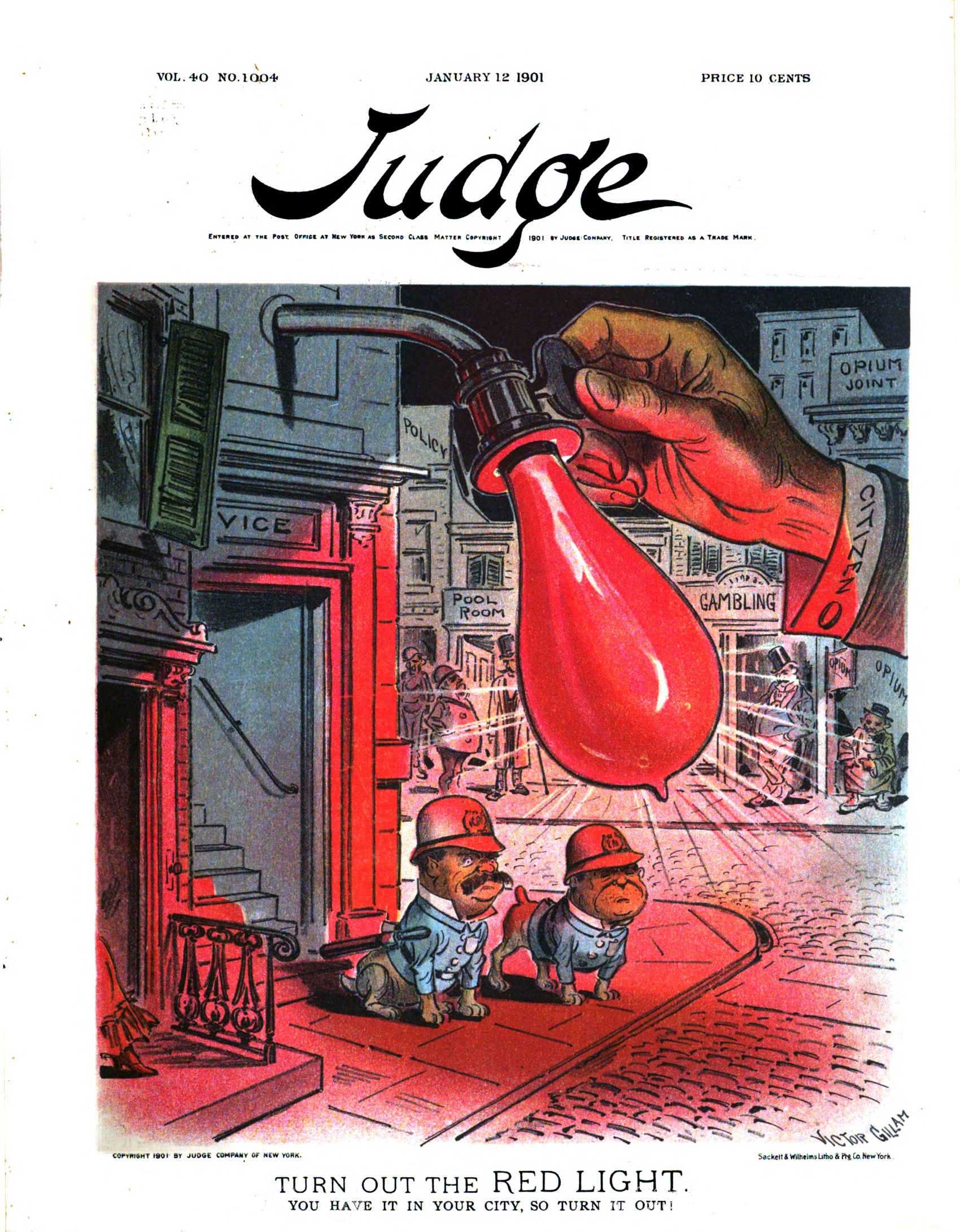
A commonly repeated, though likely spurious, folk etymology stems from sailors coming back from sea to Amsterdam (): Women working as prostitutes, deprived of proper hygiene and running fresh water, carrying red lanterns — with their color camouflaging boils, zits, inequalities in the face and on the skin — made clear they were available as women of pleasure.
One of the many terms used for a red-light district in Japanese is akasen, literally meaning "red-line". Japanese police drew a red line on maps to indicate the boundaries of legal red-light districts. In Japanese, the term aosen, literally meaning "blue-line", also exists, indicating an illegal district.
In the United States during the 19th and early 20th centuries, the term "sporting district" became popular for legal red-light districts. Municipal governments typically defined such districts explicitly to contain and regulate prostitution.{{cite book| access-date=December 5, 2025|author=Woolston, Howard Brown
Other uses
In World War I (circa 1915), "Brothels displayed blue lamps if they were for officers and red lamps for other ranks."
Legal issues
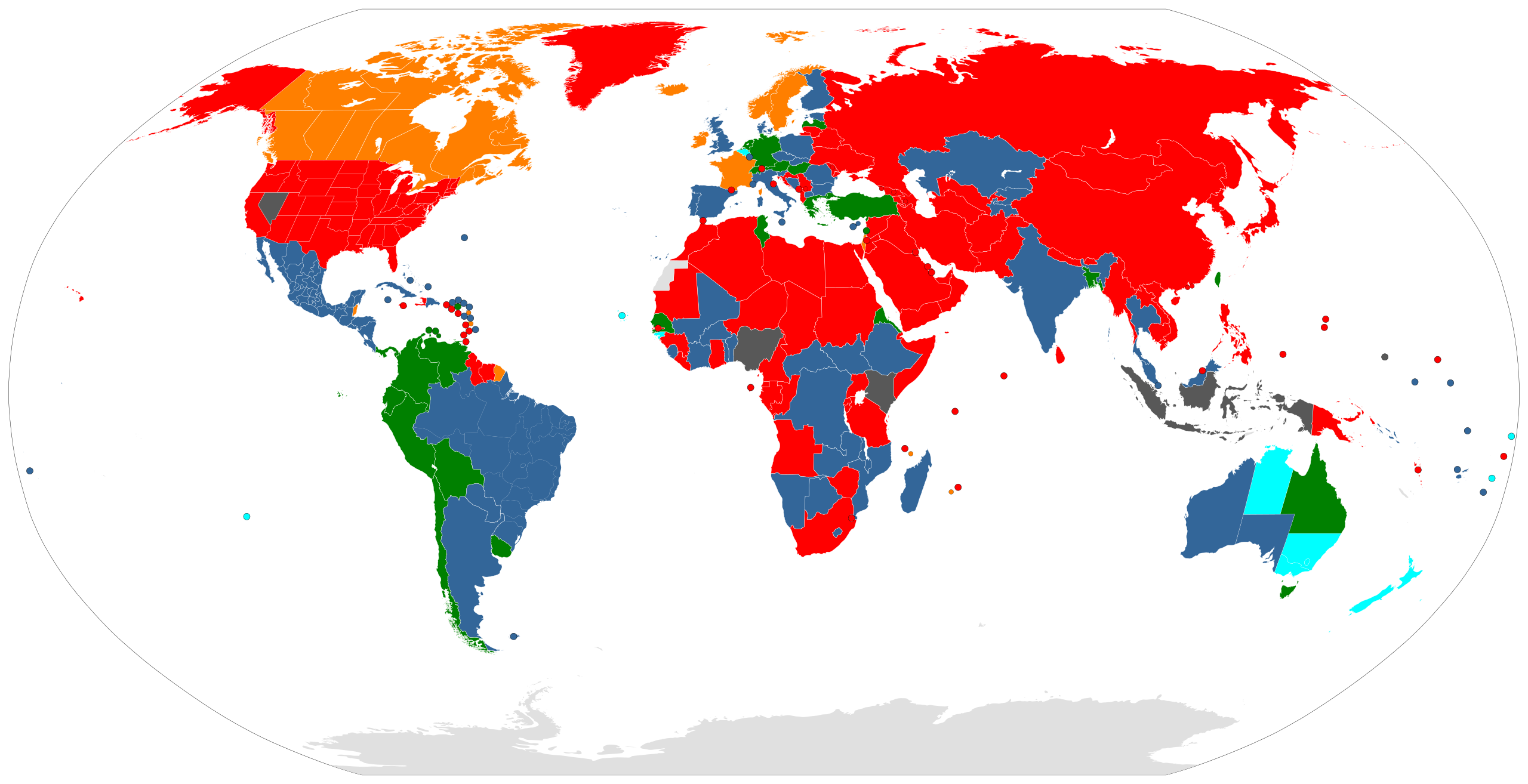
Some red-light districts (such as De Wallen, Netherlands, or Reeperbahn, Germany) are places that are officially designated by authorities for legal and regulated prostitution.
Some red-light districts (such as those in The Hague) are under video surveillance. This can help counter illegal forms of prostitution (such as child prostitution), in these areas that do allow regular prostitution to occur.
]]
Image gallery
File:Red Light District.jpg|The Red Light District in Amsterdam File:Reeperbahn at dawn.jpg|Reeperbahn in Hamburg, Germany File:Soi Cowboy - Bangkok.jpg|Soi Cowboy, Bangkok, Thailand File:RedLightDistrictAmsterdamBloedstraat.jpg|Rooms illuminated by red lights in De Wallen, Amsterdam, Netherlands File:Aarschotstraat.jpg|Rue d'Aerschot, Brussels, Belgium File:Kabukicho-Sinjyuku-Tokyo.JPG|Kabukichō Ichiban-gai gate and colorful neon street signs, Shinjuku, Tokyo, Japan
References
References
- Caves, R. W.. (2004). "Encyclopedia of the City". Routledge.
- (2009-08-27). "History of the Red light District « What you should know about Amsterdam". What you should know about Amsterdam.
- (1882). "Minutes of the Ninth Annual Meeting". National Woman's Christian Temperance Union.
- (Dec 13, 1894). "Salvation Army Restricted". [[Sandusky Register]].
- (August 21, 1893). "Stained with blood their careers two brothers who are fellow convicts, each serving a long sentence for murder.". [[Cincinnati Enquirer]].
- (2014-02-27). "WW1 brothels: Why troops ignored calls to resist 'temptation'". British Broadcasting Corporation (BBC).
- "The Red Light District of Amsterdam". CamsterDamn.
- (January 24, 2014). "Camera surveillance in red-light districts in The Hague".
This article was imported from Wikipedia and is available under the Creative Commons Attribution-ShareAlike 4.0 License. Content has been adapted to SurfDoc format. Original contributors can be found on the article history page.
Ask Mako anything about Red-light district — get instant answers, deeper analysis, and related topics.
Research with MakoFree with your Surf account
Create a free account to save articles, ask Mako questions, and organize your research.
Sign up freeThis content may have been generated or modified by AI. CloudSurf Software LLC is not responsible for the accuracy, completeness, or reliability of AI-generated content. Always verify important information from primary sources.
Report