From Surf Wiki (app.surf) — the open knowledge base
Red kite
Species of bird

Species of bird
Milvus regalis (Pall., 1811){{cite book |last1=Powys, 4th Baron Lilford |first1=Thomas Littleton |author1-link=Thomas Powys, 4th Baron Lilford
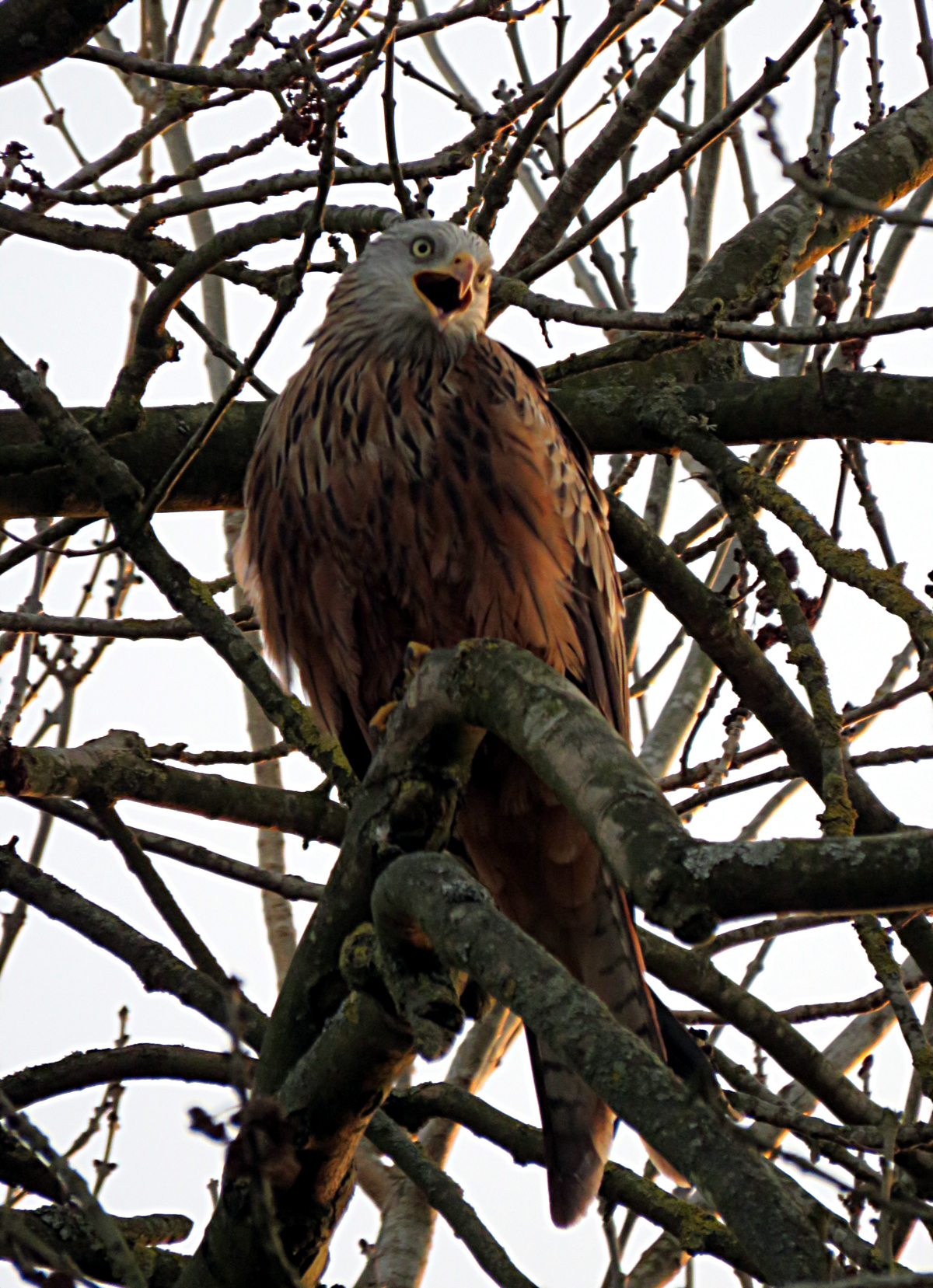
The red kite (Milvus milvus) is a bird of prey in the family Accipitridae, which also includes many other diurnal raptors such as eagles, buzzards, and harriers. The species currently breeds only in Europe, though it formerly also bred in west Asia and northwest Africa. Historically, it was only resident in the milder parts of its range in western Europe and northwestern Africa, whereas all or most red kites in northern mainland Europe wintered to the south and west, some also reaching western Asia, but an increasing number of northern birds now remain in that region year-round. Vagrants have reached north to Finland and south to Israel, Libya and the Gambia.
Etymology
The English word "kite" is from the Old English cyta which is of unknown origin. A kite is mentioned by Geoffrey Chaucer in his Knight's Tale. The early 15th century Hengwrt manuscript contains the lines: "Ther cam a kyte, whil þt they were so wrothe That bar awey the boon bitwix hem bothe." The first recorded use of the word kite for the human-operated aerial device dates from the 17th century.
Taxonomy
The red kite was described by the Swedish naturalist Carl Linnaeus in 1758 in the 10th edition of his Systema Naturae under the binomial name Falco milvus. The word milvus was the Latin name for the bird. In 1799 the French naturalist Bernard Germain de Lacépède moved the species to the genus Milvus creating the tautonym.
Two subspecies are recognised:
- M. m. milvus (Linnaeus, 1758) – Europe and Northwest Africa to the Middle East
- M. m. fasciicauda Hartert, 1914 – the Cape Verde Islands
The subspecies M. m. fasciicauda is almost certainly extinct.
The genus Milvus contains two other species: the black kite (M. migrans) and the yellow-billed kite (M. aegyptius). The red kite has been known to successfully hybridize with the black kite in captivity where both species were kept together, and in the wild on the Cape Verde Islands and infrequently in other places.
Cape Verde Kites
The red kites on the Cape Verde Islands are (or rather were) quite distinct in morphology, being somewhat intermediate with black kites. The question whether the Cape Verde kite should be considered a distinct species (Milvus fasciicauda) or a red kite subspecies has not been settled. A mitochondrial DNA study on museum specimens suggested that Cape Verde birds did not form a monophyletic lineage among or next to red kites. This interpretation is problematic: mtDNA analysis is susceptible to hybridization events, the evolutionary history of the Cape Verde population is not known, and the genetic relationship of red kites is confusing, with geographical proximity being no indicator of genetic relatedness and the overall genetic similarity high, perhaps indicating a relict species. Given the morphological distinctness of the Cape Verde birds and that the Cape Verde population was isolated from other populations of red kites, it cannot be conclusively resolved as to whether the Cape Verde population was not a distinct subspecies (as M. migrans fasciicauda) or even a species that frequently absorbed stragglers from the migrating European populations into its gene pool. The Cape Verde population became effectively extinct since 2000, all surviving birds being hybrids with black kites.
Hybridisation
The genus Milvus contains two other species: the black kite (M. migrans) and the yellow-billed kite (M. aegyptius). The red kite has been known to successfully hybridize with the black kite in captivity where both species were kept together, and in the wild on the Cape Verde Islands and in other places.
A hybrid zone in which red and black kites occasionally mate exists in Central Europe. A genetic study of kites in this area did not demonstrate any mtDNA from black kites in red kites or vice versa. As this DNA is inherited from the mother, the authors of the study which found these results suggested that female F1 hybrids were infertile in accordance with Haldane's law.
A hybridisation event leading to the successful fledging of two chicks occurred between a male black kite and a female red kite in Scotland in 2006. Scotland is not home to a breeding population of black kites, and it is likely the male was blown off course by a storm or became lost during migration.
Description
_skull_at_the_Royal_Veterinary_College_anatomy_museum.JPG)
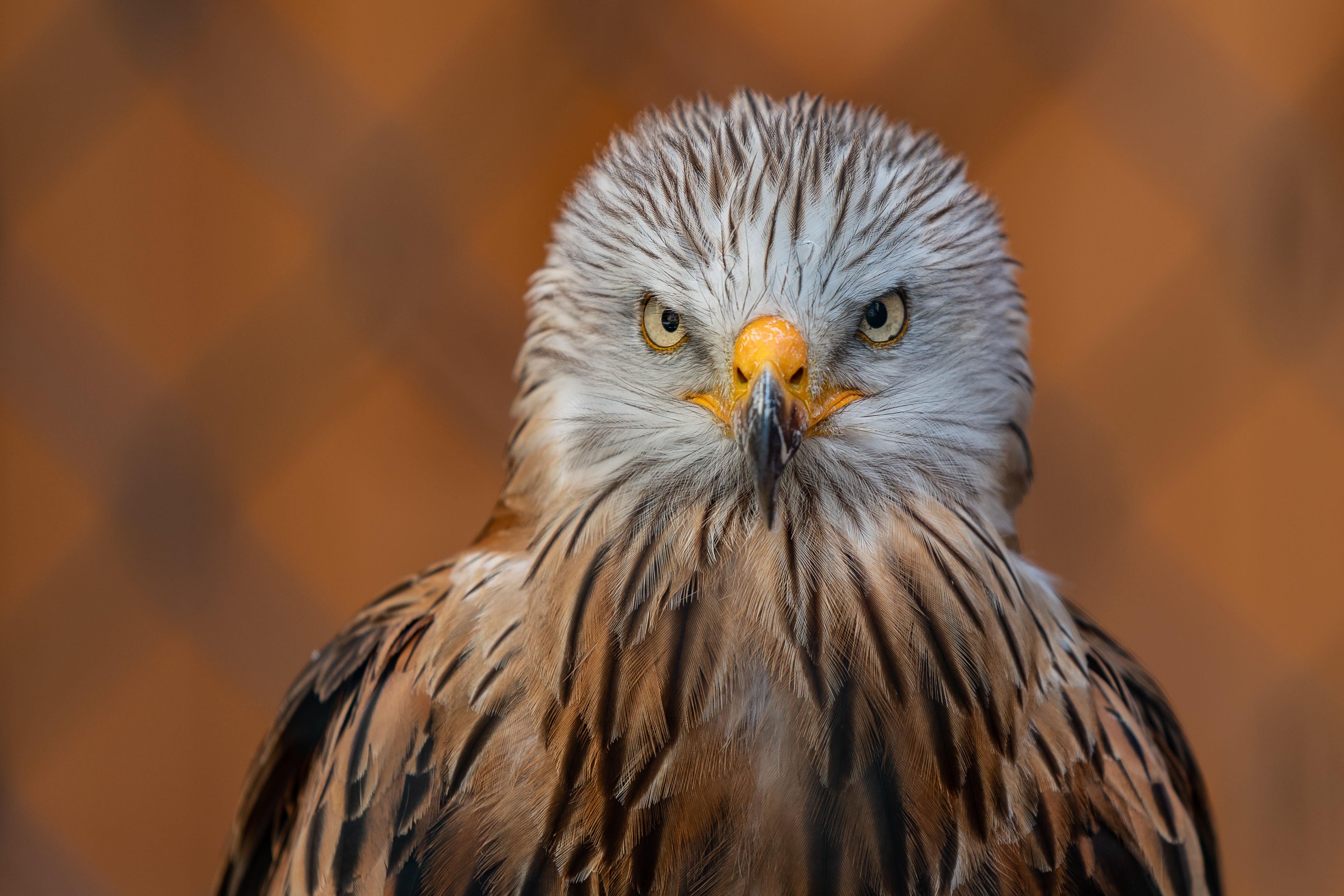
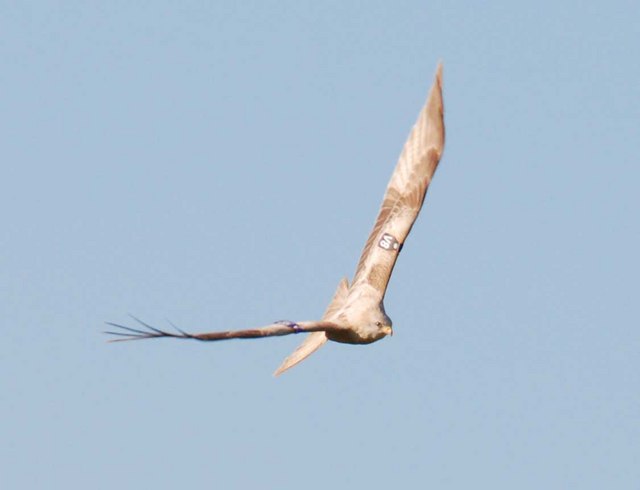
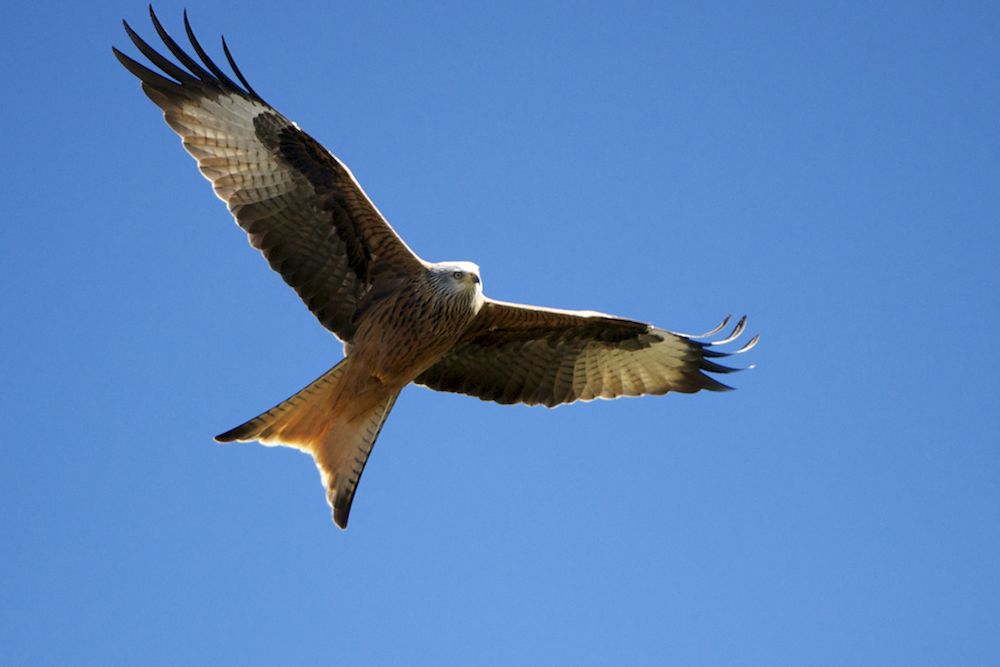
Red kites are 60 to long with a 175 - wingspan; males weigh 800 -, and females 1000 -. It is an elegant bird, soaring on long wings held at a dihedral, and long forked tail, twisting as it changes direction. The body, upper tail and wing coverts are rufous. The white primary flight feathers contrast with the black wing tips and dark secondaries. Apart from the weight difference, the sexes are similar, but juveniles have a buff breast and belly. Its call is a thin piping sound, similar to but less mewling than the common buzzard. There is a rare white leucistic form accounting for approximately 1% of hatchlings in the Welsh population, but this variation confers a disadvantage in the survival stakes.
Differences between adults and juveniles
Adults differ from juveniles in a number of characteristics:
- Adults are overall more deeply rufous, compared with the more washed out colour of juveniles;
- Adults have black breast-streaks whereas on juveniles these are pale;
- Juveniles have a less deeply forked tail, with a dark subterminal band;
- Juveniles have pale tips to all of the greater-coverts (secondary and primary) on both the upper- and under-wings, forming a long narrow pale line; adults have pale fringes to upperwing secondary-coverts only. These differences hold throughout most of the first year of a bird's life.
Behaviour
Breeding

Usually red kites first breed when they are two years old, although exceptionally they can successfully breed when they are only one year old. They are monogamous and the pair-bond in populations is probably maintained during the winter, particularly when the pair remain on their breeding territory. For migrant populations the fidelity to a particular nesting site means that the pair-bond is likely to be renewed each breeding season. The nest is normally placed in a fork of a large hardwood tree at a height of between 12 and above the ground. A pair will sometimes use a nest from the previous year and can occasionally occupy an old nest of the common buzzard. The nest is built by both sexes. The male brings dead twigs 30 - in length which are placed by the female. The nest is lined with grass and sometimes also with sheep's wool. Unlike the black kite, no greenery is added to the nest. Both sexes continue to add material to the nest during the incubation and nestling periods. Nests vary greatly in size and can become large when the same nest is occupied for several seasons.
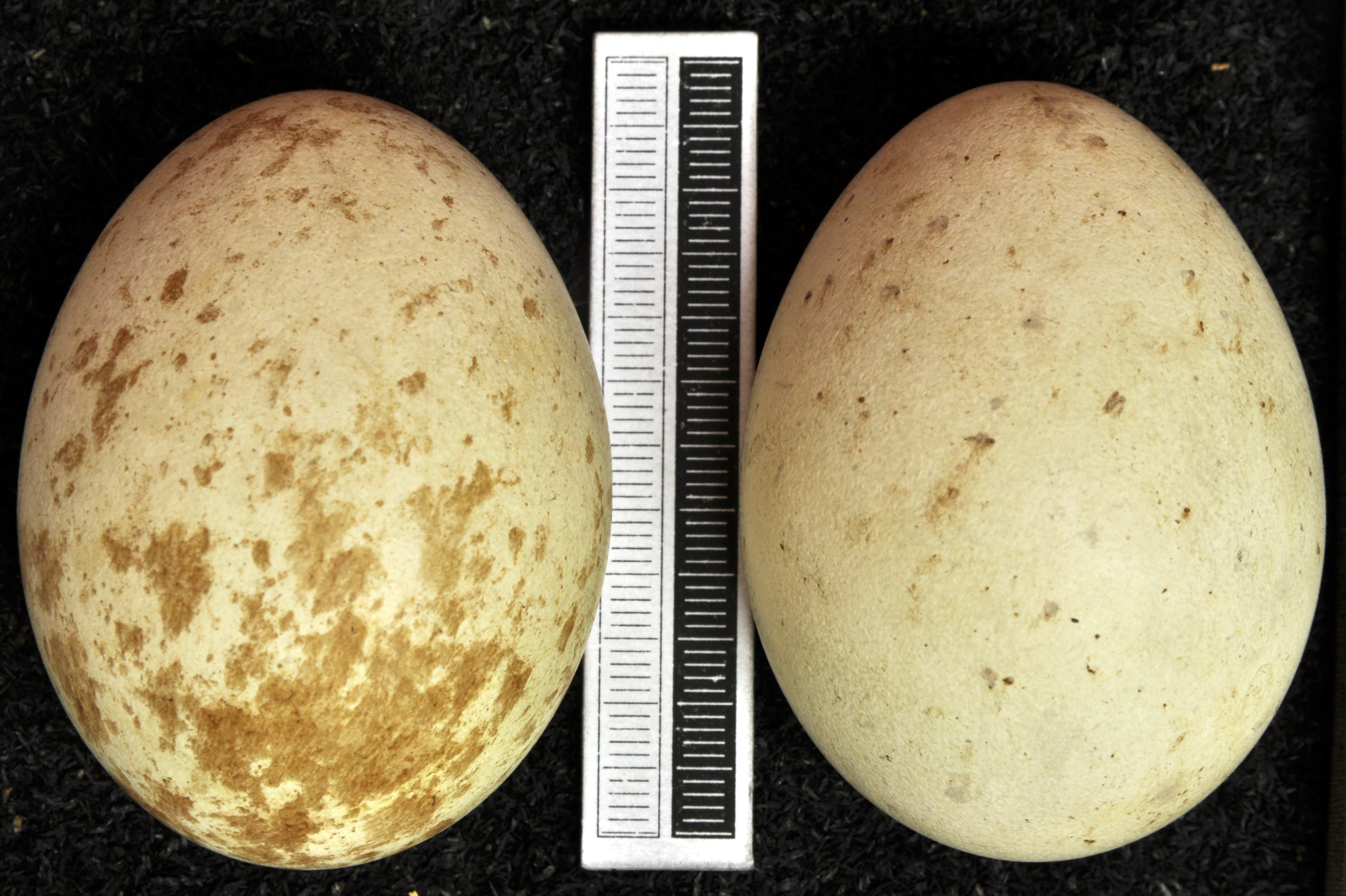
The eggs are laid at three-day intervals. The clutch is usually between one and three eggs but four and even five eggs have occasionally been recorded. The eggs are non-glossy with a white ground and red-brown spots. The average size is 57 x with a calculated weight of 63 g. In Britain and central Europe, laying begins at the end of March but in the Mediterranean area laying begins in early March. The eggs are mainly incubated by the female, but the male will relieve her for short periods while she feeds. The male will also bring food for the female. Incubation starts as soon as the first egg is laid. Each egg hatches after 31 to 32 days but as they hatch asynchronously a clutch of three eggs requires 38 days of incubation. The chicks are cared for by both parents. The female them for the first 14 days while the male brings food to the nest which the female feeds to the chicks. Later both parents bring items of food which are placed in the nest to allow the chicks to feed themselves. The nestlings begin climbing onto branches around their nest from 45 days but they rarely before 48–50 days and sometimes not until they are 60–70 days of age. The young spend a further 15–20 days in the neighbourhood of the nest being fed by their parents. Only a single brood is raised each year but if the eggs are lost the female will relay.
The maximum age recorded is 25 years and 8 months for a ringed bird in Germany. The BTO longevity record for Britain and Ireland is also 25 years and 8 months for a bird found dead in Buckinghamshire in 2018. In 2023, one of the first red kites reintroduced to the UK was found injured in Oxfordshire and later died, aged 29.
Food and feeding
.jpg)
The red kites are generalist scavengers and predators. Their diets consist mainly of carrion of large domestic animals such as sheep and pigs, roadkill, and stranded fish. They also take small mammals such as mice, voles, shrews, stoats, young hares and rabbits. Live birds are also taken, especially young or wounded, such as crows, doves, starlings, thrushes, larks, gulls, and waterfowl. Here, up to 5% of householders have provided supplementary food for red kites, with chicken being the predominant meat provided.
As scavengers, red kites are particularly susceptible to poisoning. Illegal poison baits set for foxes or crows are indiscriminate and kill protected birds and other animals. There have also been a number of incidents of red kites and other raptors being targeted by wildlife criminals.
On occasion, red kites may directly steal food from humans. One such occurrence took place in Marlow, Buckinghamshire (a town near a major reintroduction site for the species in the UK in the nearby village of Stokenchurch), in which red kites swooped down to steal sandwiches from people in one of the town's parks.
Distribution and status
Red kites inhabit broadleaf woodlands, pastures, mixed farmland, valleys and wetland edges, up to at least 1600 m elevation. They are native to the western Palearctic, with all of the currently known 32,200–37,700 breeding pairs being in Europe. There also used to be breeding populations in western Asia (northern Iran, Syria and Turkey) and northwestern Africa (Algeria, Morocco and Tunisia), but most of these were extirpated in the 19th century or earlier; Most red kites that breed in the northern European mainland used to move south or west in winter, typically wintering in Spain and other parts of western Europe with a mild climate, as well as northwestern Africa (Algeria, Morocco and Tunisia) and Turkey. In recent decades, an increasing number of red kites from the northern European mainland have stayed in the region year-round.
The populations in Germany (which alone is home to almost half of the world's breeding pairs), France and Spain declined between 1990 and 2000, and overall the species declined by almost 20% over those ten years. Populations in Germany and France have subsequently stabilised, and because of growth in other countries, the overall population is now increasing. The main threats to red kites are poisoning, through illegal direct poisoning and indirect poisoning from pesticides, particularly in the wintering ranges in France and Spain, and changes in agricultural practices causing a reduction in food resources. Other threats include electrocution, hunting and trapping, deforestation, egg-collection (on a local scale) and possibly competition with the generally more successful black kite M. migrans.
Continental Europe
German populations declined by 25%–30% between 1991 and 1997, but have remained stable since. The populations of the northern foothills of the Harz Mountains (the most densely populated part of its range) suffered an estimated 50% decline from 1991 to 2001. In Spain, the species showed an overall decline in breeding population of up to 43% for the period 1994 to 2001–02, and surveys of wintering birds in 2003–04 suggest a similarly large decline in core wintering areas. The Balearic Islands population has declined from 41 to 47 breeding pairs in 1993 to just 10 in 2003. In France, breeding populations have decreased in the northeast, but seem to be stable in southwest and central France and Corsica. Populations elsewhere are stable or undergoing increases. In Sweden, the species has increased from 30 to 50 pairs in the 1970s to 1,200 breeding pairs in 2003 and has continued growing. In Switzerland, populations have been increasing since the 1990s. Red kites have declined in their traditional strongholds of Spain, France and Germany; while now stable in the last two countries, those populations remain well below their historical peaks. In contrast, red kite populations are increasing in parts of northern Europe, such as Denmark, Poland, Sweden and the United Kingdom. The red kite is the official landscape bird of the Swedish province of Scania, and depicted on the coat of arms of the municipality of Tomelilla.
United Kingdom
.jpg)

In the United Kingdom, red kites were ubiquitous scavengers that lived on carrion and rubbish. Shakespeare's King Lear describes his daughter Goneril as a detested kite, and he wrote "when the kite builds, look to your lesser linen" in reference to them stealing washing hung out to dry in the nesting season. In the mid-15th century, King James II of Scotland decreed that they should be "killed wherever possible", but they remained protected in England and Wales for the next 100 years as they kept the streets free of carrion and rotting food. Under Tudor "vermin laws" many creatures were seen as competitors for the produce of the countryside and bounties were paid by the parish for their carcasses.
By the 20th century, the breeding population was restricted to a handful of pairs in South Wales, but recently the Welsh population has been supplemented by re-introductions in England and Scotland. In 2004, from 375 occupied territories identified, at least 216 pairs were thought to have hatched eggs and 200 pairs reared at least 286 young. In 1989, six Swedish birds were released at a site in north Scotland and four Swedish and one Welsh bird in Buckinghamshire. Altogether, 93 birds of Swedish and Spanish origin were released at each of the sites. In the second stage of reintroduction in 1995 and 1996, further birds were brought from Germany to populate areas of Dumfries and Galloway. Between 2004 and 2006, 94 birds were brought from the Chilterns and introduced into the Derwent Valley in north East England. In Northern Ireland, 80 birds from wild stock in Wales were released between 2008 and 2010, and the first successful breeding was recorded in 2010. The reintroductions in the Chilterns Area of Outstanding Natural Beauty have been a success. Between 1989 and 1993, 90 birds were released there and by 2002, 139 pairs were breeding. They can commonly be seen taking advantage of thermals from the M40 motorway. Another successful reintroduction has been in Northamptonshire, which has become a stronghold for the red kite. Thirty Spanish birds were introduced into Rockingham Forest near Corby in 2000, and by 2010, the RSPB estimated that over 200 chicks had been reared from the initial release. So successful has the reintroduction been that 30 chicks have been transported from Rockingham Forest for release in Cumbria. From the Chilterns they have spread as far east as Essex and can be seen over Harlow. By 2021 they had spread along the M4 as far as the Cotswold Edge overlooking the Severn near Bristol.
A sighting of the first red kite in London for 150 years was reported in The Independent newspaper in January 2006 and in June of that year, the UK-based Northern Kites Project reported that kites had bred in the Derwent Valley in and around Rowlands Gill, Tyne and Wear for the first time since the re-introduction.
In 1999, the red kite was named 'Bird of the Century' by the British Trust for Ornithology. According to the Welsh Kite Trust, it has been voted "Wales's favourite bird".
In June 2010, the Forestry Commission North West England announced a three-year project to release 90 red kites in Grizedale Forest, Cumbria under a special licence issued by Natural England. The Grizedale programme was the ninth reintroduction of red kites into different regions of the UK and the final re-introduction phase in England.
The stated aims of the Grizedale project were:
- To establish a viable population of red kites in Grizedale, South Cumbria by 2015.
- To increase the rate of red kite expansion into North West England and link up with existing populations in Wales, Yorkshire, North East England and South West Scotland and so increase the chances of a continuous geographical range.
- To develop community involvement and create educational opportunities arising from the project.
As of July 2011, non-breeding birds are regularly seen in all parts of Britain, and the number of breeding pairs is too large for the RSPB to continue to survey them on an annual basis.
In the 2020s, the UK kite population was deemed stable enough that, beginning in 2022, a small number of chicks have been taken to Spain to help recover populations there.
Ireland
Red kites were extinct in Ireland by the middle 19th century due to persecution, poisoning and woodland clearance. In May 2007, Minister for the Environment, Heritage and Local Government Dick Roche announced an agreement to bring at least 100 birds from Wales to restock the population as part of a five-year programme in the Wicklow Mountains, similar to the earlier golden eagle reintroduction programme. On 19 July 2007, the first 30 red kites were released in County Wicklow. On 22 May 2010, two newly hatched red kite chicks were discovered in the Wicklow Mountains, bringing the number of chicks hatched since reintroduction to seven.
Populations and trends by country
The following figures (mostly estimates) have been collated from various sources. They cover most of the countries in which red kites are believed to have bred.
| Country | Year | Pairs | Trend | Notes |
|---|---|---|---|---|
| Albania | 0 | Bred 1906 | ||
| Algeria | 0 | Bred in the 19th century, now extinct | ||
| Austria | 2019 | 90–130 | Extinct 1950, recolonised 1970s; 5–10 pairs in 2000 and since then rapidly increasing | |
| Belarus | 1997 | 1 | Extinct 1950s, recolonised 1985; 10 pairs 1990 | |
| Belgium | 2020 | 350–400 | Declined to 1–2 known pairs in 1967, then recovery | |
| Bosnia and Herzegovina | 0 | |||
| Bulgaria | 0 | May breed but no proof | ||
| Canary Islands | 0 | Extinct 1970s | ||
| Cape Verde | 2000 | 1? | 50–75 pairs late 1980s; effectively extinct | |
| Croatia | 0 | 2–5 pairs 1980s | ||
| Czech Republic | 2013 | 165–185 | Extinct late 19th century, recolonised 1975 | |
| Denmark | 2021 | 300–350 | Extinct c. 1920, then recolonised (from Germany/Sweden) 1970s. Slow increase up until the early 2000s (17 known pairs in 2001), since then rapidly increasing | |
| England | 2011 | c. 2,000 | Extinct 1870s, reintroduced 1989–1992, recovering | |
| Estonia | 1989 | |||
| France | 2018 | 3,000–3,900 | Rapidly declined from the 1980s until around 2010, since then stable or perhaps increasing locally | |
| Germany | 2018 | 14,000–16,000 | 15,000–25,000 pairs 1980s; declined up until around 2000, populations subsequently stabilised | |
| Greece | 0 | |||
| Hungary | c. 1998 | 1+ | 30 pairs 1950s | |
| 2010 | 7 | First successful breeding reported in 2010 following reintroduction in 2007 | ||
| Italy | c. 2002 | 300–400 | 70–150 pairs late 1980s. Clear increase in the mainland in recent decades, but almost extirpated in Sicily | |
| Latvia | 1992 | 0–50 | Extinct 1964, then recolonised | |
| Lithuania | 1988 | 1–2 | Extinct, then recolonised 1981 | |
| Luxembourg | 2015 | 90 | ||
| Moldova | 1990 | 1 | ||
| Montenegro | 1995 | 0 | ||
| Morocco | 2020 | 0 | Last breeding pair in 2004; rare winter visitor | |
| Netherlands | 2018 | 15–20 | Extinct 1852, recolonised 1970s, but highly irregular until 2008, since then regular and increasing | |
| Northern Ireland | 2010 | 5 | First successful breeding reported in 2010 following reintroduction in 2008 | |
| North Macedonia | 0 | |||
| Norway | 1980 | 0 | Bred occasionally in the 19th century | |
| Poland | 2012 | 1,500–1,800 | 400–450 pairs 1980s | |
| Portugal | c. 1995 | 100–200 | Appears to have rapidly decreased in recent decades, but accurate data lacking | |
| Romania | 1995 | 15–20 | ||
| Russia | 1992 | 0–50 | ||
| Scotland | 2009 | 135 | Extinct 1886, reintroduced 1989–1992 | |
| Serbia | ||||
| Slovakia | 1992 | 10–20 | ||
| Spain | 2018 | 2,312–2,440 | 10,000 pairs 1977 | |
| Sweden | 2021 | 4,000–5,000 | Increase from the low-point of 30–50 pairs in the 1970s | |
| Switzerland | 2013–2016 | 2,800–3,500 | Declined 19th century, later recovery; 235–300 pairs in the late 1980s, 800–1,000 pairs in 1995. | |
| Tunisia | 0 | Bred in the 19th century, now extinct | ||
| Turkey | 0 | May have bred in past but no firm evidence | ||
| Ukraine | 1990 | 5–8 | ||
| Wales | 2009 | c. 1,000 | Declined to two pairs in the 1930s, then recovery |
Observation
-
Note to editors:
Please do not add your own sightings to this section - this constitutes original research and will be removed. All information must be referenced
- ---
One of the best places to see the red kite in Scandinavia is Scania in southern Sweden. It may be observed in one of its breeding locations such as the Kullaberg Nature Preserve near Mölle. In Switzerland, they are a common sight in all rural areas, excluding the Alps and its foothills.
Some of the best places to see them in the United Kingdom are Gigrin Farm near Rhayader, mid Wales, where hundreds are fed by the local farmer as a tourist attraction, and the Bwlch Nant yr Arian forest visitor centre in Ceredigion where the rare leucistic variant can be seen. In England, the Oxfordshire part of the Chilterns has many red kites, especially near Henley-on-Thames and Watlington, where they were introduced on John Paul Getty's estate. Red Kites are also becoming common across the border in Buckinghamshire, often being seen near Stokenchurch, where a population was released in the 1990s, and Flackwell Heath near High Wycombe. They can also be seen around Harewood near Leeds where they were re-introduced in 1999. In Ireland they can be best observed at Redcross, near Avoca, County Wicklow.
Footnotes
References
Sources
References
- (30 Jul 2025). "Milvus milvus".
- BirdLife International. (2020). "''Milvus milvus''".
- {{cite OED. kite
- (2018). "New World vultures, Secretarybird, kites, hawks, eagles". International Ornithologists' Union.
- (2009). "The taxonomic and conservation status of ''Milvus'' kites in the Cape Verde archipelago: further (and final?) reflections". Bulletin of the British Ornithologists' Club.
- (2016). "Conservation of the Red Kite Milvus milvus (Aves: Accipitriformes) Is Not Affected by the Establishment of a Broad Hybrid Zone with the Black Kite Milvus migrans migrans in Central Europe". PLoS ONE.
- "First for UK as black and red kites produce two young".
- (1989). "Age of first breeding, dispersal and survival of Red Kites ''Milvus milvus'' in Wales". Ibis.
- (1998). "Successful breeding at one year of age by Red Kites ''Milvus milvus'' in southern England". Ibis.
- "European Longevity Records". Euring.
- "Summary of Ringing Totals - Longevity records 2021". [[British Trust for Ornithology]].
- (20 May 2023). "One of the first red kites released into Thames Valley dies". BBC News.
- Ferguson-Lees, James, and David A. Christie. Raptors of the world. Houghton Mifflin Harcourt, 2001.
- J. T. GARCÍA; J. VIÑUELA; C. SUNYER (1998). Geographic variation of the winter diet of the Red Kite Milvus milvus in the Iberian Peninsula., 140(2), 302–309.
- Wildman, L., L. O'Toole, and R. W. Summers. "The diet and foraging behaviour of the Red Kite in northern Scotland." Scottish Birds 19 (1998): 134-140.
- Korpimäki, Erkki, and Kai Norrdahl. "Avian predation on mustelids in Europe 1: occurrence and effects on body size variation and life traits." Oikos (1989): 205-215.
- (2014). "Supplementary feeding of the reintroduced Red Kite ''Milvus milvus'' in UK gardens". Bird Study.
- (31 July 2023). "Red kite awareness campaign after reports of stolen food". BBC News.
- (27 April 2018). "Fresh warning over red kite 'attacks' in Higginson Park, Marlow". [[Bucks Free Press]].
- (1991). "World status of the Red Kite". Brit. Birds.
- (11 January 2022). "Fugleart sætter rekord i Danmark: – Det er helt fantastisk". TV2.
- "Landskapssyboler". lansstyrelsen.se.
- "Grafisk handbok – Tomelilla kommun". tomelilla.se.
- "Back from the brink: UK red kites aid Spanish cousins".
- Cramp. 1980
- Uhl, H.. (2019). "Artenschutzprojekt für den Rotmilan (Milvus milvus) und dessen Wiederbesiedlung Oberösterreichs". Vogelkdl. Nachr. Österreich.
- (3 January 2021). "Fokus på røde rovfugle: Rød glente fortsætter sin fremgang i Danmark". [[Dansk Ornitologisk Forening]] (Danish Ornithological Society).
- (13 June 2018). "Zeldzame rode wouw nestelt bij Deventer". Dagblad De Stentor.
- "Röd glada". BirdLife Sverige).
- "Brecon Beacons Feeding Station".
- (17 August 2010). "Red kite chicks from Northamptonshire released to wild". BBC News.
- (16 June 2006). "Delight as red kite chicks hatch". BBC News.
- (15 September 2008). "RSPB Red Kite numbers are soaring across the UK". Birdguides.
- (1998). "The Birds of the Western Palearctic". Oxford University Press.
- Campbell, David. (2000). "The Encyclopedia of British Birds". Parragon.
- (3 April 2014). "Scottish bird of prey colony hit by mass poisonings". The Guardian.
- Carter, Ian (2009): The Red Kite. presentation to the Cambridgeshire Bird Club, Cambridge, UK, 13 November 2009.
- Carter, Ian. (2001). "The Red Kite". Arlequin Press.
- Schurmer, Michael. (November 2002). "Breeding Bird Survey of the Chilterns Area of Outstanding Natural Beauty 2002". RSPB.
- (21 May 2007). "Red Kite Reintroduction Project in Wicklow".
- "Grizedale Red Kite Project". Forestry commission.
- (1997). "A Field Guide to Birds of the Gambia and Senegal". Pica Press.
- "Red Kite Feeding Station — Gigrin Farm".
- "Golden Eagle Trust | Red Kite | Project Updates". Goldeneagle.ie.
- "Birder watchers' paradise". BBC.
- "Danmarks Fugle".
- Hjembæk, Gert. (25 November 2009). "Den røde drage bliver hængende i Danmark". [[Dansk Ornitologisk Forening]].
- (12 September 2007). "Wildlife crime soars". The Herald Series.
- (2000). "The imminent extinction of the kites ''Milvus milvus fasciicauda'' and ''Milvus m. migrans'' on the Cape Verde Islands". Bird Conservation International.
- Hogan, C. Michael (2005): ''Kullaberg Nature Reserve, Sweden''. Lumina technologies.
- Holloway, S.. (1996). "The Historical Atlas of Breeding Birds in Britain and Ireland: 1875–1900". T & A D Poyser.
- Jobling, James A.. (2010). "The Helm Dictionary of Scientific Bird Names". Christopher Helm.
- (2005). "Prioritizing species conservation: does the Cape Verde kite exist?". [[Proceedings of the Royal Society B: Biological Sciences]].
- Lacépède, Bernard Germain de. (1799). "Discours d'ouverture et de clôture du cours d'histoire naturelle". Plassan.
- Linnaeus, C.. (1758). "Systema naturae per regna tria naturae, secundum classes, ordines, genera, species, cum characteribus, differentiis, synonymis, locis. Tomus I. Editio decima, reformata.". Laurentius Salvius.
- "Red kite makes triumphant return in England and Scotland but numbers decline elsewhere".
- McCarthy, Michael. (13 January 2006). "Shakespeare's red kite returns to London after an absence of 150 years". Independent News and Media Limited.
- McCarthy, Michael. (23 March 2007). "Book Review:Silent Field, By Roger Lovegrove: songbirds versus shotguns". The Independent.
- Melia, Paul. (22 May 2010). "Two chicks about the size of a fist". Irish Independent.
- Melton, Tom. (13 August 2008). "Leucistic Red Kite". ephotozone.
- (2008). "Bwlch Nant-yr-Arian". Bwlch Nant Yr Arian Visitor Centre.
- "Golden Eagle Trust, Glenveagh National Park". NDP.
- Atrill, Rod. "The Red Kite in West Wales". Rod Attrill.
- (9 November 2007). "Red Kite project a soaring success". Evening Telegraph.
- Pugh, Elfyn. "The Red Kite". Birds of Britain.
- "BBC Radio 4, Debating Animals, Series 2, The Kestrel and Red Kite by Rod Liddle".
- "Red kite: Distribution and population size". The RSPB.
- "Red Kite". RSPB.
- (2000). "Red kite (''Milvus milvus'') and black kite (''M. migrans''): minute genetic interspecies distance of two raptors breeding in a mixed community (Falconiformes: Accipitridae)". [[Biological Journal of the Linnean Society]].
- "The Welsh Kite Trust".
- "Red Kites decline in Europe". Welsh Kite Trust.
- (17 June 2010). "Red kites to make a Lake District return". Newsquest media group.
- "Red Kites fly again in Ireland". Wildlife Extra.
- "The White Kite". Gigrin Farm.
- "Red Kites and poisons". Yorkshire Red Kites.
This article was imported from Wikipedia and is available under the Creative Commons Attribution-ShareAlike 4.0 License. Content has been adapted to SurfDoc format. Original contributors can be found on the article history page.
Ask Mako anything about Red kite — get instant answers, deeper analysis, and related topics.
Research with MakoFree with your Surf account
Create a free account to save articles, ask Mako questions, and organize your research.
Sign up freeThis content may have been generated or modified by AI. CloudSurf Software LLC is not responsible for the accuracy, completeness, or reliability of AI-generated content. Always verify important information from primary sources.
Report