From Surf Wiki (app.surf) — the open knowledge base
Red Hook, Brooklyn
Neighborhood in New York City

Neighborhood in New York City
| Field | Value |
|---|---|
| name | Red Hook |
| settlement_type | Neighborhood of Brooklyn |
| image_skyline | RH Houses East Lorraine eve jeh.jpg |
| image_caption | NYCHA Red Hook Houses |
| image_map | |
| mapsize | |
| map_caption | Location in New York City |
| coordinates | |
| subdivision_type | Country |
| subdivision_name | United States |
| subdivision_type1 | State |
| subdivision_name1 | New York |
| subdivision_type2 | City |
| subdivision_name2 | New York City |
| subdivision_type3 | Borough |
| subdivision_name3 | Brooklyn |
| subdivision_type4 | Community District |
| subdivision_name4 | Brooklyn 6 |
| established_title | Settled |
| established_date | 1636 |
| founder | Dutch colonists |
| named_for | red clay on the point of a nearby island in the Upper New York Bay |
| population_as_of | 2010 |
| population_density_sq_mi | auto |
| demographics_type1 | Economics |
| demographics1_title1 | Median income |
| demographics_type2 | Ethnicity |
| demographics2_title1 | White |
| demographics2_title2 | African American |
| demographics2_title3 | Hispanic American |
| demographics2_title4 | Asian/Pacific Islander |
| demographics2_title5 | Other |
| timezone1 | Eastern |
| utc_offset1 | −5 |
| timezone1_DST | EDT |
| utc_offset1_DST | −4 |
| postal_code_type | ZIP Code |
| postal_code | 11231 |
| area_code_type | Area codes |
| area_code | 718, 347, 929, and 917 |
--
Red Hook is a neighborhood in western Brooklyn, New York City, United States, within the area once known as South Brooklyn. It is located on a peninsula projecting into the Upper New York Bay and is bounded by the Gowanus Expressway and the Carroll Gardens neighborhood on the northeast, Gowanus Canal on the east, and the Upper New York Bay on the west and south. A prosperous shipping and port area in the early 20th century, the area declined in the latter part of the century. Today, it is home to the Red Hook Houses, the largest housing project in Brooklyn.
Red Hook is part of Brooklyn Community District 6, and its primary ZIP Code is 11231. It is patrolled by the 76th Precinct of the New York City Police Department. Politically, Red Hook is represented by the New York City Council's 38th District.
History
Colonization
Rapelye Street in Red Hook commemorates the beginnings of one of New Amsterdam's earliest families, the Rapelje clan, descended from the first European child born in the new Dutch settlement in the New World, Sarah Rapelje. She was born near Wallabout Bay, which later became the site of the New York (Brooklyn) Naval Shipyard. A couple of decades after the birth of his daughter Sarah, Joris Jansen Rapelje removed to Brooklyn, where he was one of the Council of twelve men, and where he was soon joined by son-in-law Hans Hansen Bergen. Rapelye Street in Red Hook is named for Rapelje and his descendants, who lived in Brooklyn for centuries.
American Revolution
During the Battle of Brooklyn (also known as the Battle of Long Island), Fort Defiance was constructed on the hoek. It is shown on a map called "a Map of the Environs of Brooklyn" drawn in 1780 by Loyalist engineer George S. Sproule. The Sproule map shows that the Fort Defiance complex consisted of three redoubts on a small island connected by trenches, with an earthwork on the island's south side to defend against a landing. The entire earthwork was about 1,600 feet long and covered the entire island. The three redoubts covered an area about 400 feet by 800 feet. The two principal earthworks were about 150 feet by 175 feet, and the tertiary one was about 75 feet by 100 feet. Maps from Sproule and Bernard Ratzer show that Red Hook was a low-lying area full of tidal mill ponds created by the Dutch.
General Israel Putnam came to New York on April 4, 1776, to assess the state of its defenses and strengthen them. Among the works initiated were forts on Governor's Island and Red Hook, facing the bay. On April 10, one thousand Continentals took possession of both points and began constructing Fort Defiance which mounted one three pounder cannon and four eighteen pounders. The cannons were to be fired over the tops of the fort's walls. In May, George Washington described it as "small but exceedingly strong". On July 5, General Nathanael Greene called it "a post of vast importance" and, three days later, Col. Varnum's regiment joined its garrison. On July 12, the British frigates Rose and Phoenix and the schooner Tyrol ran the gauntlet past Defiance and the stronger Governor's Island works without firing a shot, and got all the way to Tappan Zee. They stayed there for over a month, beating off harassing attacks, and finally returned to Staten Island on August 18. It appeared that gunfire from Fort Defiance did damage to the British ships.
Samuel Shaw wrote to his parents on July 15:
Almost the entire New York metropolitan area was under British military occupation from the end of 1776 until November 23, 1783, when they evacuated the city.
Industrial era

In the 1840s, entrepreneurs began to build ports as the "offloading end" of the Erie Canal. These included the Atlantic Basin, dredged in 1850, and the Erie Basin, dredged in 1864. Simultaneously, in 1849, the New York Legislature granted permission to dredge the nearby Gowanus Creek so it could be used as a 1.5 mi commercial waterway connected to Upper New York Bay. The creek's dredging was completed in 1860. Another act of the Legislature in 1867 allowed the canal to be deepened further. With the completion of the creek's dredging, Red Hook became an industrial hub, seeing up to 26,000 ships per year.
Dockworkers of various ethnicities began settling in Red Hook. African-American dockworkers began to move to Red Hook in the 1890s, while Italians had settled around Columbia Street. Many dockworkers lived in boarding houses, some of which had been speculatively built rowhouses. The industrial development also gave way to haphazard shanty towns. By the mid-1880s, a "Slab City" of 2,000 squatters and several hundred livestock had developed around Hamilton Avenue.
By the early 20th century, Red Hook had gained a reputation of decay, with organized crime having started to develop in the area. From the 1920s on, many poor and unemployed Norwegians, mostly former sailors, were living in the area in what they called Ørkenen Sur ("The Bitter Desert") around places like Hamilton Avenue and Gospel Hill. In 2015, NRK made a documentary about it in Norwegian. There is also an old documentary film about this.
Investment and decline
In the 1930s, the area was poor, and the site of the current Red Hook Houses was the site of a shack city for the homeless called a "Hooverville". Officials began looking to revitalize Red Hook at that time. The Red Hook Play Center and Red Hook Recreational Area opened in 1936 and 1940, respectively. The Red Hook Houses were completed in 1939.
In the 1990s, Life magazine named Red Hook as one of the "worst" neighborhoods in the United States and as "the crack capital of America". Patrick Daly, the principal of P.S. 15 in Red Hook, was killed in 1992 in the crossfire of a drug-related shooting while looking for a pupil who had left his school. The school was later renamed the Patrick Daly School after him, who was beloved within the school.

The Red Hook Star-RevueIn 2010, Red Hook's first community newspaper, The Red Hook Star-Revue, began publication. Red Hook was heavily damaged by Hurricane Sandy in 2012, two years later. In 2024, the New York City government took over about 120 acre of land on Red Hook's waterfront, with plans to redevelop it.
The Mary A. Whalen and Lehigh Valley Railroad Barge No. 79 are listed on the National Register of Historic Places.
Location
Red Hook is a peninsula between Buttermilk Channel, Gowanus Bay, and Gowanus Canal at the southern edge of Downtown Brooklyn. Red Hook is in the area known as South Brooklyn, which, contrary to its name, is actually in western Brooklyn. This name is derived from the original City of Brooklyn which ended at Atlantic Street, now Atlantic Avenue. By the 1950s, anything south of Atlantic Avenue was considered South Brooklyn; thus, the names "Red Hook" and "South Brooklyn" were applied also to today's Carroll Gardens, Cobble Hill, Columbia Heights, and Gowanus neighborhoods. Portions of Carroll Gardens and Cobble Hill were granted landmark status in the 1970s and were carved out of Red Hook.
Red Hook has a fully frontal view of the Statue of Liberty, which was oriented to face towards the southeast, welcoming ships coming into New York Harbor.

Red Hook is the site of the NYCHA Red Hook Houses, the largest public housing development in Brooklyn, which accommodates about 6,000 people. Red Hook also contains several parks, including Red Hook Park. The park is in the vicinity, if not the exact location, of where the celebrated Civil War era baseball team Excelsior of Brooklyn played many of their home games. The neighborhood contains a heritage trail recalling its portion of the Battle of Brooklyn in the revolutionary war.
IKEA CONTROVERSY

Red Hook has a large IKEA store (346000 ft2) that opened on June 18, 2008, near the Gowanus Expressway. The building of IKEA was controversial. Opponents cited concerns including traffic congestion, a decrease in property values and destruction of this transit-oriented neighborhood and historically significant buildings in the area. Brooklyn artist Greg Lindquist exhibited a group of paintings in February 2008 in New York City that depicted the IKEA site in process, juxtaposing the maritime decay with the new construction.

As part of the IKEA development, a number of Civil War era buildings were demolished and the Red Hook graving dock, a 19th-century dry dock still in use, was filled in and leveled for use as a parking lot. A Maritime Support Services Location Study by the New York City Economic Development Corporation found that New York City needed eight more dry docks. According to the report, it would cost $1 billion to replace the one sold to IKEA, although no schedule for replacement was announced. In addition, IKEA's contractor was found to be in "violation for not having filed asbestos work, failing to monitor the air, not posting warnings, failure to construct decontamination protections before disturbing the asbestos-containing materials, and doing nothing to protect and decontaminate the material, as well as the workers and building waste."
Demographics
Based on data from the 2010 United States census, the population of the Carroll Gardens/Columbia Street/Red Hook neighborhood tabulation area was 38,353, a change of 26 (0.1%) from the 38,327 counted in 2000. Covering an area of 1040.71 acres, the neighborhood had a population density of 36.9 PD/acre.
The racial makeup of the Carroll Gardens/Columbia Street/Red Hook neighborhood tabulation area was 60.9% (23,342) White, 11.9% (4,573) African American, 0.2% (61) Native American, 4.5% (1,728) Asian, 0% (13) Pacific Islander, 0.4% (143) from other races, and 2.4% (912) from two or more races, and Hispanic or Latino of any race were 19.8% (7,581) of the population.
The majority of residents identified as either Black, Hispanic, or Latino during the late 20th century. As late as 2000, 43% of the neighborhood's population was Black, and nearly half identified as Hispanic of Latino. Between 2000 and 2016, the ratio of white residents increased by 320%. According to a 2016 U.S. Census estimate, Red Hook's population was 31% white and 35% Black; in addition, 44% of residents identified as Hispanic or Latino of any race.
Police and crime
Red Hook is patrolled by the 76th Precinct of the NYPD, located at 191 Union Street. The 76th Precinct ranked 37th safest out of 69 patrol areas for per-capita crime in 2010. The 76th Precinct has a lower crime rate than in the 1990s, with crimes across all categories having decreased by 83.1% between 1990 and 2018. The precinct reported 4 murders, 9 rapes, 53 robberies, 91 felony assaults, 65 burglaries, 210 grand larcenies, and 28 grand larcenies auto in 2018.
Fire safety
The New York City Fire Department (FDNY) operates two fire stations serving Red Hook:
- Engine Company 202/Ladder Company 101 – 31 Richards Street
- Engine Company 279/Ladder Company 131 – 252 Lorraine Street
Education

Schools
Schools in Red Hook include:
- Pave Academy Charter School – Grades K–8
- P.S.15 Patrick F. Daly – Grades PK–5
- Summit Academy Charter School – Grades 6–12
- South Brooklyn Community High School – Grades 9–12
- Red Hook Neighborhood School – Grades PK–5
- Basis Independent Brooklyn – Grade K-12
Library
The Brooklyn Public Library's Red Hook branch is located at 7 Wolcott Street, near Dwight Street. The branch was originally housed in a Carnegie library structure, which was built in 1915 but burned down in a 1946 fire.
Transportation
Water
Red Hook has been served by NYC Ferry's South Brooklyn route since 2017. NY Waterway operates a free ferry service between the IKEA store, Wall St/Pier 11, and Midtown/Pier 79 on weekends; the route was previously operated by New York Water Taxi and began operation in 2008 in conjunction with the store's opening.
The transatlantic liner docks in Red Hook. In spring 2006, a new Carnival Cruise Lines terminal, the Brooklyn Cruise Terminal, opened at Pier 12 at Pioneer Street, bringing additional tourists.
The Red Hook Container Terminal is one of four such facilities in the Port of New York and New Jersey and is the only maritime facility in Brooklyn to handle container ships.
|File:Lehigh_Valley_Red_Hook_jeh.JPG |Lehigh Valley Railroad Barge Number 79 Waterfront Museum |File:NY_Brooklyn_Columbia_Street_Waterfront_District_IMG_2473.JPG |Red Hook Container Terminal |File:Into_Erie_Basin_jeh.JPG |Erie Basin harbor constructed in the 1850s. |File:Queen_Mary_2_in_New_York_08_2008.jpg |Queen Mary 2 docked at the Brooklyn Cruise Terminal
Public transport

Subway service in the area is sparse. The closest subway stops are along the IND Culver Line (), at either Carroll Street or Smith–Ninth Streets stations.
New York City Bus service is also sparse, but popular. The B61 bus route provides service from Hamilton Avenue, through Erie Basin/IKEA Plaza, to Van Brunt Street and then northward, through the Columbia Street Waterfront District and terminates in Downtown Brooklyn. It also connects with the Culver Line's Smith–Ninth Streets station. The B57 bus connects Red Hook with Downtown Brooklyn and Maspeth, Queens.
New York Water Taxi began operating a ferry route to the IKEA store in Red Hook when the store opened in 2008; the free service was implemented as a measure to improve transportation access to the new store but was not limited to use by store customers. The overall demand for the ferry by shoppers and non-shoppers was so high that the following year a $5 fare was charged for the service on weekdays, except for passengers that spent more than $10 in the store. Ferry service on weekends remained free of charge. The ferry service was taken over by NY Waterway in 2021 and remains free, but now only operates on weekends.
Streetcar project
Main article: Brooklyn–Queens Connector

Although electric trolleys have not run in Brooklyn since 1956, activists led by the Brooklyn Historic Railway Association (BHRA) have been trying to revive streetcars in Red Hook since 1989. With permission from New York City's government to develop a streetcar line running from Beard Street to Borough Hall, in the 1990s BHRA president Robert Diamond collected disused PCC streetcars that had been used in Boston and Buffalo for potential use on the new line. By 1999, Diamond had begun laying new track for the project, but in 2003 transportation officials elected to revoke Diamond's rights to the route's right of way, instead intending to sell them to the highest bidder in the event that the project ever moved forward. Diamond's efforts to secure independent funding were not successful.
In 2005, Rep. Nydia Velázquez helped obtain a $300,000 federal grant for a six-month streetcar study. Although BHRA had estimated $10–$15 million would be required to complete the project, the New York City Department of Transportation (NYCDOT) streetcar feasibility study (completed in April 2011) concluded that the 6.8 mile line would cost $176 million in capital funding, plus an additional $6.2 to $7.2 million in annual operating funds. A significant portion of the capital cost would be required to make modifications to Red Hook's narrow streets in order to allow streetcars to make right turns. The study ultimately found that the streetcar was not feasible because of high costs, potentially low ridership, and physical constraints like narrow streets.
In January 2016, a new proposal for a streetcar line in Red Hook, called the Brooklyn–Queens Connector, was made public by a non-profit group named Friends of the Brooklyn Queens Connector. The study proposed a 17 mi route between the neighborhoods of Astoria in Queens and Sunset Park in Brooklyn, passing through several neighborhoods on the way, including Red Hook. The private results of the study estimated that the streetcar's construction would cost $1.7 billion and would serve 15.8 million annual riders by 2035. In February 2016, the office of Mayor Bill de Blasio announced that the city would begin planning work for the streetcar line. However, although a list of possible routings for the streetcar was released in November 2016, there was insufficient funding to start construction. By August 2018, the southern terminal of the proposed streetcar had been truncated to Red Hook and the proposed cost rose to $2.73 billion, with projected completion postponed to 2029.
Vehicular
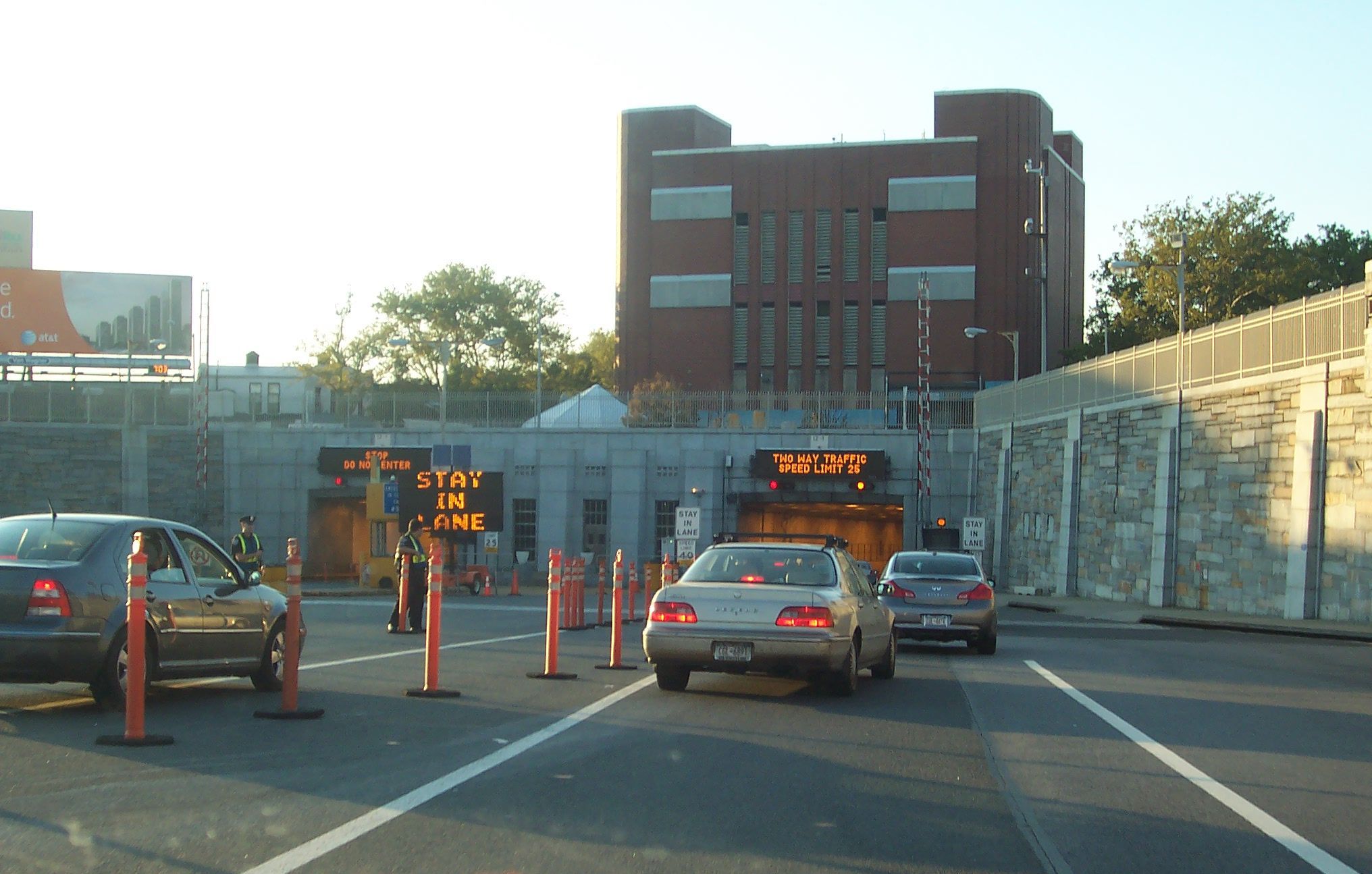
Red Hook is connected to Manhattan by the Brooklyn–Battery Tunnel, whose approaches separate it from Carroll Gardens and Columbia Street to the north. The tunnel's toll plaza was formerly located in Red Hook but was removed in 2017, replaced by electronic toll collection gantries on the Manhattan side of the tunnel.
The Gowanus Expressway (Interstate 278) also runs through the neighborhood.
Events
.jpg)
The Red Hook Waterfront Arts Festival is an annual summer kick-off held in Louis J. Valentino Jr. Park & Pier featuring dance, music, and spoken-word poetry. Dance Theatre Etcetera, the producers of the event, concentrate local resources for residents and bring in community partners with activities for the whole family.
Sundays at Sunny's is a reading series held the first Sunday of every month, co-sponsored by Sunny's Bar and the independent bookstore BookCourt, and co-ordinated by writer Gabriel Cohen.
Red Hook Crit is an annual, unsanctioned bicycle race held on a springtime night on track bikes. It began as an underground event but has grown to become "what is possibly the country's coolest bike race."
The Brooklyn Street Circuit is located in Red Hook and hosts the annual New York City ePrix.
Notable residents
- Carmelo Anthony (born 1984), former NBA player
- Jaimie Branch (1983–2022), jazz trumpeter
- Al Capone (1899–1947), gangster
- Joe Gallo (1929–1972), who was commemorated in Bob Dylan's song "Joey" from the album Desire.
- Albert Gallo, mobster and brother of Joe Gallo
- Stephen Kunken (born c. 1971), actor
- Michael Lerner (1941–2023), actor
- James McBride, writer
- Greg O'Connell (1942–2025), property developer
- Sarah Rapelje, for whose family Brooklyn's Rapelye Street is named
- Hell Razah, rapper, member of hip-hop group Sunz of Man
- Matty Rich, director of movies Straight Out of Brooklyn and The Inkwell
- Shabazz the Disciple, rapper, member of hip-hop group Sunz of Man
- Michael Shannon (born 1974), actor
- Peter Steele (1962–2010), member of Type O Negative
- Taz (born 1967 as Peter Senerchia), former professional wrestler and color commentator
- Eli Wallach (1915–2014), actor
- Michelle Williams (born 1980), actress
- Dustin Yellin (born 1975), artist
In popular culture
.jpg)
- Red Hook was the setting for the H. P. Lovecraft 1927 story "The Horror at Red Hook".
- In Thomas Wolfe's short story "Only the Dead Know Brooklyn", a character rides the subway at night and is warned by the narrator to not walk around in Red Hook. It is written in transliterated circa 1936 Brooklynese.
- The 1954 film On the Waterfront is set in Red Hook, though it was filmed in Hoboken, New Jersey.
- The area was used as the setting for Arthur Miller's 1955 play A View from the Bridge, and subsequently for the opera of the same name by William Bolcom.
- Red Hook is the setting for the 1961 book Memos from Purgatory by Harlan Ellison.
- Red Hook is the birthplace of gangster Joe Gallo, which was commemorated in Bob Dylan's song "Joey" from the album Desire.
- In the 1988 film Spike of Bensonhurst, the protagonist moves from Bensonhurst to Red Hook after being chased out of his old neighborhood by the Mafia.
- Red Hook was the setting for the 1964 novel Last Exit to Brooklyn by Hubert Selby Jr. and the 1989 film of the same name.
- The 1991 independent film Straight Out of Brooklyn is set in the Red Hook Housing Projects.
- Red Hook is the setting of Reggie Nadelson's 2005 crime novel, also called Red Hook.
- Red Hook is featured in Lil Kim's music video for the song "Lighters Up", which pays homage to Lil Kim's hometown of Brooklyn.
- Pier 41 at 204 Van Dyke Street was used as the setting of a bar scene in the 2005 Will Smith film Hitch.
- The cast of The Real World: Brooklyn, part of MTV's reality television series The Real World, resided at Pier 41 in 2009.
- Red Hook is the setting for Visitation Street, a 2013 novel by Ivy Pochoda.
- Red Hook is the birthplace and sometimes current residence of Steve Rogers, also known as Captain America.
- "The Red Hook" is the name of a cocktail created at Milk & Honey.
- Red Hook is featured prominently in the FX TV series The Strain.
- Red Hook is the setting of the Type O Negative song "In Praise Of Bacchus" from the album October Rust, as evidenced by the lyric, "The street lamps light a wet old Red Hook road". The song also references the Brooklyn Bridge and Pier 6. Frontman Peter Steele has mentioned the neighborhood in other songs, such as "Nettie" and "Stay Out Of My Dreams".
- Red Hook is the setting of the 2018 indie drama-comedy music film Hearts Beat Loud directed by Brett Haley.
References
References
- "NYC Planning {{!}} Community Profiles". New York City Department of City Planning.
- [http://www.nyc.gov/html/dc/downloads/pdf/brooklyn.pdf Current City Council Districts for Kings County], [[New York City]]. Accessed May 5, 2017.
- Klose, Olivia. (June 26, 2007). "Red Hook Play Center (Sol Goldman Pool)". [[New York City Landmarks Preservation Commission]].
- (September 4, 2016). "Red Hook History".
- Reiss, Marcia. (2000). "Red Hook, Gowanus Neighborhood History Guide". Brooklyn Historical Society.
- Stiles, Henry R.. (1869). "A History of the City of Brooklyn: Including the Old Town and Village of Brooklyn, the Town of Bushwick, and the Village and City of Williamsburgh (Volume 2)".
- Wick, Steve. (March 28, 2009). "14 Generations: New Yorkers Since 1624, the Rapeljes Are On a Mission to Keep Their History Alive". [[Newsday]].
- "Urban Environmentalist: The Hidden History of the Rapaljes".
- (2006). "Brooklyn by Name: How the Neighborhoods, Streets, Parks, Bridges, and More Got Their Names". New York University Press.
- (July 25, 2016). "Historic Maps".
- "Exploring Pre-Revolutionary New York: THE RATZER MAP". [[Brooklyn Historical Society]].
- Roberts, Robert B.. (1980). "New York's Forts in the Revolution". Fairleigh Dickinson University Press.
- "Gowanus Canal History".
- (December 2, 1867). "Laws of New York – By Authority".
- (1885-05-09). "Opportunities for Sanitary Improvement in the Sixth and Twelfth Wards". Brooklyn Daily Eagle.
- "Red Hook Recreation Area Highlights". New York City Department of Parks & Recreation.
- "Report by City Missionary, Karl Holm".
- "Dokumentar: Ørkenen Sur".
- "The Bitter Desert".
- (July 2, 1939). "$13,000,000 Red Hook Housing Project to Open Tuesday". Brooklyn Daily Eagle.
- "Red Hook Justice".
- Rogan, Helen. (August 7, 2000). "Red Hook Catches the Wave".
- Orchant, Rebecca. (November 9, 2012). "Brooklyn's Court Street Grocers On Hurricane Sandy's Aftermath In Red Hook".
- O'Neil, Meaghan McGoldrick. (May 15, 2024). "City takes ownership of Brooklyn Marine Terminal, planning modern mixed-use transformation".
- Manna, Victoria. (May 14, 2024). "Officials unveil plan to transform Brooklyn Marine Terminal".
- (October 12, 2012). "National Register of Historic Places Listings". National Park Service.
- (June 12, 2015). "National Register of Historic Places Listings". National Park Service.
- [https://www.nps.gov/stli/planyourvisit/frequently-asked-questions-statue-of-liberty.htm Frequently Asked Questions], [[Statue of Liberty National Monument]]. Accessed March 9, 2025. "Which direction does the statue face? The Statue of Liberty faces Southeast and was strategically placed inside of Fort Wood which was a perfect base for the Statue. The Statue's position was also perfect for ships, entering the harbor, to see her as a welcoming symbol."
- "Home".
- "Red Hook Recreation Area".
- "BrooklynBallParks.com – Other Ancient Parks".
- Carter, Nicole. (June 17, 2008). "9 questions for the Brooklyn IKEA store manager". [[Daily News (New York).
- "Ten Reasons To Oppose Ikea-Red Hook".
- Calder, Rich. (June 23, 2008). "IKEA Berth Pangs; City Dock Deal a $1B Blunder". [[New York Post]].
- (2007). "Maritime Support Services Location Study". [[New York City Economic Development Corporation]].
- Wisloski, Jess. (January 29, 2005). "IKEA hit with asbestos fines". [[The Brooklyn Paper]].
- [http://www1.nyc.gov/assets/planning/download/pdf/data-maps/nyc-population/census2010/t_pl_p5_nta.pdf Table PL-P5 NTA: Total Population and Persons Per Acre – New York City Neighborhood Tabulation Areas*, 2010], Population Division – [[New York City]] Department of City Planning, February 2012. Accessed June 16, 2016.
- [http://www1.nyc.gov/assets/planning/download/pdf/data-maps/nyc-population/census2010/t_pl_p3a_nta.pdf Table PL-P3A NTA: Total Population by Mutually Exclusive Race and Hispanic Origin – New York City Neighborhood Tabulation Areas*, 2010], Population Division – [[New York City]] Department of City Planning, March 29, 2011. Accessed June 14, 2016.
- Venugopal, Nikhita. (November 18, 2016). "MAP: How Red Hook's White Population Surge Is Changing the Neighborhood".
- "NYPD – 76th Precinct". [[New York City Police Department]].
- "Red Hook, Carroll Gardens & Cobble Hill – DNAinfo.com Crime and Safety Report".
- "76th Precinct CompStat Report". [[New York City Police Department]].
- {{Cite FDNY locations
- "Engine Company 202/Ladder Company 101".
- "Engine Company 279/Ladder Company 131".
- "School Reviews for Red Hook".
- (August 19, 2011). "Red Hook Library".
- "Routes and Schedules: South Brooklyn".
- (May 1, 2017). "NYC launches ferry service with Queens, East River routes". Associated Press.
- (May 1, 2017). "New York Today: Our City's New Ferry". The New York Times.
- (May 14, 2008). "In Brief". [[New York Newsday.
- (July 13, 2021). "Red Hook IKEA gets new ferry line". [[Queens Ledger]].
- "IKEA Ferry Service".
- (May 3, 2000). "Press Release Archives #157: City Purchases New Container Cranes For Brooklyn's Red Hook Container Terminal".
- "Home".
- {{NYCS const. map
- {{cite NYC bus map. B
- McLaughlin, Mike. (July 22, 2009). "Ikea to start charging for ferry service to Hook superstore". [[Brooklyn Paper]].
- Geberer, Raanan. (November 22, 2013). "De Blasio gives Diamond hope for Red Hook trolley plan". [[Brooklyn Daily Eagle]].
- Calder, Rich. (May 18, 2010). "Trolley good news for Red Hook rail plan". New York Post.
- (March 13, 2012). "Red Hook Trolley Revival".
- (August 2011). "Brooklyn Streetcar Feasibility Study Final Report".
- Schwartz, Sam. "Brooklyn-Queens Connector". Sam Schwartz Transportation Consultants.
- Rivoli, Dan. (January 5, 2016). "$1.7B streetcar route desired for Brooklyn-Queens waterfront". NY Daily News.
- Grynbaum, Michael M.. (February 3, 2016). "Mayor de Blasio to Propose Streetcar Line Linking Brooklyn and Queens". [[The New York Times]].
- Fitzsimmons, Emma G.. (November 1, 2016). "City Unveils Possible Routes for Streetcar in Brooklyn and Queens". The New York Times.
- (November 1, 2016). "BQX Fall 2016". [[Government of New York City]].
- Rubinstein, Dana. (April 14, 2017). "City memo suggests BQX may not be financially feasible after all". Politico PRO.
- Warerkar, Tanay. (August 30, 2018). "Brooklyn-Queens streetcar changes course, will cost more".
- (August 30, 2018). "Shorter route, higher cost unveiled for BQX".
- (August 30, 2018). "New Plan for City Streetcar: Shorter, Pricier and Not Coming Soon".
- George, Michael. (August 30, 2018). "Brooklyn-Queens Connector Streetcar Would Cost $2.7 Billion".
- Siff, Andrew. (October 5, 2016). "Automatic Tolls to Replace Gates at 9 NYC Spans: Cuomo".
- WABC. (December 21, 2016). "MTA rolls out cashless toll schedule for bridges, tunnels".
- "Red Hook Waterfront Arts Festival".
- "Red Hook Crit Championship Series".
- Landau, Ian. "At the Red Hook Crit, It's Anyone's Race".
- Mather, Victor. (September 22, 2016). "An Event That Is Truly Electric: Formula E to Race in Brooklyn". The New York Times.
- Taylor, Nate. (November 26, 2012). "Excited for Return to Brooklyn, Anthony Gets the Ending Wrong". The New York Times.
- Rubin, Mike. [https://www.nytimes.com/2022/08/28/arts/music/jaimie-branch-dead.html "Jaimie Branch, Trumpeter Who Crossed Genre Lines, Dies at 39"], ''[[The New York Times]]'', August 28, 2022. Accessed August 26, 2023. "Jaimie Branch, an innovative avant-garde trumpet player and composer whose punk-rock intensity and commitment to experimentation and to dissolving the distinctions between genres invigorated the music scenes of New York and Chicago, died on Aug. 22 at her home in Red Hook, Brooklyn. She was 39."
- McShane, Larry. (March 31, 2012). "Tribute for dead mobster, Crazy Joe Gallo". [[New York Daily News]].
- (August 13, 2012). "'Red Hook Summer' writer James McBride wants America 'shaken awake' to life in public housing". [[Daily News (New York).
- (November 28, 1994). "New York's Red Hook: an inner-city model". [[Honolulu Star-Bulletin]].
- Bagli, Charles. (November 12, 2010). "Resurrecting a Village by Buying Up Main Street". [[The New York Times]].
- (1858). "The New American Cyclopaedia: A Popular Dictionary of General Knowledge". D. Appleton.
- Kaufman, Joanne. (June 20, 2014). "Michael Shannon Finds Balance on the Waterfront; Michael Shannon's Red Hook, Brooklyn, Loft Rental". [[The New York Times]].
- Fortunato, John. (May 11, 2010). "Lost Interview with Peter Steele of Type O Negative, Circa October Rust". [[The Aquarian Weekly]].
- Berkvist, Robert. (June 25, 2014). "Eli Wallach, Multifaceted Actor on Stage and Screen, Dies at 98". The New York Times.
- Kussin, Zachary. (July 15, 2016). "Share a street with Michelle Williams for $3 million". [[New York Post]].
- Colman, David. (October 11, 2009). "A Red Hook Tale of Domesticity; Was: Large industrial complex used mostly for storage. v Is: Live-work haven for two artists, even when it's not heaven exactly".
- (March 3, 2015). "Lovecraft's Most Bigoted Story, No Really: 'The Horror at Red Hook'".
- "On This Day in History, February 10: Death of a Playwright". [[Brooklyn Daily Eagle]].
- Yagoda, Ben. (December 9, 1988). "Shades of 'Moonstruck'". [[The Philadelphia Inquirer]].
- DePalma, Anthony. (April 27, 2004). "Hubert Selby Jr. Dies at 75; Wrote 'Last Exit to Brooklyn'". The New York Times.
- Martin, Michael. (July 21, 2008). "Real World Brooklyn Docks at Pier 41 in Red Hook".
- Rickhouse, Roddy. (May 20, 2011). "Frontier Mixology: Bar Review & Cocktail Two-fer, Red Hook's Fort Defiance".
This article was imported from Wikipedia and is available under the Creative Commons Attribution-ShareAlike 4.0 License. Content has been adapted to SurfDoc format. Original contributors can be found on the article history page.
Ask Mako anything about Red Hook, Brooklyn — get instant answers, deeper analysis, and related topics.
Research with MakoFree with your Surf account
Create a free account to save articles, ask Mako questions, and organize your research.
Sign up freeThis content may have been generated or modified by AI. CloudSurf Software LLC is not responsible for the accuracy, completeness, or reliability of AI-generated content. Always verify important information from primary sources.
Report