From Surf Wiki (app.surf) — the open knowledge base
Reciprocating compressor
Device used to pump gases at high pressure
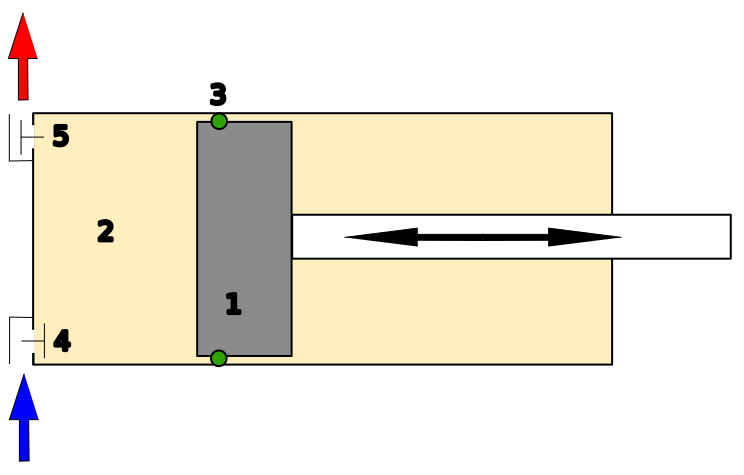
Device used to pump gases at high pressure


A ** reciprocating compressor** or piston compressor is a positive-displacement compressor that uses pistons driven by a crankshaft to deliver gases at high pressure.{{cite book |last1=Bloch |first1=H.P. |last2=Hoefner |first2=J.J. |name-list-style=amp |title=Reciprocating Compressors, Operation and Maintenance|publisher=Gulf Professional Publishing|year=1996|isbn=0-88415-525-0
The intake gas enters the suction manifold, then flows into the compression cylinder where it gets compressed by a piston driven in a reciprocating motion via a crankshaft, and is then discharged. Applications include railway and road vehicle air brake systems oil refineries, gas pipelines, oil and gas production drilling and well services, air and nitrogen injection, offshore platforms, chemical plants, natural gas processing plants, air conditioning, and refrigeration plants. One specialty application is the blowing of plastic bottles made of polyethylene terephthalate (PET).
References
References
This article was imported from Wikipedia and is available under the Creative Commons Attribution-ShareAlike 4.0 License. Content has been adapted to SurfDoc format. Original contributors can be found on the article history page.
Ask Mako anything about Reciprocating compressor — get instant answers, deeper analysis, and related topics.
Research with MakoFree with your Surf account
Create a free account to save articles, ask Mako questions, and organize your research.
Sign up freeThis content may have been generated or modified by AI. CloudSurf Software LLC is not responsible for the accuracy, completeness, or reliability of AI-generated content. Always verify important information from primary sources.
Report