From Surf Wiki (app.surf) — the open knowledge base
Reciprocal gamma function
Mathematical function
Mathematical function

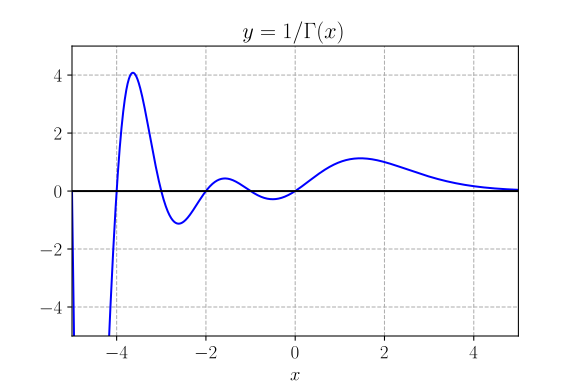
In mathematics, the reciprocal gamma function is the function f(z) = \frac{1}{\Gamma(z)}, where Γ(z) denotes the gamma function. Since the gamma function is meromorphic and nonzero everywhere in the complex plane, its reciprocal is an entire function. As an entire function, it is of order 1 (meaning that log log grows no faster than log ), but of infinite type (meaning that log grows faster than any multiple of , since its growth is approximately proportional to log in the left-half plane).
The reciprocal is sometimes used as a starting point for numerical computation of the gamma function, and a few software libraries provide it separately from the regular gamma function.
Karl Weierstrass called the reciprocal gamma function the "factorielle" and used it in his development of the Weierstrass factorization theorem.
Infinite product expansion
Following from the infinite product definitions for the gamma function, due to Euler and Weierstrass respectively, we get the following infinite product expansion for the reciprocal gamma function: \begin{align} \frac{1}{\Gamma(z)} &= z \prod_{n=1}^\infty \frac{1+\frac{z}{n}}{\left(1+\frac{1}{n}\right)^z} \ \frac{1}{\Gamma(z)} &= z e^{\gamma z} \prod_{n=1}^\infty \left(1 + \frac{z}{n}\right) e^{-\frac{z}{n}} \end{align}
where is the Euler–Mascheroni constant. These expansions are valid for all complex numbers z.
Taylor series
Taylor series expansion around 0 gives: \frac{1}{\ \Gamma(z)\ } = z + \gamma\ z^2 + \left(\frac{\gamma^2}{2} - \frac{\pi^2}{12}\right)\ z^3 + \left(\frac{\gamma^3}{6} - \frac{\gamma\pi^2}{12} + \frac{\zeta(3)}{3}\ \right)z^4 + \cdots\ where γ is the Euler–Mascheroni constant. For n 2, the coefficient a**n for the z**n term can be computed recursively as a_n = \frac{\ {a_2\ a_{n-1} + \sum_{j=2}^{n-1} (-1)^{j+1}\ \zeta(j)\ a_{n-j}}\ }{n-1} = \frac{\ \gamma\ a_{n-1} - \zeta(2)\ a_{n-2} + \zeta(3)\ a_{n-3}-\cdots\ }{n-1} where ζ is the Riemann zeta function. An integral representation for these coefficients was recently found by Fekih-Ahmed (2014): a_n = \frac{(-1)^n}{\pi n!}\int_0^\infty e^{-t}\ \operatorname{Im}\Bigl[\ \bigl( \log(t)-i\pi \bigr)^n\ \Bigr]\ \mathrm{d} t ~.
For small values, these give the following values:
| n | *a*n |
|---|---|
| 1 | +1.0000000000000000000000000000000000000000 |
| 2 | +0.5772156649015328606065120900824024310422 |
| 3 | −0.6558780715202538810770195151453904812798 |
| 4 | −0.0420026350340952355290039348754298187114 |
| 5 | +0.1665386113822914895017007951021052357178 |
| 6 | −0.0421977345555443367482083012891873913017 |
| 7 | −0.0096219715278769735621149216723481989754 |
| 8 | +0.0072189432466630995423950103404465727099 |
| 9 | −0.0011651675918590651121139710840183886668 |
| 10 | −0.0002152416741149509728157299630536478065 |
| 11 | +0.0001280502823881161861531986263281643234 |
| 12 | −0.0000201348547807882386556893914210218184 |
| 13 | −0.0000012504934821426706573453594738330922 |
| 14 | +0.0000011330272319816958823741296203307449 |
| 15 | −0.0000002056338416977607103450154130020573 |
| 16 | +0.0000000061160951044814158178624986828553 |
| 17 | +0.0000000050020076444692229300556650480600 |
| 18 | −0.0000000011812745704870201445881265654365 |
| 19 | +0.0000000001043426711691100510491540332312 |
| 20 | +0.0000000000077822634399050712540499373114 |
| 21 | −0.0000000000036968056186422057081878158781 |
| 22 | +0.0000000000005100370287454475979015481323 |
| 23 | −0.0000000000000205832605356650678322242954 |
| 24 | −0.0000000000000053481225394230179823700173 |
| 25 | +0.0000000000000012267786282382607901588938 |
| 26 | −0.0000000000000001181259301697458769513765 |
| 27 | +0.0000000000000000011866922547516003325798 |
| 28 | +0.0000000000000000014123806553180317815558 |
| 29 | −0.0000000000000000002298745684435370206592 |
| 30 | +0.0000000000000000000171440632192733743338 |
Fekih-Ahmed (2014) also gives an approximation for a**n:
a_n \approx (-1)^n \sqrt{\frac{ 2 }{ \pi }\ } \frac{\sqrt{n\ }}{n!}
\ \operatorname\mathcal{I_m} \left( \frac{\ z_0^{(1/2-n)}\ e^{-n z_0}\ }{\sqrt{ 1 + z_0\ }} \right)\ , --
a_n \approx \frac{(-1)^n}{\ (n-1)!\ } \ \sqrt{ \frac{2}{\ \pi n \ }\ }
\operatorname{Im} \left( \frac{\ z_0^{\left( 1/2 - n \right)}\ e^{-n z_0}\ }{\sqrt{ 1 + z_0\ }} \right)\ ,
where , and W−1 is the negative-first branch of the Lambert W function.
The Taylor expansion around 1 has the same (but shifted) coefficients, i.e.: \frac{1}{\Gamma(1+z)} = \frac{1}{z\Gamma(z)} = 1 + \gamma\ z + \left(\frac{\gamma^2}{2} - \frac{\pi^2}{12}\right)\ z^2 + \left(\frac{\gamma^3}{6} - \frac{\gamma\pi^2}{12} + \frac{\zeta(3)}{3}\ \right)z^3 + \cdots\ (the reciprocal of Gauss's pi function).
Asymptotic expansion
As goes to infinity at a constant arg(z) we have: \ln (1/\Gamma(z)) \sim -z \ln (z) + z + \tfrac{1}{2} \ln \left (\frac{z}{2\pi} \right ) - \frac{1}{12z} + \frac{1}{360z^3} -\frac{1}{1260 z^5}\qquad \text{for}~ \left|\arg(z)\right|
Contour integral representation
An integral representation due to Hermann Hankel is \frac{1}{\Gamma(z)} = \frac{i}{2\pi} \oint_H (-t)^{-z} e^{-t} , dt, where H is the Hankel contour, that is, the path encircling 0 in the positive direction, beginning at and returning to positive infinity with respect for the branch cut along the positive real axis. According to Schmelzer & Trefethen,; ; numerical evaluation of Hankel's integral is the basis of some of the best methods for computing the gamma function.
Integral representations at the positive integers
For positive integers n ≥ 1, there is an integral for the reciprocal factorial function given by \frac{1}{n!} = \frac{1}{2\pi} \int_{-\pi}^{\pi} e^{-nit} e^{e^{it}}\ dt.
Similarly, for any real c 0 and z ∈ C such that Re(z) 0 we have the next integral for the reciprocal gamma function along the real axis in the form of: \frac{1}{\Gamma(z)} = \frac{1}{2\pi} \int_{-\infty}^{\infty} (c+ it)^{-z} e^{c+it} dt, where the particular case when provides a corresponding relation for the reciprocal double factorial function, \frac{1}{(2n-1)!!} = \frac{\sqrt{\pi}}{2^n \cdot \Gamma\left(n+\frac{1}{2}\right)}.
Integral along the real axis
Integration of the reciprocal gamma function along the positive real axis gives the value \int_{0}^\infty \frac{1}{\Gamma(x)}, dx \approx 2.80777024, which is known as the Fransén–Robinson constant.
We have the following formula \int_0^\infty \dfrac{a^x}{\Gamma(x)},dx=ae^a+a\int_0^\infty\dfrac{e^{-ax}}{\log^2(x)+\pi^2},dx
References
- Mette Lund, An integral for the reciprocal Gamma function
- Milton Abramowitz & Irene A. Stegun, Handbook of Mathematical Functions with Formulas, Graphs, and Mathematical Tables
- Eric W. Weisstein, Gamma Function, MathWorld
References
- Weisstein, Eric W.. "Gamma function".
- Wrench, J.W.. (1968). "Concerning two series for the gamma function". Mathematics of Computation.
- Fekih-Ahmed, L.. (2014). "On the power series expansion of the reciprocal gamma function".
- (1994). "Concrete Mathematics". Addison-Wesley.
- {{cite OEIS. A058655. Decimal expansion of area under the curve 1/Gamma(x) from zero to infinity
- Henri Cohen. (2007). "Number Theory Volume II: Analytic and Modern Tools".
This article was imported from Wikipedia and is available under the Creative Commons Attribution-ShareAlike 4.0 License. Content has been adapted to SurfDoc format. Original contributors can be found on the article history page.
Ask Mako anything about Reciprocal gamma function — get instant answers, deeper analysis, and related topics.
Research with MakoFree with your Surf account
Create a free account to save articles, ask Mako questions, and organize your research.
Sign up freeThis content may have been generated or modified by AI. CloudSurf Software LLC is not responsible for the accuracy, completeness, or reliability of AI-generated content. Always verify important information from primary sources.
Report