From Surf Wiki (app.surf) — the open knowledge base
Real gas
Non-hypothetical gases whose molecules occupy space and have interactions
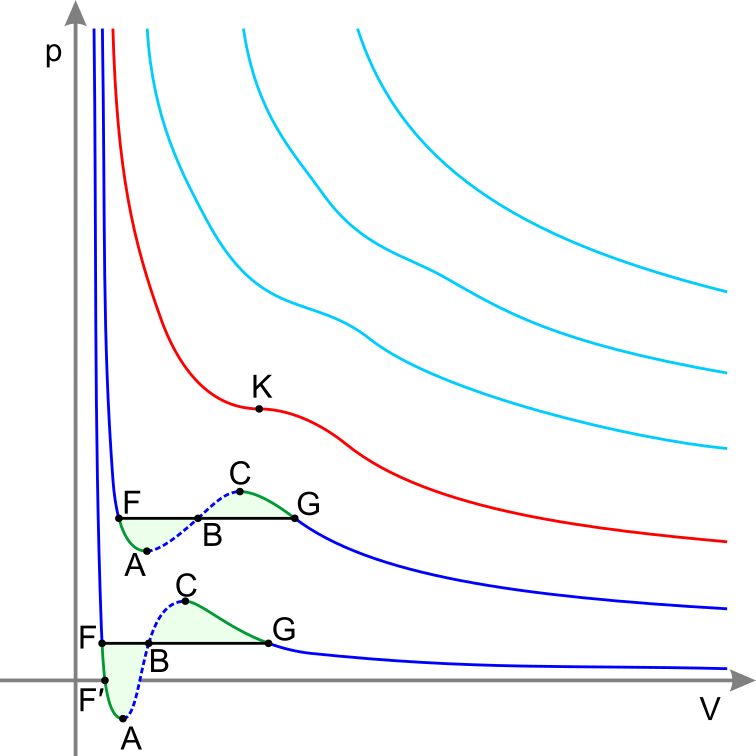
Non-hypothetical gases whose molecules occupy space and have interactions
Dark blue curves – isotherms below the critical temperature. Green sections – metastable states.
The section to the left of point F – normal liquid.
Point F – boiling point.
Line FG – equilibrium of liquid and gaseous phases.
Section FA – superheated liquid.
Section F′A – stretched liquid (p Section AC – analytic continuation of isotherm, physically impossible.
Section CG – supercooled vapor.
Point G – dew point.
The plot to the right of point G – normal gas.
Areas FAB and GCB are equal.
Red curve – Critical isotherm.
Point K – critical point.
Light blue curves – supercritical isotherms]]
Real gases are non-ideal gases whose molecules occupy space and have interactions; consequently, they do not adhere to the ideal gas law. To understand the behaviour of real gases, the following must be taken into account:
- compressibility effects;
- variable specific heat capacity;
- van der Waals forces;
- non-equilibrium thermodynamic effects;
- issues with molecular dissociation and elementary reactions with variable composition
For most applications, such a detailed analysis is unnecessary, and the ideal gas approximation can be used with reasonable accuracy. On the other hand, real-gas models have to be used near the condensation point of gases, near critical points, at very high pressures, to explain the Joule–Thomson effect, and in other less usual cases. The deviation from ideality can be described by the compressibility factor Z.
Models
Main article: Equation of state
Van der Waals model
Main article: van der Waals equation
Real gases are often modeled by taking into account their molar weight and molar volume RT = \left(p + \frac{a}{V_\text{m}^2}\right)\left(V_\text{m} - b\right)
or alternatively: p = \frac{RT}{V_m - b} - \frac{a}{V_m^2}
Where p is the pressure, T is the temperature, R the ideal gas constant, and Vm the molar volume. a and b are parameters that are determined empirically for each gas, but are sometimes estimated from their critical temperature (Tc) and critical pressure (pc) using these relations: \begin{align} a &= \frac{27R^2 T_\text{c}^2}{64p_\text{c}}, & b &= \frac{RT_\text{c}}{8p_\text{c}} \end{align}
The constants at critical point can be expressed as functions of the parameters a, b: \begin{align} p_c &= \frac{a}{27b^2}, & V_{m,c} &= 3b, \[2pt] T_c &= \frac{8a}{27bR}, & Z_c &= \frac{3}{8} \end{align}
With the reduced properties p_r = p / p_\text{c} , V_r = V_\text{m} / V_\text{m,c} , T_r = T / T_\text{c} the equation can be written in the reduced form: p_r = \frac{8}{3}\frac{T_r}{V_r - \frac{1}{3}} - \frac{3}{V_r^2}
Redlich–Kwong model

The Redlich–Kwong equation is another two-parameter equation that is used to model real gases. It is almost always more accurate than the van der Waals equation, and often more accurate than some equations with more than two parameters. The equation is RT = \left(p + \frac{a}{\sqrt{T}V_\text{m}\left(V_\text{m} + b\right)}\right)\left(V_\text{m} - b\right)
or alternatively: p = \frac{RT}{V_\text{m} - b} - \frac{a}{\sqrt{T}V_\text{m}\left(V_\text{m} + b\right)}
where a and b are two empirical parameters that are not the same parameters as in the van der Waals equation. These parameters can be determined: \begin{align} a &= 0.42748, \frac{R^2{T_\text{c}}^\frac{5}{2}}{p_\text{c}}, \[2pt] b &= 0.08664, \frac{RT_\text{c}}{p_\text{c}} \end{align}
The constants at critical point can be expressed as functions of the parameters a, b: \begin{align} p_c &= {\left[\frac{(\sqrt[3]{2} - 1)^7}{3} , R , \frac{a^2}{b^5}\right]}^{1/3}, & V_{m,c} &= \frac{b}{\sqrt[3]{2}-1}, \[4pt] T_c &= {\left[3 {\left(\sqrt[3]{2} - 1\right)}^2 \frac{a}{bR}\right]}^{2/3}, & Z_c &= \frac{1}{3} \end{align}
Using p_r = p/p_\text{c}, V_r = V_\text{m}/V_\text{m,c}, T_r = T / T_\text{c} the equation of state can be written in the reduced form: p_r = \frac{3 T_r}{V_r - b'} - \frac{1}{b'\sqrt{T_r} V_r \left(V_r + b'\right)} with b' = \sqrt[3]{2} - 1 \approx 0.26
Berthelot and modified Berthelot model
The Berthelot equation (named after D. Berthelot) is very rarely used, p = \frac{RT}{V_\text{m} - b} - \frac{a}{TV_\text{m}^2}
but the modified version is somewhat more accurate p = \frac{RT}{V_\text{m}} \left[1 + \frac{9}{128} \cdot \frac{p}{p_c} \cdot \frac{T_c}{T} \left(1 - 6 \frac{T_\text{c}^2}{T^2}\right)\right]
Dieterici model
This model (named after C. Dieterici) fell out of usage in recent years p = \frac{RT}{V_\text{m} - b} \exp\left(-\frac{a}{V_\text{m}RT}\right)
with parameters a, b. These can be normalized by dividing with the critical point state:\tilde p = p \frac{(2be)^2}{a}; \quad \tilde T =T \frac{4bR}{a}; \quad \tilde V_m = V_m \frac{1}{2b}which casts the equation into the reduced form:\tilde p \left(2\tilde V_m - 1\right) = \tilde T \exp\left(2 - \frac{2}{\tilde T \tilde V_m}\right)
Clausius model
The Clausius equation (named after Rudolf Clausius) is a very simple three-parameter equation used to model gases. RT = \left(p + \frac{a}{T {\left(V_\text{m} + c\right)}^2}\right) \left(V_\text{m} - b\right)
or alternatively: p = \frac{RT}{V_\text{m} - b} - \frac{a}{T\left(V_\text{m} + c\right)^2}
where \begin{align} a &= \frac{27R^2 T_\text{c}^3}{64p_\text{c}}, \[4pt] b &= V_\text{c} - \frac{RT_\text{c}}{4p_\text{c}}, \[4pt] c &= \frac{3RT_\text{c}}{8p_\text{c}} - V_\text{c} \end{align}
where Vc is critical volume.
Virial model
The Virial equation derives from a perturbative treatment of statistical mechanics. pV_\text{m} = RT\left[1 + \frac{B(T)}{V_\text{m}} + \frac{C(T)}{V_\text{m}^2} + \frac{D(T)}{V_\text{m}^3} + \cdots\right]
or alternatively pV_\text{m} = RT \left[1 + B'(T) p + C'(T) p^2 + D'(T) p^3 + \cdots\right]
where A, B, C, A′, B′, and C′ are temperature dependent constants.
Peng–Robinson model
Peng–Robinson equation of state (named after D.-Y. Peng and D. B. Robinson) has the interesting property being useful in modeling some liquids as well as real gases. p = \frac{RT}{V_\text{m} - b} - \frac{a(T)}{V_\text{m}\left(V_\text{m} + b\right) + b\left(V_\text{m} - b\right)}
Wohl model


The Wohl equation (named after A. Wohl) is formulated in terms of critical values, making it useful when real gas constants are not available, but it cannot be used for high densities, as for example the critical isotherm shows a drastic decrease of pressure when the volume is contracted beyond the critical volume. p = \frac{RT}{V_\text{m} - b} - \frac{a}{TV_\text{m}\left(V_\text{m} - b\right)} + \frac{c}{T^2 V_\text{m}^3}\quad
or: \left(p - \frac{c}{T^2 V_\text{m}^3}\right)\left(V_\text{m} - b\right) = RT - \frac{a}{TV_\text{m}}
or, alternatively: RT = \left(p + \frac{a}{TV_\text{m}(V_\text{m} - b)} - \frac{c}{T^2 V_\text{m}^3}\right)\left(V_\text{m} - b\right)
where \begin{align} a &= 6p_\text{c} T_\text{c} V_\text{m,c}^2, & b &= \frac{V_\text{m,c}}{4}, \[2pt] c &= 4p_\text{c} T_\text{c}^2 V_\text{m,c}^3 \end{align} where V_\text{m,c} = \frac{4}{15}\frac{RT_c}{p_c}, p_\text{c} , T_c are (respectively) the molar volume, the pressure and the temperature at the critical point.
And with the reduced properties p_r = p/p_\text{c}, V_r = V_\text{m} / V_\text{m,c}, T_r = T / T_\text{c} one can write the first equation in the reduced form: p_r = \frac{15}{4}\frac{T_r}{V_r - \frac{1}{4}} - \frac{6}{T_r V_r\left(V_r - \frac{1}{4}\right)} + \frac{4}{T_r^2 V_r^3}
Beattie–Bridgeman model
This equation is based on five experimentally determined constants. It is expressed as p = \frac{RT}{V_\text{m}^2}\left(1 - \frac{c}{V_\text{m}T^3}\right)(V_\text{m} + B) - \frac{A}{V_\text{m}^2}
where \begin{align} A &= A_0 \left(1 - \frac{a}{V_\text{m}}\right), & B &= B_0 \left(1 - \frac{b}{V_\text{m}}\right) \end{align}
This equation is known to be reasonably accurate for densities up to about 0.8 ρcr, where ρcr is the density of the substance at its critical point. The constants appearing in the above equation are available in the following table when p is in kPa, Vm is in \frac{\text{m}^3}{\text{k},\text{mol}}, T is in K and R = 8.314 \mathrm{\frac{kPa \cdot m^3}{kmol \cdot K}}
| Gas | A0 | a | B0 | b | c |
|---|---|---|---|---|---|
| Air | 131.8441 | 0.01931 | 0.04611 | −0.001101 | 4.34×10⁴ |
| Argon, Ar | 130.7802 | 0.02328 | 0.03931 | 0.0 | 5.99×10⁴ |
| Carbon dioxide, CO2 | 507.2836 | 0.07132 | 0.10476 | 0.07235 | 6.60×10⁵ |
| Ethane, C2H6 | 595.791 | 0.05861 | 0.09400 | 0.01915 | 90.00×10⁴ |
| Helium, He | 2.1886 | 0.05984 | 0.01400 | 0.0 | 40 |
| Hydrogen, H2 | 20.0117 | −0.00506 | 0.02096 | −0.04359 | 504 |
| Methane, CH4 | 230.7069 | 0.01855 | 0.05587 | -0.01587 | 12.83×10⁴ |
| Nitrogen, N2 | 136.2315 | 0.02617 | 0.05046 | −0.00691 | 4.20×10⁴ |
| Oxygen, O2 | 151.0857 | 0.02562 | 0.04624 | 0.004208 | 4.80×10⁴ |
Benedict–Webb–Rubin model
Main article: Benedict–Webb–Rubin equation
The BWR equation, p = RTd + d^2\left(RT(B + bd) - \left(A + ad - a\alpha d^4\right) - \frac{1}{T^2}\left[C - cd\left(1 + \gamma d^2\right) \exp\left(-\gamma d^2\right)\right]\right)
where d is the molar density and where a, b, c, A, B, C, α, and γ are empirical constants. Note that the γ constant is a derivative of constant α and therefore almost identical to 1.
Thermodynamic expansion work
The expansion work of the real gas is different than that of the ideal gas by the quantity \int_{V_i}^{V_f} \left(\frac{RT}{V_m} - P_\text{real}\right) dV .
References
References
- D. Berthelot in ''Travaux et Mémoires du Bureau international des Poids et Mesures – Tome XIII'' (Paris: Gauthier-Villars, 1907)
- C. Dieterici, ''Ann. Phys. Chem. Wiedemanns Ann.'' 69, 685 (1899)
- Pippard, Alfred B.. (1981). "Elements of classical thermodynamics: for advanced students of physics". Univ. Pr.
- (1976). "A New Two-Constant Equation of State". Industrial and Engineering Chemistry: Fundamentals.
- (1914). "Investigation of the condition equation". Zeitschrift für Physikalische Chemie.
- Yunus A. Cengel and Michael A. Boles, ''Thermodynamics: An Engineering Approach'' 7th Edition, McGraw-Hill, 2010, {{ISBN. 007-352932-X
- Gordan J. Van Wylen and Richard E. Sonntage, ''Fundamental of Classical Thermodynamics'', 3rd ed, New York, John Wiley & Sons, 1986 P46 table 3.3
This article was imported from Wikipedia and is available under the Creative Commons Attribution-ShareAlike 4.0 License. Content has been adapted to SurfDoc format. Original contributors can be found on the article history page.
Ask Mako anything about Real gas — get instant answers, deeper analysis, and related topics.
Research with MakoFree with your Surf account
Create a free account to save articles, ask Mako questions, and organize your research.
Sign up freeThis content may have been generated or modified by AI. CloudSurf Software LLC is not responsible for the accuracy, completeness, or reliability of AI-generated content. Always verify important information from primary sources.
Report