From Surf Wiki (app.surf) — the open knowledge base
RBL 40-pounder Armstrong gun

| Field | Value |
|---|---|
| name | RBL 40-pounder gun |
| image | RBL 40 pounder 35 cwt gun diagram.jpg |
| caption | Diagram from Treatise on the Construction and Manufacture of Ordnance in the British Service (HMSO), 1877 |
| origin | United Kingdom |
| type | Naval gun |
| Fortification gun | |
| is_ranged | yes |
| is_artillery | yes |
| is_UK | yes |
| service | 1860s – 1900? |
| used_by | United Kingdom |
| Australian colonies | |
| wars | New Zealand Wars |
| Bombardment of Kagoshima | |
| designer | W.G. Armstrong Co. |
| manufacturer | W.G. Armstrong Co. |
| Royal Gun Factory | |
| production_date | 1859 – 1863 |
| number | 1013 |
| variants | 32cwt, 35cwt |
| weight | 32 cwt (3584 lb), later 35 cwt (3920 lb) gun & breech |
| part_length | 106.3 in bore & chamber |
| cartridge | 40 lb |
| caliber | 4.75 in |
| velocity | 1180 ft/s |
| breech | Armstrong screw with vertical sliding vent-piece (block) |
Fortification gun Australian colonies Bombardment of Kagoshima Royal Gun Factory The Armstrong RBL 40-pounder gun was introduced into use in 1860 for service on both land and sea. It used William Armstrong's new and innovative rifled breechloading mechanism. It remained in use until 1902 when replaced by more modern Breech Loading (BL) guns.
Design history
The Armstrong screw breech had already proved successful in the RBL 12 pounder 8 cwt field gun, and the British Government requested it be implemented for heavier guns despite Armstrong's protests that the mechanism was unsuited to heavy guns. Guns were produced at both the Royal Gun Factory in Woolwich, and the Elswick Ordnance Company.
Like other early Armstrong guns they were rifled on a polygroove system, firing a variety of lead coated projectiles.
Variants
The first version weighed 32 cwt, followed by the 35 cwt version which introduced a longer and stronger breech-piece. A 32 cwt variant having a horizontal sliding-wedge breech instead of the Armstrong screw with vertical vent-piece was introduced in 1864 as an attempt to address the perceived weaknesses of the screw-breech design. It was withdrawn from service by 1877.
From 1880 a small number of 35 cwt guns had their trunnion rings rotated to the left to allow the vent-piece to open horizontally to the right, being known as "side-closing" guns. They differed from the wedge guns in that the vent piece was still locked in place by tightening the screw behind it.
Naval service

The gun was recommended in 1859 for the Navy as a broadside or pivot gun.
An officer from HMS Euryalus described the gun's performance at the Bombardment of Kagoshima of August 1863:
_(14781197824).jpg)
Following the bombardment of Alexandria in 1882, as part of the Anglo-Egyptian War, an armed train was employed. One 40 Pounder RBL was mounted onto the train and manned by men of the Royal Navy. It saw some action at the battle of Kassasin on 1 September 1882.
Land service
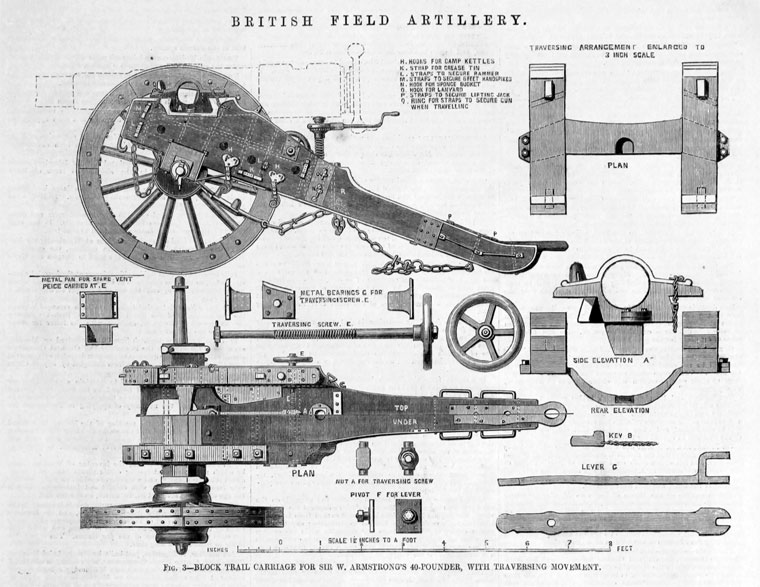

A number of different carriages for guns employed for Land Service were available. A wooden siege carriage with wheels and attached limbers, enabled the guns to be drawn by teams of heavy horses.
For guns mounted in fortifications they could be mounted on two different types of carriage. The first was an iron traversing carriage, enabling the gun to be traversed right and left, with recoil being absorbed with a carriage being mounted on a slide. Others were mounted on high "siege travelling carriages" for use as semi-mobile guns in forts, firing over parapets.
Many were re-issued to Volunteer Artillery Batteries of Position from 1889, with 40 Pounders among 226 guns issued to the Volunteer Artillery during 1888 and 1889. The 1893 the War Office Mobilisation Scheme shows the allocation of thirty Artillery Volunteer position batteries equipped with 40 Pounder guns which would be concentrated in Surrey and Essex in the event of mobilisation. They remained in use in this role until 1902 when they were gradually replaced by 4.7-inch Quick Firing (QF) guns. A number were used for some years afterwards as saluting guns.
Indian subcontinent
An RBL 40-pounder Armstrong breechloader appears to be present in a photograph by John Burke (photographer) from the Second Anglo-Afghan War (November 1878 – September 1880). The war began when Great Britain, fearful of what it saw as growing Russian influence in Afghanistan, invaded the country from British India. The first phase of the war ended in May 1879 with the Treaty of Gandamak, which permitted the Afghans to maintain internal sovereignty but forced them to cede control over their foreign policy to the British. Fighting resumed in September 1879, after an anti-British uprising in Kabul, and finally concluded in September 1880 with the decisive Battle of Kandahar.
Colony of Victoria service
The Australian colony of Victoria received six 35 cwt guns in August 1865. They were used as mobile coast fortification guns with one gun being fitted to the colonial sloop Victoria during 1866 & 1867. Later four of the guns were used as field guns at Hastings. Three of these guns are known to survive.
Colony of Tasmania service

As a result of the Jervois-Scratchley reports of 1877 into the defence of Australian colonies following the withdrawal of British troops, the Launceston Volunteer Artillery Corps in Tasmania acquired two guns on late-model iron carriages with iron wheels, which they continued to operate until at least 1902.
Surviving examples

- A gun made by Royal Gun Factory in 1865 at Elizabeth Castle, Jersey
- Three guns recovered as bollards at Broughty Castle, Dundee, Scotland
- Restored gun No. 272 at Hastings-Western Port Historical Society Museum, Victoria, Australia
- Restored Gun No. 271 at Fort Queenscliff, Victoria, Australia
- Unrestored Gun No. 268 in Como Park, South Yarra, Victoria
- A gun at Fort Henry, Canada
- Preserved gun No. 419 G dated 1867 at Canadian War Museum, Ottawa, Canada
- Royal Canadian Artillery Museum, Manitoba, Canada
- A 40-pounder side closing gun made by Elswick Ordnance Company at Royal Armouries, Fort Nelson, Portsmouth
- Fort St. Catherine's, Bermuda. One of eight (of which five are known to survive) sent to the Imperial fortress colony for use as mobile guns to be kept in storage and deployed as required, via the military road (now the South Shore Road) constructed in the 1860s and 1870s, to the various old fortified batteries on the South Shore that had been stripped of their fixed coastal artillery. Replaced by more modern weapons, some or all of these had been relegated to a saluting battery at Fort Victoria before the First World War, remaining there as late as the 1930s.
- Royal Naval Dockyard, Bermuda (two). Another of the eight sent to Bermuda was recovered, with its original mobile carriage, from Bailey's Bay Battery and has been restored and displayed in the Bermuda's Defence Heritage Exhibit (since it opened in 2002) of the Bermuda Maritime Museum (now National Museum of Bermuda) in the cellar of the Commissioner's House, atop the Keep of the fortified North Yard of the dockyard. A third (Mark I serial, number 280 G, manufactured by the Royal Gun Factory in 1864) was set into the wharf as a bollard at Red Barracks, near St. George's Town, on 26 June, 1936. The property is now a private home and guest house, and the owners donated the gun to the museum, which has recovered it and moved it to the Keep.
- Penno's Wharf, St. George's Town, Bermuda. Two were set into the wharf (with the warehouse on the wharf, historically used by the military ordnance) as bollards. These were recovered and restored, and are currently on iron mounts outside the door of the warehouse which now houses the World Heritage Centre created by the St. George's Foundation after the town, along with those fortresses at the East End of Bermuda, were designated in 2000 by the United Nations Educational, Scientific and Cultural Organization's (UNESCO) World Heritage Committee as a World Heritage Site, the Historic Town of St George and Related Fortifications, Bermuda.
- On board HMS Warrior, Portsmouth, UK
Bibliography
- Treatise on the Construction and Construction of Ordnance in the British Service. 1877
- Text Book of Gunnery, 1887. LONDON : PRINTED FOR HIS MAJESTY'S STATIONERY OFFICE, BY HARRISON AND SONS, ST. MARTIN'S LANE
- Text Book of Gunnery, 1902. LONDON : PRINTED FOR HIS MAJESTY'S STATIONERY OFFICE, BY HARRISON AND SONS, ST. MARTIN'S LANE
- Alexander Lyman Holley, "A treatise on Ordnance and Armor" published by D Van Nostrand, New York, 1865
References
- 1013 were in service in 1877 : 819 35cwt & 194 32cwt. Quoted in Treatise on Manufacture of Ordnance 1877, page 150. Holley 1865, page 13 quotes 641 as at 1863 : 535 manufactured by Elswick Ordnance and 106 by the Royal Gun Factory. From the Report of the Select Committee on Ordnance, 1863.
- Text Book of Gunnery, 1887
- 1180 ft/sec firing 40 lb 2 oz projectile with 5 lb RLG2 (gunpowder). Text Book of Gunnery 1887, Table XVI page 313
- Ruffell, The Armstrong Gun Part 5: British revert to Muzzle Loading
- ''Treatise on the Construction and Manufacture of Ordnance in the British Service''.{{page needed. (August 2025)
- ''Treatise on the Construction and Manufacture of Ordnance in the British Service'' pages 89, 153
- "Victorian Forts and Artillery: Victorian Artillery: List of British Service Artillery in use during the Victorian period".
- ''The Times'', 25th April 1864 : 25 April 1864 THE ARMSTRONG GUNS IN JAPAN http://www.pdavis.nl/Japan.php {{Webarchive. link. (6 March 2012)
- Goodrich, Caspar F (Lt Cdr), Report of the British Naval and Military Operations in Egypt 1882, Navy Department, Washington, 1885, p.188
- ''Elephant and Mule Battery ("Dignity & Impudence") WDL11496.png'' caption, Library of Congress
- Report on the Account of Army Expenditure from 1888–1889, The National archives, WO33/50
- Mobilization Tables for Home Defence, List of Militia, Yeomanry and Volunteer Units, HMSO, London, 1893
- Friends of the Cerberus Website : slideshow http://www.cerberus.com.au/reenactors/40_pounder_slideshow.html
- David Spethman, "The Garrison Guns of Australia" page 49. 2008, published by Ron H Mortensen, Inala, Qld. {{ISBN. 978-0-9775990-8-0
- Harris, Edward Cecil. (2011-02-10). "Heritage Matters: Translating a bollard back into a gun". The Royal Gazette.
This article was imported from Wikipedia and is available under the Creative Commons Attribution-ShareAlike 4.0 License. Content has been adapted to SurfDoc format. Original contributors can be found on the article history page.
Ask Mako anything about RBL 40-pounder Armstrong gun — get instant answers, deeper analysis, and related topics.
Research with MakoFree with your Surf account
Create a free account to save articles, ask Mako questions, and organize your research.
Sign up freeThis content may have been generated or modified by AI. CloudSurf Software LLC is not responsible for the accuracy, completeness, or reliability of AI-generated content. Always verify important information from primary sources.
Report