From Surf Wiki (app.surf) — the open knowledge base
Rayah
Name given to common people by Ottomans
_(14578503099).jpg)
Name given to common people by Ottomans
The rayah or reaya was a member of the tax-paying lower class of Ottoman society, in contrast to the askeri (military) and kul (slaves, including Janissaries). Ottoman subjects were initially divided into roughly two taxable classes, the military class (askeri) and working class (rayah). The term was attributed to the peasant tax-paying subjects of the Timariots, active until the disintegration of the timar system in the 16th century. A clear social distinction was made between the Muslim and Christian rayah, with legal and religious discrimination against the latter, viewed of as infidels (giaour). Although the term initially and generally was used to encompass all of the subject lower class (taxed Muslims, Christians and Jews), it was particularly attributed to the Christian (also called zimmi), mostly Eastern Orthodox communities (the Rum Millet) in the Balkans (Rumelia).
NOTOC
History
The rayah were the peasant tax-paying subjects of the Timariots, active until the disintegration of the timar system in the 16th century. The Timariot made sure that the peasants preserved their status, and although a peasant could reach a public function, it would not change his status. There was an Ottoman principle saying "the son of a rayah is a rayah". After the mid-15th century, members of the sipahi and devshirme managed to enter the elite as advisors or viziers, while the chances of the rayah diminished. Lütfi Pasha, the Grand Vizier (1539–41), described the specific classification of the rayah as tax-paying subjects, and explained that if a member managed to become a Timariot through distinction he should not engage in nepotism, while if becoming a scholar, his children would remain rayah. At first, rayah were ineligible for military service, but this changed for the Muslims in the late 16th century, to the dismay of some of the elite.
The chiflik system replaced that of the timar.
By the end of the 18th century, while the term theoretically applied to the tax-paying subjects, it had become synonymous with "Christians".
Taxation
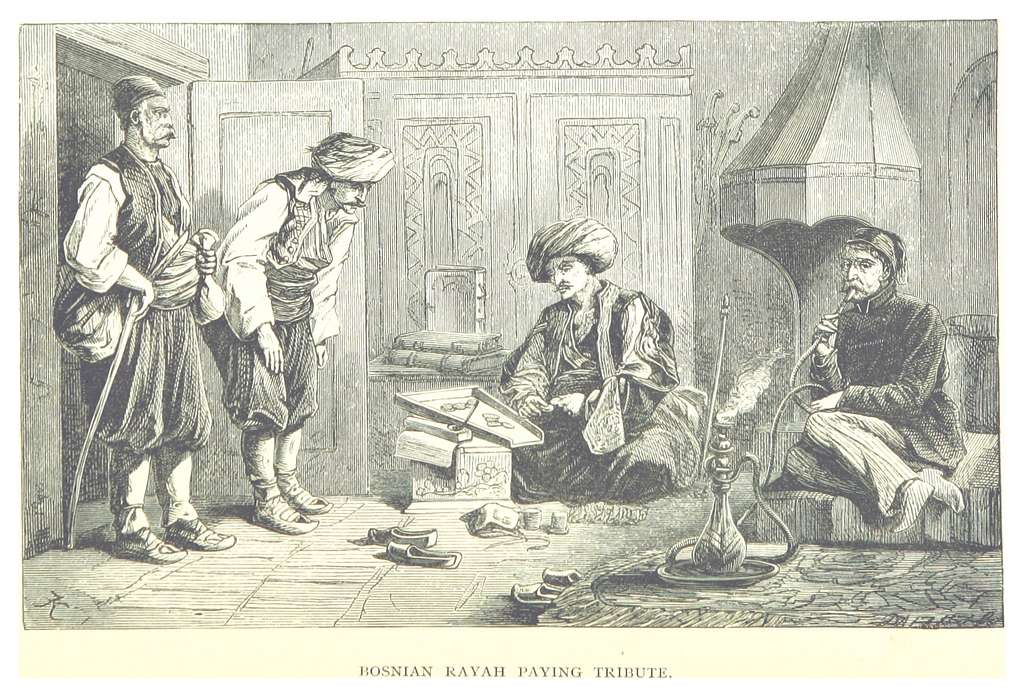
The Christian rayah paid the specific haraç, a land tax on non-Muslims, and cizye, a poll tax on non-Muslims. The Muslims paid the zakat, the counterpart of haraç.
Through paying the haraç, Christians were exempted from military service.
Annotations
References
Sources
This article was imported from Wikipedia and is available under the Creative Commons Attribution-ShareAlike 4.0 License. Content has been adapted to SurfDoc format. Original contributors can be found on the article history page.
Ask Mako anything about Rayah — get instant answers, deeper analysis, and related topics.
Research with MakoFree with your Surf account
Create a free account to save articles, ask Mako questions, and organize your research.
Sign up freeThis content may have been generated or modified by AI. CloudSurf Software LLC is not responsible for the accuracy, completeness, or reliability of AI-generated content. Always verify important information from primary sources.
Report