From Surf Wiki (app.surf) — the open knowledge base
Ravi Shankar
Indian musician and sitar player (1920–2012)

Indian musician and sitar player (1920–2012)
| Field | Value | |||||||||
|---|---|---|---|---|---|---|---|---|---|---|
| honorific_prefix | Pandit | |||||||||
| image | Ravi Shankar.jpg | |||||||||
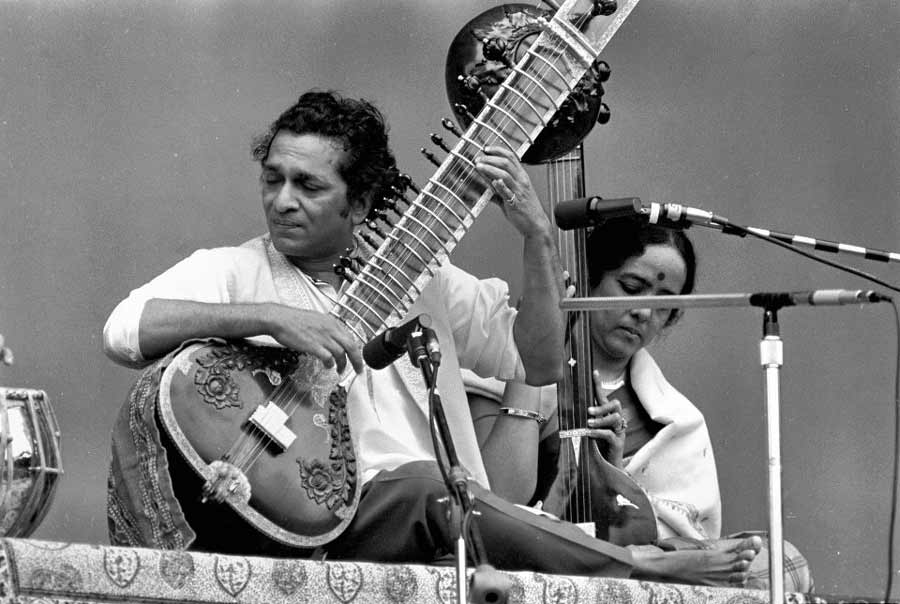
| caption | Shankar performing at Woodstock in 1969 | |||||||||
| birth_name | Robindro Shaunkor Chowdhury | |||||||||
| birth_date | ||||||||||
| birth_place | Banaras, Banaras State, British India | |||||||||
| death_date | ||||||||||
| death_place | San Diego, California, U.S. | |||||||||
| occupation | {{flatlist | |||||||||
| module2 | {{Infobox musical artist | |||||||||
| embed | yes | |||||||||
| genre | Indian classical music | |||||||||
| instrument | {{flatlist | |||||||||
| years_active | 1930–2012 | |||||||||
| label | {{flatlist | |||||||||
| * East Meets West<ref>{{cite web | url | http://eastmeetswestmusic.com/ | title=East Meets West Music & Ravi Shankar Foundation | year=2010 | work=East Meets West Music, Inc | publisher=Ravi Shankar Foundation | access-date=12 December 2012 | archive-date=20 November 2012 | archive-url=https://web.archive.org/web/20121120172523/http://eastmeetswestmusic.com/ | url-status=live}}}} |
| associated_acts | {{flatlist | |||||||||
| module | {{Infobox officeholder | |||||||||
| embed | yes | |||||||||
| office | Member of Parliament, Rajya Sabha | |||||||||
| termstart1 | 12 May 1986 | |||||||||
| termend1 | 11 May 1992 | |||||||||
| website |
- Musician
- composer
- Sitar
- World Pacific
- Angel
- His Master's Voice
- Apple
- Dark Horse
- Private Music
- East Meets West}}
- Uday Shankar
- Allauddin Khan
- Ali Akbar Khan
- Lakshmi Shankar
- Yehudi Menuhin
- Chatur Lal
- Alla Rakha
- George Harrison
- Anoushka Shankar
- Norah Jones
- John Coltrane
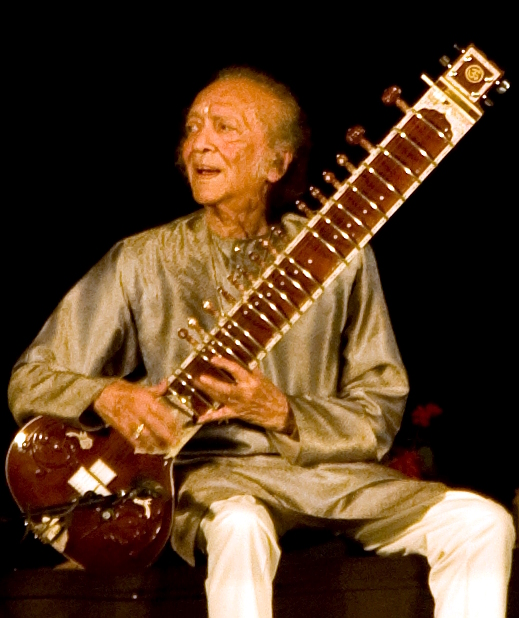
Pandit Ravi Shankar (; born Robindro Shaunkor Chowdhury, sometimes spelled as Ravindra Shankar Chowdhury; and influenced many musicians in India and throughout the world. Shankar was awarded India's highest civilian honour, the Bharat Ratna, in 1999. He is also the father of American singer Norah Jones and British-American musician and sitar player Anoushka Shankar.
Shankar was born to a Bengali family in India, and spent his youth as a dancer touring India and Europe with the dance group of his brother Uday Shankar. At age 18, he gave up dancing to pursue a career in music, studying the sitar for seven years under court musician Allauddin Khan. After finishing his studies in 1944, Shankar worked as a composer, creating the music for the Apu Trilogy by Satyajit Ray, and was music director of All India Radio, New Delhi, from 1949 to 1956.
In 1956, Shankar began to tour Europe and America, playing Indian classical music. He increased its popularity there in the 1960s through teaching, performance, and his association with violinist Yehudi Menuhin and Beatles guitarist George Harrison. His influence on Harrison helped popularize the use of Indian instruments in Western pop music in the latter half of the 1960s. Shankar engaged Western music by writing compositions for sitar and orchestra and touring the world in the 1970s and 1980s. From 1986 to 1992, he served as a nominated member of Rajya Sabha, the upper house of the Parliament of India. He continued to perform until the end of his life. He was a recipient of numerous prestigious musical accolades, including a Polar Music Prize and four Grammy Awards, including Album of the Year for The Concert for Bangladesh in 1973, as well as an Academy Award nomination for Best Original Score for scoring the blockbuster Gandhi (1982).
Early life
Shankar was born on 7 April 1920 in Benares (now Varanasi), then the capital of the princely state of the same name, in a Bengali Hindu family, as the youngest of seven brothers. His father, Shyam Shankar Chowdhury, was a Middle Temple barrister and scholar who was from Narail district, Bangladesh (then Jessore district in Bengal). A respected statesman, lawyer, and politician, he served for several years as dewan (Prime Minister) of Jhalawar State, Rajasthan, and used the Sanskrit spelling of the family name and removed its last part. Shyam was married to Hemangini Devi, who hailed from a small village named Nasrathpur in Mardah block of Ghazipur district, near Benares and her father was a prosperous landlord. Shyam later worked as a lawyer in London, England, and there he married a second time while Devi raised Shankar in Benares, and he did not meet his son until he was eight years old.
Shankar shortened the Sanskrit version of his first name, Ravindra, to Ravi, for "sun". Shankar had five siblings: Uday (who became a choreographer and dancer), Rajendra, Debendra and Bhupendra. Shankar attended the Bengalitola High School in Benares between 1927 and 1928.
At the age of 10, after spending his first decade in Benares, Shankar went to Paris with the dance group of his brother, choreographer Uday Shankar. By the age of 13 he had become a member of the group, accompanied its members on tour and learned to dance, and play various Indian instruments. Shankar heard Allauddin Khan – the lead musician at the court of the princely state of Maihar – play at a music conference in December 1934 in Calcutta, and Uday persuaded the Maharaja of Maihar H.H. Maharaja Brijnath Singh Judev in 1935 to allow Khan to become his group's soloist for a tour of Europe. Shankar was sporadically trained by Khan on tour, and Khan offered Shankar training to become a serious musician under the condition that he abandon touring and come to Maihar.
Career
Musical training and work in India
Shankar's parents had died by the time he returned from the European tour, and touring the West had become difficult because of political conflicts that would lead to World War II. In 1938, Shankar decided to leave his dancing career to study Indian classical music under the tutelage of Khan in Maihar. He lived with Khan’s family as part of the traditional gurukul system. Khan was a strict teacher, and during his training, Shankar learned to play the sitar and surbahar. He also studied various ragas and musical styles, including dhrupad, dhamar, and khyal, and received instruction on instruments such as the rudra veena, rubab, and sursingar. He often studied with Khan's children Ali Akbar Khan and Annapurna Devi.
Shankar completed his musical training in 1944. He then moved to Mumbai and joined the Indian People's Theatre Association, for whom he composed music for ballets in 1945 and 1946, Dharti Ke Lal, 1946. Shankar recomposed the music for the popular song "Sare Jahan Se Achcha" at the age of 25. He began to record music for His Master's Voice and worked as a music director for All India Radio (AIR), New Delhi, from February 1949 until January 1956. Shankar founded the Indian National Orchestra at AIR and composed for it; in his compositions he combined Western and classical Indian instrumentation. Beginning in the mid-1950s he composed the music for the Apu Trilogy by Satyajit Ray, which became internationally acclaimed. He was music director for several Hindi movies including Godaan and Anuradha.
1956–1969 International performances

V. K. Narayana Menon, director of AIR Delhi, introduced the Western violinist Yehudi Menuhin to Shankar during Menuhin's first visit to India in 1952. Shankar had performed as part of a cultural delegation in the Soviet Union in 1954 and Menuhin invited Shankar in 1955 to perform in New York City for a demonstration of Indian classical music, sponsored by the Ford Foundation.
Shankar heard about the positive response Khan received and resigned from AIR in 1956 to tour the United Kingdom, Germany, and the United States. He played for smaller audiences and educated them about Indian music, incorporating ragas from the South Indian Carnatic music in his performances, and recorded his first LP album Three Ragas in London, released in 1956.
Shankar befriended Richard Bock, founder of World Pacific Records, on his first American tour and recorded most of his albums in the 1950s and 1960s for Bock's label. In 1967, Shankar performed a well-received set at the Monterey Pop Festival. While complimentary of the talents of several of the rock artists at the festival, he said he was "horrified" to see Jimi Hendrix set fire to his guitar on stage: "That was too much for me. In our culture, we have such respect for musical instruments, they are like part of God." Shankar's live album from Monterey peaked at number 43 on Billboards pop LPs chart in the US, which remains the highest placing he achieved on that chart.
Shankar won a Grammy Award for Best Chamber Music Performance for West Meets East, a collaboration with Yehudi Menuhin. He opened a Western branch of the Kinnara School of Music in Los Angeles, in May 1967, and published an autobiography, My Music, My Life, in 1968. In 1968, he composed the score for the film Charly.
He performed at the Woodstock Festival in August 1969, and found he disliked the venue. He explained during an interview:
1970–2012: International performances
In October 1970, Shankar became chair of the Department of Indian Music of the California Institute of the Arts after previously teaching at the City College of New York, the University of California, Los Angeles, and being guest lecturer at other colleges and universities, including the Ali Akbar College of Music. Shankar performed at the Concert for Bangladesh in August 1971, held at Madison Square Garden in New York. After the musicians had tuned up on stage for over a minute, the crowd of rock-music fans broke into applause, to which the amused Shankar responded, "If you like our tuning so much, I hope you will enjoy the playing more." which confused the audience. Still, the audience well received the subsequent performance. Although interest in Indian music had decreased in the early 1970s, the live album from the concert became one of the best-selling recordings to feature the genre and won Shankar a second Grammy Award.
In November and December 1974, Shankar co-headlined a North American tour with George Harrison. The demanding schedule weakened his health, and he suffered a heart attack in Chicago, causing him to miss a portion of the tour. Harrison, Shankar and members of the touring band visited the White House on invitation of John Gardner Ford, son of US president Gerald Ford. Shankar was nominated for an Academy Award for Best Original Music Score for his work on the 1982 movie Gandhi.
He performed in Moscow in 1988, with 140 musicians, including the Russian Folk Ensemble and members of the Moscow Philharmonic, along with his own group of Indian musicians.
He served as a member of the Rajya Sabha, the upper chamber of the Parliament of India, from 12 May 1986 to 11 May 1992, after being nominated by Indian Prime Minister Rajiv Gandhi. Shankar composed the dance drama Ghanashyam in 1989. His liberal views on musical co-operation led him to contemporary composer Philip Glass, with whom he released an album, Passages, in 1990, in a project initiated by Peter Baumann of the band Tangerine Dream.
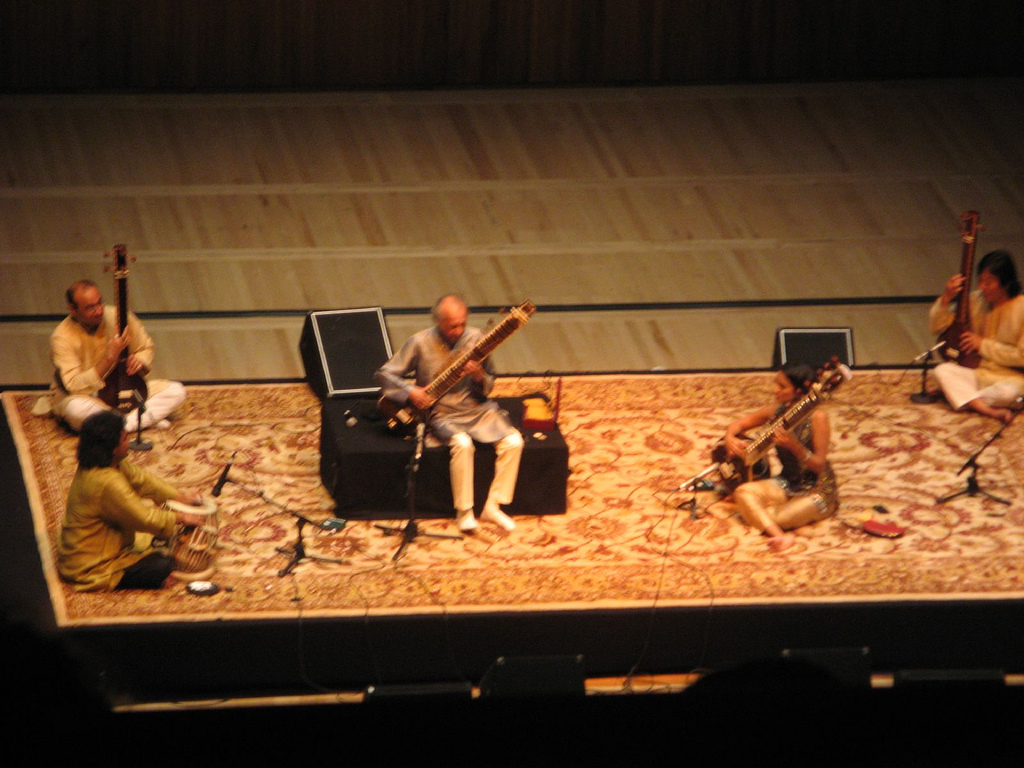
Because of the positive response to Shankar's 1996 career compilation In Celebration, Shankar wrote a second autobiography, Raga Mala. He performed between 25 and 40 concerts every year during the late 1990s. Shankar taught his daughter Anoushka Shankar to play sitar and in 1997 became a Regents' Professor at University of California, San Diego.
He performed with Anoushka for the BBC in 1997 at the Symphony Hall in Birmingham, England. In the 2000s, he won a Grammy Award for Best World Music Album for Full Circle: Carnegie Hall 2000 and toured with Anoushka, who released a book about her father, Bapi: Love of My Life, in 2002. After George Harrison's death in 2001, Shankar performed at the Concert for George, a celebration of Harrison's music staged at the Royal Albert Hall in London in 2002.
In June 2008, Shankar played what was billed as his last European concert,
On 1 July 2010, at the Southbank Centre's Royal Festival Hall, London, England, Anoushka Shankar, on sitar, performed with the London Philharmonic Orchestra, conducted by David Murphy, which was billed the first Symphony by Ravi Shankar.
Collaboration with George Harrison

The Beatles' guitarist George Harrison, who was first introduced to Shankar's music by the American singers Roger McGuinn and David Crosby, themselves big fans of Shankar, became influenced by Shankar's music. Harrison went on to help popularize Shankar and the use of Indian instruments in pop music throughout the 1960s. Olivia Harrison explains:
Harrison became interested in Indian classical music, bought a sitar and used it to record the song "Norwegian Wood (This Bird Has Flown)". In 1968, he went to India to take lessons from Shankar, some of which were captured on film. This led to Indian music being used by other musicians and popularised the raga rock trend. The influence even extended to blues musicians such as Michael Bloomfield, who created a raga-influenced improvisation number, "East-West" (Bloomfield scholars have cited its working title as "The Raga" when Bloomfield and his collaborator Nick Gravenites began to develop the idea) for the Butterfield Blues Band in 1966.
Harrison met Shankar in London in June 1966 and visited India later that year for six weeks to study sitar under Shankar in Srinagar. During the visit, a documentary film about Shankar named Raga was shot by Howard Worth and released in 1971. Shankar's association with Harrison greatly increased Shankar's popularity, and decades later Ken Hunt of AllMusic wrote that Shankar had become "the most famous Indian musician on the planet" by 1966.
George Harrison organized the charity Concert for Bangladesh in August 1971, in which Shankar participated. During the 1970s, Shankar and Harrison worked together again, recording Shankar Family & Friends in 1973 and touring North America the following year to a mixed response after Shankar had toured Europe with the Harrison-sponsored Music Festival from India. Shankar wrote a second autobiography, Raga Mala, with Harrison as editor.
Style and contributions
Shankar developed a style distinct from that of his contemporaries and incorporated influences from rhythm practices of Carnatic music. His performances begin with solo alap, jor, and jhala (introduction and performances with pulse and rapid pulse) influenced by the slow and serious dhrupad genre, followed by a section with tabla accompaniment featuring compositions associated with the prevalent khyal style. Shankar often closed his performances with a piece inspired by the light-classical thumri genre.
Shankar has been considered one of the top sitar players of the second half of the 20th century. He popularised performing on the bass octave of the sitar for the alap section and became known for a distinctive playing style in the middle and high registers that used quick and short deviations of the playing string and his sound creation through stops and strikes on the main playing string. Narayana Menon of The New Grove Dictionary noted Shankar's fondness for rhythmic novelties, among them the use of unconventional rhythmic cycles. Hans Neuhoff of Musik in Geschichte und Gegenwart has argued that Shankar's playing style was not widely adopted and that he was surpassed by other sitar players in the performance of melodic passages. Shankar's interplay with Alla Rakha improved appreciation for tabla playing in Hindustani classical music. Shankar promoted the jugalbandi duet concert style. Shankar introduced at least 31 new ragas, including Nat Bhairav, Ahir Lalit, Rasiya, Yaman Manjh, Gunji Kanhara, Janasanmodini, Tilak Shyam, Bairagi, Mohan Kauns, Manamanjari, Mishra Gara, Pancham Se Gara, Purvi Kalyan, Kameshwari, Gangeshwari, Rangeshwari, Parameshwari, Palas Kafi, Jogeshwari, Charu Kauns, Kaushik Todi, Bairagi Todi, Bhawani Bhairav, Sanjh Kalyan, Shailangi, Suranjani, Rajya Kalyan, Banjara, Piloo Banjara, Suvarna, Doga Kalyan, Nanda Dhwani, and Natacharuka (for Anoushka). In 2011, at a concert recorded and released in 2012 as Tenth Decade in Concert: Ravi Shankar Live in Escondido, Shankar introduced a new percussive sitar technique called Goonga Sitar, whereby the strings are muffled with a cloth.
Awards
Indian government honours
- Bharat Ratna (1999)
- Padma Vibhushan (1981)
- Padma Bhushan (1967)
- Sangeet Natak Akademi Award (1962)
- Sangeet Natak Akademi Fellowship (1975)
- Kalidas Samman from the Government of Madhya Pradesh for 1987–88
Other governmental and academic honours
- Ramon Magsaysay Award (1992)
- Commander of the Legion of Honour of France (2000)
- Honorary Knight Commander of the Order of the British Empire (KBE) for "services to music" (2001)
- Honorary degrees from universities in India and the United States.
- Honorary member of the American Academy of Arts and Letters
- Honorary Doctor of Laws from the University of Melbourne, Australia (2010)
Arts awards
- 1964 fellowship from the John D. Rockefeller 3rd Fund
- Silver Bear Extraordinary Prize of the Jury at the 1957 Berlin International Film Festival (for composing the music for the movie Kabuliwala).
- UNESCO International Music Council (1975)
- Fukuoka Asian Culture Prize (1991)
- Praemium Imperiale for music from the Japan Art Association (1997)
- Polar Music Prize (1998)
- Four Grammy Awards
- 1967: Best Chamber Music Performance – West Meets East (with Yehudi Menuhin)
- 1973: Album of the Year – The Concert for Bangladesh (with George Harrison)
- 2002: Best World Music Album – Full Circle: Carnegie Hall 2000
- 2013: Best World Music Album – The Living Room Sessions Pt. 1
- Lifetime Achievement Award received at the 55th Annual Grammy Awards
- Nominated for an Academy Award for Best Original Score, along with George Fenton, for Gandhi.
- Posthumous nomination in the 56th Annual Grammy Awards for his album "The Living Room Sessions Part 2".
- First recipient of the Tagore Award in recognition of his outstanding contribution to cultural harmony and universal values (2013; posthumous)
Other honours and tributes
- 1997 James Parks Morton Interfaith Award
- American jazz saxophonist John Coltrane named his son Ravi Coltrane after Shankar.
- On 7 April 2016 (his 96th birthday), Google published a Google Doodle to honour his work. Google commented: "Shankar evangelized the use of Indian instruments in Western music, introducing the atmospheric hum of the sitar to audiences worldwide. Shankar's music popularized the fundamentals of Indian music, including raga, a melodic form and widely influenced popular music in the 1960s and 70s.".
- In September 2014, a postage stamp featuring Shankar was released by India Post commemorating his contributions.
Personal life and family
In 1941, Shankar married Annapurna Devi (Roshanara Khan), daughter of musician Allauddin Khan. Their son, Shubhendra "Shubho" Shankar, was born in 1942.
An affair with Sue Jones, a New York concert producer, led to the birth of Norah Jones in 1979. He separated from Shastri in 1981 and lived with Jones until 1986.
He began an affair in 1978 with married tanpura player Sukanya Rajan, whom he had known since 1972, which led to the birth of their daughter Anoushka Shankar in 1981. In 1989, he married Sukanya Rajan at Chilkur Temple in Hyderabad.
Shankar's son, Shubhendra, often accompanied him on tours. He could play the sitar and surbahar, but elected not to pursue a solo career. Shubhendra died of pneumonia in 1992.
Ananda Shankar, the experimental fusion musician, was his nephew.
His daughter Norah Jones became a successful musician, winning five Grammy Awards in 2003 and overall ten Grammy Awards as of 2025.
His daughter Anoushka Shankar was nominated for a Grammy Award for Best World Music Album in 2003. Anoushka and her father were both nominated for Best World Music Album at the 2013 Grammy Awards for separate albums.
Shankar was a Hindu, and a devotee of the Hindu god Hanuman. He was also an "ardent devotee" of the Bengali Hindu saint, Sri Anandamayi Ma. Shankar used to visit Anandamayi Ma frequently and performed for her on various occasions. Shankar wrote of his hometown, Benares (Varanasi), and his initial encounter with "Ma":
Varanasi is the eternal abode of Lord Shiva, and one of my favorite temples is that of Lord Hanuman, the monkey god. The city is also where one of the miracles that have happened in my life took place: I met Ma Anandamayi, a great spiritual soul. Seeing the beauty of her face and mind, I became her ardent devotee. Sitting at home now in Encinitas, in Southern California, at the age of 88, surrounded by the beautiful greens, multi-colored flowers, blue sky, clean air, and the Pacific Ocean, I often reminisce about all the wonderful places I have seen in the world. I cherish the memories of Paris, New York, and a few other places. But Varanasi seems to be etched in my heart!
Shankar was a vegetarian. He wore a large diamond ring that he said was manifested by Sathya Sai Baba. He lived with Sukanya in Encinitas, California.
Shankar performed his final concert with daughter Anoushka on 4 November 2012 at the Terrace Theater in Long Beach, California.
Illness and death
On 9 December 2012, Shankar was admitted to Scripps Memorial Hospital in La Jolla, San Diego, California, after having complained of breathing difficulties. He died on 11 December 2012 at around 16:30 PST at age 92 after undergoing heart valve replacement surgery.
The Swara Samrat festival, organized on 5–6 January 2013 and dedicated to Ravi Shankar and Ali Akbar Khan, included performances by such musicians as Shivkumar Sharma, Birju Maharaj, Hariprasad Chaurasia, Zakir Hussain, and Girija Devi.
Discography
Main article: Ravi Shankar discography
Books
Notes
References
General sources
References
- (2010). "East Meets West Music & Ravi Shankar Foundation". Ravi Shankar Foundation.
- (2006). "The Dawn of Indian Music in the West". [[A&C Black]].
- "Ravi Shankar".
- (October 2009). "The 100 Most Influential Musicians of All Time". Britannica Educational Publishing.
- Vasudev Vasanthi. (2008). "Harmony 4". Pearson Education India.
- "Pandit Ravi Shankar".
- Lavezzoli 2006, p. 48.
- Hunt, Ken. "Ravi Shankar – Biography". AllMusic.
- Massey 1996, p. 159.
- "Shankar, Ravi (Biography)".
- Slawek 2001, pp. 202–203.
- Ghosh 1983, p. 55.
- Uday's dance group travelled Europe and the United States in the early to mid-1930s and Shankar learned French, discovered Western classical music, jazz, cinema and became acquainted with Western customs.Lavezzoli 2006, p. 50.
- Lavezzoli 2006, p. 51.
- Lavezzoli 2006, p. 52.
- Shankar made his public debut on the sitar in December 1939, performing a ''[[jugalbandi]]'' (duet) with Ali Akbar Khan, who played the string instrument ''[[sarod]]''.Lavezzoli 2006, p. 53.
- Ghosh 1983, p. 57.
- Sharma 2007, pp. 163–164.
- Deb, Arunabha. (26 February 2009). "Ravi Shankar: 10 interesting facts". [[Mint (newspaper).
- Lavezzoli 2Ravi ShankarRavi ShankarRavi Shankar006, p. 56.
- (12 December 2012). "A lesser known side of Ravi Shankar". Hindustan Times.
- Lavezzoli 2006, p. 47.
- Lavezzoli 2006, p. 57.
- Lavezzoli 2006, p. 58.
- Khan reluctantly accepted and performed with ''[[tabla]]'' (percussion) player [[Chatur Lal]] in the [[Museum of Modern Art]], and he later became the first Indian classical musician to perform on American television and record a full ''raga'' performance, for [[Angel Records]].Lavezzoli 2006, pp. 58–59.
- Lavezzoli 2006, p. 61.
- In 1958, Shankar participated in the celebrations of the 10th anniversary of the United Nations and [[UNESCO]] music festival in Paris. From 1961, he toured Europe, the United States, and Australia, and became the first Indian to compose music for non-Indian films.{{efn|Chatur Lal accompanied Shankar on ''tabla'' until 1962, when Alla Rakha assumed the role.}} Shankar founded the [[Kinnara School of Music]] in [[Mumbai]] in 1962.''Brockhaus'', p. 199.
- "Photo of George Harrison and Ravi Shankar".
- "Photo of Ravi Shankar performing in late 1960s".
- {{Pop Chronicles. 47
- link. (16 October 2016 , 18 min.)
- link. (1 October 2016)
- [https://www.bbc.com/news/world-asia-india-20690632 "Ravi Shankar, Indian sitar maestro, dies"] {{Webarchive. link. (2 June 2018 , ''BBC'', 12 December 2012.)
- Gallo, Phil. (12 December 2012). "Ravi Shankar's Impact on Pop Music: An Appreciation".
- ""West Meets East" album cover".
- "Past Winners Search". [[National Academy of Recording Arts and Sciences]].
- ''Independent Star-News'', Associated Press interview, 4 November 1967.
- Ghosh 1983, p. 56.
- In late 1970, the [[London Symphony Orchestra]] invited Shankar to compose a concerto with ''sitar''. ''[[Concerto for Sitar & Orchestra]]'' was performed with [[André Previn]] as conductor and Shankar playing the ''sitar''.Lavezzoli 2006, p. 221.
- Neuhoff 2006, pp. 672–673.
- [[Associated Press]]. (11 December 2012). "Sitar virtuoso Ravi Shankar dies at 92". [[Canadian Broadcasting Corporation]].
- Lavezzoli 2006, p. 66.
- Hume, Paul. "A Sensational Jam Session with India's Ravi Shankar", ''Washington Post'', 11 September 1968.
- Lavezzoli 2006, pp. 195–96.
- Lavezzoli 2006, p. 196.
- "Photo of Ravi Shankar with conductor Zubin Mehta joking around after a concert".
- Rogers, Adam. (8 August 1994). "Where Are They Now?". Newsweek.
- Lavezzoli 2006, p. 222.
- Piccoli, Sean. (19 April 2005). "Ravi Shankar remains true to his Eastern musical ethos". [[South Florida Sun-Sentinel]].
- "Ravi Shankar – Inside the Kremlin".
- (6 January 2004). "'Rajya Sabha Members'/Biographical Sketches 1952 – 2003". [[Rajya Sabha]].
- Lavezzoli 2006, p. 197.
- (16 November 1999). "Shankar advances her music". The Washington Times.
- (18 September 1997). "Legendary Virtuoso Sitarist Rave Shankar Accepts Regents' Professor Appointment at University of California, San Diego". UCSDnews.
- "Ravi Shankar & Anoushka Shankar Live: Raag Khamaj (1997)".
- Idato, Michael. (9 April 2004). "Concert for George". Sydney Morning Herald.
- (4 February 2009). "Anoushka enthralls at New York show". The Hindu.
- link. (24 April 2017)
- Barnett, Laura. (6 June 2011). "Portrait of the artist: Ravi Shankar, musician". The Guardian.
- "Photo of Ravi Shankar (3rd from left) and his wife Sukanya Shankar with former Beatle Sir Paul McCartney (2nd from left) and Ringo Starr (right).".
- "New album: Ravi Shankar Symphony – exclusive on iTunes – London Philharmonic Orchestra News". London Philharmonic Orchestra News.
- "Ravi Shankar".
- Thomson, Graeme. ''George Harrison: Behind the Locked Door'', Overlook-Omnibus (2016) {{ISBN. 1468313932
- Lavezzoli 2006, p. 9.
- (2010). "Fab Four FAQ 2.0: The Beatles' Solo Years, 1970–1980". Backbeat Books.
- Schaffner 1980, p. 64.
- link. (24 November 2016)
- link. (6 January 2018 , ''New York Times'', 12 December 2012.)
- Kozinn, Allan. (1 December 2001). "George Harrison, 'Quiet Beatle' And Lead Guitarist, Dies at 58". The New York Times.
- Thompson, Howard. (24 November 1971). "Screen: Ravi Shankar; ' Raga,' a Documentary, at Carnegie Cinema". The New York Times.
- "Raga (2010 Remaster)".
- Lavezzoli 2006, p. 195.
- Menon 1995, p. 220.
- (2020). "Indian Sun: The Life and Music of Ravi Shankar". Hachette Books.
- (1999). "[[Raga Mala (book)". [[Welcome Rain Publications]].
- (2020). "Indian Sun: The Life and Music of Ravi Shankar". Hachette Books.
- (26 December 2012). "How West meets East in Ravi Shankar's music". India Post News - Breaking and Latest News Worldwide - Indian Diaspora.
- "Padma Awards". [[Ministry of Communications and Information Technology (India).
- (2015). "Padma Awards". Ministry of Home Affairs, Government of India.
- "SNA: List of Akademi Awardees – Instrumental – Sitar". [[Sangeet Natak Academi]].
- "SNA: List of Akademi Fellows". Sangeet Natak Akademi.
- (2006). "राष्ट्रीय कालिदास सम्मान". Department of Public Relations of Madhya Pradesh.
- "Citation for Ravi Shankar". Ramon Magsaysay Award Foundation.
- Massey, Reginald. (12 December 2012). "Ravi Shankar obituary: Indian virtuoso who took the sitar to the world". The Guardian.
- (12 May 2001). "Sir Ravi". Nielsen Business Media, Inc..
- "Citation for Doctor of Laws honoris causa – Mr Ravi Shankar".
- "Archive > Annual Archives > 1957 > Prize Winners". [[Berlin International Film Festival]].
- (2009). "Ravi Shankar – The 2nd Fukuoka Asian Culture Prizes 1991". Asian Month.
- van Gelder, Lawrence. (14 May 1998). "Footlights". The New York Times.
- (23 November 2020). "Ravi Shankar".
- "Ravi Shankar {{!}} Biography, Music, & Facts {{!}} Britannica".
- (12 December 2012). "Ravi Shankar".
- Greenburg, Zack O'Malley. "Grammy Winners 2013: The Full List".
- PTI. (6 December 2012). "Arts / Music : Ravi Shankar to be honoured with lifetime Grammy". The Hindu.
- (7 December 2013). "Pt Ravi Shankar gets posthumous Grammy nomination".
- PTI. (6 March 2013). "Arts / Music : Ravi Shankar to be honoured with Tagore Award". Zee News.
- Watrous, Peter. (16 June 1998). "Pop Review; Just Music, No Oedipal Problems". The New York Times.
- "- YouTube".
- (June 2024). "Ravi Shankar's 96th Birthday".
- Govind, Ranjani. (3 September 2014). "Four of eight commemorative stamps feature musical legends from State". [[The Hindu]].
- (13 May 2003). "Hard to say no to free love: Ravi Shankar". [[Rediff.com]].
- (13 December 2012). "Balaji temple in Hyderabad was stage for Pandit Ravi Shankar's secret wedding". The Times of India.
- Lindgren, Kristina. (21 September 1992). "Shubho Shankar Dies After Long Illness at 50". Los Angeles Times.
- Venugopal, Bijoy. (24 February 2003). "Norah's night at the Grammys". Rediff.com.
- "Norah Jones {{!}} Artist {{!}} GRAMMY.com".
- Jamkhandikar, Shilpa. (6 December 2012). "It's Ravi Shankar versus daughter Anoushka at the Grammys". Reuters.
- Melwani, Lavina. (24 December 1999). "In Her Father's Footsteps". Rediff.com.
- Dunn, Jerry Camarillo (2009). My Favorite Place on Earth: Celebrated People Share Their Travel Discoveries. National Geographic Books. p. 213.
- (8 December 2000). "Signing up for the veg revolution". [[Screen (magazine).
- Schnabel, Tom. (27 April 2011). "Ravi Shankar, Sai Baba, and the Huge Diamond Ring". [[KCRW]].
- Varga, George. (10 April 2011). "At 91, Ravi Shankar seeks new musical vistas". signonsandiego.com.
- Allan Kozinn. (12 December 2012). "Ravi Shankar, Sitarist Who Introduced Indian Music to the West, Dies at 92". [[The New York Times]].
- "Photo of Ravi Shankar in January 2012".
- "Classical legends leave their mark". [[The Times of India]].



This article was imported from Wikipedia and is available under the Creative Commons Attribution-ShareAlike 4.0 License. Content has been adapted to SurfDoc format. Original contributors can be found on the article history page.
Ask Mako anything about Ravi Shankar — get instant answers, deeper analysis, and related topics.
Research with MakoFree with your Surf account
Create a free account to save articles, ask Mako questions, and organize your research.
Sign up freeThis content may have been generated or modified by AI. CloudSurf Software LLC is not responsible for the accuracy, completeness, or reliability of AI-generated content. Always verify important information from primary sources.
Report