From Surf Wiki (app.surf) — the open knowledge base
Rand Airport
General aviation airport of Johannesburg; in Germiston, Gauteng, South Africa
General aviation airport of Johannesburg; in Germiston, Gauteng, South Africa
| Field | Value |
|---|---|
| name | Rand Airport |
| nativename | |
| image | Rand Airport Control Tower landside.JPG |
| image-width | 220 |
| caption | Rand Airport Control Tower from landside |
| IATA | QRA |
| ICAO | FAGM |
| type | Public |
| operator | Rand Airport Management Company (Pty) Ltd. |
| city-served | Johannesburg |
| location | Germiston, Gauteng |
| elevation-f | 5,482 |
| elevation-m | 1,671 |
| coordinates | |
| website | http://www.randairport.co.za |
| pushpin_map | Greater Johannesburg |
| pushpin_label | QRA |
| pushpin_map_caption | Location in the Johannesburg area |
| metric-elev | 1600 |
| r1-number | 11/29 |
| r1-length-f | |
| r1-length-m | |
| r1-surface | Asphalt |
| r2-number | 17/35 |
| r2-length-f | |
| r2-length-m | |
| r2-surface | Asphalt |
| nativename-a = | nativename-r = | image-width = 220 | city-served = Johannesburg | elevation-f = 5,482 | elevation-m = 1,671 | metric-elev = 1600 | metric-rwy = | r1-number = 11/29 | r1-length-f = | r1-length-m = | r1-surface = Asphalt | r2-number = 17/35 | r2-length-f = | r2-length-m = | r2-surface = Asphalt | stat-year = | stat1-header = | stat1-data = | stat2-header = | stat2-data =
Rand Airport is an airport in Germiston, South Africa. It was constructed in the 1920s as the main airport for Johannesburg, but the city outgrew it and replaced the airport with Palmietfontein Airport in 1948 (itself replaced by Jan Smuts International Airport in 1952).
History
Before World War II
In 1917, Major Allister Miller landed on Germiston Golf Course and thought the area close by would be suitable as an airfield due to its location near to Johannesburg, the landmark of Victoria Lake and the well-drained land. But it would take until February 1929, for the three interested parties to agree for 400 acre of land to be set aside for what was called the Germiston Public Aerodrome. The three parties were the Germiston Town Council, Elandsfontein Estate Company and the Rand Refinery. Later that year, the Germiston Town Council gained full control and further plans were developed for the aerodrome when Imperial Airways was thinking of adding South Africa to their flight schedules. After the involvement of the South African government, they were able to convince the airline that Johannesburg, with its mining and industry, should be their base rather than Cape Town, with Rand Refinery seeking to export its refined gold by air.
Imperial Airways received a £400000 () subsidy from both the South African and UK governments over five years. In November 1929, the Germiston Town Council bought a further 700 acre of land for £14000, after permission was given by the Mining Commissioner, as the land was owned by the Simmer and Jack mine with the understanding that the land could be reacquired as a mining area. In order to proceed with the development, the Johannesburg and Germiston Town Councils formed a joint committee on 14 November 1930 and £85000 () was set aside for infrastructure. This would consist of a large and small hangar, administrative buildings, a workshop, floodlights and cottages.
The airport was officially opened on 21 December 1931 by the Governor-General Earl of Clarendon and owned jointly by the Germiston and Johannesburg Town Councils. By 1938, the development costs had reached £200000 () and losses of £20000 (), a cost the Germiston Town Council could no longer afford and so sold its share to the Johannesburg City Council for £106,498, with 207 acre of land not used resold to the former and land provided for a future highway to connect to the Heidelberg road. The final transfer took place in 1944.
In early 1939, the Union Defence Force took control of Rand Airport and by May 1940, all commercial flights ended. The training schools based there trained pilots for the war effort and the facilities were extended with fifteen additional hangars built. By 1944, a limited number of internal commercial flights resumed from the airport.
After World War II
SAA moved its headquarters to Palmietfontein Airport in 1948 because of runway length constraints. Nevertheless, Rand Airport grew quickly after World War II ended because of the influx of former air force pilots. In 1975, with 133135 recorded aircraft movements, Rand Airport was the busiest airport in the southern hemisphere.
The ownership of the airport originally consisted of 23 private shareholders and there has been very little change. Most of the re-sales have been taken up by existing owners under new company names so there has been a small increase to the current 25 owners, plus the Mayondi BEE consortium and Ekurhuleni Metropolitan Council.


Rand Airport today
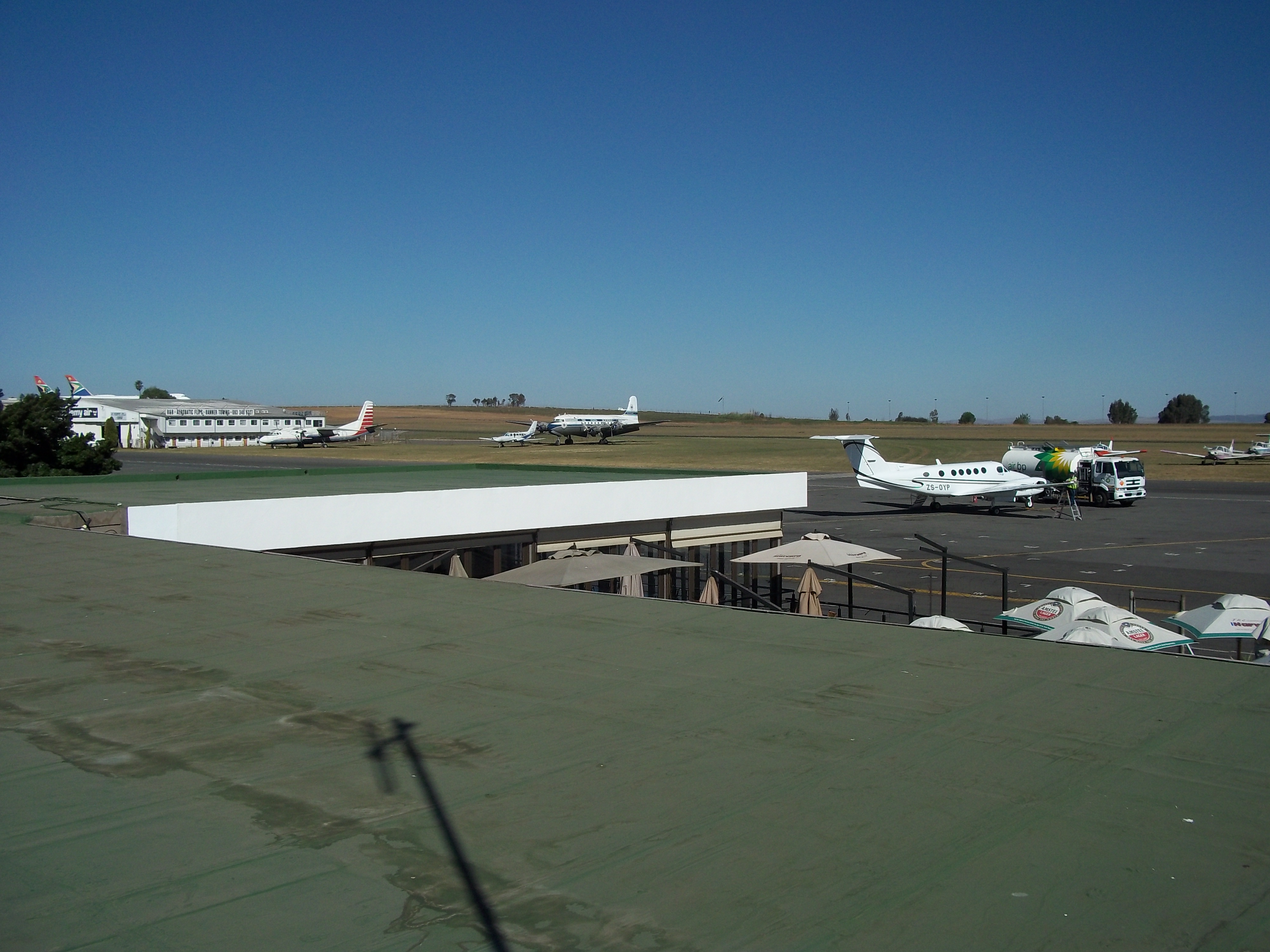
Today, the airport hosts air charter operators, flying schools and a number of aircraft maintenance organisations, as well other aviation-related enterprises. Charter operator Phoebus Apollo Aviation has its headquarters at Rand; the airport is also home to the Flying Lions Aerobatic Team.
South African Airways donated a Boeing 747-200 and a Boeing 747SP to the South African Airways Museum Society which are on display at the airport. The museum also owns a Boeing 737-200, two DC-4s, a DC-3, Vickers Viking, Lockheed Lodestar, Lockheed L1649 Starliner, DH Dove and numerous other exhibits. The airport also hosts an annual air show.
The airport recently saw extensive industrial development, including new business parks and modern industrial units. These facilities cater to logistics, manufacturing, and other commercial activities, contributing to the region's economic growth. The strategic location and upgraded infrastructure make it a prime site for industrial expansion.
Airlines and destinations
Today, all scheduled flights operate at the nearby O. R. Tambo International Airport.
Hot and high conditions
Rand Airport is notorious for its hot and high conditions and relatively short runways. Situated at an altitude of 1680 m above sea level, the density altitude is as high as 2590 m when the outside air temperature (OAT) is 30 °C. Special consideration must be given to flight planning in the summer when the ambient temperature is that high; there have been many accidents at this airfield as a result of reduced aircraft performance under these extreme conditions. A compounding factor is the lack of forced landing fields or areas, as the airport is surrounded by urban sprawl.
Notable accidents and incidents
- On 6 October 1970, at about 7:10 am, Douglas DC-3 registration ZS-DKR en route for Orapa, Botswana crashed as it attempted to return to Rand Airport after the left engine failed just after take-off. There were two crew and ten passengers aboard. The Captain and two passengers subsequently died of injuries. The aircraft was completely burnt-out after impact.
- On 2 August 1995, an Antonov An-2 on a cargo flight from Rand airport to Jamba, Angola, crashed shortly after takeoff killing all three persons on board. The accident was attributed to the cargo which was not properly secured and shifted during the initial climb out, rendering the aircraft uncontrollable.
- On 6 December 1999, a Piper PA-31-350 ZS-OJY crashed shortly after takeoff after suffering an engine failure. All ten people on board were killed.
- On 30 August 2022, a SAPS PC-6 Turbo Porter crashed after takeoff. Reports indicate that five people on board were killed, with one of the pilots in critical condition.
References
References
- Shorten, John R.. (1970). "The Johannesburg Saga". John R. Shorten Pty Ltd.
- "Rand Airport, About Us".
- "History". [[South African Airways Museum Society]].
- Nel, Elizabeth Johanna. (6 September 2012). "The development of a strategic marketing plan for Rand Airport". University of Johannesburg.
- "Companies on Airport".
- "What's New".
- [[The Star (South Africa). The Star]], newspapers dated 6 October 1970, 11 January 1971 and 30 March 1971
- [[Rand Daily Mail]] newspaper, dated 7 October 1970
- "ASN Aircraft accident Antonov 2R RA-05708 Johannesburg-Randgermiston Airport (QRA)".
- "IAD00WA011".
- Bhengu, Cebelihle. "Two police officers, three others die in Rand Airport crash".
- "5 dead after SAPS plane crash {{!}} eNCA".
- Wicks, Bernadette. "Police aircraft crash at Rand Airport leaves five people dead, one injured".
- Masilela, Brenda. "Five killed as SAPS plane crashes at Rand Airport, pilot critically injured".
This article was imported from Wikipedia and is available under the Creative Commons Attribution-ShareAlike 4.0 License. Content has been adapted to SurfDoc format. Original contributors can be found on the article history page.
Ask Mako anything about Rand Airport — get instant answers, deeper analysis, and related topics.
Research with MakoFree with your Surf account
Create a free account to save articles, ask Mako questions, and organize your research.
Sign up freeThis content may have been generated or modified by AI. CloudSurf Software LLC is not responsible for the accuracy, completeness, or reliability of AI-generated content. Always verify important information from primary sources.
Report