From Surf Wiki (app.surf) — the open knowledge base
Ramallah
City in the West Bank, Palestine

City in the West Bank, Palestine
| Field | Value | |||
|---|---|---|---|---|
| name | Ramallah | |||
| native_name | رام الله | |||
| translit_lang1 | Arabic | |||
| translit_lang1_type | Arabic | |||
| translit_lang1_info | رام الله | |||
| translit_lang2_type | Hebrew | |||
| translit_lang2_info | רמאללה | |||
| type | Municipality type A (City) | |||
| image_skyline | {{multiple image | |||
| border | infobox | |||
| total_width | 300 | |||
| perrow | 1/2/2/2 | |||
| image1 | Ramallah Sunset.jpg | |||
| caption1 | Ramallah skyline | |||
| image2 | Mausolée de Yasser Arafat.jpg | |||
| caption2 | Arafat Mausoleum, Mukataa | |||
| image3 | Jamal Abdel Nasser Mosque.jpg | |||
| caption3 | Jamal Abdel Nasser Mosque | |||
| image4 | Palestine_Medical_Complex_002.jpg | |||
| caption4 | Palestine Medical Complex | |||
| image5 | Mahmoud Darwish Museum IMG 4087.jpg | |||
| caption5 | Darwish Museum | |||
| image6 | Roman Grain mill - panoramio.jpg | |||
| caption6 | Roman ruins | |||
| image7 | Al Manara Square.jpg | |||
| caption7 | Al-Manara Square | |||
| spacing | 1 | |||
| color | transparent | |||
| image_blank_emblem | Ramallah Logo.gif | |||
| blank_emblem_type | Municipal seal of Ramallah | |||
| pushpin_map | Palestine | |||
| pushpin_map_caption | Location of Ramallah within Palestine | |||
| mapframe | yes | |||
| mapframe-zoom | 12 | |||
| grid_name | Palestine grid | |||
| grid_position | 168/145 | |||
| subdivision_type | State | |||
| subdivision_name | Palestine | |||
| subdivision_type1 | Governorate | |||
| subdivision_name1 | Ramallah and al-Bireh | |||
| established_title | Founded | |||
| government_footnotes | tags -- | |||
| government_type | City (from 1995) | |||
| leader_title | Mayor | |||
| leader_name | Issa Kassis | |||
| unit_pref | dunam | |||
| area_total_km2 | 16.3 | |||
| area_total_dunam | 16344 | |||
| population_total | 43,880 | |||
| population_as_of | 2024 | |||
| population_footnotes | ||||
| population_metro | 153,237 (2002) | |||
| 362,445 (2<span>0</span>16) <ref>{{cite web | url | https://www.timesofisrael.com/despite-low-cost-luxury-hotels-ramallah-struggles-to-lure-tourists/ | title=It has new, low-cost, rave-reviewed luxury hotels, but Ramallah struggles to lure tourists | website=The Times of Israel }} |
| population_density_km2 | auto | |||
| website | www.ramallah.ps |
the major Palestinian city in the West Bank
| mapframe-zoom = 12 362,445 (2016)
Ramallah ( , ; ; ; ) is a city in the central West Bank, Palestine. It serves as the administrative capital of Palestine, as well as capital of the Ramallah and al-Bireh Governorate. The city is situated on the Judaean Mountains, 10 km north of Jerusalem, at an average elevation of 872 meters above sea level, adjacent to al-Bireh.
Ramallah has buildings containing masonry from the period of Herod the Great, but no complete building predates the Crusades of the 11th century. The modern city was founded during the 16th century by the Hadadeens, an Arab Christian clan descended from Ghassanids. In 1517, the city was incorporated into the Ottoman Empire, and in 1920, it became part of British Mandatory Palestine after it was captured by the United Kingdom during World War I. The 1948 Arab–Israeli War saw the entire West Bank, including Ramallah, occupied and annexed by Transjordan. Ramallah was later captured by Israel in the 1967 Six-Day War. Since the 1995 Oslo Accords, Ramallah has been governed by the Palestinian Authority, as part of Area A in the West Bank.
Ramallah has emerged as a key political, cultural, and economic center in recent years. It houses various Palestinian governmental bodies, including the Mukataa, the official residence of the president of the Palestinian National Authority, the Palestinian Legislative Council, and the headquarters of the Palestinian Security Services. It is also home to several museums and cultural centers, and has a notable nightlife scene. Historically, the city was a predominantly Christian town, however the population of Muslims has increased to constitute a majority of Ramallah's 38,998 residents by 2017, while Christians make up a significant minority.
History
Early history
Ramallah was founded in the 16th century by the Hadadeens, an Arab Christian clan. The city boasts archaeological remnants from earlier epochs. Ancient rock-cut tombs have been found near Ramallah. Located just south of the built-up area is Tell en-Nasbeh, an archeological site where biblical Mizpah in Benjamin is likely to have been located.
Several Ramallah buildings incorporate masonry dating back to the reign of Herod the Great (37–4 BCE). Potsherds from the Crusader/Ayyubid and early Ottoman period have also been found there. Ramallah has been identified with the Crusader place called Ramalie. Remains of a building with an arched doorway from the Crusader era, called al-Burj, have been identified, but the original use of the building is undetermined.
Ottoman period
The area of Ramallah was incorporated into the Ottoman Empire in 1517 with all of Palestine. Modern Ramallah was founded in the mid-1500s by the Haddadins (also: Haddadeen), a clan of brothers descended from Ghassanid Christians. The Haddadins (ancestors of the present-day Jadallah family, among others), and their leader Rashid el-Haddadin, arrived from east of the Jordan River from the areas of Karak and Shoubak. The Haddadin migration is attributed to fighting and unrest among clans in that area.
Haddadin was attracted to the mountainous site of Ramallah because it was similar to the mountainous areas he came from. In addition, the heavily forested area could supply him with plenty of fuel for his forges. In 1596, Ramallah was listed in the tax registers as being in the nahiya of Quds (Jerusalem), part of the Liwa of Quds. It had a population of 71 Christian households and 9 Muslim households. It paid a fixed tax rate of 25% on wheat, barley, olives, vines or fruit trees, and goats or beehives; a total of 9,400 akçe. All of the revenue went to a waqf.
In 1838, American biblical scholar Edward Robinson visited the area, noting that the inhabitants were Christian "of the Greek rite". There were 200 taxable men, which gives an estimated total population of 800–900 people. The village "belonged" to the Haram al-Sharif, Jerusalem, to which it paid an annual tax of 350 Mids of grain. In 1883, the PEF's Survey of Western Palestine described Ramallah as
A large Christian village, of well-built stone houses, standing on a high ridge, with a view on the west extending to the sea. It stands amongst gardens and olive-yards, and has three springs to the south and one on the west; on the north there are three more, within a mile from the village. On the east there is a well. There are rock-cut tombs to the north-east with well-cut entrances, but completely blocked with rubbish. In the village is a Greek church, and on the east a Latin convent and a Protestant schoolhouse, all modern buildings. The village lands are Wakuf, or ecclesiastical property, belonging to the Haram of Jerusalem. About a quarter of the inhabitants are Roman Catholics, the rest Orthodox Greeks.
British Mandate
The city became a center of insurgent activity when the 1936–39 Arab revolt in Palestine broke out. The rebels subsequently established a court near Ramallah, in order to provide legal alternatives to the courts of the British Mandate. One British schoolteacher noted that the Ramallah court judge began to produce "news sheets on typewriters and duplicators, aimed at publicizing the alternative rebel regime."
Jordanian and Israeli occupation
Following the creation of the State of Israel and the ensuing conflict, Jordan seized part of the territory, which they named the West Bank, which included Ramallah. Jordan annexed the West Bank, applying its national law to the conquered territory. The West Bank was relatively peaceful during the years of Jordanian occupation between 1948 and 1967, with its residents enjoying freedom of movement between the West Bank, Jordan, Lebanon, and Syria. However, many Palestinians were arrested and jailed for being members of "illegal political parties", which included the Palestine Communist Party, and other socialist and pro-independence groups. The city's population had doubled by 1953, but the economy and infrastructure could not accommodate the influx of poor villagers. Natives of Ramallah began to emigrate, primarily to the United States. About one fourth of Ramallah's 6,000 natives had left by 1956, with Arabs from the surrounding towns and villages (particularly Hebron) buying the homes and land the émigrés left behind.

During the Six-Day War in 1967, Israel captured Ramallah from Jordan, imposing a military closure and conducting a census a few weeks later. Every person registered in the census was given an Israeli identity card which allowed the bearer to continue to reside there. Those who were abroad during the census lost their residency rights. Because of Israeli control of the West Bank and Gaza Strip, for the first time in 19 years, residents of Ramallah could freely visit the Gaza Strip, as well as Israel, and engage in commerce there.
Unlike the Jordanians, Israel did not offer citizenship to the residents. Ramallah residents were issued permits to work in Israel, but did not gain the rights associated with Israeli citizenship. The city remained under Israeli military rule for more than four decades. The Israeli Civil Administration (CA), established in 1981, was in charge of civilian and day-to-day services such as issuing permission to travel, build, export or import, and host relatives from abroad. The CA reprinted Jordanian textbooks for distribution in schools but did not update them. The CA was in charge of tax collection and land expropriation, which sometimes included Israeli seizure of olive groves that Arab villagers had tended for generations.
According to the Israeli Human Rights activists, the development of Jewish settlements in the Ramallah area, such as Beit El and Psagot, prevented the expansion of the city and cut it off from the surrounding Arab villages. As resistance increased, Ramallah residents who were members of the Palestine Liberation Organization were jailed or deported to neighboring countries. The popular uprising known as the First Intifada erupted in December 1987, protesting against the continued Israeli occupation.
Ramallah residents were among the early joiners of the First Intifada. The Intifada Unified Leadership, an umbrella organization of various Palestinian factions, distributed weekly bulletins on the streets of Ramallah with a schedule of the daily protests, strikes and action against Israeli patrols in the city. At the demonstrations, tires were burned in the street, and the crowds threw stones and Molotov cocktails. The IDF responded with tear gas and rubber bullets. Schools in Ramallah were forcibly shut down, and opened gradually for a few hours a day. The Israelis conducted house arrests, imposing curfews that restricted travel and exports in what Palestinians regarded as collective punishment. In response to the closure of schools, residents organized home schooling sessions to help students make up missed material; this became one of the few symbols of civil disobedience. Following the Oslo Accords, the Israeli army abandoned the Mukataa in December 1995 and withdrew to the city outskirts. The newly established Palestinian Authority assumed civilian and security responsibility for the city, which was designated "Area A" under the accords.
Palestinian Authority control
The years between 1993 and 2000 (known locally as the "Oslo Years") brought relative prosperity to Ramallah. Ramallah and its immediate environs were classified as Area A in the Oslo Accords, under full civil and security control of the Palestinian Authority (PA) administration in September 1995. Many expatriates returned to establish businesses there, and the atmosphere was one of optimism. In 2000, unemployment began to rise and the economy of Ramallah declined. The Israel Defense Forces remained in control of the territories and its government did not restore the freedom of movement enjoyed by Ramallah residents prior to the first Intifada. Travel to Jerusalem required special permits. The number and size of Israeli settlements around Ramallah increased dramatically. A network of bypass roads for use of Israeli citizens only was built around Ramallah, and Israel expropriated land for settlements. Many official documents previously handled by the Israeli Civil Administration were now handled by the Palestinian Authority but still required Israeli approval. A Palestinian passport issued to Ramallah residents was not valid unless the serial number was registered with the Israeli authorities, who controlled border crossings.[[File:Psagot Settlement.JPG|thumb|[[Israeli settlement]] of [[Psagot]] on Jabal al-Tawil (Tawil Hill), east of Ramallah and Al-Bireh (2004)|left]]The failure of the Camp David summit in July 2000 led to the outbreak of the Second Intifada (al-Aqsa Intifada) in September 2000. Young Ramallah residents demonstrated daily against the Israeli army, with marches to the Israeli checkpoints at the outskirts of the city. Over time, the marches were replaced by sporadic use of live ammunition against Israeli soldiers; and various attacks targeting Jewish settlers, particularly on the Israeli-only bypass roads. Army checkpoints were established to restrict movement in and out of Ramallah. On October 12, 2000, two Israeli army reservists, Vadim Norzhich and Yosef Avrahami were lynched in Ramallah. They had taken a wrong turn, and were set upon by a mob, enraged in particular by the Muhammad al-Durrah incident in Gaza. A frenzied crowd killed the two IDF reservists, mutilated their bodies, and dragged them through the streets. Later that afternoon, the Israeli army carried out an air strike on Ramallah, demolishing the police station. Israel later succeeded in capturing and prosecuting some of those involved in the deaths of the reservists.[[File:Ramallah Muqata'a 2013.jpg|thumb|[[Mukataa]] in 2013|left]]The IDF has occasionally operated inside Ramallah, in breach of the 1995 Oslo Accords. The first and largest incursion was the 2002 Operation Defensive Shield, with a more recent intervention coming in March 2017 while attempting to arrest a suspected terrorist. In 2002, the army imposed curfews, electricity cuts, school closures and disruptions of commercial life. Many Ramallah institutions, including government ministries, were vandalized, and equipment was destroyed or stolen. The IDF took over local Ramallah television stations, and social and economic conditions deteriorated. Many expatriates left, as did many other Palestinians who complained that the living conditions had become intolerable. Construction of the Israeli West Bank barrier has added to Ramallah's isolation. Yasser Arafat established his West Bank headquarters, the Mukataa, in Ramallah. Although considered an interim solution, Ramallah became the de facto capital of the Palestinian Authority, now officially known as the State of Palestine. It hosts almost all governmental headquarters. In December 2001, Arafat held meetings at the Mukataa, but lived with his wife and daughter in Gaza City. After suicide bombings in Haifa, Arafat was confined to the Ramallah compound. In 2002, the compound was partly demolished by the Israeli Defense Forces and Arafat's building was cut off from the rest of the compound.
On November 11, 2004, Arafat died at the Percy training hospital of the Armies near Paris. He was buried in the courtyard of the Mukataa on November 12, 2004. The site still serves as the Ramallah headquarters of the Palestinian Authority, as well the official West Bank office of Mahmoud Abbas. Throughout 2005, while the Disengagement Plan was underway, some US government officials suggested to the Palestinian leadership to move the provisional capital back to Gaza, where it had been when the Palestinian Authority was first established in 1994. President Abbas, however, refrained from doing so, arguing that at this point, it was important to keep the administrative center in the West Bank in order to remind the international community that the West Bank was still awaiting a territorial solution.[[File:Ramallah Residential.JPG|thumb|right|Residential neighborhood in Ramallah, 2005]]
In December 2005, local elections were held in Ramallah in which candidates from three different factions competed for a four-year term on the fifteen-seat municipal council. The council elected Janet Mikhail as mayor, the first woman to hold the post.
Munir Hamdan, a member of Fatah and a Ramallah businessman, discussed the concentration of government offices with a journalist. He said, "The president and prime minister have their offices here. So do the parliament and all the government ministries", representing a "collusion" between the Palestinian Authority and Israel to turn Ramallah into the political as well as the financial capital of the Palestinians. He is particularly worried by the construction of a large new governmental complex by the PA.
Geography and climate
.png)

This area enjoys a Mediterranean climate of a dry summer and mild, rainy winter with occasional snowfall. The recorded average of Ramallah's rainfall is about 615 mm and minimum rainfall is 307 mm and maximum rainfall is 1591 mm.
The Köppen climate classification places Ramallah in the Csa category. Climates of this class generally occur on the western sides of continents between the latitudes of 30° and 45°. These climates are in the polar front region in winter, and thus have moderate temperatures and changeable, rainy weather. Summers are hot and dry, due to the domination of the subtropical high pressure systems, except in the immediate coastal areas, where summers are milder due to the nearby presence of cold ocean currents that may bring fog but prevent rain.
|Jan record high C = 24.0 |Feb record high C = 26.2 |Mar record high C = 31.5 |Apr record high C = 34.0 |May record high C = 37.3 |Jun record high C = 39.4 |Jul record high C = 37.5 |Aug record high C = 39.8 |Sep record high C = 40.0 |Oct record high C = 35.0 |Nov record high C = 29.6 |Dec record high C = 27.4 |year record high C = 40.0 |Jan record low C = -2.0 |Feb record low C = -1.4 |Mar record low C = -0.6 |Apr record low C = 2.8 |May record low C = 8.5 |Jun record low C = 11.4 |Jul record low C = 14.8 |Aug record low C = 16.0 |Sep record low C = 14.0 |Oct record low C = 6.0 |Nov record low C = 3.0 |Dec record low C = -0.6 |year record low C = -2.0 | access-date = October 25, 2015 | archive-date = March 4, 2016 | archive-url = https://web.archive.org/web/20160304072830/http://extras.springer.com/2007/978-1-4020-4577-6/Book_Shahin_ISBN_9781402045776_Appendix.pdf | url-status = dead}}
File:Ramallah4.JPG|A view from Ramallah File:Judean Hills from Ramallah.jpg|Hills surrounding Ramallah File:Ramallah Sunset.jpg|Sunset in Ramallah
Economy

Construction boom is one of the most obvious signs of West Bank economic growth, estimated at an annual rate of 8 percent. This has been attributed to relative stability and Western donor support to the Palestinian Authority. The PIF have begun work on a $400 million commercial center comprising 13 towers which will be some of the tallest in Ramallah. The Ersal Commercial Center has drawn investment from a Saudi Arabian firm, The Land Holding, which has a 10% stake. It is not the only Gulf Arab firm investing in Ramallah and its outskirts. The Qatari Diar Real Estate Investment Company has a stake in Rawabi, a completely new town being constructed in the hills outside Ramallah at a cost of $1 billion.
Ramallah has highest concentration of high-tech companies. ASAL technologies, an information technology company in Ramallah, has 120 employees and is looking forward to "exponential growth". In collaboration with the Republic of India, a new tech park named, the India Palestine Techno Park is located in Birzeit. Apple Inc operates a research & development center in Rawabi with ASAL Technologies. A large number multinational companies operates facilities in Ramallah, which outsource Palestinians.
By 2010, Ramallah had become the leading center of economic and political activity in the territories under the control of the Palestinian Authority. During a building boom in the early years of the 21st century, apartment buildings and "five-star" hotels were erected, particularly in the Al-Masyoun neighborhood. In 2010, "more than one hundred" Palestinian businesses were reported to have moved to Ramallah from East Jerusalem, because "Here they pay less taxes and have more customers." One local boasted to a journalist that "Ramallah is becoming the de facto capital of Palestine." This boast was seconded by The New York Times which, in 2010, called Ramallah the "de facto capital of the West Bank. According to Sani Meo, the publisher of This Week in Palestine, "Capital or no capital, Ramallah has done well and Palestine is proud of its achievements." Some Palestinians allege that Ramallah's prosperity is part of an Israeli "conspiracy" to make Ramallah the capital of a Palestinian state, instead of Jerusalem.
Demographics
|1896 |2,061 |1922 |3,104 |1931 |4,286 |1938 |4,900. |1945 |5,080 |1961 |14,759 |1967 |12,134 |1997 |17,851 |2007 |27,460 |2017 |38,998
An Ottoman village list of about 1870 showed that Ramallah had 249 houses and a population of 635, though the population count included men only. The village was described as being in the Bire area, "north of Mikhmas, on a rocky hill." In 1896, the population of Ramallah was estimated to be about 2,061 persons.
In the 1922 census of Palestine conducted by the British Mandate authorities, Ramallah had a population of 3,104 (2,972 Christians, 125 Muslims, and seven Jews), the Christians consisting of 2,162 Orthodox, 1 Syriac Orthodox (Jacobite), 332 Roman Catholics, 144 Greek Catholic (Melkite Catholic), 211 Church of England, and 122 "other". The population increased at the time of the 1931 census to 4,286 (3,766 Christians, 519 Muslims and one Jew) in a total of 1,014 houses. In the 1938 village statistics, the population is listed as 4,900. In the 1945 statistics, the population stood at 5,080, with Christians forming the majority of the population (4,440 Christians and 640 Muslims).
However, the demographic makeup of the town changed drastically under Jordanian occupation, when considerable emigration of Christians took place. This left slightly more than half of the city's 12,134 inhabitants Christian by 1967, and the remainder Muslim.
Ramallah expatriates created one of the largest Arab communities in the United States, settling mainly in Washington, New York, Florida, California, Texas, and especially in Michigan. Many worked in the auto industry. In 1959, the American Federation of Ramallah, Palestine (AFRP) was established in Detroit. The AFRP has several branches in the United States, and holds an annual convention every summer attended by a sizable number of former Ramallah residents and their offspring.
Ramallah's population drastically decreased in the late 20th century from 24,722 inhabitants in 1987 to 17,851 in 1997. In the Palestinian Central Bureau of Statistics (PCBS) census in 1997, Palestinian refugees accounted for 60.3% of the population, which was 17,851. There were 8,622 males and 9,229 females. People younger than 20 years of age made up 45.9% of the population, while those aged between 20 and 64 were 45.4%, and residents aged over 64 constituted 4.7%.
Only in 2005 did the population reach more than 24,000. In a PCBS projection in 2006, Ramallah had a population of 25,467 inhabitants. In the 2007 PCBS census, there were 27,460 people living in the city. Sources vary about the current Christian population in the city, ranging around 25%.
Health


In the aftermath of the 1936–1939 Arab revolt, the Ramallah Hospital Foundation was established and registered as a tax exempt organization in New York in 1944. It bought large pieces of land in the south-eastern fringes of the city dedicated for the future hospital. In 1963, a hospital was opened.
Religion
The Jamal Abdel Nasser Mosque is one of the city's largest mosques. The Orthodox Church of Ramallah, an Orthodox Christian convent, Melkite Catholic Church, Evangelical Lutheran Church, Arab Episcopal (Anglican) Church, Ramallah Local Church (Evangelical\Born Again) and Ramallah Baptist Church all operate schools in the city.
Christian presence

Ramallah grew dramatically throughout the 17th and 18th centuries as an agricultural village, attracting more (predominantly Christian) inhabitants from all around the region. In 1700, Yacoub Elias was the first Ramallah native to be ordained by the Greek Orthodox Church of Jerusalem, the Christian denomination that prevailed in the Holy Land at the time. In the early 19th century, the first Jerusalemite Greek Orthodox Christian church was built. Later, in 1852, the Greek Orthodox Church of the Transfiguration, was built to replace it; it is the sole Eastern Orthodox Church in Ramallah today.
There is also a Melkite Greek Catholic Church in Ramallah, built in 1895. The Roman Catholic Church also established its presence in Ramallah the 19th century and constitutes today the second-largest Christian denomination in the city. The Roman Catholic Church established the St. Joseph's Girls' School run by St. Joseph sisters, as well as the co-educational Al-Ahliyyah College high school run by Rosary sisters. In 1913, construction of the Catholic Holy Family Church was started.
, Ramallah also has a Coptic Orthodox Church, an Evangelical Lutheran Church and an Episcopalian (Anglican) Church. In the 19th century, the Religious Society of Friends (Quakers) established a presence in Ramallah and built the Ramallah Friends Schools, one for girls and later a boys' school, to alleviate the dearth of education for women and girls. Eli and Sybil Jones opened "The Girls Training Home of Ramallah" in 1869. A medical clinic was established in 1883, with Dr. George Hassenauer serving as the first doctor in Ramallah. In 1889, the girls academy became the Friends Girls School (FGS). As the FGS was also a boarding school, it attracted a number of girls from surrounding communities, including Jerusalem, Lydda, Jaffa, and Beirut. The Friends Boys School (FBS) was founded in 1901 and opened in 1918. The Quakers opened a Friends Meeting House for worship in the city center in 1910. According to the school's official website, most high school students choose to take the International Baccalaureate exams (IBE) instead of the traditional "Tawjihi" university exams.
The activity of foreign churches in Palestine in the late 19th century increased awareness of prosperity in the West. In Ramallah and Bethlehem, a few miles south, local residents began to seek economic opportunity overseas. In 1901, merchants from Ramallah emigrated to the United States and established import-export businesses, selling handmade rugs and other exotic wares across the Atlantic. Increased trade dramatically improved living standards for Ramallah's inhabitants. American cars, mechanized farming equipment, radios, and later televisions became attainable luxuries for upper-class families. As residents of Jaffa and Lydda moved to Ramallah, the balance of Muslims and Christians began to change.
In the 21st century, a large community of people with direct descent from the Haddadins who founded Ramallah live in the United States. The town is now predominately Muslim, but still contains a Christian minority. The change in demographics is due mostly to new migration of Muslims to the area, and emigration of Christians from the area.
File:2010-08 Ramallah 59.jpg|A Coptic church File:2010-08 Ramallah 14.jpg|A local mosque File:2010-08 Ramallah 07.jpg|Church of Our Lady of the Annunciation File:2010-08 Ramallah 56.jpg|Holy Family Church File:Jamal Abdel Nasser Mosque.jpg|Jamal Abdel Nasser Mosque File:2010-08 Ramallah 32.jpg|Evangelical Lutheran Church of Hope
Culture
_01.JPG)
Ramallah is generally considered the most affluent and cultural, as well as the most liberal, of all Palestinian cities, and is home to a number of popular Palestinian activists, poets, artists, and musicians.
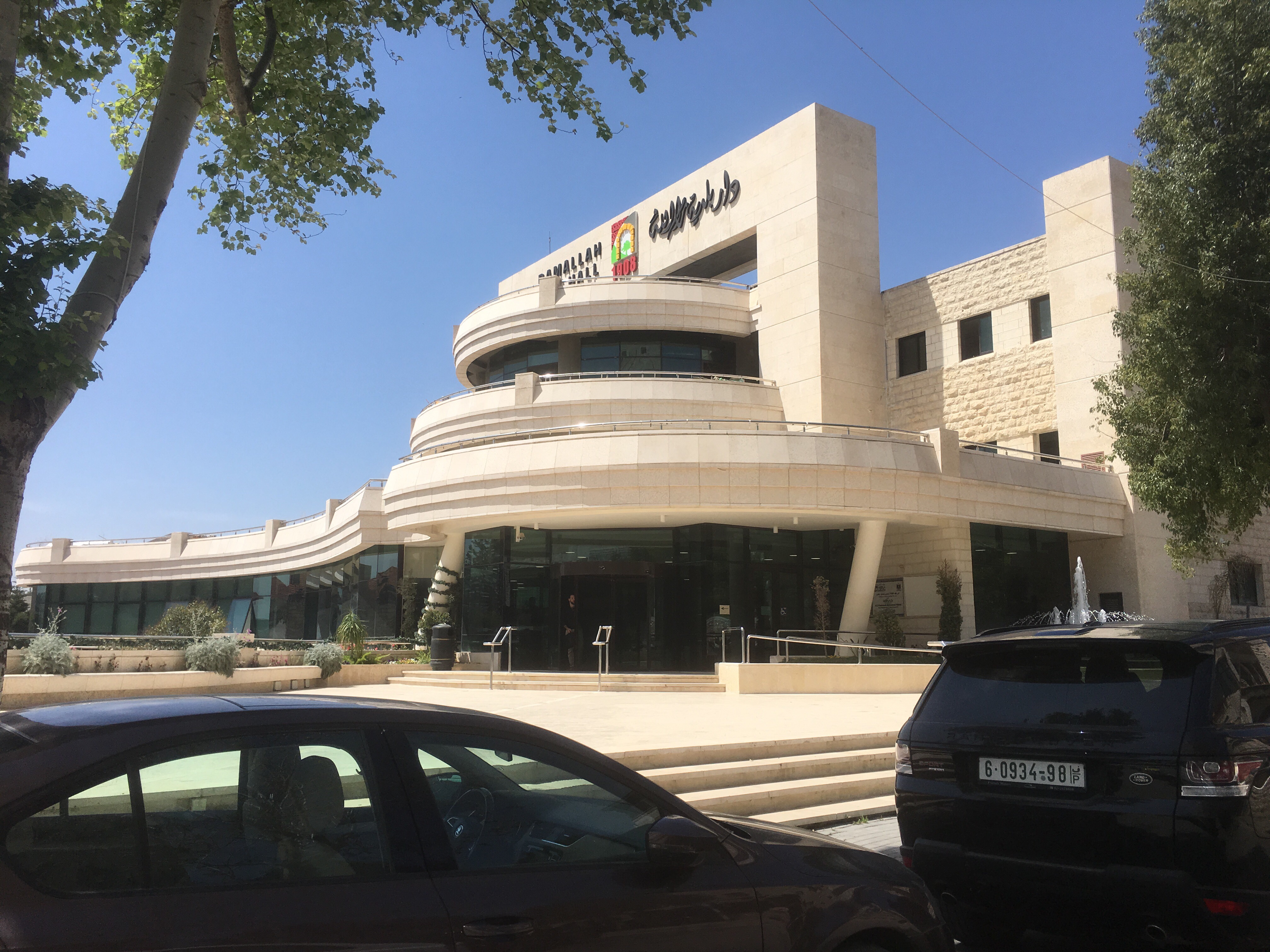
In 2004 the Ramallah Cultural Palace opened in the city. The only cultural center of its kind in the Palestinian-governed areas, it houses a 736-seat auditorium, as well as conference rooms, exhibit halls, and movie-screening rooms. It was a joint venture of the Palestinian Authority, the United Nations Development Programme (UNDP), and the Japanese government. Ramallah hosted its first annual international film festival in 2004.
File:Kebap a Ramallah01.JPG|Kebab stand in Ramallah File:2010-08 Ramallah 22.jpg|Lion sculptures in Ramallah's central square File:Ramallah square.jpg|Monument and Palestinian flag at Al Sa’a Square/Yasser Arafat Square File:2010-08 Ramallah 51.jpg|Ceramic mural File:French-German Cultural Center, Ramallah (2019) 1.jpg|French-German Cultural Center File:2010-08 Ramallah 10.jpg|DownTown Cafe File:Ramallah Martyrs Memorial.jpg|Ramallah Martyrs Memorial
Palestinian costume
Main article: Palestinian traditional costumes
Until the 1940s, traditional Palestinian costumes reflected a woman's economic and marital status and her town or district of origin, with knowledgeable observers discerning this information from the fabric, colours, cut, and embroidery motifs (or lack thereof) used in the apparel.
Villages in the Levant under Ottoman rule remained isolated due to the difficulty of travel in the 19th century. As a result, clothing and accessories became a statement of region. In Ramallah, the back panels of dresses often incorporated a palm tree motif embroidered in cross-stitch. File:Ramallah-Family-1905.jpg|Christian family from Ramallah wearing typical Palestinian Ottoman-period clothing, c. 1905 File:Ramallah woman2.jpg|Young woman of Ramallah wearing dowry headdress, c. 1898–1914 (American Colony Collection) File:Ramlah costumewo.jpg|Ramallah woman, c. 1920 (The Matson Photo Service) File:Arabic-traditional-Dress.jpg|Traditional Women's Dress in Ramallah. Khalil Raad, c. 1920. File:American Colony, Ramallah peasant spinning wool 18417-020u.jpg|A man from Ramallah spinning wool. Hand tinted photograph from 1919, restored (American Colony Collection) File:OIMpalcost1.jpg|Ramallah dress at the Oriental Institute Museum
International relations
Many foreign nations have located their diplomatic missions to the Palestinian Authority in Ramallah, including, , Argentina, Australia, Austria, Korea, South Africa, Norway, Sri Lanka, Switzerland, China, Poland, Portugal, The Netherlands, Russia, Jordan, Brazil, Finland, Denmark, Ireland, Germany, India, Japan, the Czech Republic, Canada and Mexico.
Twin towns – sister cities

Ramallah is twinned with:
- FRA Bordeaux, France
- ENG Hounslow, England, United Kingdom
- RSA Johannesburg, South Africa
- BEL Liège, Belgium
- USA Muscatine, Iowa, United States
- ENG Oxford, England, United Kingdom
- USA Paterson, New Jersey, United States
- TUR Sur, Turkey
- NOR Trondheim, Norway
- IRL Dublin, Ireland
Notable people
- Paul Ajlouny (b. 1933), Palestinian-American publisher and businessman
- Hamze Awawde (b. 1990), Palestinian peace activist
- Mahmoud Eid (b. 1993), professional footballer
- Amber Fares, Lebanese Canadian filmmaker
- Yasmeen Mjalli (born 1996), American and Palestinian fashion designer, photographer and anti-street harassment activist.
- Jibril Rajoub (b. 1953), Palestinian political leader, former militant
- Mosab Hassan Yousef (b. 1978), Palestinian ex-militant and defector
References
Bibliography
- (pp. 40- 41)
- Shaheen, Azeez (1982): Ramallah: Its history and genealogies. Birzeit University Press
References
- "Main Indicators by Type of Locality – Population, Housing and Establishments Census 2017". [[Palestinian Central Bureau of Statistics]] (PCBS).
- "It has new, low-cost, rave-reviewed luxury hotels, but Ramallah struggles to lure tourists".
- "Ramallah & Al Bireh urban area: joint urban planning and development".
- "Ramallah". [[HarperCollins]].
- {{Cite American Heritage Dictionary. Ramallah
- "Ramallah.ps". Ramallah.ps.
- {{harvnb. Palmer. 1881
- "Ramallah {{!}} town, West Bank {{!}} Britannica".
- (August 20, 2010). "'Palestine's new bride'".
- [http://travel.nytimes.com/2010/06/06/travel/06next-1.html Michael T. Luongo, "Ramallah Attracts a Cosmopolitan Crowd"] {{Webarchive. link. (June 8, 2010, June 3, 2010, ''The New York Times''.)
- "Preliminary Results of the Population, Housing and Establishments Census, 2017".
- {{harvnb. Conder. Kitchener. 1883
- {{harvnb. Finkelstein. Lederman. 1997
- {{harvnb. Rey. 1883
- Prawer and Benvenisti, 1970, cited in Finkelstein and Lederman, 1997, p. 353
- {{harvnb. Pringle. 1997
- {{harvnb. Pringle. 1997
- "American Federation of Ramallah Palestine".
- {{harvnb. Hütteroth. Abdulfattah. 1977
- {{harvnb. Robinson. Smith. 1841
- {{harvnb. Conder. Kitchener. 1883
- "From a Village to a Town".
- Kelly, Matthew. (2017). "The Crime of Nationalism: Britain, Palestine, and Nation-Building on the Fringe of Empire". [[University of California Press]].
- [http://www.btselem.org/english/Family_Separation/Origins.asp "Creation of the problem of family separation in the Occupied Territories"] [[Btselem]] {{webarchive. link. (June 5, 2011)
- [http://www.jmcc.org/research/special/military.html Israeli Military Orders in the Occupied Palestinian West Bank] Jerusalem Media and Communications Centre (JMCC), 2nd edition, pp.241. 1995 {{webarchive. link. (July 12, 2009)
- Abdullah Salah. [http://domino.un.org/UNISPAL.NSF/0/b43bb37dd727f0c0852570120072d4f6?Letter dated 25 May 1983 from the Permanent Representative of Jordan to the United Nations addressed to the Secretary-General] {{webarchive. link. (October 11, 2013 , A/38/257-S/15810 of June 2, 1983)
- Nakhleh, Issa. (1991). "Encyclopedia of the Palestine Problem". Palestine-encyclopedia.com.
- (May 2002). "LAND GRAB: Israel's Settlement Policy in the West Bank". [[B'Tselem]].
- Coon, Anthony. (8 December 1999). "ISRAEL AND THE OCCUPIED TERRITORIES: Demolition and dispossession: the destruction of Palestinian homes [MDE 15/59/99]". Amnesty International.
- (February 10, 2007). "JMCC / Research".
- link. (January 18, 2019 . Text of the Accord)
- "UNU-WIDER : Publications".
- Said, Edward. (2000). "The End of the Peace Process". The New York Times.
- "ariga.com".
- (3 July 1995). "PERMANENT SOVEREIGNTY OVER NATIONAL RESOURCES IN THE OCCUPIED PALESTINIAN AND OTHER ARAB TERRITORIES". United Nations.
- [http://www.badil.org/e-library/Resident_PA.htm Badil.org] Badil.org {{webarchive. link. (January 11, 2009)
- (July 5, 2002). "Zmag.org". Zmag.org.
- "Miftah.org". Miftah.org.
- (November 1, 2007). "מחסום WATCH".
- (13 October 2000). "Lynch mob's brutal attack". BBC News.
- Nahum Barnea, [http://www.ynetnews.com/articles/0,7340,L-4780153,00.html 'Beitunian nights: The IDF in the West Bank'] {{Webarchive. link. (November 18, 2016 , [[Ynet]] 18 March 2016.)
- Lotto Persio, Sofia. (6 March 2017). "Palestinian militant 'plotting attack in Israel' shot dead by Swat team in West Bank". International Business Times (via Yahoo.com).
- "ICPH.birzeit.edu".
- (December 11, 2008). "banned interdit verboden prohibido vietato proibido".
- "Siteresources.worldbank.org".
- (April 27, 2006). "Checkpoints".
- "Btselem.org". Btselem.org.
- (January 20, 2002). "The Palestinians under closure". BBC News.
- "Meeting minutes between Saeb Erekat and David Welch, ''Palestine Papers'', 16 June 2005".
- (January 2, 2006). "Khaleejtimes.com". Khaleejtimes.com.
- Karin Laub. (January 1, 2006). "Ocala.com". Ocala.com.
- link. (August 23, 2010, Khaled Abu Toameh, ''Jerusalem Post'', 20 August 2010)
- (November 21, 2011). "Jordan's King Abdullah visits West Bank for first time in decade". telegraph.co.uk.
- "Palestinian Central Bureau of Statistics – State of Palestine". Palestinian Central Bureau of Statistics.
- "Climatic Averages". Palestinian Meteorological Department.
- (January 14, 2009). "West Bank and Gaza Economy: Before and After the Crisis – Brookings Institution". Brookings.edu.
- (August 2, 2010). "Ramallah building boom symbolizes West Bank growth".
- (2020-12-08). "India donates $3 million to complete Palestine-India Techno Park". The Times of India.
- (July 30, 2012). "West Bank's Emerging Silicon Valley Evades Issues of Borders".
- (2022-06-28). "Apple expanding R&D hub in Palestinian Authority".
- . ["Table 1.6 Population of Capitals of Jordan, Districts and Sub-Districts by Sex"](https://users.cecs.anu.edu.au/~bdm/yabber/census/JordanCensusPages/JordanCensus1961-p12.pdf).
- (1878). "Socin, 1879".
- (1878). "Hartmann, 1883".
- "Ben-Arieh, 1985".
- (1878). "Schick, 1896".
- "Barron, 1923".
- Harris, Chauncy Dennison. (1948). "Research paper: Issues 217–218 of World Patterns of Modern Urban Change: Essays in Honor of Chauncy D. Harris". University of Chicago, Department of Geography.
- "Barron, 1923".
- (1932). "Mills, 1932".
- (1938). "Village Statistics".
- . (April 1, 1945). ["Village Statistics – 1945"](https://users.cecs.anu.edu.au/~bdm/yabber/census/VSpages/VS1945_p65.jpg).
- "Ramallah".
- "koolpages.com/wael2003/history".
- "afrp.org".
- . ["Palestinian Population by Locality, Sex and Age Groups in Years"](http://www.pcbs.gov.ps/Portals/_pcbs/phc_97/ram_t6.aspx). *[[Palestinian Central Bureau of Statistics]]*.
- "Palestinian Population by Locality, Sex and Age Groups in Years".
- "Projected Mid -Year Population for Ramallah & Al Bireh Governorate by Locality 2004– 2006".
- . ["Table 26 (Cont.): Localities in the West Bank by Selected Indicators, 2007"](http://www.pcbs.gov.ps/Portals/_PCBS/Downloads/book1487.pdf). *[[Palestinian Central Bureau of Statistics]]*.
- Hall, Andy. [http://www.eappi.org/ar/news-events/ea-reports/r/browse/17/article/4837/quaker-meeting-in-ramalla.html Quaker Meeting in Ramallah] [[Ecumenical Accompaniment Programme in Palestine and Israel]]. {{webarchive. link. (February 25, 2011)
- Keulemans, Chris. [http://iwp.uiowa.edu/91st/vol4_n1/pdfs/keulemans.pdf Imagination Behind the Wall: Cultural Life in Ramallah] p.2. April 2005. {{webarchive. link. (October 6, 2011)
- (October 5, 1996). "Foes Take Steps To Cut Tension In West Bank". The New York Times.
- "Religion in Ramallah City". Ramallah Municipality.
- "Greek Catholic "Melkite" Church".
- "Coptic Church".
- "Evangelical Lutheran Church".
- "Episcopalian Church".
- "Religious Society of Friends (Palestine)". Palfriends.org.
- "History of Friends School". Visuals Active Media.
- [https://www.theguardian.com/books/2005/jan/16/biography.features2 Emails from the edge] [[The Observer]], January 16, 2005
- [https://www.nbcnews.com/id/wbna10704035 Hamas says it will use Islamic law as guide] [[NBC News]], January 29, 2006
- [http://www.jerusalemites.org/jerusalem/cultural_dimensions/71.htm Jerusalemites.org], cultural dimensions {{webarchive. link. (December 22, 2010)
- Jane Waldron Grutz. (January–February 1991). "Woven Legacy, Woven Language".
- "Heritage Newsletter of the Palestinian Heritage Foundation Volume 6". Palestineheritage.org.
- "International Relations of Ramallah Municipality". ArcGIS.
- "International Links – Ramallah". Oxford City Council.
- Adely, Hannan. [https://archive.today/20230628175900/https://www.northjersey.com/story/news/passaic/paterson/2023/06/26/paterson-nj-sister-city-ramallah-palestine/70343619007/ "In nod to its Palestinian community, Paterson signs sister city agreement with Ramallah"], ''[[The Record (North Jersey). The Record]]'', Archived from the [https://www.northjersey.com/story/news/passaic/paterson/2023/06/26/paterson-nj-sister-city-ramallah-palestine/70343619007/ original] on June 26, 2023. Accessed May 19, 2025.
- Awawde, Hamze. (2012-06-27). "The new Palestinian".
- Lough, Catherine. (2023-11-28). "Bereaved Israeli and Palestinian families to march together in anti-hate vigil". The Telegraph.
- "BBC 100 Women 2024: Who is on the list this year? - BBC News".
- Whitaker, Brian. (September 3, 2001). "The summit of Middle East tension". The Guardian.
This article was imported from Wikipedia and is available under the Creative Commons Attribution-ShareAlike 4.0 License. Content has been adapted to SurfDoc format. Original contributors can be found on the article history page.
Ask Mako anything about Ramallah — get instant answers, deeper analysis, and related topics.
Research with MakoFree with your Surf account
Create a free account to save articles, ask Mako questions, and organize your research.
Sign up freeThis content may have been generated or modified by AI. CloudSurf Software LLC is not responsible for the accuracy, completeness, or reliability of AI-generated content. Always verify important information from primary sources.
Report